
Discover key trends and forces shaping the Floating Offshore Wind market, including investment dynamics, technological advancements, and regulatory challenges influencing growth.
The Floating Offshore Wind market is poised for significant growth, driven by various factors shaping its future. This blog discusses the critical forces influencing this dynamic sector, providing insights for stakeholders looking to navigate the evolving landscape.
1. Accelerating investment fuels market expansion
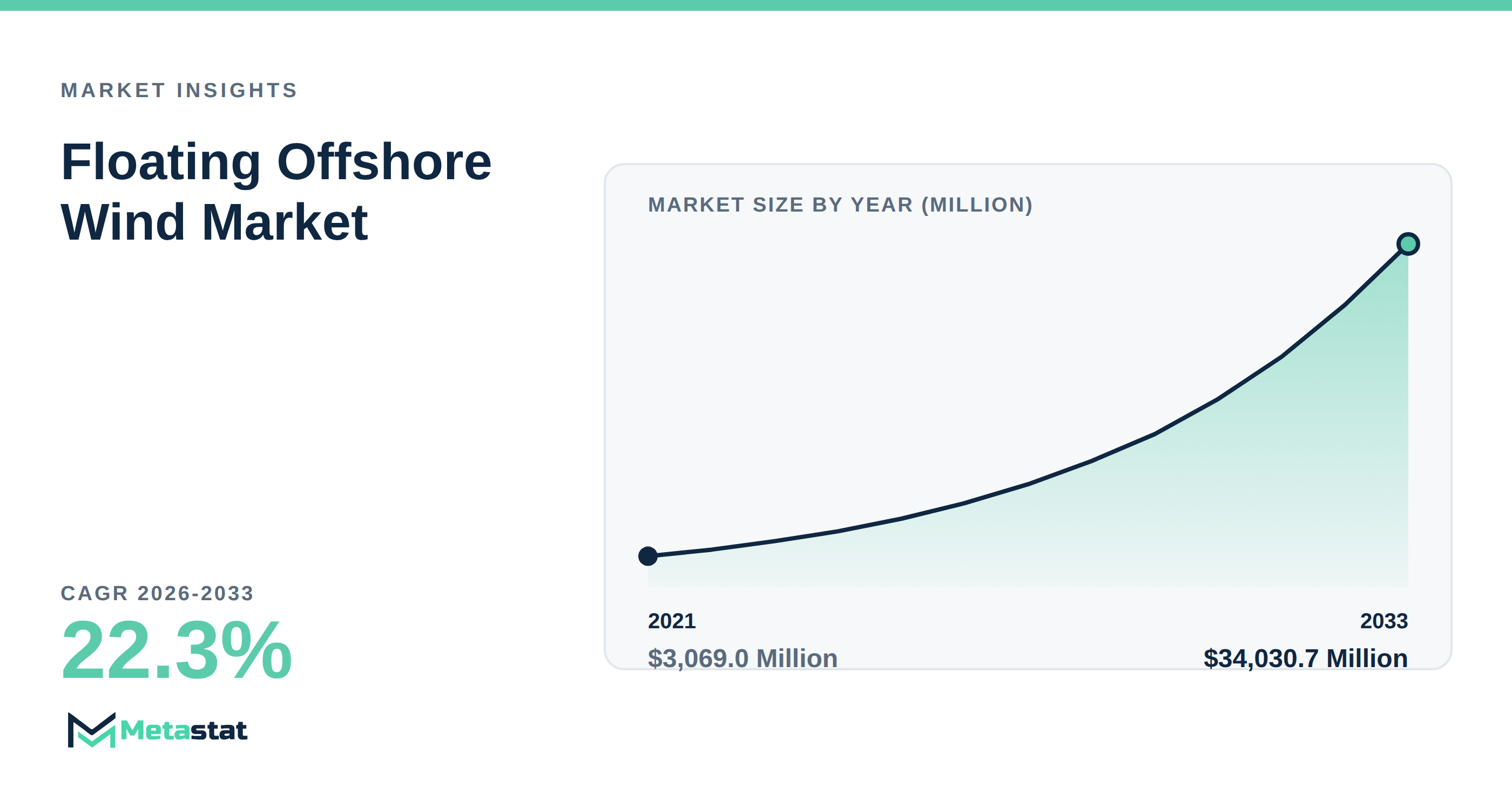
Investment in floating offshore wind technology is witnessing substantial growth, resulting from a global shift towards renewable energy solutions. Regions including Europe, North America, and Asia Pacific are significantly increasing funding in this sector, driven by favorable government initiatives and the urgent cut carbon emissions. Market value is projected to increase from USD 6,797.3 million in 2025 to USD 34,030.7 million by 2033, indicating a compound annual growth rate (CAGR) of 22.3%. This heightened capital allocation underscores the robust demand for clean energy sources, bolstering the prospects for the Floating Offshore Wind market.
2. Technological innovations enhance operational efficiency
Innovations in technology are transforming the Floating Offshore Wind market, optimizing operations and reducing costs. Advancements including automation, artificial intelligence, and improved turbine designs streamline processes, enabling more efficient energy production. Real-time data analysis, facilitated by enhanced monitoring systems, empowers operators to make informed decisions swiftly. These efficiencies ultimately lead to reduced downtime and increased productivity, drawing investments from stakeholders eager to capitalize on the improved cost-effectiveness associated with floating wind systems.
3. Regulatory compliance drives innovation and investment
Compliance with regulatory frameworks significantly shapes the operational landscape of the Floating Offshore Wind market. Governments enforce stringent environmental regulations aimed at promoting the adoption of renewable energy. Adhering to these regulations impacts investment strategies and operational practices within the industry. Although navigating compliance challenges are complex, they often stimulate innovation because firms work to develop new technologies and practices that meet these requirements. This push for regulatory alignment cultivates an environment conducive to continuous improvement and sustainable growth.
4. Geopolitical factors introduce market complexities
Geopolitical tensions present notable challenges for the Floating Offshore Wind market, because they influence supply chains and investment flows. Trade regulations and regional conflicts disrupt sourcing and delay project timelines, leading to increased operational costs. Companies actively track geopolitical developments to mitigate risks and ensure consistent project execution. Addressing these uncertainties is crucial for maintaining investment momentum and the successful rollout of floating offshore wind initiatives.
5. Evolving consumer behavior shifts energy demands
Shifting consumer behaviors and demographic trends exert a significant influence on the demand for renewable energy solutions. Increasing urbanization and a growing aging population drive the transition towards cleaner energy options, encouraging stakeholders to implement floating offshore wind technologies. With rising awareness of climate change issues, consumers increasingly prioritize sustainability in their energy choices. This shift not only creates opportunities for innovative solutions but catalyzes investments in sustainable infrastructure, enhancing growth within the Floating Offshore Wind market.
6. The circular economy enhances resource utilization
The principles of the circular economy significantly impact the Floating Offshore Wind market, advocating for sustainable practices and efficient resource use. Companies adopt strategies focused on recycling materials and minimizing waste throughout the sector. This approach not only strengthens supply chain resilience but contributes to overall cost reductions. By integrating circular economy practices, market participants lessen their environmental impact while enhancing operational efficiency, improving their competitive positioning.
The Floating Offshore Wind market is influenced by various forces, including investment dynamics, technological advancements, regulatory compliance, geopolitical factors, changing consumer preferences, and circular economy principles. These elements create a vibrant environment ripe for growth and innovation, solidifying the market's importance in the global drive towards sustainable energy solutions.
Global Floating Offshore Wind MarketTags
About the Authors

LEAD ANALYST
Utkarsh Khirodkar is a Lead Market Research Analyst at MetaStat Insight, specializing in market intelligence, technology sector assessments, and competitive strategy.

PRINCIPAL CONSULTANT - ENTERPRISE AI & EMERGING TECHNOLOGIES
Banking & Finance · Electronics and Semiconductor · Energy and Power · Healthcare IT · Information & Technology · Professional Services
Vijay Gunti is a Principal Consultant at MetaStat Insight, bringing over two decades of experience across enterprise digital transformation, technology strategy, and intelligent systems.

ENERGY & INFRASTRUCTURE INDUSTRY CONSULTANT
Automotive and Transportation · Electronics and Semiconductor · Energy and Power · Machinery & Equipment
Saurabh Vasant Ganvir consults for Energy & Infrastructure Industry at MetaStat Insight, specializing in renewable energy, solar EPC, and electric vehicle (EV) infrastructure markets.