
The Advertising Services market is navigating significant transformations. Explore how technological integration, regulatory compliance, and evolving consumer behaviors are shaping the landscape.
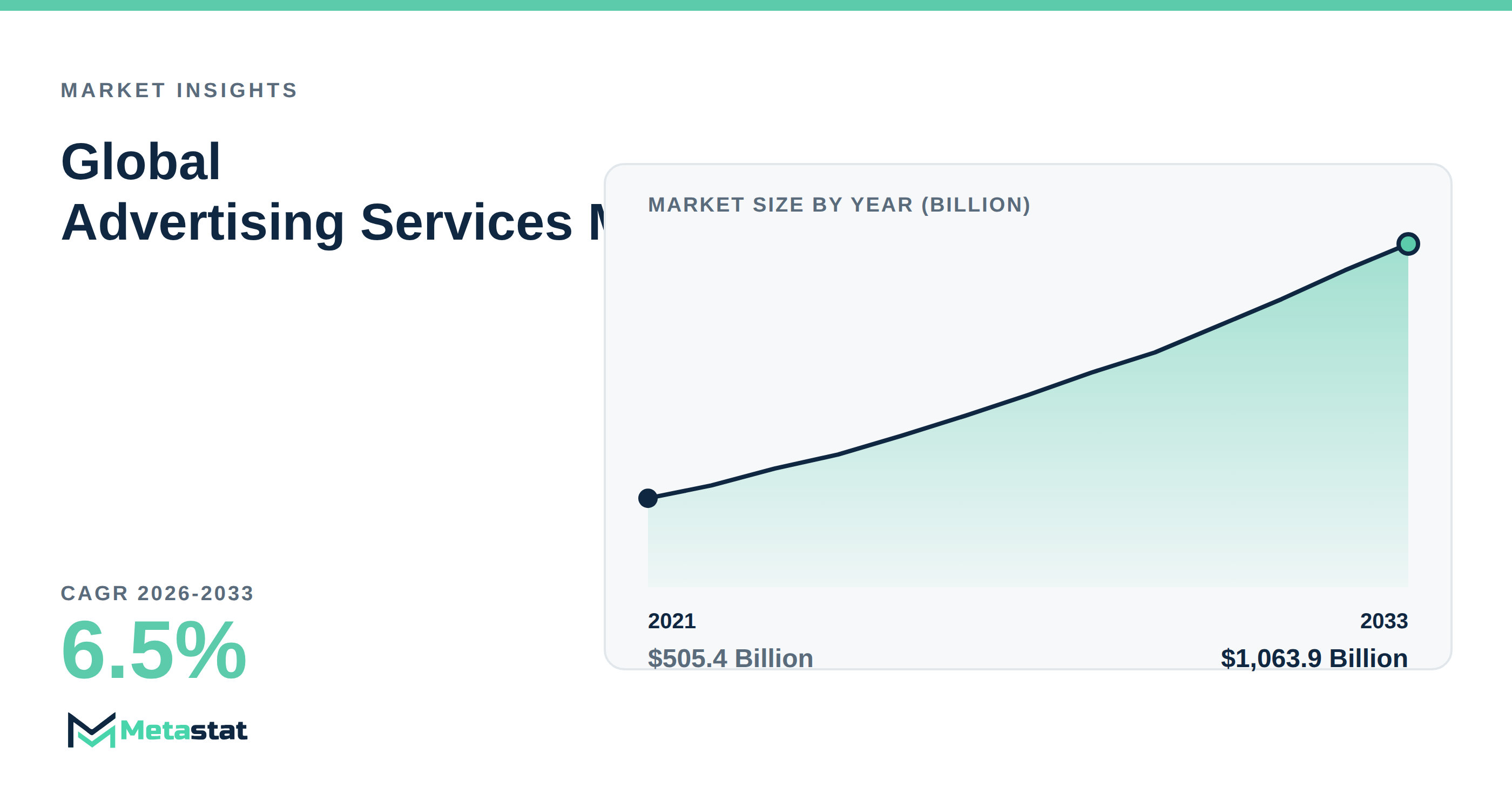
The Advertising Services market is undergoing notable transformations because it moves towards a projected valuation of USD 1,063.9 billion by 2033. Understanding the forces driving this evolution is vital for industry stakeholders aiming to navigate the complexities of the current landscape.
1. Technological integration enhances advertising effectiveness
Advancements in automation and artificial intelligence significantly impact the Advertising Services market. These innovations streamline advertising processes, allowing advertisers to implement more effective targeting strategies while improving consumer engagement. Automation facilitates real-time data analysis, enabling businesses to quickly adjust their strategies and enhance their campaign returns. Digital advertising leads this transformation, with the segment expected to rise from USD 271.5 billion in 2026 to USD 454.6 billion by 2033, reflecting a compound annual growth rate (CAGR) of 7.6% during the forecast period.
2. Regulatory compliance influences operational strategies
Complex regulatory environments across regions profoundly influence advertisers' operational strategies. Companies face the challenge of navigating numerous compliance requirements that result in increased operational costs and strain on resources. Smaller enterprises particularly struggle with these compliance issues, highlighting the necessity for a deep understanding of regional regulations to maintain market presence while adhering to legal standards.
3. Economic pressures create budget constraints
Macroeconomic factors including inflation and currency volatility impose significant constraints on advertising budgets. These economic pressures compel businesses to prioritize cost-effective advertising strategies while striving to maintain brand visibility. A marked shift towards digital and social media advertising occurs, because these platforms provide more measurable outcomes compared to traditional mediums. This reallocation of budgets necessitates that advertisers continually adapt their spending strategies to align with the prevailing economic conditions.
4. Evolving consumer behaviors drive the shift to digital
Changing consumer preferences have a substantial impact on the Advertising Services market, especially with the increasing engagement of users on digital platforms. The shift from traditional media to online advertising channels is evident, with brands now focusing on digital engagement to effectively reach their target audiences. Internet advertising, projected to achieve USD 101.1 billion by 2033, illustrates this trend, because companies emphasize optimizing their online presence and enhancing interactions with consumers.
5. Emerging regional demands create new opportunities
Growing economic activities in regions including Asia Pacific and South America present untapped opportunities within the Advertising Services market. Rising urbanization and investments in technology infrastructure contribute to increasing advertising expenditures in these areas. Advertisers are encouraged to customize their campaigns to align with regional preferences and cultural nuances, maximizing their outreach and brand recognition in these expanding markets.
6. Sustainability trends shape advertising strategies
Increasing consumer awareness regarding environmental responsibility drives advertisers to adopt sustainable practices. This movement transcends mere compliance with consumer demand, enhancing brand reputations in the process. Companies aligning their advertising strategies with sustainability imperatives create a competitive edge by appealing to environmentally conscious consumers. While this trend evolves, advertisers are likely to adopt innovative solutions prioritizing sustainable messaging and practices.
In conclusion, the Advertising Services market is influenced by a complex array of technological advancements, regulatory pressures, economic constraints, shifting consumer behaviors, emerging regional demands, and sustainability trends. Companies acknowledging and responding to these dynamics are positioned to secure a competitive advantage in this transforming landscape. For further insights, explore the Global Advertising Services Market.
Tags
About the Authors

LEAD ANALYST
Utkarsh Khirodkar is a Lead Market Research Analyst at MetaStat Insight, specializing in market intelligence, technology sector assessments, and competitive strategy.

PRINCIPAL CONSULTANT - ENTERPRISE AI & EMERGING TECHNOLOGIES
Banking & Finance · Electronics and Semiconductor · Energy and Power · Healthcare IT · Information & Technology · Professional Services
Vijay Gunti is a Principal Consultant at MetaStat Insight, bringing over two decades of experience across enterprise digital transformation, technology strategy, and intelligent systems.

PRINCIPAL CONSULTANT - QUALITY SYSTEMS & COMPLIANCE
Electronics and Semiconductor · Machinery & Equipment · Professional Services
Omkar Phadtare is an Industry Consultant at MetaStat Insight, specializing in quality systems, regulatory compliance, and standards benchmarking to drive data-driven market intelligence and strategic industry research.

LEAD CONSULTANT - COMMUNICATION, TELECOM, AND IT
Electronics and Semiconductor · Information & Technology · Machinery & Equipment · Professional Services
Ravindra Sathe Consultants for Communication, Telecom, and IT at MetaStat Insight. He leads the firm's industry research initiatives across telecommunications infrastructure, digital connectivity, enterprise networking, and emerging information technology domains.