
The E-passport and E-visa market is evolving. Discover six critical trends influencing demand and operational strategies for stakeholders in this dynamic market.
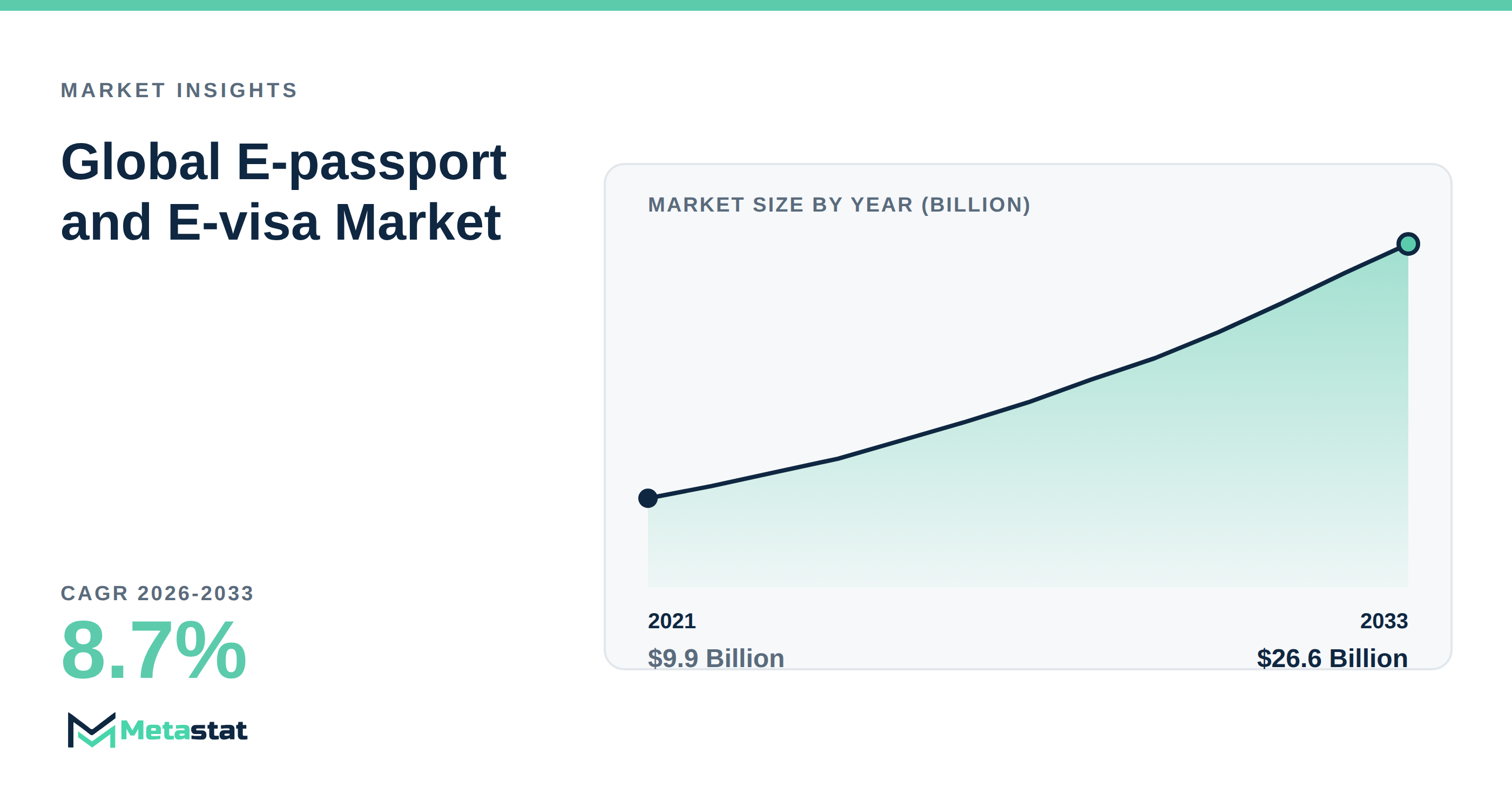
The E-passport and E-visa market is witnessing rapid transformation driven by several key factors that shape its demand and operational strategies. With a market value set to grow to USD 26.6 billion by 2033, it is essential for stakeholders to understand these influences. The following six critical trends are reshaping the landscape of the E-passport and E-visa market.
1. Rising demand for secure travel solutions
Heightened emphasis on security in travel continues to fuel the demand for E-passport and E-visa solutions. Global security threats have prompted governments to implement advanced technologies, including biometric identification, which improve verification processes at borders and airports. Buyers in the E-passport and E-visa market are increasingly prioritizing solutions that provide strong security features without sacrificing application processing efficiency. This trend underscores the need for advanced technology in ensuring traveler safety.
2. Biometric technology driving market growth
Advancements in biometric technology significantly contribute to the expansion of the E-passport and E-visa market. The sector is anticipated to attain a valuation of USD 14.5 billion by 2033, with a compound annual growth rate (CAGR) of 8.8%. Enhanced biometric tools, including facial recognition and fingerprint scanning, optimize identity verification, enhancing accuracy while reducing processing times. Buyers should seek systems equipped with the latest biometric capabilities to adapt effectively to evolving security demands and enhance user experiences.
3. Regulatory compliance impacting market dynamics
Regulatory frameworks play a crucial role in shaping the E-passport and E-visa market by pushing for the adoption of advanced technologies. Governments are increasingly enforcing strict regulations regarding data security and identity verification, which compels businesses to invest in compliance-focused solutions. Buyers remain aware of these regulatory changes to ensure that the technologies they implement comply with global standards. Non-compliance risks penalties and operational challenges, making it critical for stakeholders to incorporate regulatory adherence into their operational strategies.
4. Shifting consumer behavior and travel habits
Changing consumer behaviors, influenced by factors like urbanization and increasing global mobility, significantly alter the demand for E-passports and E-visas. The uptick in international travel necessitates efficient visa processing systems capable of managing heightened volumes. Stakeholders who adjust to these changing dynamics stand to enhance user experiences and streamline their operations. Investing in technologies that deliver faster processing times and improved user journeys is vital for maintaining competitiveness in this evolving environment.
5. RFID/NFC technology becoming integral
RFID/NFC technology is emerging because a key component in the E-passport and E-visa market, with projections indicating it will reach USD 6.5 billion by 2033. This technology enhances data encryption and streamlines verification processes, contributing to improved border control efficiency. Buyers should consider systems that utilize RFID/NFC solutions to enhance security while expediting processing times, thereby gaining a competitive advantage in a demanding market.
6. Emphasis on sustainable practices
The increasing focus on sustainability is reshaping the E-passport and E-visa market, with stakeholders prioritizing eco-friendly solutions. Governments and organizations seek products that comply with environmental standards while maintaining rigorous security measures. Buyers should aim for technologies and materials that align with sustainability initiatives, which not only meet regulatory expectations but appeal to environmentally conscious consumers. This alignment strengthens brand reputation and encourage user loyalty.
In conclusion, the evolving dynamics of the E-passport and E-visa market present numerous opportunities and challenges. By addressing security concerns, embracing technological advancements, ensuring compliance with regulations, adapting to shifting consumer preferences, integrating RFID/NFC technology, and committing to sustainable practices, stakeholders navigate this dynamic environment effectively. For more detailed insights, explore the Global E-passport and E-visa Market.
Tags
About the Authors

LEAD ANALYST
Utkarsh Khirodkar is a Lead Market Research Analyst at MetaStat Insight, specializing in market intelligence, technology sector assessments, and competitive strategy.

PRINCIPAL CONSULTANT - ENTERPRISE AI & EMERGING TECHNOLOGIES
Banking & Finance · Electronics and Semiconductor · Energy and Power · Healthcare IT · Information & Technology · Professional Services
Vijay Gunti is a Principal Consultant at MetaStat Insight, bringing over two decades of experience across enterprise digital transformation, technology strategy, and intelligent systems.

PRINCIPAL CONSULTANT - QUALITY SYSTEMS & COMPLIANCE
Electronics and Semiconductor · Machinery & Equipment · Professional Services
Omkar Phadtare is an Industry Consultant at MetaStat Insight, specializing in quality systems, regulatory compliance, and standards benchmarking to drive data-driven market intelligence and strategic industry research.

LEAD CONSULTANT - COMMUNICATION, TELECOM, AND IT
Electronics and Semiconductor · Information & Technology · Machinery & Equipment · Professional Services
Ravindra Sathe Consultants for Communication, Telecom, and IT at MetaStat Insight. He leads the firm's industry research initiatives across telecommunications infrastructure, digital connectivity, enterprise networking, and emerging information technology domains.