
Navigate the complexities of the Industrial Machinery Manufacturing market by asking suppliers these critical questions. Insights on compliance, automation, and more await.
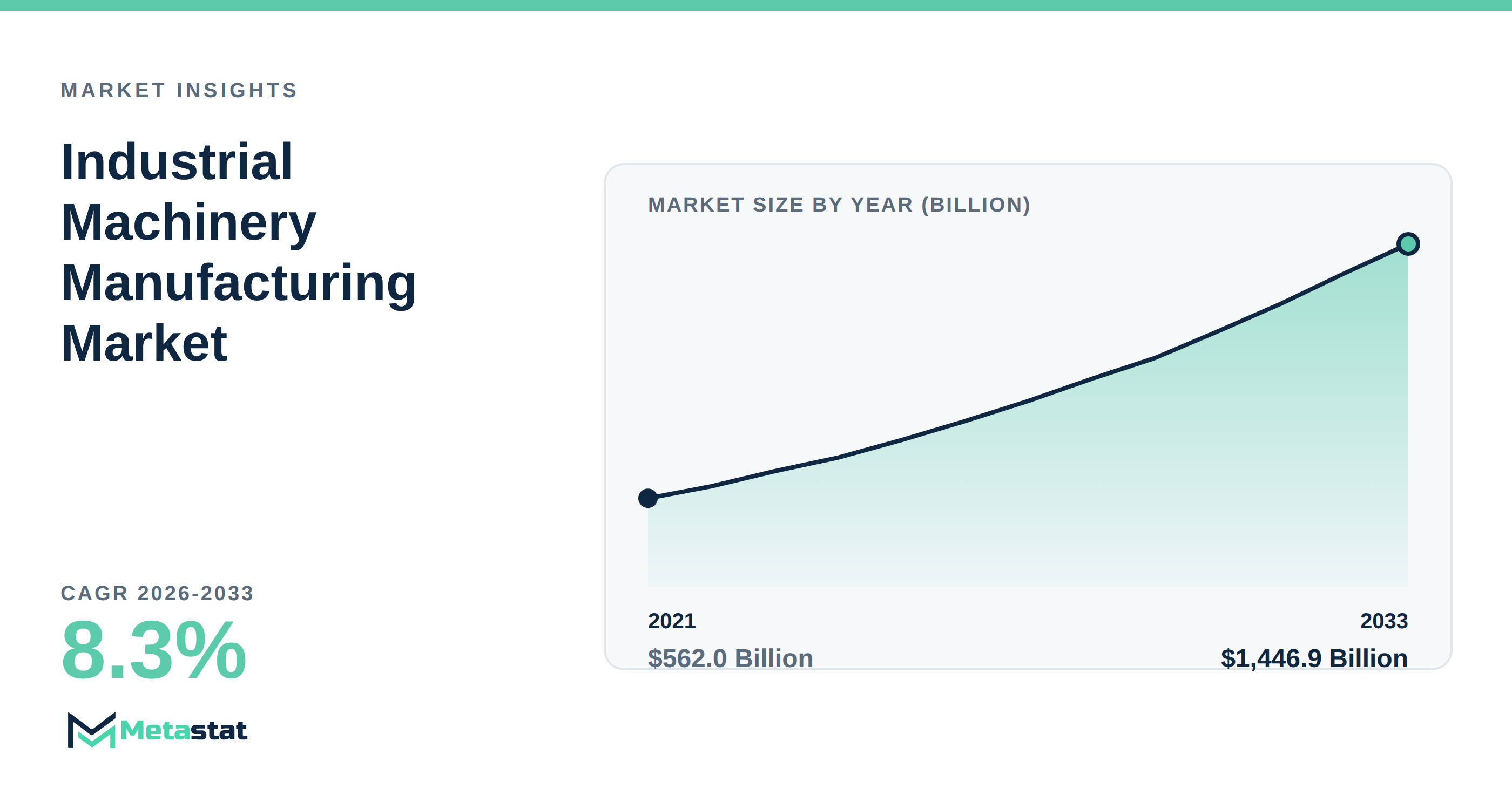
The Industrial Machinery Manufacturing market, valued at USD 764.3 billion in 2025, is projected to reach USD 1,446.9 billion by 2033. This substantial growth presents unique challenges and opportunities for buyers looking to procure equipment. Understanding the dynamics of this evolving market requires asking essential questions that guide purchasing decisions.
1. How do you ensure compliance with evolving regulations?
Manufacturers face increasing scrutiny regarding environmental compliance and safety standards. Buyers should inquire about suppliers’ strategies for adhering to these regulations. Suppliers that invest in eco-friendly technologies and sustainable practices position themselves because reliable partners. Such compliance facilitates market entry in regions with stringent regulations and enhances a buyer's reputation for sustainability. Understanding a supplier's commitment to regulatory adherence influences long-term partnerships and operational continuity.
2. What is your approach to integrating automation into machinery?
Automation significantly drives efficiency in the Industrial Machinery Manufacturing market. Buyers should ask suppliers about their strategies for incorporating automation technologies into their machinery. A supplier's ability to provide automated solutions enhances production speed while reducing labor costs. This capability is particularly relevant, because industries including automotive and aerospace increasingly adopt high-tech equipment. Assessing a supplier’s commitment to automation technologies leads to more agile and productive operations.
3. How do you address supply chain vulnerabilities?
Geopolitical tensions and economic fluctuations create a complex supply chain landscape. Buyers understand how suppliers manage their supply chains to mitigate risks of disruptions. Effective sourcing strategies and logistics capabilities are vital for maintaining production levels and meeting customer demands. Suppliers that demonstrate resilience in their supply chains offer stability and reliability, essential for maintaining operational efficiency during unpredictable market conditions.
4. What measures do you take to support sustainability initiatives?
Sustainability has emerged because a critical concern within the Industrial Machinery Manufacturing market. Buyers should ask suppliers about their initiatives aimed at reducing the environmental impact of their machinery. Companies that prioritize energy-efficient production and recyclable materials provide equipment that aligns with sustainability goals. This shift not only meets regulatory requirements but directly caters to a growing market segment that values eco-friendly practices.
5. How do your products support technological advancements?
Innovation is essential for remaining competitive in the Industrial Machinery Manufacturing market. Buyers should question how suppliers integrate new technologies into their products. Suppliers that continually invest in research and development introduce next-generation machinery equipped with advanced features. This forward-thinking approach helps buyers access modern solutions that enhance productivity and efficiency, directly impacting operational success and market positioning.
6. What are your strategies for managing pricing volatility?
Rising material costs and fluctuating exchange rates impact margins significantly. Buyers should inquire about suppliers' pricing strategies. Understanding how suppliers navigate price volatility allows buyers to assess the financial implications of their purchasing decisions. Suppliers that employ effective cost management techniques offer competitive pricing without compromising quality. This transparency enables buyers to plan their budgets effectively and minimize risks associated with unexpected price fluctuations.
7. How do you facilitate after-sales support and service?
After-sales service plays a crucial role in maintaining machinery and ensuring optimal performance. Buyers should evaluate suppliers’ capabilities in providing support services post-purchase. Reliable after-sales support includes maintenance, training, and troubleshooting assistance, which significantly impacts equipment longevity and performance. Suppliers that prioritize customer service build strong relationships with buyers, enhancing satisfaction and fostering ongoing collaboration.
In conclusion, the Industrial Machinery Manufacturing market's growth trajectory is linked with various factors influencing purchasing decisions. By aligning with suppliers that demonstrate innovation, compliance, and sustainability, buyers position themselves for success in a competitive environment, ensuring they are equipped to meet future demands.
The full analysis is in Global Industrial Machinery Manufacturing Market.
Tags
About the Authors

LEAD ANALYST
Utkarsh Khirodkar is a Lead Market Research Analyst at MetaStat Insight, specializing in market intelligence, technology sector assessments, and competitive strategy.

INDUSTRY CONSULTANT - CHEMICALS & ADVANCED MATERIALS
Chemicals and Materials · Machinery & Equipment · Packaging
Amit Gadhekar Consultant for Chemicals and Materials at MetaStat Insight, directing sector-specific intelligence, research, and strategic consulting across global chemical and processing markets.

PRINCIPAL CONSULTANT - QUALITY SYSTEMS & COMPLIANCE
Electronics and Semiconductor · Machinery & Equipment · Professional Services
Omkar Phadtare is an Industry Consultant at MetaStat Insight, specializing in quality systems, regulatory compliance, and standards benchmarking to drive data-driven market intelligence and strategic industry research.

ENERGY & INFRASTRUCTURE INDUSTRY CONSULTANT
Automotive and Transportation · Electronics and Semiconductor · Energy and Power · Machinery & Equipment
Saurabh Vasant Ganvir consults for Energy & Infrastructure Industry at MetaStat Insight, specializing in renewable energy, solar EPC, and electric vehicle (EV) infrastructure markets.

LEAD CONSULTANT - COMMUNICATION, TELECOM, AND IT
Electronics and Semiconductor · Information & Technology · Machinery & Equipment · Professional Services
Ravindra Sathe Consultants for Communication, Telecom, and IT at MetaStat Insight. He leads the firm's industry research initiatives across telecommunications infrastructure, digital connectivity, enterprise networking, and emerging information technology domains.