
The Microsoft outage affecting Outlook and related workplace services highlights the operational risks of shared cloud dependencies. This analysis examines recovery planning, backup accessibility, procurement priorities, and the commercial opportunities for providers that can demonstrate practical business continuity.
The Microsoft outage affecting Outlook and related workplace services on 13 November 2026 exposes a practical weakness in cloud procurement: businesses can buy integrated software without testing how work continues when a shared dependency becomes unavailable. The commercial issue extends from delayed messages to stalled approvals, customer responses, and coordination between suppliers.
Earlham College's Microsoft 365 status feed, which identifies Microsoft Graph Service Communications API as its source, showed Exchange Online service degradation in its 05:48 UTC snapshot that day. Its notices included mailbox connectivity problems and an incident affecting multiple Microsoft 365 services. That establishes disruption, rather than a uniform failure of every application or customer. It does not establish the final technical cause or total economic loss.
For business leaders, the purchasing question is whether essential workflows can continue through an uncertain recovery window. The analysis below considers the implications for procurement and supplier competition, rather than claiming that one incident has already changed market spending.
What the Microsoft Outage Reveals About Shared Dependencies
Integrated workplace platforms simplify collaboration and administration. Their commercial appeal includes fewer interfaces, consolidated purchasing, and familiar user tools. However, those advantages can coexist with dependencies that are difficult for individual departments to see.
A sales team may use email to approve a quotation. Procurement may rely on the same service to confirm a supplier change. Customer support may need mailbox access to retrieve previous correspondence. These are illustrative workflows, but they show how one inaccessible component can interrupt several business processes.
The effects also vary within an organization. In its 13 November 2026 Microsoft services outage notice, Australia's Bureau of Meteorology warned that customers and media might be unable to contact it through email. It explicitly said forecasts and warnings remained available on its website and weather app. The Bureau of Meteorology
That distinction matters. A communication failure does not automatically mean the underlying operational service has stopped. Buyers should assess specific customer journeys and dependencies rather than treating an entire organization as either online or offline.
Recovery Planning Needs Ownership and Independent Communication
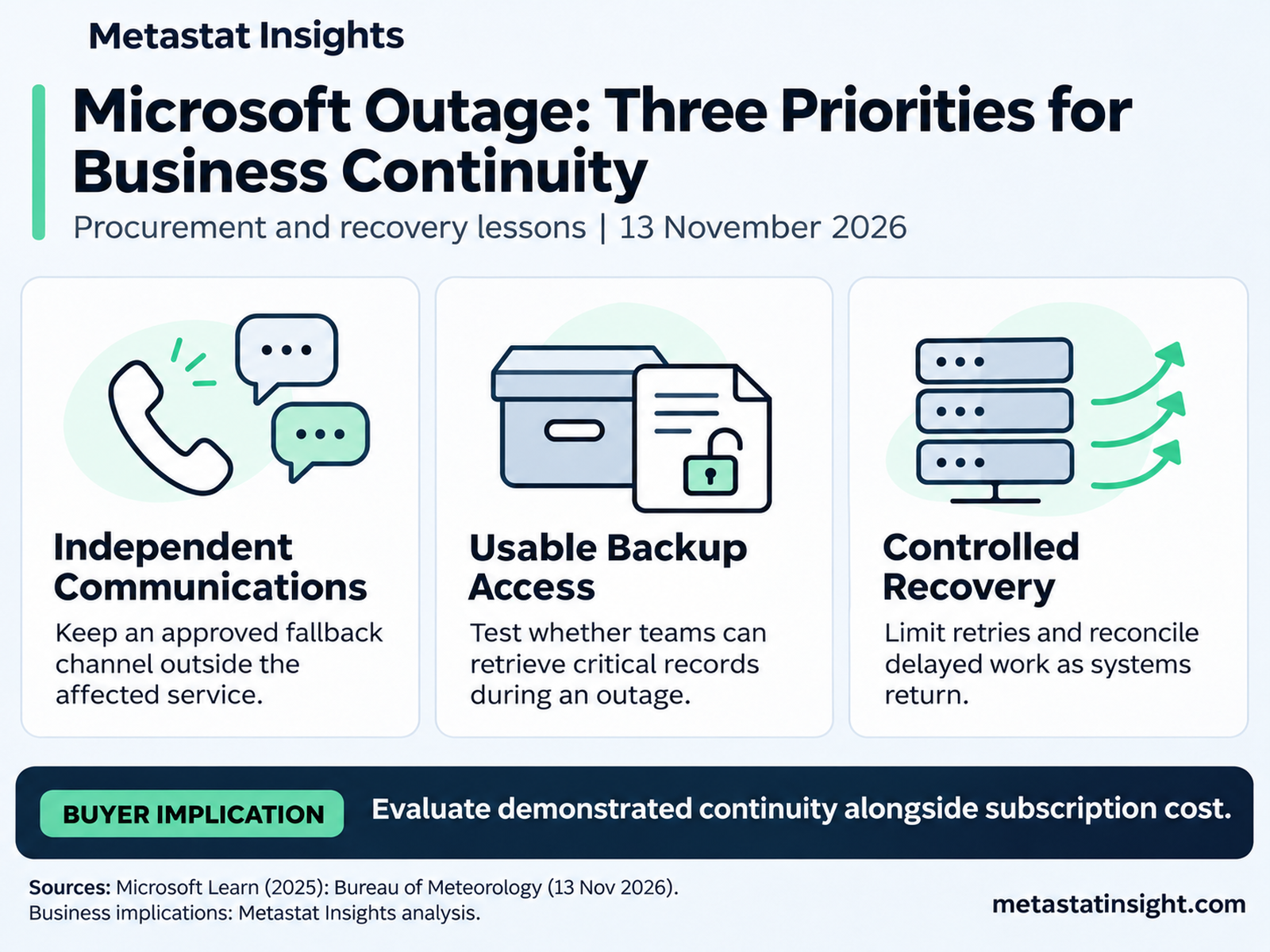
A continuity plan becomes useful when staff know which activities take priority, who can authorize exceptions, and which communication route remains available.
An alternative channel should be tested against the same failure scenario as the primary platform. If it requires the unavailable service to deliver a login code, provide instructions, or retrieve contact details, its practical independence is limited. This is a design test, not a finding that those authentication systems failed during this incident.
Organizations should give priority to time-sensitive activities such as customer escalation, payment authorization, urgent supplier coordination, and operational incident management. Each needs an accountable owner and an approved fallback procedure.
Metastat Insights' business continuity management software report provides related industry context through its coverage of business impact analysis, crisis communication, dependency mapping, and scenario testing. Those functions help frame the purchasing discussion. Software still needs maintained contact records, management decisions, and rehearsed procedures to support it.
For smaller businesses, a practical starting point may be a controlled emergency contact list and a documented process for urgent approvals. Larger organizations may need coordinated exercises across departments and service providers.
Why Controlled Reconnection Matters During Cloud Recovery
Service restoration involves more than restarting equipment. A recovering service must also absorb returning users and automated requests without becoming overloaded.
Microsoft's Azure Architecture Center guidance on retry storms, updated in August 2025, explains that excessive repeated connection attempts can worsen an interruption and impede recovery. It recommends limiting retries, increasing the delay between attempts, and honoring server instructions about when to reconnect.
This is established engineering guidance. It should not be treated as proof that a retry storm caused the November 2026 outage.
For enterprise buyers, the implication is to examine the behavior of connected applications as well as the main platform. An integration that repeatedly resubmits a failed request can create unnecessary load or complicate recovery. Technical teams should ask how connectors pause, resume, and prevent duplicate processing.
Operational teams need a recovery sequence too. Once access returns, staff may face delayed messages, queued approvals, and uncertain transaction status. Reconciliation should establish what completed, what remains pending, and what requires human review before automated workflows resume fully.
 Can Backup Access Keep Work Moving During an Email Outage?
Backup and continuity solve related problems, but their purchasing requirements differ. Retaining a copy of business information does not by itself ensure that employees can use it while the production service is unavailable.
The procurement test should be concrete: can an authorized employee retrieve a critical record through an approved route during the defined outage scenario? Buyers should establish which records are available, how current they are, and whether access depends on components included in that scenario.
Metastat Insights' data backup and recovery report examines service, media storage, and email backup across cloud, on-premises, and hybrid deployments. That broader context is useful when separating data protection requirements from immediate workflow continuity.
A demonstration should use a realistic business task, such as retrieving a supplier agreement or previous customer instruction. Successful retrieval should be assessed alongside permissions, auditability, and the work needed to return to normal operations.
These tests also reveal trade-offs. Additional copies and access routes require administration and controls. Buyers should compare those ongoing costs with the importance of the workflows they protect.
Procurement Should Reward Demonstrated Recovery Capability
The outage creates a reason to review supplier evidence. It does not, by itself, establish that changing platforms or buying another subscription will improve resilience.
Procurement teams can ask vendors to demonstrate three capabilities:
- Dependency transparency: Explain which services, identity components, and access routes support critical workflows.
- Continuity under disruption: Show how approved users perform priority tasks during a defined failure.
- Recovery reconciliation: Demonstrate how delayed work resumes without duplicate actions or lost accountability.
Price comparisons should include implementation, exercises, administration, and support. Service commitments also deserve careful review against the buyer's operational needs. A contractual remedy and a functioning fallback process serve different purposes.
Selective diversification may be appropriate for critical communication or records access. It also introduces additional training, governance, and integration work. Its value depends on whether it reduces a specific shared dependency at an acceptable cost.
For continuity, backup, and managed-service providers, a plausible competitive opportunity is to offer verifiable recovery outcomes. This remains a forward-looking interpretation. The incident alone cannot substantiate a market growth rate, a pricing premium, or a shift in supplier share.
The immediate business implication is to test one essential workflow from interruption through recovery, then use the findings to guide investment. Teams evaluating the supporting software categories can explore Metastat Insights' business continuity management software report.
Tags
About the Authors

LEAD ANALYST
Utkarsh Khirodkar is a Lead Market Research Analyst at MetaStat Insight, specializing in market intelligence, technology sector assessments, and competitive strategy.

PRINCIPAL CONSULTANT - ENTERPRISE AI & EMERGING TECHNOLOGIES
Banking & Finance · Electronics and Semiconductor · Energy and Power · Healthcare IT · Information & Technology · Professional Services
Vijay Gunti is a Principal Consultant at MetaStat Insight, bringing over two decades of experience across enterprise digital transformation, technology strategy, and intelligent systems.

LEAD CONSULTANT - COMMUNICATION, TELECOM, AND IT
Electronics and Semiconductor · Information & Technology · Machinery & Equipment · Professional Services
Ravindra Sathe Consultants for Communication, Telecom, and IT at MetaStat Insight. He leads the firm's industry research initiatives across telecommunications infrastructure, digital connectivity, enterprise networking, and emerging information technology domains.