
Explore the dynamics of the Photolithography market, including technological advancements, regional influences, and investment trends shaping its future.
The increasing demand for advanced semiconductors is a primary driver of growth in the Photolithography market. With widespread digital transformation and the surge in smart device adoption, industries are compelled to invest in semiconductor manufacturing. This demand is pronounced in sectors including automotive, telecommunications, and consumer electronics, which rely heavily on sophisticated chips for improved functionality.
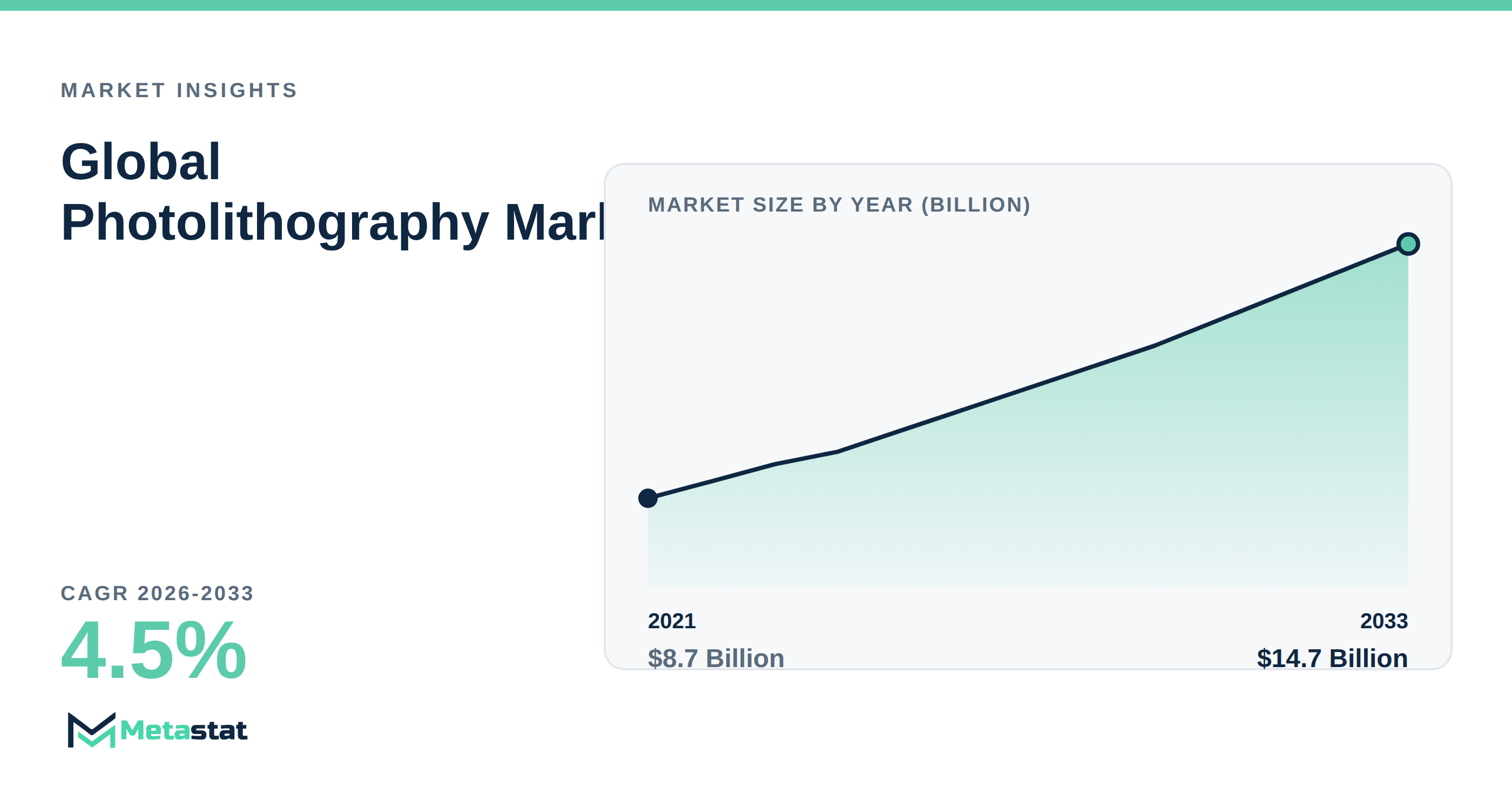
The Photolithography market benefits from the necessity for higher precision in manufacturing processes. While companies across different sectors streamline their operations, the need for sophisticated photolithography technologies intensifies. By investing in these advanced systems, manufacturers enhance production efficiency, meeting increasing consumer expectations for smarter and faster devices.
How technology advancements are shaping the Photolithography market
Technological advancements play a significant role in the Photolithography market. The rise of Deep Ultraviolet (DUV) and Extreme Ultraviolet (EUV) technologies demonstrates the growing necessity for enhanced resolution and precision in semiconductor production. DUV technology is estimated to expand from USD 4.7 billion in 2026 to USD 6.2 billion by 2033, while EUV technology is projected to achieve USD 5.6 billion within the same period. These innovations enable manufacturers to produce smaller, more efficient semiconductor devices, further driving demand for photolithography systems.
The impact of regional dynamics
Regional dynamics significantly influence the trajectory of the Photolithography market. Asia Pacific leads the market with a substantial 53.4% share, bolstered by a robust presence of semiconductor manufacturers in nations including China, Japan, and South Korea. North America and Europe contribute notably, driven by established technology firms and research institutions. This geographical distribution highlights the competitive landscape across regions and emphasizes the importance of local manufacturing capabilities in meeting global demand.
Challenges posed by regulatory compliance
Despite the promising growth, regulatory compliance presents notable challenges for the Photolithography market. Stricter environmental regulations necessitate manufacturers to adopt sustainable practices, often resulting in increased capital expenditures that disproportionately affect smaller companies. These companies struggle to compete effectively in a market where compliance costs add financial strain. Macroeconomic factors, including inflation and currency volatility, further complicate operational strategies, impacting profit margins across the industry.
Investment trends and their implications
Investment in automation and advanced technologies continues to reshape the Photolithography market. Companies increasingly embrace automation to boost productivity, optimize operational costs, and reduce labor expenses. This transition streamlines production and contributes to producing high-precision semiconductor devices that meet evolving consumer demands. While firms detail capital allocation and infrastructure investments, the future of the market appears optimistic, with sustained growth expected over the forecast period.
To summarize, the Photolithography market is influenced by a range of factors, including technological advancements, regional dynamics, and regulatory compliance challenges. Stakeholders should closely monitor these trends to capitalize on the opportunities presented by evolving market conditions. For a more comprehensive analysis, access the Global Photolithography Market report.
Tags
About the Authors

LEAD ANALYST
Utkarsh Khirodkar is a Lead Market Research Analyst at MetaStat Insight, specializing in market intelligence, technology sector assessments, and competitive strategy.

PRINCIPAL CONSULTANT - ENTERPRISE AI & EMERGING TECHNOLOGIES
Banking & Finance · Electronics and Semiconductor · Energy and Power · Healthcare IT · Information & Technology · Professional Services
Vijay Gunti is a Principal Consultant at MetaStat Insight, bringing over two decades of experience across enterprise digital transformation, technology strategy, and intelligent systems.

PRINCIPAL CONSULTANT - QUALITY SYSTEMS & COMPLIANCE
Electronics and Semiconductor · Machinery & Equipment · Professional Services
Omkar Phadtare is an Industry Consultant at MetaStat Insight, specializing in quality systems, regulatory compliance, and standards benchmarking to drive data-driven market intelligence and strategic industry research.

ENERGY & INFRASTRUCTURE INDUSTRY CONSULTANT
Automotive and Transportation · Electronics and Semiconductor · Energy and Power · Machinery & Equipment
Saurabh Vasant Ganvir consults for Energy & Infrastructure Industry at MetaStat Insight, specializing in renewable energy, solar EPC, and electric vehicle (EV) infrastructure markets.

LEAD CONSULTANT - COMMUNICATION, TELECOM, AND IT
Electronics and Semiconductor · Information & Technology · Machinery & Equipment · Professional Services
Ravindra Sathe Consultants for Communication, Telecom, and IT at MetaStat Insight. He leads the firm's industry research initiatives across telecommunications infrastructure, digital connectivity, enterprise networking, and emerging information technology domains.