
The Oil and Gas market is expected to undergo significant changes by 2033, driven by technological advancements, infrastructure development, and evolving regional dynamics.
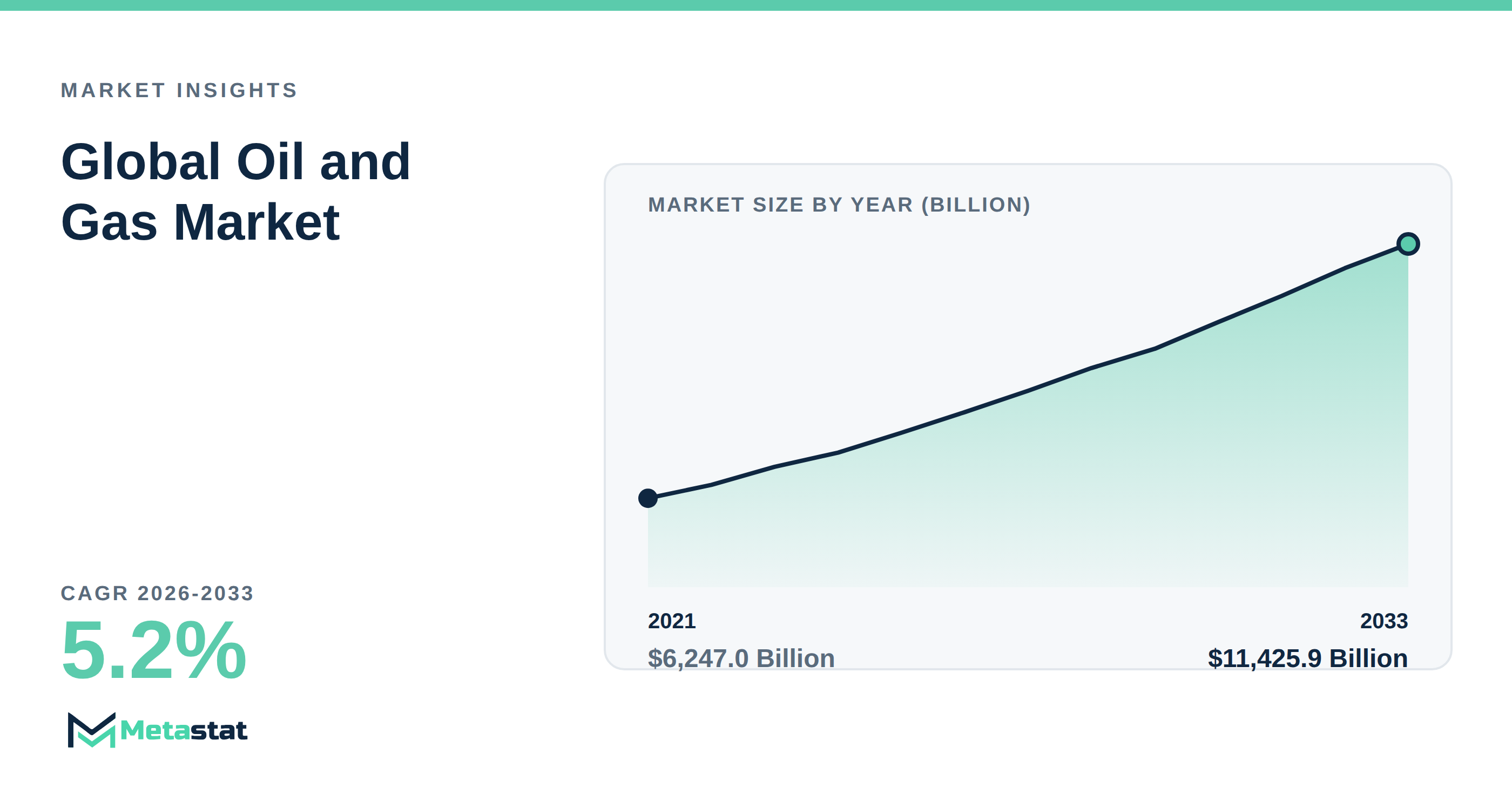
The global Oil and Gas market is poised for substantial growth, with estimates suggesting an increase from USD 7,579.6 billion in 2025 to USD 11,425.9 billion by 2033. This growth represents a compound annual growth rate (CAGR) of 5.2%. Understanding the factors influencing this upward trend is crucial for stakeholders who seek to navigate challenges and capitalize on emerging opportunities.
What factors will drive growth in the Oil and Gas market?
Several elements are fueling expansion in the Oil and Gas market, including the surging demand for energy, advancements in technology, and significant capital investments. The ongoing transition towards sustainable practices and decarbonization efforts significantly influence the industry’s trajectory. Companies are making substantial investments in innovative solutions that enhance efficiency while minimizing environmental impact.
Infrastructure development serves because a vital enabler, allowing firms to improve their operational capabilities and respond effectively to evolving market demands. Enhanced physical and digital assets support the adoption of advanced technologies, aligning with an urgent need for modernization in response to updated environmental regulations.
What challenges could impede market progress?
While the growth outlook is positive, the Oil and Gas market contends with notable challenges, particularly regarding compliance with regulations and macroeconomic factors. Stricter environmental mandates introduce additional operational costs and can hinder efficiency. Uncertainties stemming from fluctuating oil prices, geopolitical tensions, and inflationary pressures complicate investment decision-making.
Technological obsolescence remains a significant concern because rapid advances in alternative energy technologies compel traditional oil and gas companies to innovate or risk losing market share. Workforce skill gaps and cultural resistance in certain regions further complicate modernization efforts, potentially delaying progress.
How will key segments perform by the end of the forecast window?
The structure of the Oil and Gas market reveals considerable segmentation, with significant growth anticipated across various sectors. The upstream segment is expected to increase from USD 3,657 billion in 2026 to USD 5,484.4 billion by 2033, reflecting a CAGR of 6%. This growth stems from heightened demand for crude oil and natural gas, especially in emerging economies.
The midstream segment is projected to reach USD 1,828.1 billion by 2033, driven by an expanding need for transportation, storage, and distribution of oil and gas products. Improved logistics and supply chain dynamics will optimize efficiencies within this segment, facilitating a smoother operation.
Lastly, the downstream segment is anticipated to attain USD 4,113.3 billion by 2033. This growth will be supported by increasing demand for refined petroleum products, with innovations in refining technologies continuing to improve operational efficiencies and product quality, essential for meeting regulatory standards and evolving consumer expectations.
Which regions are central to market dynamics?
Currently, the Asia Pacific region commands the largest share of the Oil and Gas market, holding 34.4% of the total market. This dominance is attributed to ongoing industrialization and urbanization in the region. North America follows with a 23.7% share, while Europe accounts for 15.8%. The Middle East and Africa collectively comprise 19%, with South America contributing 7.1% to the overall market.
These regional dynamics illustrate diverse demand patterns, shaped by resource availability and technological investments. Companies should prioritize understanding these regional nuances to effectively capitalize on emerging opportunities.
How should companies prepare for the changing Oil and Gas landscape?
For companies operating within the Oil and Gas sector, embracing innovation and sustainability will be essential for long-term success. Strategic investments in advanced technologies and infrastructure will not only enhance operational capabilities but improve supply chain resilience. Companies should prioritize compliance with evolving regulations while proactively addressing sustainability imperatives.
Market participants should consider forming strategic partnerships or pursuing mergers and acquisitions to strengthen resources and positions in this increasingly competitive environment. With the Oil and Gas market projected for considerable growth through 2033, those equipped to adapt to changing dynamics are more likely to thrive.
For deeper insights into market trends, growth drivers, and challenges, refer to the Global Oil and Gas Market.
Tags
About the Authors

LEAD ANALYST
Utkarsh Khirodkar is a Lead Market Research Analyst at MetaStat Insight, specializing in market intelligence, technology sector assessments, and competitive strategy.

PRINCIPAL CONSULTANT - ENTERPRISE AI & EMERGING TECHNOLOGIES
Banking & Finance · Electronics and Semiconductor · Energy and Power · Healthcare IT · Information & Technology · Professional Services
Vijay Gunti is a Principal Consultant at MetaStat Insight, bringing over two decades of experience across enterprise digital transformation, technology strategy, and intelligent systems.

ENERGY & INFRASTRUCTURE INDUSTRY CONSULTANT
Automotive and Transportation · Electronics and Semiconductor · Energy and Power · Machinery & Equipment
Saurabh Vasant Ganvir consults for Energy & Infrastructure Industry at MetaStat Insight, specializing in renewable energy, solar EPC, and electric vehicle (EV) infrastructure markets.