
The Property Management Services market is set to expand significantly, driven by technological advancements and urbanization trends that stakeholders navigate.
Growth in the Property Management Services market is evolving because the industry transitions from its current state toward 2033. Significant changes on the horizon warrant attention from stakeholders navigating this dynamic environment.
What drives growth in the Property Management Services market?
Increased capital investment significantly contributes to market expansion. Favorable economic conditions, including rising GDP and reduced interest rates, facilitate the expansion of portfolios for institutional investors and real estate funds. This growth increases the demand for efficient property management solutions tailored to residential, commercial, and mixed-use properties. Integrating technology enhances productivity and reduces operational costs, creating a more competitive environment.
Urbanization and shifting demographic patterns further amplify this demand. Rising population densities in urban centers generate a pressing need for diverse residential and multifamily properties, pushing the market for comprehensive property management services. Stakeholders should monitor urbanization trends closely, because these demographic shifts define future investment strategies and market positioning.
How does regional variation impact the market?
The geographical distribution of the Property Management Services market reveals substantial growth opportunities, particularly in emerging markets. The Asia Pacific region commands the largest market share at 46%, driven by rapid urbanization and economic development. Europe and North America account for shares of 26.4% and 15.7%, respectively.
Companies targeting these regions adapt to local market conditions and regulatory requirements to remain competitive. Emerging markets present unique challenges but promise significant growth potential, particularly due to accelerated urbanization. Stakeholders should focus on developing region-specific strategies to capitalize on these trends.
What technological advancements should be prioritized?
The integration of smart building technologies and automation will transform service delivery in the Property Management Services market. Companies increasingly adopt advanced software solutions to streamline operations, enhance tenant experiences, and ensure compliance with evolving regulatory standards. Investments in these technologies will drive operational efficiency and improve service quality.
The Tenant and Lease Management segment, for example, is expected to reach USD 422.2 million by 2033, reflecting a CAGR of 7.8%. This growth arises from organizations prioritizing effective lease administration and efficient tenant interactions. Stakeholders who adopt these technological innovations position themselves to meet changing consumer expectations and gain a competitive advantage.
What challenges and restraints should be addressed?
The Property Management Services market faces a range of challenges, including regulatory pressures and economic constraints. Compliance with stringent regulations across various jurisdictions raises operational costs, impacting profit margins. Macroeconomic factors including inflation and geopolitical uncertainties create an unpredictable investment environment.
Companies confront these complexities to maintain profitability while delivering quality services. Investing in robust procurement strategies and leveraging technology helps alleviate these challenges. Continuous innovation in service delivery and operational efficiency remains critical for adaptation within this dynamic market.
What future trends are emerging in the Property Management Services market?
Sustainability and compliance with environmental, social, and governance (ESG) standards have become central themes in the Property Management Services market. Companies prioritize sustainable practices, aligning service offerings with contemporary consumer values. This trend encourages property managers to invest in energy-efficient properties and innovative practices that boost overall market appeal.
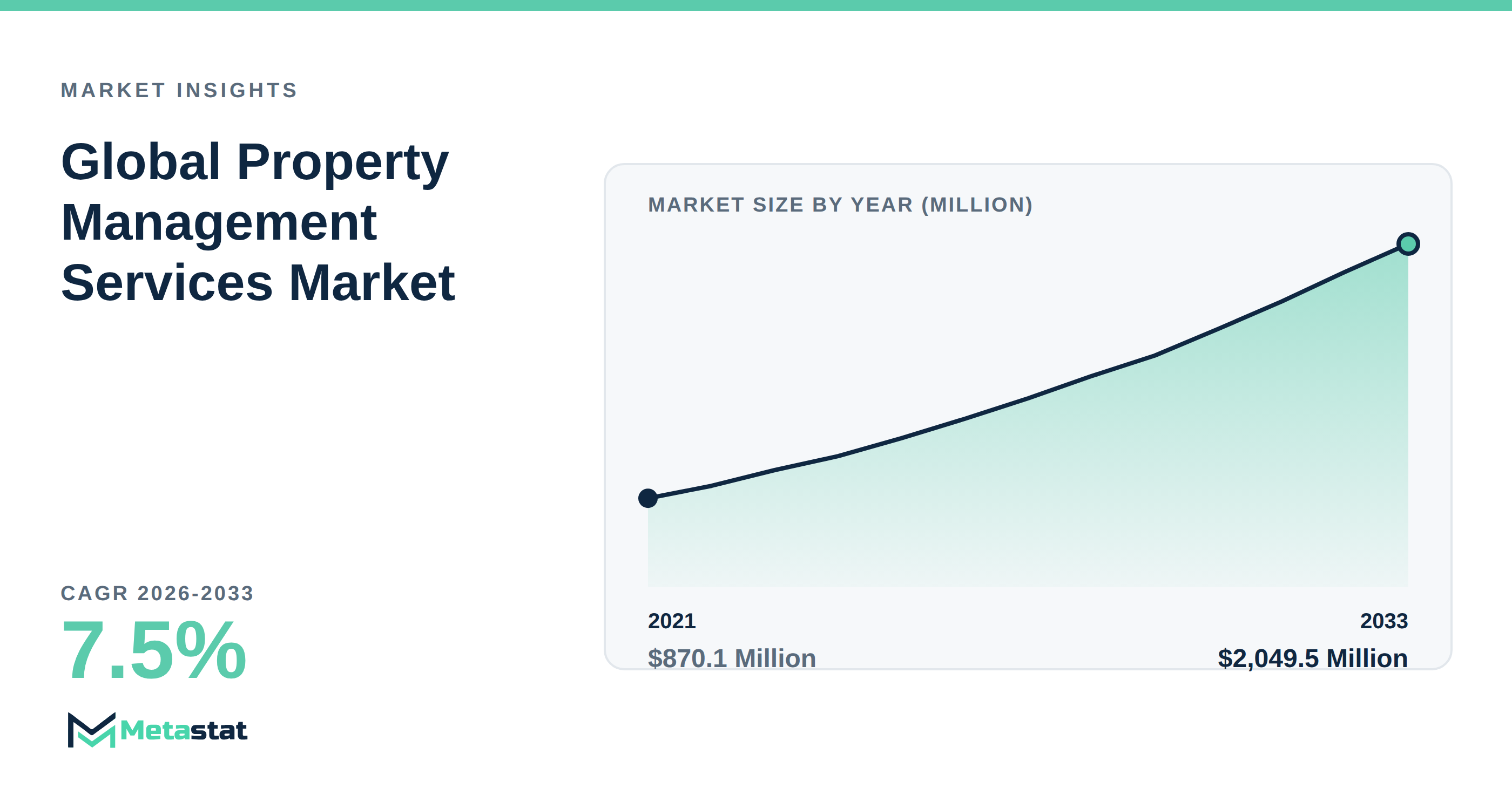
With the market anticipated to reach USD 2,049.5 million by 2033, stakeholders should remain vigilant to these shifts, because they shape service delivery models and investment strategies. Firms that adapt to evolving client needs and emphasize technology integration are well-positioned to leverage the future of the Property Management Services market.
For a deeper understanding of the trends and opportunities within the industry, refer to the Global Property Management Services Market.
Tags
About the Authors

LEAD ANALYST
Utkarsh Khirodkar is a Lead Market Research Analyst at MetaStat Insight, specializing in market intelligence, technology sector assessments, and competitive strategy.

PRINCIPAL CONSULTANT - ENTERPRISE AI & EMERGING TECHNOLOGIES
Banking & Finance · Electronics and Semiconductor · Energy and Power · Healthcare IT · Information & Technology · Professional Services
Vijay Gunti is a Principal Consultant at MetaStat Insight, bringing over two decades of experience across enterprise digital transformation, technology strategy, and intelligent systems.

PRINCIPAL CONSULTANT - QUALITY SYSTEMS & COMPLIANCE
Electronics and Semiconductor · Machinery & Equipment · Professional Services
Omkar Phadtare is an Industry Consultant at MetaStat Insight, specializing in quality systems, regulatory compliance, and standards benchmarking to drive data-driven market intelligence and strategic industry research.

LEAD CONSULTANT - COMMUNICATION, TELECOM, AND IT
Electronics and Semiconductor · Information & Technology · Machinery & Equipment · Professional Services
Ravindra Sathe Consultants for Communication, Telecom, and IT at MetaStat Insight. He leads the firm's industry research initiatives across telecommunications infrastructure, digital connectivity, enterprise networking, and emerging information technology domains.