
Silver's sharp correction is changing investment decisions and industrial purchasing economics in India. This analysis examines interest rates, manufacturing demand, the gold-silver ratio, and inventory exposure to explain why lower prices warrant a disciplined buying framework rather than an automatic bullish call.
When silver prices in India fall sharply, investors and industrial buyers face different decisions. Manufacturers may see an opportunity to reduce input costs. Investors must assess whether the correction offers better value or reflects a weaker demand outlook.
For a consistent reference, the India Bullion and Jewellers Association’s main rates website publishes gold and silver benchmark quotations. Its silver prices are quoted per kilogram and exclude GST and making charges. Buyers should check the displayed quotation before making a purchase rather than rely on a price embedded in an article.
A cheaper input can improve purchasing economics, but a lower market price does not automatically create a better investment. The distinction matters because silver combines industrial consumption with investment demand.
A fall from an earlier high measures price damage, but it does not establish fair value. The useful task is to examine financing conditions, physical consumption, relative pricing, and the costs of holding metal.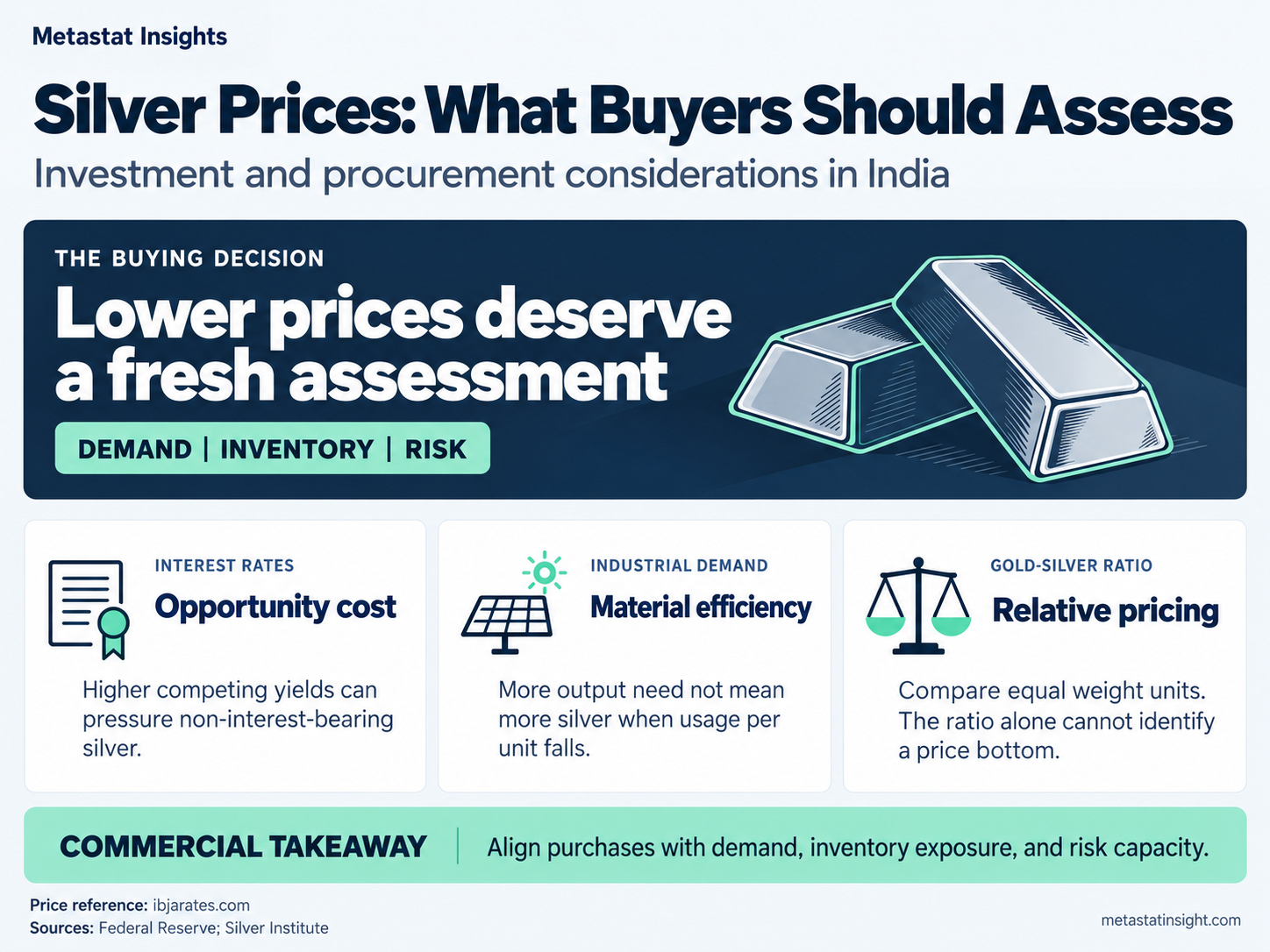
Why silver prices in India need a consistent benchmark
A meaningful comparison must use the same purity, market, quotation time, and tax treatment. A retail bullion quote, an association benchmark, and a futures contract can produce different prices without any of them being inherently incorrect.
This matters when assessing claims about the size of a silver-price correction. Comparing a retail peak with a later wholesale quotation can exaggerate or understate the movement. A defensible peak-to-current calculation requires a continuous, comparable price series.
Businesses should therefore identify the price specified in their supplier contracts before interpreting a headline decline. Their payable price may include fabrication, logistics, financing, and supplier premiums. A falling benchmark does not guarantee an identical percentage reduction in delivered cost.
For Indian buyers, exchange-rate movements also matter: a weaker rupee can offset part of a decline in dollar-denominated silver. Procurement teams should separate metal-price changes from currency exposure when assessing savings.
Oil and interest rates create pressure through several channels
The argument that expensive oil can hurt silver is plausible, but the sequence is conditional. Higher energy costs can increase transport and production expenses. Whether central banks respond with higher rates depends on inflation persistence, expectations, employment, and broader economic conditions.
The Federal Reserve’s explanation of monetary policy transmission describes how policy rates influence borrowing costs and broader financial conditions. It also stresses that the effects on inflation and employment are neither direct nor immediate. A rise in oil prices alone therefore cannot establish the timing or size of the next policy move.
Higher yields on competing assets can increase the opportunity cost of owning non-interest-bearing silver. However, nominal interest rates alone do not explain the metal’s direction. Inflation expectations influence real yields, while currency movements and changes in investor positioning can alter the response.
The second channel runs through customers. More expensive financing can discourage inventory accumulation and postpone investment. Yet industrial demand does not fall uniformly: spending on one application may remain resilient while another contracts. Treating every industrial buyer as equally sensitive to interest rates obscures the commercial picture.
Industrial consumption depends on silver intensity as well as output
The Silver Institute’s explanation of industrial silver applications identifies uses across solar cells, electrical contacts, electronics, automotive systems, and chemical catalysts. These applications help explain why silver responds to manufacturing conditions as well as investment sentiment.
Assessing that demand requires attention to both production volumes and material intensity. In solar manufacturing, for example, the relevant question is how much silver each cell design requires and whether process improvements reduce that requirement. Material savings must also meet technical performance and reliability needs.
The implication is that manufacturing growth and silver consumption can diverge. If a producer uses less silver per unit, higher production does not necessarily translate into proportionately higher metal demand.
For suppliers, this makes customer technology choices commercially significant. Selling into a growing application may still involve pressure on material volumes, specifications, or pricing. For buyers, successful material reduction can lower exposure to future silver volatility.
Metastat Insights’ global Solar Cell Materials Market report provides adjacent context on photovoltaic materials, manufacturing applications, and customer groups. Its broader materials scope should be distinguished from a dedicated silver-price forecast.
Does the gold-silver ratio show that silver is cheap?
The gold-silver ratio divides the gold price by the silver price using equal weight units. It describes relative pricing, not an intrinsic value or a guaranteed trading range.
To calculate it correctly, both quotations must use the same currency, weight basis, and observation time. Indian gold prices are commonly expressed per 10 grams, while silver is quoted per kilogram. Those units must be aligned before division.
A higher ratio means silver is cheaper relative to gold than at a lower ratio. It does not establish that silver is undervalued in absolute terms or that a reversal is imminent.
The ratio can decline because silver rises, gold falls, or both move at different rates. It can also rise further if silver underperforms. Any historical reference band depends on the period chosen, rather than representing a boundary markets must respect.
Consequently, the ratio alone cannot establish that speculative excess has disappeared. Investors still need a view on demand, financing conditions, and the price paid.
Lower replacement costs can expose inventory losses
For manufacturers and retailers, a correction creates opposing effects. New purchases become cheaper, while stock acquired at higher prices may lose economic value.
A jewellery seller could face pressure to lower selling prices before expensive inventory has cleared. Conversely, buying replacement stock at lower cost may improve margins once older material is sold. The outcome depends on stock turnover, pricing practices, and customer demand.
Online sellers face an additional operational challenge: keeping product prices aligned with changing material costs without undermining consumer confidence. Metastat Insights’ global Online Jewelry Market report, which includes silver among its material segments, provides context on this downstream sales channel.
Procurement teams can respond by separating confirmed production requirements from discretionary inventory. Scheduled purchases against committed orders address a different need from accumulating metal in anticipation of a rebound.
A buying framework should survive more than one price scenario
An investment decision should begin with purpose, holding period, liquidity needs, and acceptable loss. Staggered purchases can reduce dependence on a single entry date, but they cannot prevent losses if the metal continues falling.
A 5% portfolio allocation can serve as an illustrative personal limit. It is not a universal ceiling or an evidence-based prescription for every investor. Existing commodity exposure and the investor’s capacity to absorb volatility matter more than applying one percentage mechanically.
Businesses need a similarly explicit framework. If inflation stays persistent and industrial orders weaken, preserving purchasing flexibility may be valuable. If financing pressure eases and customer orders recover, securing production requirements could become more urgent. Neither scenario establishes a reliable price target.
The immediate commercial opportunity is to reassess delivered costs, inventory exposure, and purchase commitments against actual demand. Buyers examining the industrial side of that decision can explore Metastat Insights’ Solar Cell Materials Market report for broader application and value-chain context.
Tags
About the Authors

LEAD ANALYST
Utkarsh Khirodkar is a Lead Market Research Analyst at MetaStat Insight, specializing in market intelligence, technology sector assessments, and competitive strategy.

PRINCIPAL CONSULTANT - ENTERPRISE AI & EMERGING TECHNOLOGIES
Banking & Finance · Electronics and Semiconductor · Energy and Power · Healthcare IT · Information & Technology · Professional Services
Vijay Gunti is a Principal Consultant at MetaStat Insight, bringing over two decades of experience across enterprise digital transformation, technology strategy, and intelligent systems.

ENERGY & INFRASTRUCTURE INDUSTRY CONSULTANT
Automotive and Transportation · Electronics and Semiconductor · Energy and Power · Machinery & Equipment
Saurabh Vasant Ganvir consults for Energy & Infrastructure Industry at MetaStat Insight, specializing in renewable energy, solar EPC, and electric vehicle (EV) infrastructure markets.