
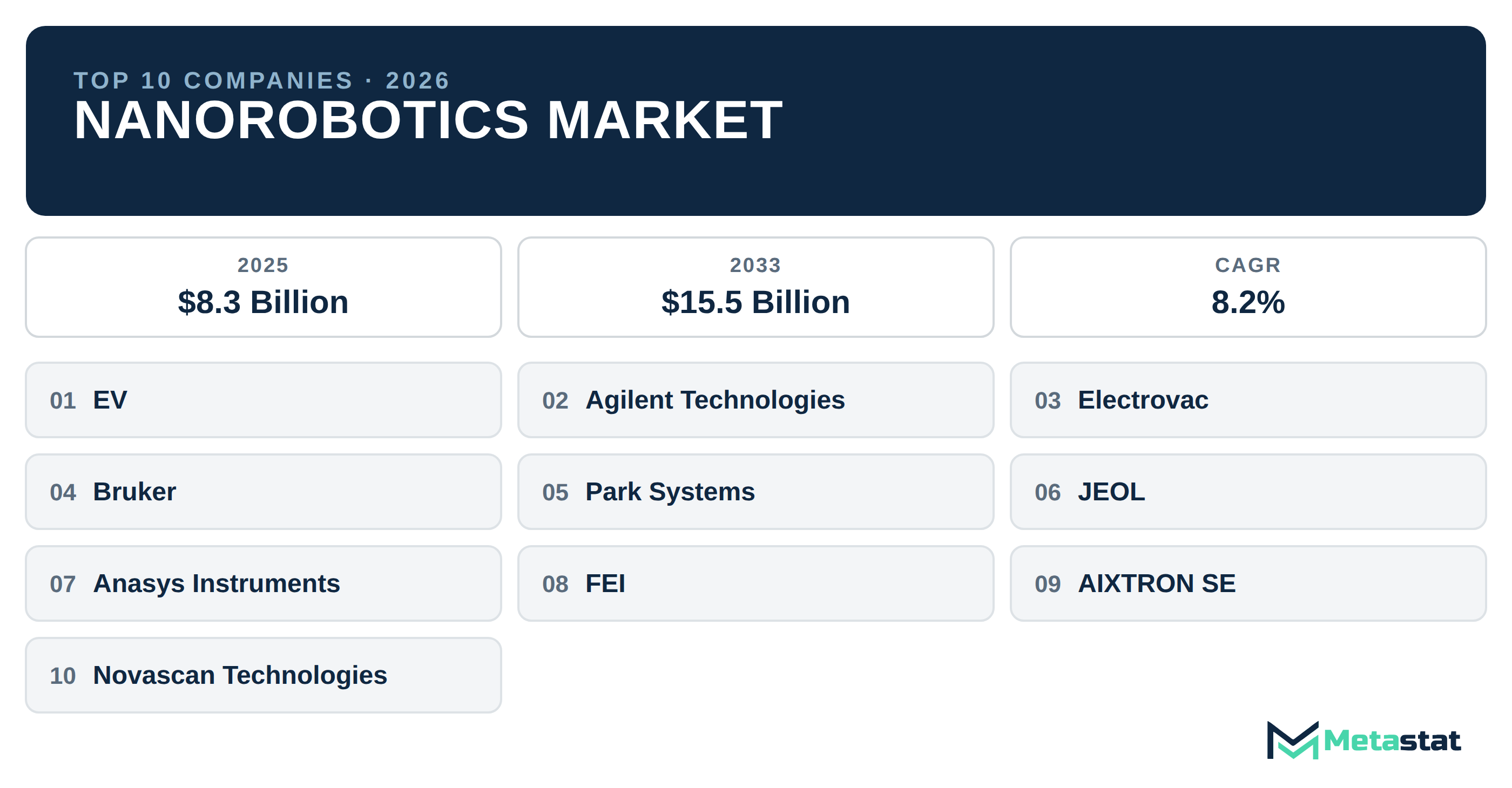
The Global Nanorobotics Market, valued at USD 8.3 Billion in 2025, is projected to reach USD 15.5 Billion by 2033. This post explores ten leading companies in this exciting industry.
The Global Nanorobotics Market is valued at USD 8.3 Billion in 2025 and is projected to reach USD 15.5 Billion by 2033, growing at a CAGR of 8.2%. This market encompasses advanced technology focused on the development and application of nanorobots for various uses, particularly in fields such as nanomedicine and biomedical applications. Factors driving this growth include increasing investments in nanotechnology and the rising demand for precision in medical procedures.
As applications of nanorobotics expand, industries leverage these innovations to enhance processes and improve outcomes in health and manufacturing. The integration of nanorobots into medical therapies and diagnostics illustrates the significant potential for advancements in healthcare.
Global Nanorobotics Market Size, Data, & Statistics
The base year for the Global Nanorobotics Market is 2021, with a market size of USD 6.1 Billion. This figure reflects the initial growth phase of the market, which has expanded steadily in recent years.
In 2022, the market size increased to USD 6.5 Billion, demonstrating ongoing investment and interest in nanotechnology. By 2023, the market rose further to USD 7.1 Billion, reinforcing the growing acceptance of nanorobotics in various applications.
Forecasts indicate that by 2024, the market will reach USD 7.6 Billion. The projected growth continues with an expected increase to USD 8.3 Billion in 2025, highlighting strong growth potential.
Looking ahead, the market is forecasted to reach USD 9 Billion in 2026 and USD 15.5 Billion by 2033, affirming a robust compound annual growth rate (CAGR) of 8.2% from 2025 to 2033. This growth reflects increasing applications and technological advancements.
The regional distribution of the market shows North America holds 37.8%, Europe at 31.7%, Asia Pacific at 20.6%, and both South America and the Middle East and Africa at 5%. This diverse geographic share indicates widespread interest and investment in nanorobotics technology.
Top 10 Trends in the Global Nanorobotics Market
Inline metrology moves onto the production line
Inline metrology integrates measurement technology directly into production processes, enhancing precision and quality control. This trend allows manufacturers to detect and correct errors in real time, leading to fewer defects and improved efficiency.
Expansion of nanomedicine applications
Nanomedicine is becoming increasingly relevant as research advances. The application of nanorobots in drug delivery systems enables targeted therapies, enhancing treatment efficacy while minimizing side effects.
Collaboration between research institutions and industry
Partnerships between academia and industry drive innovation in nanorobotics. Collaborative efforts enable the transfer of knowledge and technology, accelerating development cycles and market readiness.
Development of multifunctional nanorobots
Multifunctional nanorobots capable of performing various tasks simultaneously are gaining traction. These devices can address multiple challenges in a single application, significantly enhancing operational efficiency.
Increased regulatory focus on safety
As nanorobotics technology evolves, regulatory bodies emphasize safety standards. Compliance with regulations fosters consumer trust and encourages broader acceptance of nanotechnology in healthcare.
Emergence of nano-sensors in diagnostics
Nano-sensors are reshaping diagnostic capabilities by providing rapid and accurate results. Their application in medical diagnostics improves patient outcomes through early detection of diseases.
Investment in educational programs
Investment in educational initiatives is crucial for developing skilled professionals in nanorobotics. A well-trained workforce ensures continued growth and innovation within the industry.
Adoption of artificial intelligence in nanorobotics
Artificial intelligence enhances the capabilities of nanorobots by enabling autonomous decision-making. This advancement improves the efficiency and effectiveness of nanorobotic applications across various sectors.
Integration of nanorobotics in surgery
Minimally invasive surgical techniques benefit from the integration of nanorobotics. These advancements lead to reduced recovery times and improved surgical outcomes for patients.
Focus on sustainability in nanotechnology
Sustainability is becoming a priority in the development of nanorobotics technologies. Efforts to create eco-friendly materials and processes reflect a growing awareness of environmental impacts.
Top 10 Companies in the Global Nanorobotics Market
1. EV Group
Headquarters: St. Florian, Austria · Founded: 1980
EV Group specializes in the development of innovative microfabrication solutions for the semiconductor and nanotechnology sectors. Their products, particularly in the area of wafer bonding and lithography, contribute to the advancement of nanorobotics applications. The company emphasizes precision and quality in its manufacturing processes, which are essential for the production of reliable nanorobots.
With a commitment to research and development, EV Group continues to drive advancements that support the integration of nanotechnology in various applications. Their robust portfolio caters to the needs of industries focused on nanomedicine and electronics, highlighting their significant role in the growing nanorobotics market.
2. Agilent Technologies
Headquarters: Santa Clara, USA · Founded: 1999
Agilent Technologies delivers a wide range of analytical instruments and solutions that support research and development in nanorobotics. Their expertise in measurement science and diagnostics is crucial for advancing nanotechnology applications. The company focuses on innovative solutions that enhance productivity and streamline research workflows.
With a strong commitment to sustainability and collaboration, Agilent Technologies partners with academic institutions and research organizations to enhance advancements in nanotechnology. Their contributions to nanorobotics reflect their dedication to improving healthcare and technology through precise instrumentation.
3. Electrovac
Headquarters: Vienna, Austria · Founded: 1960
Electrovac is a prominent player in the production of vacuum technology and related components used in nanorobotics. Their engineered solutions facilitate the development and manufacturing of high-precision nanodevices. The company’s focus on quality and innovation makes it a trusted partner in the nanotechnology sector.
Electrovac's products enhance the functionality of nanorobots, contributing to their effectiveness in various applications. By leveraging advanced vacuum technologies, Electrovac supports the ongoing evolution of the nanorobotics market and the development of groundbreaking solutions.
4. Bruker Corporation
Headquarters: Billerica, USA · Founded: 1960
Bruker Corporation provides analytical instrumentation and tools essential for nanotechnology research and development. Their advanced imaging and measurement solutions support the characterization of nanomaterials and nanorobots. Focused on innovation, Bruker continuously enhances its portfolio to meet the needs of the evolving nanorobotics industry.
Through strategic partnerships and collaborative efforts, Bruker aims to advance developments in nanorobotics applications across various sectors. Their commitment to excellence positions them as a key contributor to the growth of the global nanorobotics market.
5. Park Systems Corporation
Headquarters: Suwon, South Korea · Founded: 1997
Park Systems Corporation focuses on atomic force microscopy (AFM) technologies critical for nanorobotics applications. Their solutions enable researchers to analyze and manipulate materials at the nanoscale, which is essential for developing effective nanorobots. The company's innovative AFM systems enhance imaging and measurement capabilities.
With a strong emphasis on customer support and technological advancements, Park Systems Corporation plays an important role in the nanotechnology field. Their commitment to precision and quality ensures that their products meet the demanding requirements of the nanorobotics industry.
6. JEOL Ltd
Headquarters: Tokyo, Japan · Founded: 1949
JEOL Ltd specializes in the development of advanced electron microscopes and analytical instruments used in nanotechnology research. Their technologies support the characterization and analysis of nanomaterials, making them indispensable in the field of nanorobotics. JEOL's commitment to innovation drives advancements in imaging and analysis techniques.
The company collaborates with research institutions to explore new applications for its technologies in nanorobotics. Through its focus on quality and precision, JEOL Ltd continues to contribute significantly to the growth and development of nanotechnology.
7. Anasys Instruments
Headquarters: Santa Barbara, USA · Founded: 2003
Anasys Instruments develops innovative techniques in nanoscale characterization and materials analysis. Their systems facilitate the study of nanomaterials and nanorobots, providing valuable insights into their properties and functionalities. The company's focus on advanced analytical tools positions it as a key player in the nanorobotics sector.
Through continuous research and collaboration, Anasys Instruments aims to enhance the capabilities of its products to meet the evolving demands of the nanotechnology field. Their commitment to innovation ensures a significant impact on the ongoing development of nanorobotics applications.
8. FEI Company
Headquarters: Hillsboro, USA · Founded: 1971
FEI Company delivers high-performance electron microscopes and nanotechnology solutions that are essential for the development and characterization of nanorobots. Their instruments enable researchers to visualize and manipulate materials at the nanoscale, enhancing the potential of nanorobotics.
With a strong emphasis on innovation and customer service, FEI Company supports the nanotechnology community through advanced solutions and technical expertise. Their contributions significantly influence the advancement of nanorobotics applications in various fields.
9. AIXTRON SE
Headquarters: Herzogenrath, Germany · Founded: 1983
AIXTRON SE specializes in the development of deposition equipment used in the production of nanomaterials and devices. Their advanced technologies facilitate the creation of high-quality nanorobots, supporting the growth of the nanorobotics market. The company’s approach emphasizes innovation and quality in manufacturing.
AIXTRON's equipment is vital for researchers and manufacturers aiming to develop advanced nanorobotics applications. By providing specialized tools for nanotechnology, AIXTRON SE reinforces its role in the expanding nanorobotics industry.
10. Novascan Technologies
Headquarters: Ames, USA · Founded: 2004
Novascan Technologies focuses on innovative solutions for cleaning and processing substrates used in nanotechnology. Their products enhance the efficiency and effectiveness of nanorobotics applications, supporting advancements in the field. The company's commitment to research and development promotes innovation in nanotechnology.
Through strategic partnerships and collaborations, Novascan Technologies aims to drive growth and innovation in the nanorobotics sector. Their focus on quality and customer satisfaction strengthens their position in the evolving nanotechnology market.
Conclusion
The Global Nanorobotics Market is on the path to significant growth, driven by advancements in technology and increasing applications across various sectors. The companies listed play important roles in this transformation, showcasing a diverse range of expertise and innovations within the industry.
Understanding the contributions of these nanorobotics companies provides valuable insights for stakeholders looking to engage with this dynamic market. As the demand for nanotechnology solutions rises, exploring partnerships and collaborations with these companies can offer strategic advantages.
Tags
About the Authors

LEAD ANALYST
Utkarsh Khirodkar is a Lead Market Research Analyst at MetaStat Insight, specializing in market intelligence, technology sector assessments, and competitive strategy.

LEAD PRINCIPAL ANALYST, PHARMA AND HEALTHCARE
Food and Beverages · Healthcare · Healthcare IT · Medical Devices
Ajay Devgire is the Lead Healthcare Analyst at MetaStat Insight, leading strategic research and market intelligence initiatives across the global healthcare domain.

SENIOR RESEARCH ANALYST
Biotechnology · Food and Beverages · Medical Devices · Packaging
Snehal Pasalkar is a Research Analyst at MetaStat Insight, operating at the intersection of life sciences research, competitive strategy, and market intelligence.