
Explore the Global Energy Market, projected to reach USD 4,845.7 Billion by 2033, featuring insights on the top 20 energy companies driving this growth.
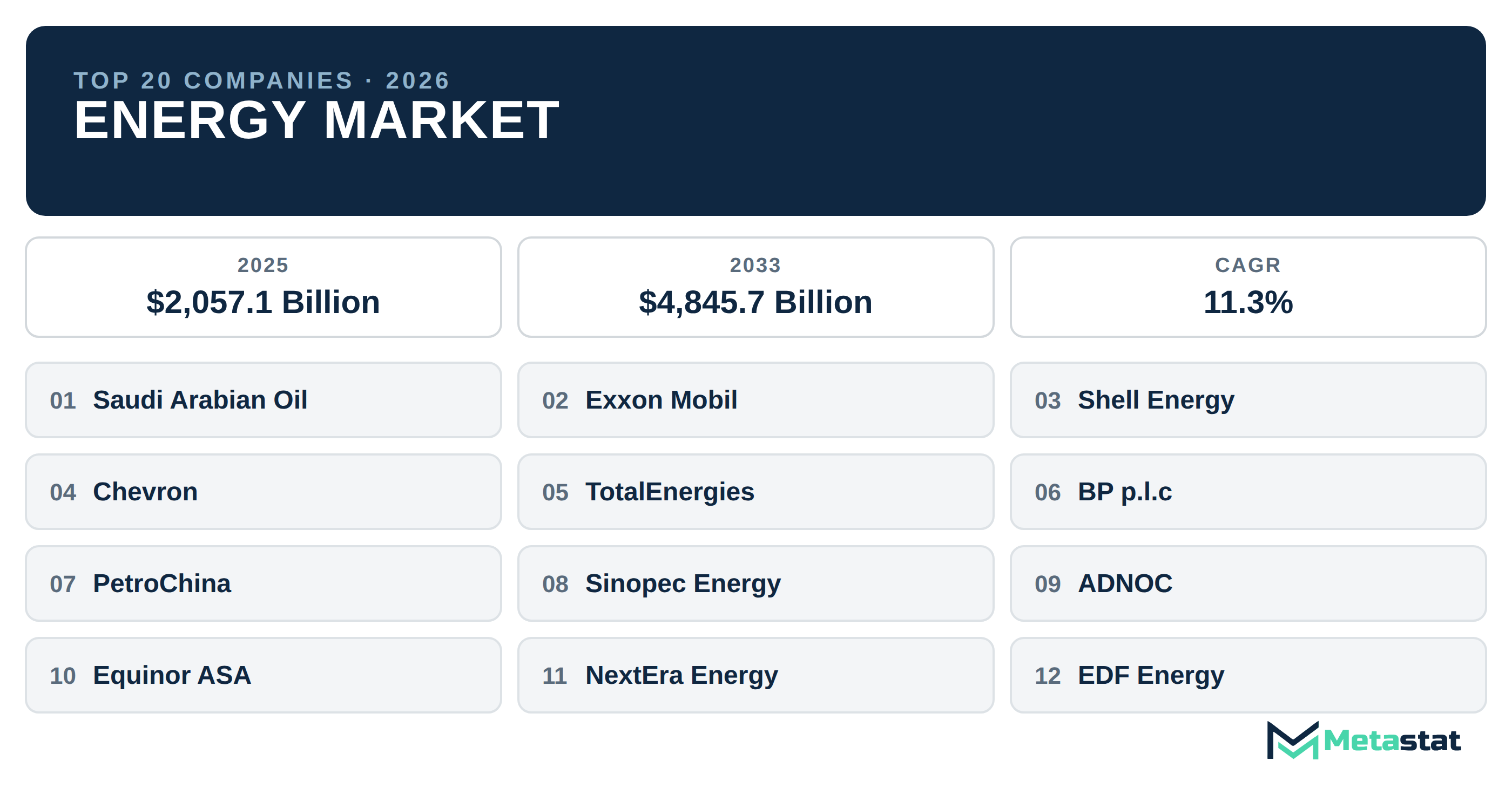
The Global Energy Market is valued at USD 2,057.1 Billion in 2025 and is projected to reach USD 4,845.7 Billion by 2033, growing at a CAGR of 11.3%. This market encompasses various energy sources, including oil, natural gas, coal, nuclear, hydropower, solar, wind, bioenergy, and geothermal. Key drivers of growth include rising energy demand, technological advancements, and regulatory frameworks emphasizing sustainability.
Energy serves a vital role in powering economies and supporting infrastructure development. As nations transition to cleaner energy sources, the energy market evolves rapidly, creating opportunities for innovation and investment.
Global Energy Market Size, Data, & Statistics
The base year for the Global Energy Market is 2021, with a value of USD 1,355.5 Billion. This figure reflects the market's size before expansion in subsequent years.
In 2025, the market is expected to reach USD 2,057.1 Billion, indicating a substantial increase in energy demand and investment. The forecast for 2033 anticipates a market size of USD 4,845.7 Billion, illustrating the long-term growth prospects in this sector.
The CAGR from 2025 to 2033 is projected at 11.3%, highlighting an accelerating growth rate as global energy needs rise. This outlook reflects a shift towards diversified energy portfolios and investment in renewable resources.
Annual values show a consistent upward trend, with USD 1,496.4 Billion in 2022, USD 1,671.4 Billion in 2023, USD 1,842.2 Billion in 2024, and reaching USD 2,295.7 Billion by 2026. By 2033, the market is forecasted to reach USD 4,845.7 Billion.
Geographically, the market is distributed with North America holding a share of 24.4%, Europe at 20.6%, Asia Pacific leading with 35.2%, South America at 6.2%, and the Middle East and Africa at 13.7%.
Top 10 Trends in the Global Energy Market
Increased investment in renewable energy
Investment in renewable energy sources like solar and wind is gaining momentum as governments prioritize sustainability and carbon neutrality. This trend promotes innovation and job creation in green technologies.
Advancements in energy storage solutions
Energy storage solutions are evolving, enhancing the reliability of renewable energy. Improved battery technologies enable better integration of intermittent energy sources, supporting grid stability.
Decentralized energy systems
Decentralized energy systems are emerging, allowing consumers to generate and manage their energy. This shift encourages users and promotes local energy resilience while reducing reliance on centralized grids.
Smart grid implementation
The deployment of smart grids is transforming energy distribution and management. Enhanced data analytics and communication technologies optimize energy usage and improve operational efficiency.
Focus on energy efficiency
Energy efficiency initiatives are gaining traction as businesses and consumers seek to lower costs and reduce environmental impact. This trend drives innovation in energy-saving technologies.
Electrification of transportation
Electrification of transportation is increasing demand for cleaner energy sources. Increased adoption of electric vehicles encourages infrastructure development that supports renewable energy integration.
Carbon capture and storage technologies
Carbon capture and storage technologies are advancing, offering solutions to mitigate emissions from fossil fuel usage. This innovation supports transitional strategies towards a lower carbon footprint.
Regulatory support for clean energy
Regulatory frameworks are increasingly favoring clean energy investments. Policymakers are incentivizing renewable projects, aligning economic growth with environmental goals.
Global collaboration on energy strategies
International collaboration on energy strategies is intensifying, fostering knowledge sharing and best practices. Collaborative efforts aim to address global energy challenges while promoting sustainable development.
Resilience in energy supply chains
Resilience in energy supply chains is receiving attention as disruptions highlight vulnerabilities. Companies are adopting strategies to enhance supply chain robustness and ensure energy security in the future.
Top 20 Companies in the Global Energy Market
1. Saudi Arabian Oil Co.
Headquarters: Dhahran, Saudi Arabia · Founded: 1933. Saudi Arabian Oil Co. is a state-owned oil company known for its extensive oil reserves and production capacity. The company plays a critical role in the global energy market by supplying crude oil and petroleum products, while also investing in natural gas and petrochemicals.
The company emphasizes efficiency and sustainability in its operations, focusing on maximizing resource recovery and minimizing environmental impact. Saudi Arabian Oil Co. continues to innovate and enhance its capabilities, ensuring it remains a key participant in energy supply.
2. Exxon Mobil Corporation
Headquarters: Irving, Texas, USA · Founded: 1870. Exxon Mobil Corporation is one of the largest publicly traded oil and gas companies in the world. It engages in exploring, producing, and distributing oil and natural gas, alongside manufacturing petrochemicals.
The company is committed to operational excellence and environmental stewardship, ensuring responsible energy development while addressing climate challenges. Exxon Mobil's diverse portfolio allows it to adapt to market changes while meeting global energy demands.
3. Shell Energy
Headquarters: The Hague, Netherlands · Founded: 1907. Shell Energy is a globally integrated energy company that focuses on oil and gas exploration, production, and distribution. The company is actively transitioning towards renewable energy sources and low-carbon technologies.
Shell Energy aims to reduce its carbon footprint while meeting the energy needs of customers worldwide. Its commitment to innovation and sustainability is evident in its investments in clean energy projects and initiatives to reduce greenhouse gas emissions.
4. Chevron Corporation
Headquarters: San Ramon, California, USA · Founded: 1879. Chevron Corporation is a multinational corporation engaged in all aspects of the energy sector, including oil and gas exploration, production, refining, and marketing.
The company prioritizes operational efficiency and environmental responsibility, focusing on sustainable practices within its operations. Chevron continues to invest in new technologies to enhance productivity while minimizing its environmental impact.
5. TotalEnergies
Headquarters: Courbevoie, France · Founded: 1924. TotalEnergies is a diversified energy company with activities across oil, natural gas, and renewable energy sources. The company is committed to transitioning towards cleaner energy solutions.
TotalEnergies focuses on innovation and sustainability, seeking to provide reliable energy while reducing its carbon footprint. The company's approach includes investing in renewable projects and technologies that support energy transition.
6. BP p.l.c.
Headquarters: London, England · Founded: 1909. BP p.l.c. is a global energy company involved in oil and gas exploration, production, and renewable energy. The company emphasizes its commitment to transitioning to a lower-carbon energy system.
BP's strategy includes investing in renewable energy projects and technologies. Its diverse portfolio allows for a comprehensive approach to energy supply, addressing the evolving needs of customers and the environment.
7. PetroChina Company Limited
Headquarters: Beijing, China · Founded: 1999. PetroChina Company Limited is China's largest oil and gas producer, involved in the exploration, production, refining, and distribution of oil and natural gas.
The company is focused on enhancing energy security and developing sustainable practices within its operations. PetroChina continues to invest in modern technologies to improve efficiency and minimize environmental impact in energy production.
8. Sinopec Energy
Headquarters: Beijing, China · Founded: 2000. Sinopec Energy is one of the largest oil refining and petrochemical companies in the world. The company operates across the entire oil and gas value chain, including exploration, production, refining, and distribution.
Sinopec Energy is committed to sustainability and innovation, investing in clean energy technologies and practices. Its focus on operational excellence helps meet both domestic and international energy demands effectively.
9. ADNOC
Headquarters: Abu Dhabi, United Arab Emirates · Founded: 1971. ADNOC (Abu Dhabi National Oil Company) is a state-owned oil company responsible for the exploration, production, and distribution of petroleum and petrochemicals.
ADNOC emphasizes technological innovation and collaboration in its operations. The company is committed to maximizing resource recovery while minimizing environmental impact, ensuring sustainable energy development.
10. Equinor ASA
Headquarters: Stavanger, Norway · Founded: 1972. Equinor ASA is a leading energy company focusing on oil, natural gas, and renewables. The company aims to be a global leader in energy transition, emphasizing sustainability and low-carbon solutions.
Equinor's approach includes significant investments in renewable energy projects and technologies that reduce greenhouse gas emissions. The company is focused on delivering energy solutions that meet the demands of a changing global landscape.
11. NextEra Energy, Inc.
Headquarters: Juno Beach, Florida, USA · Founded: 1925. NextEra Energy, Inc. is a leading clean energy company focused on renewable energy generation and energy storage. The company operates extensively in the wind and solar energy sectors.
NextEra Energy emphasizes innovation in technology and sustainability, supporting the transition to a low-carbon future. Its broad portfolio of renewable energy projects showcases the company's commitment to clean energy solutions.
12. EDF Energy
Headquarters: London, England · Founded: 2000. EDF Energy is a major player in the UK energy market, focusing on electricity generation and supply, including nuclear and renewable energy.
The company is committed to sustainability and reducing carbon emissions. EDF Energy actively invests in renewable energy sources and technologies that enable cleaner energy production.
13. Enel Spa
Headquarters: Rome, Italy · Founded: 1962. Enel Spa is a multinational energy company involved in electricity generation and distribution, with a strong focus on renewable energy and sustainability.
Enel Spa emphasizes innovation and environmental responsibility, investing in clean energy solutions that support the energy transition. The company's efforts in renewable projects reflect its commitment to sustainable energy practices.
14. Iberdrola, S.A.
Headquarters: Bilbao, Spain · Founded: 1992. Iberdrola, S.A. is a global leader in renewable energy, particularly in wind energy production. The company is committed to sustainability and reducing its carbon footprint.
Iberdrola focuses on innovation and investment in clean energy technologies, positioning itself as a key player in the transition to a greener energy model. Its efforts contribute to global sustainability goals.
15. ENGIE
Headquarters: La Défense, France · Founded: 2008. ENGIE is a multinational utility company involved in electricity and natural gas. The company is focused on energy transition and sustainability.
ENGIE invests significantly in renewable energy projects and technologies that reduce environmental impact. Its commitment to innovation positions ENGIE as a key participant in the move towards sustainable energy solutions.
16. Ørsted A/S
Headquarters: Fredericia, Denmark · Founded: 1972. Ørsted A/S is a leading renewable energy company, with a strong focus on offshore wind energy and sustainable energy solutions.
The company emphasizes innovation and environmental responsibility, committing to reducing carbon emissions and promoting renewable energy investments. Ørsted's projects reflect its dedication to a sustainable energy future.
17. RWE
Headquarters: Essen, Germany · Founded: 1898. RWE is one of Germany's leading energy companies, involved in electricity generation and supply, including renewables and conventional energy sources.
The company is transitioning towards a greener energy portfolio, focusing on sustainability and reducing its carbon footprint. RWE's commitment to innovation helps facilitate the energy transition in Europe.
18. Duke Energy Corporation
Headquarters: Charlotte, North Carolina, USA · Founded: 1904. Duke Energy Corporation is a major electric power holding company in the United States, focused on electricity generation, distribution, and renewable energy.
The company is invested in transforming its energy supply towards cleaner sources, aiming to reduce emissions and support sustainable practices. Duke Energy's initiatives highlight its commitment to a low-carbon future.
19. Southern Company
Headquarters: Atlanta, Georgia, USA · Founded: 1902. Southern Company is a leading energy provider in the southeastern United States, focusing on electricity generation and distribution.
The company is committed to incorporating renewable energy and enhancing energy efficiency in its operations. Southern Company's approach supports the transition to sustainable energy solutions.
20. GE Vernova (General Electric Company)
Headquarters: Boston, Massachusetts, USA · Founded: 1892. GE Vernova is the energy business of General Electric, providing technology solutions across the energy sector, including renewable and conventional energy.
GE Vernova emphasizes innovation and sustainability, developing technologies that enhance energy efficiency and reduce environmental impact. The company focuses on advancing the energy transition through its diverse portfolio of solutions.
Conclusion
The Global Energy Market is poised for significant growth, driven by a shift towards renewable energy and advancements in technology. The top 20 energy companies play strategic roles in shaping the future of energy supply and transition.
Investors and stakeholders should monitor developments in these energy companies as they adapt to changing market dynamics and pursue innovation in clean energy solutions, ensuring alignment with global sustainability goals.
Tags
About the Authors

LEAD ANALYST
Utkarsh Khirodkar is a Lead Market Research Analyst at MetaStat Insight, specializing in market intelligence, technology sector assessments, and competitive strategy.

PRINCIPAL CONSULTANT - ENTERPRISE AI & EMERGING TECHNOLOGIES
Banking & Finance · Electronics and Semiconductor · Energy and Power · Healthcare IT · Information & Technology · Professional Services
Vijay Gunti is a Principal Consultant at MetaStat Insight, bringing over two decades of experience across enterprise digital transformation, technology strategy, and intelligent systems.

ENERGY & INFRASTRUCTURE INDUSTRY CONSULTANT
Automotive and Transportation · Electronics and Semiconductor · Energy and Power · Machinery & Equipment
Saurabh Vasant Ganvir consults for Energy & Infrastructure Industry at MetaStat Insight, specializing in renewable energy, solar EPC, and electric vehicle (EV) infrastructure markets.