
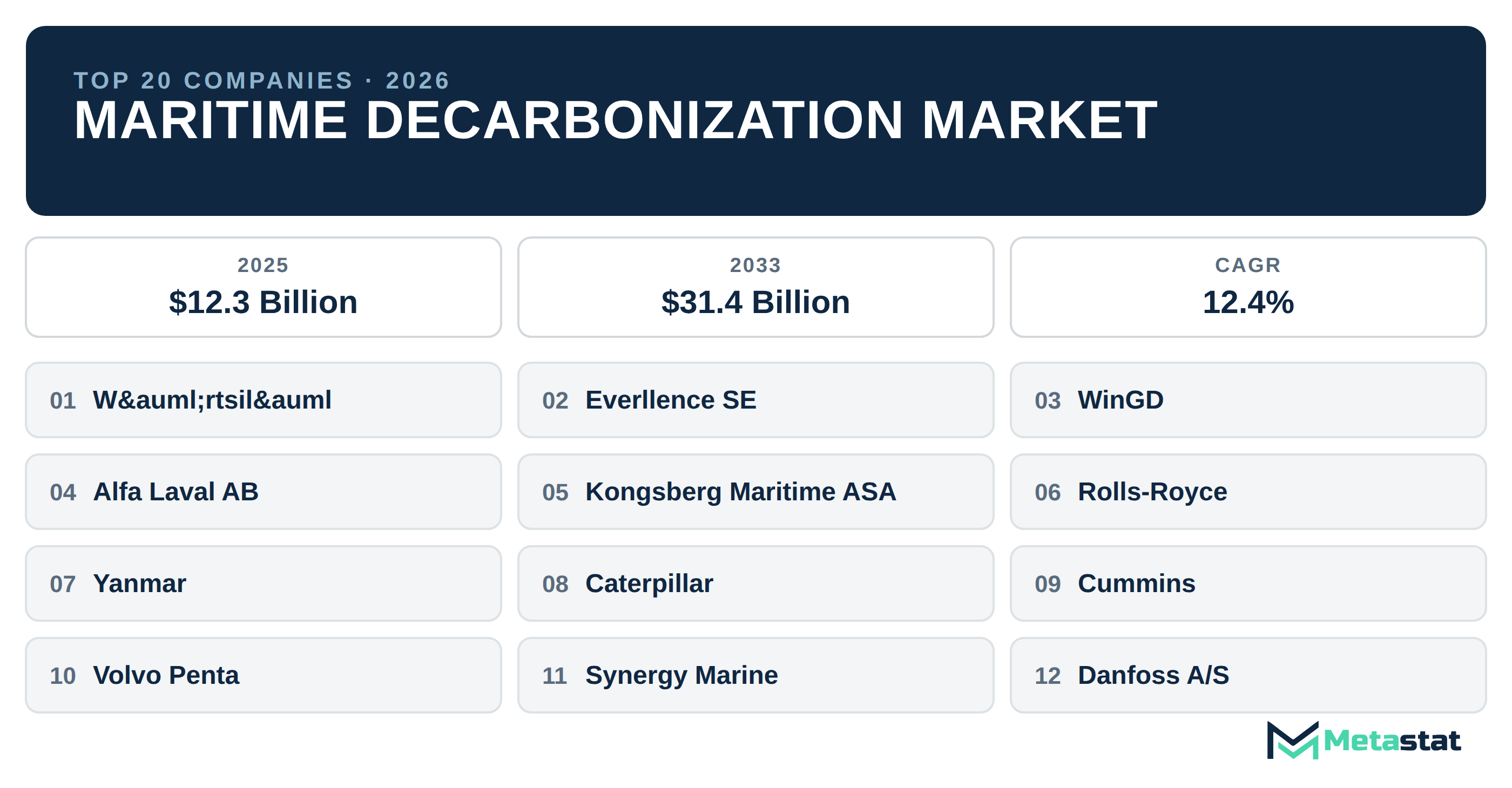
Explore the top 20 companies in the Global Maritime Decarbonization Market, projected to reach USD 31.4 Billion by 2033.
The Global Maritime Decarbonization Market is valued at USD 12.3 Billion in 2025 and is projected to reach USD 31.4 Billion by 2033, growing at a CAGR of 12.4%. This market encompasses technologies and solutions aimed at reducing greenhouse gas emissions from shipping activities, which are crucial to meeting international climate targets. Factors driving market growth include regulatory pressures, advancements in alternative fuels, and growing environmental awareness among consumers and companies.
Maritime decarbonization efforts involve multiple sectors, from shipping and shipbuilding to technology development, reflecting a comprehensive approach to reducing emissions. As the industry evolves, innovative solutions such as wind-assisted propulsion, electrification, and carbon capture technologies play an increasingly vital role.
Global Maritime Decarbonization Market Size, Data, & Statistics
The Global Maritime Decarbonization Market achieved a value of USD 9.8 Billion in 2023. This growth trajectory marks a significant increase from previous years, demonstrating the sector's adaptability to emerging sustainability challenges.
By 2025, the market is expected to reach USD 12.3 Billion, illustrating a robust expansion amid ongoing investments in greener technologies and alternatives. The forecast for 2033 estimates market size at USD 31.4 Billion, indicating a strong commitment to decarbonization.
The CAGR from 2025 to 2033 stands at 12.4%, signifying a healthy growth rate driven by innovation and regulatory incentives designed to encourage the adoption of sustainable practices.
Regional shares reflect diverse participation in the market: North America holds 17.9%, Europe dominates with 32.8%, Asia Pacific accounts for 31.3%, while South America and the Middle East and Africa represent 6.9% and 11.1%, respectively. This distribution showcases varying levels of investment and regulatory support across regions.
Top 10 Trends in the Global Maritime Decarbonization Market
Inline metrology moves onto the production line
Integrating inline metrology into production processes enhances quality control and efficiency, leading to reduced waste and emissions. This trend aids manufacturers in meeting regulatory standards while optimizing operations.
Investment in hydrogen fuel technologies
Growing investments in hydrogen fuel technologies are reshaping the maritime sector. This shift supports the transition from traditional fossil fuels to cleaner alternatives, positioning hydrogen as a viable solution for long-term sustainability.
Expansion of wind-assisted propulsion systems
Wind-assisted propulsion systems are gaining traction as a cost-effective means to reduce fuel consumption. By utilizing wind energy, vessels can significantly decrease emissions, benefiting both operators and the environment.
Enhanced digital decarbonization solutions
Advancements in digital decarbonization technology facilitate real-time monitoring and management of emissions. These solutions allow shipping companies to make informed decisions that align with sustainability goals.
Rise of alternative marine fuels
The maritime sector is witnessing a surge in the adoption of alternative marine fuels, including biofuels and LNG. These fuels offer lower emissions compared to traditional options, contributing to overall decarbonization efforts.
Collaboration between industry stakeholders
Strong collaboration among shipping companies, technology providers, and regulators fosters innovation in decarbonization practices. Working together, these stakeholders can drive the development of effective solutions that meet climate targets.
Regulatory frameworks encouraging emission reductions
New regulatory frameworks promote stricter emissions standards for the maritime industry. Compliance with these regulations is essential for companies aiming to remain competitive while addressing environmental concerns.
Focus on energy efficiency measures
Investing in energy efficiency measures enables shipping companies to reduce operational costs and emissions. Efficiency improvements are critical as firms seek to balance profitability with sustainability.
Growth of electric and hybrid vessels
The trend toward electric and hybrid vessels continues to grow, driven by advancements in battery technology and increasing demand for cleaner transportation options. These vessels minimize emissions and operational costs.
Development of carbon capture technologies
Carbon capture technologies are being explored to mitigate emissions from maritime operations. As these technologies advance, they may provide significant benefits in achieving climate goals within the sector.
Top 20 Companies in the Global Maritime Decarbonization Market
1. Wärtsilä Corporation
Headquarters: Helsinki, Finland · Founded: 1834. Wärtsilä Corporation specializes in providing advanced technologies for the marine and energy sectors. The company focuses on developing solutions that enhance the efficiency of vessels while minimizing their environmental impact. Wärtsilä offers a range of products including engines, propulsion systems, and hybrid solutions specifically designed for the decarbonization of maritime operations.
With a commitment to sustainability, Wärtsilä invests in research and development to create innovative technologies that help shipping companies transition to alternative fuels and improve energy efficiency. The company contributes significantly to enabling the maritime industry to meet stringent emissions targets.
2. Everllence SE
Headquarters: Hamburg, Germany · Founded: 2020. Everllence SE focuses on developing and implementing sustainable solutions for the maritime industry. The company specializes in technologies that reduce emissions from shipping activities, contributing to the overall decarbonization efforts in the sector. Everllence offers consulting services, as well as software solutions designed to improve operational efficiency and compliance with environmental regulations.
Through strategic partnerships and a commitment to innovation, Everllence SE aims to facilitate the adoption of sustainable practices within the maritime industry. Its approach emphasizes the importance of collaboration and knowledge sharing among industry stakeholders.
3. WinGD Ltd.
Headquarters: Winterthur, Switzerland · Founded: 2016. WinGD Ltd. specializes in developing high-efficiency marine engines and propulsion systems. The company is known for its focus on alternative fuel solutions, particularly liquefied natural gas (LNG), which significantly reduce greenhouse gas emissions compared to traditional fuels. WinGD's innovative technologies enable ship operators to meet stringent emissions regulations.
WinGD places a strong emphasis on research and development, working closely with customers to create tailored solutions that address specific efficiency and emissions challenges. This customer-centric approach ensures that WinGD remains at the forefront of maritime decarbonization efforts.
4. Alfa Laval AB
Headquarters: Lund, Sweden · Founded: 1883. Alfa Laval AB is a leading provider of specialized products and engineering solutions for the maritime industry. The company's offerings include heat exchangers, separators, and systems designed to improve energy efficiency and reduce emissions from vessels. Alfa Laval's commitment to sustainability drives its innovation in energy-efficient technologies.
Through a focus on continuous improvement and technological advancement, Alfa Laval aims to enable shipowners to comply with environmental regulations while optimizing operational performance. The company actively engages in initiatives aimed at promoting sustainable practices within the maritime sector.
5. Kongsberg Maritime ASA
Headquarters: Kongsberg, Norway · Founded: 1814. Kongsberg Maritime ASA provides advanced maritime technology and services aimed at enhancing the efficiency and sustainability of shipping operations. The company offers a range of solutions, including automation systems, asset management, and vessel performance optimization tools that contribute to decarbonization efforts.
Kongsberg emphasizes the integration of digital solutions with traditional maritime practices, enabling operators to make data-driven decisions that minimize emissions and improve energy efficiency. Its commitment to innovation positions Kongsberg as a key player in the maritime decarbonization landscape.
6. Rolls-Royce Holdings plc
Headquarters: London, United Kingdom · Founded: 1904. Rolls-Royce Holdings plc is a prominent player in the marine sector, providing a wide range of products and services, including engines, propulsion systems, and support services. The company's focus on high-performance and low-emission technologies positions it as a leader in maritime decarbonization efforts.
Rolls-Royce actively invests in research and development to create innovative solutions that reduce emissions from marine operations. The company collaborates with industry stakeholders to promote sustainable practices and enhance the overall efficiency of shipping activities.
7. Yanmar Holdings Co., Ltd.
Headquarters: Osaka, Japan · Founded: 1912. Yanmar Holdings Co., Ltd. specializes in the development of high-efficiency engines and propulsion systems for the maritime industry. The company's commitment to sustainability is reflected in its focus on reducing emissions through innovative technology and design.
Yanmar offers a range of products including hybrid systems and alternative fuel engines that allow shipowners to meet environmental regulations while optimizing performance. The company's expertise and dedication to reducing the maritime carbon footprint position it as a significant contributor to decarbonization efforts.
8. Caterpillar Inc.
Headquarters: Peoria, Illinois, USA · Founded: 1925. Caterpillar Inc. is a global leader in providing solutions for the marine industry, offering a comprehensive range of engines, propulsion systems, and services. The company's focus on sustainable practices drives its innovation in alternative fuel technologies and energy efficiency measures.
Caterpillar's advanced solutions enable marine operators to reduce emissions and improve operational performance. By continually evolving its product offerings, Caterpillar plays an essential role in driving the shift toward cleaner maritime operations.
9. Cummins Inc.
Headquarters: Columbus, Indiana, USA · Founded: 1919. Cummins Inc. specializes in engine manufacturing and technology solutions for various sectors, including maritime. The company's focus on reducing emissions through advanced engine designs and alternative fuel options positions it as a key player in the maritime decarbonization market.
With a commitment to sustainability, Cummins invests heavily in research and development to create solutions that enhance energy efficiency and minimize environmental impact. Its innovative technologies support ship operators in achieving compliance with stringent emissions regulations.
10. Volvo Penta
Headquarters: Gothenburg, Sweden · Founded: 1907. Volvo Penta provides marine engines and drive systems designed to enhance performance and reduce emissions in the maritime sector. The company's focus on sustainable technology includes hybrid and electric propulsion systems that contribute to overall decarbonization efforts.
Volvo Penta emphasizes innovation and customer collaboration, developing tailored solutions that meet the specific needs of marine operators. Its commitment to sustainability positions Volvo Penta as a significant contributor to the industry's efforts to minimize its carbon footprint.
11. Synergy Marine Group
Headquarters: Singapore · Founded: 2006. Synergy Marine Group provides ship management and crew management services, focusing on enhancing operational efficiency and sustainability in maritime operations. The company is dedicated to implementing best practices aimed at reducing emissions and improving energy efficiency.
With a commitment to continuous improvement, Synergy Marine Group collaborates with clients to develop tailored solutions that address specific operational challenges. Its focus on sustainability aligns with the broader industry effort to achieve net-zero emissions.
12. Danfoss A/S
Headquarters: Nordborg, Denmark · Founded: 1933. Danfoss A/S specializes in providing engineering solutions for various industries, including maritime. The company focuses on energy efficiency and sustainable technologies that support the decarbonization of shipping operations. Danfoss offers a range of products that optimize energy use and reduce emissions.
Through continuous innovation and a commitment to sustainability, Danfoss A/S aims to enable maritime operators to improve their energy efficiency and meet environmental standards while enhancing overall performance.
13. A.P. Moller-Maersk
Headquarters: Copenhagen, Denmark · Founded: 1904. A.P. Moller-Maersk is a global leader in shipping and logistics, committed to sustainability and decarbonization across its operations. The company invests significantly in alternative fuel technologies and emissions reduction strategies as part of its vision to become carbon neutral by 2050.
A.P. Moller-Maersk's extensive fleet and operational capabilities enable it to implement innovative solutions that enhance efficiency while minimizing the environmental impact. The company's proactive approach positions it as a major contributor to maritime decarbonization efforts.
14. CMA CGM Group
Headquarters: Marseille, France · Founded: 1978. CMA CGM Group is a prominent shipping company focused on sustainability initiatives and reducing its environmental footprint. The company invests in eco-friendly technologies and alternative fuels, striving to improve the efficiency of its operations and achieve ambitious emissions reduction targets.
CMA CGM Group's commitment to sustainability drives its innovation in maritime transport solutions, making it a key player in the global maritime decarbonization market. The company's initiatives align with industry trends toward greener and more sustainable shipping practices.
15. Leclanché SA
Headquarters: Yverdon-les-Bains, Switzerland · Founded: 1909. Leclanché SA specializes in energy storage solutions, including those for the maritime sector. The company develops advanced lithium-ion batteries and hybrid systems designed to reduce emissions and enhance energy efficiency for vessels.
By focusing on innovative energy storage technologies, Leclanché contributes to the decarbonization of maritime operations, supporting shipowners in their transition to cleaner energy sources. Its commitment to sustainability aligns with broader goals in the maritime industry.
16. Ballard Power Systems Inc.
Headquarters: Burnaby, British Columbia, Canada · Founded: 1979. Ballard Power Systems Inc. is a leader in fuel cell technology, providing clean energy solutions for various industries, including maritime. The company focuses on developing hydrogen fuel cells that enable vessels to operate with zero emissions.
Ballard's innovative technologies support the transition to sustainable maritime operations, allowing shipowners to reduce their carbon footprint while maintaining performance. Its commitment to clean energy aligns with global efforts to combat climate change within the maritime sector.
17. Norsepower Oy Ltd.
Headquarters: Helsinki, Finland · Founded: 2012. Norsepower Oy Ltd. specializes in wind propulsion technology for shipping. The company develops rotor sail solutions that harness wind energy to reduce fuel consumption and emissions from vessels, contributing to the overall decarbonization of maritime operations.
Through innovative designs and effective wind-assisted propulsion strategies, Norsepower enables shipowners to enhance operational efficiency while minimizing their environmental impact. Its focus on sustainability positions Norsepower as a significant player in the maritime decarbonization market.
18. bound4blue
Headquarters: Barcelona, Spain · Founded: 2014. bound4blue specializes in wind-assisted propulsion technology, providing solutions that help vessels reduce fuel consumption and emissions. The company develops innovative systems that harness wind energy, promoting sustainability in maritime operations.
bound4blue's commitment to clean technology and reducing the carbon footprint of shipping operations aligns with the industry's broader goals for decarbonization. Its solutions enable shipowners to enhance efficiency while adhering to environmental regulations.
19. BAR Technologies Ltd.
Headquarters: Portsmouth, United Kingdom · Founded: 2015. BAR Technologies Ltd. focuses on providing advanced marine technology solutions aimed at enhancing efficiency and sustainability in maritime operations. The company specializes in the development of innovative designs and systems that help reduce emissions.
Through collaboration and cutting-edge research, BAR Technologies contributes to the decarbonization of the industry, helping shipowners operate more sustainably. Its approach emphasizes the importance of adaptation and innovation in the maritime sector.
20. OceanWings
Headquarters: Paris, France · Founded: 2018. OceanWings specializes in the development of wind-assisted propulsion systems for maritime vessels. The company designs innovative solutions that leverage wind energy to decrease fuel consumption and emissions, supporting the industry's decarbonization efforts.
OceanWings is dedicated to advancing sustainable technologies that align with environmental goals, enabling shipowners to operate more efficiently while reducing their carbon footprint. Its commitment to innovation reflects the ongoing transformation of the maritime sector.
Conclusion
The Global Maritime Decarbonization Market is set for significant growth over the coming years, driven by technological advancements and increasing regulatory pressures. The companies listed represent a diverse range of approaches to decarbonization, highlighting the importance of innovative solutions in achieving sustainability goals within the maritime industry.
As the sector continues to evolve, stakeholders should consider the contributions of these Maritime Decarbonization companies when developing strategies for compliance and efficiency. Engaging with innovative firms can enhance operational performance while supporting the transition to a more sustainable future.
Tags
About the Authors

LEAD ANALYST
Utkarsh Khirodkar is a Lead Market Research Analyst at MetaStat Insight, specializing in market intelligence, technology sector assessments, and competitive strategy.

ENERGY & INFRASTRUCTURE INDUSTRY CONSULTANT
Automotive and Transportation · Electronics and Semiconductor · Energy and Power · Machinery & Equipment
Saurabh Vasant Ganvir consults for Energy & Infrastructure Industry at MetaStat Insight, specializing in renewable energy, solar EPC, and electric vehicle (EV) infrastructure markets.