
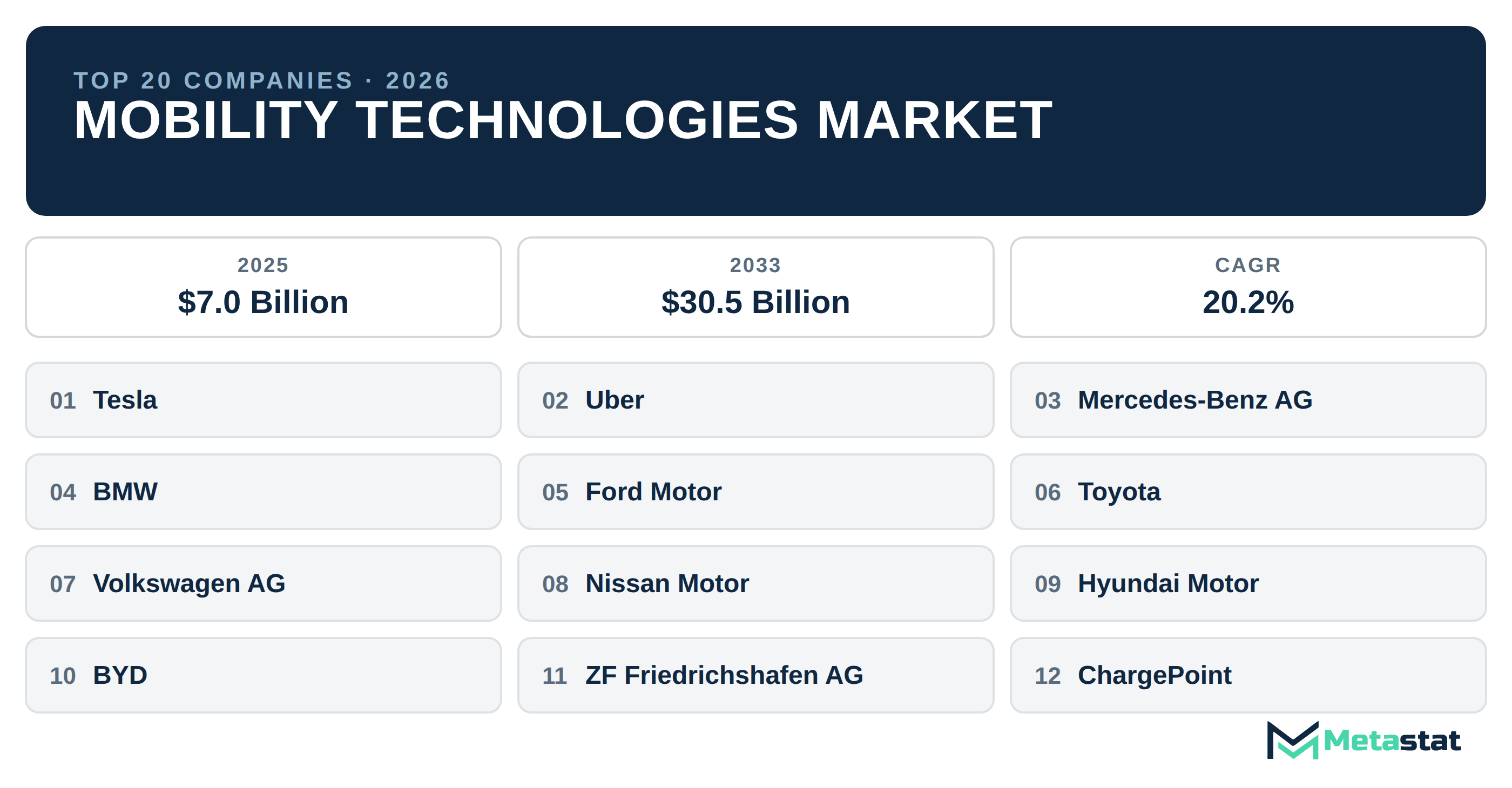
Explore the top 20 companies in the Global Mobility Technologies Market, with insights into their contributions and innovations shaping the industry.
The Global Mobility Technologies Market is valued at USD 7 Billion in 2025 and is projected to reach USD 30.5 Billion by 2033, growing at a CAGR of 20.2%. This market encompasses a variety of technologies such as connected vehicle technologies, telematics, mobility-as-a-service, and autonomous driving technologies, among others. The increasing demand for innovative transportation solutions and a focus on sustainability are driving growth in this sector.
Technological advancements, the rise of electric vehicles, and the growing emphasis on smart city initiatives further contribute to the expansion of Mobility Technologies. Businesses and consumers alike are seeking efficient, sustainable, and integrated mobility solutions that enhance convenience and reduce environmental impact.
Global Mobility Technologies Market Size, Data, & Statistics
The market size for the Global Mobility Technologies Market in 2021 was USD 3.4 Billion. This figure increased to USD 4 Billion in 2022, reflecting a growing interest and investment in mobility solutions.
By 2023, the market size reached USD 4.9 Billion, and it is expected to continue its upward trajectory, reaching USD 5.8 Billion in 2024. The forecast for 2025 places the market size at USD 7 Billion, underscoring significant growth potential.
The market is projected to grow to USD 8.4 Billion in 2026, USD 10.2 Billion in 2027, and USD 12.2 Billion in 2028. This growth will continue, with projections indicating the market will reach USD 14.6 Billion in 2029 and USD 17.6 Billion in 2030.
By 2031, the market size is expected to be USD 21.2 Billion, increasing to USD 25.5 Billion in 2032, ultimately reaching USD 30.5 Billion by 2033. The compound annual growth rate from 2025 to 2033 stands at 20.2%.
The regional distribution of the market indicates that North America holds a significant share at 38.4%, followed by Europe at 21.8% and Asia Pacific at 34.7%. South America and the Middle East and Africa account for 3.2% and 1.8%, respectively.
Top 10 Trends in the Global Mobility Technologies Market
Increased adoption of electric vehicles
The shift towards electric vehicles enhances sustainability and reduces greenhouse gas emissions. Buyers benefit from lower operating costs and government incentives for electric vehicle adoption, which drive development in related infrastructure.
Expansion of Mobility-as-a-Service (MaaS)
MaaS integrates various transportation services into a single accessible platform, allowing consumers to plan and pay for multiple modes of transport efficiently. This trend enables enhanced mobility options and convenience for users.
Advancements in autonomous driving technologies
Continued innovations in autonomous driving technologies lead to safer and more efficient transportation systems. As these technologies evolve, buyers see improvements in vehicle safety and reduced traffic congestion.
Growth of digital payment solutions
The increasing use of digital payments in mobility services simplifies transactions and enhances user experience. This trend supports efficient service access and encourages higher adoption rates for mobility solutions.
Integration of AI and machine learning
AI and machine learning technologies improve decision-making and operational efficiency in mobility systems. Buyers experience enhanced predictive maintenance, route optimization, and personalized service offerings as these technologies are adopted.
Focus on connected vehicle technologies
Connected vehicle technologies enhance communication between vehicles and infrastructure, improving safety and efficiency. This focus aids in traffic management and provides consumers with real-time information on road conditions.
Development of smart city initiatives
Smart city initiatives leverage mobility technologies to create more efficient urban environments. Buyers benefit from improved public transport, reduced congestion, and enhanced overall urban living standards.
Rise of shared mobility solutions
The popularity of car-sharing, ride-hailing, and bike-sharing services increases as consumers seek cost-effective and sustainable transportation options. This trend promotes collaboration among service providers to enhance accessibility.
Emphasis on sustainability and environmental impact
Growing awareness of environmental issues drives demand for sustainable mobility solutions. Buyers increasingly prefer companies that prioritize green technologies and practices in their operations.
Integration of V2X communication technologies
Vehicle-to-everything (V2X) communication technologies enhance safety and efficiency by facilitating communication among vehicles, infrastructure, and pedestrians. This integration supports a more connected transportation ecosystem.
Top 20 Companies in the Global Mobility Technologies Market
1. Tesla
Headquarters: Palo Alto, United States · Founded: 2003. Tesla specializes in electric vehicles and renewable energy solutions. The company is known for its innovative approach to mobility, combining cutting-edge technology with sustainable design.
As a leader in electric vehicle production, Tesla provides a range of models designed to enhance performance and sustainability. Its commitment to developing advanced driver-assistance systems and autonomous driving features positions Tesla as a key player in the Mobility Technologies market.
2. Uber
Headquarters: San Francisco, United States · Founded: 2009. Uber operates a ride-hailing platform that fosters convenient and accessible transportation solutions for users worldwide.
By integrating various mobility services, Uber enhances user experience through its app, facilitating seamless ride-sharing and food delivery services. The company's agile approach to developing new offerings, such as autonomous vehicles, reflects its focus on innovation in the Mobility Technologies sector.
3. Mercedes-Benz Group AG
Headquarters: Stuttgart, Germany · Founded: 1926. Mercedes-Benz Group AG is known for luxury vehicles and cutting-edge automotive technology, including electric and hybrid models.
The company's commitment to innovation extends to advanced driver-assistance systems and autonomous driving technologies, positioning Mercedes-Benz as a significant contributor to the Mobility Technologies market.
4. BMW Group
Headquarters: Munich, Germany · Founded: 1916. BMW Group manufactures luxury vehicles and emphasizes sustainability through its range of electric and hybrid offerings.
With a focus on integrating advanced mobility technologies, BMW delivers innovative solutions that enhance user experience and contribute to the overall growth of the Mobility Technologies market.
5. Ford Motor Company
Headquarters: Dearborn, United States · Founded: 1903. Ford Motor Company is a leading automobile manufacturer known for its wide range of vehicles, including electric and hybrid models.
Ford is dedicated to integrating mobility technologies into its offerings, focusing on connectivity, autonomy, and sustainability, which positions the company as a significant player in the Mobility Technologies sector.
6. Toyota, Inc.
Headquarters: Toyota City, Japan · Founded: 1937. Toyota is a global leader in automobile manufacturing, with a strong emphasis on hybrid and electric vehicle technologies.
The company's innovative approach to mobility solutions, including advancements in hydrogen fuel cell technology, positions Toyota as a key contributor to the evolution of the Mobility Technologies market.
7. Volkswagen AG
Headquarters: Wolfsburg, Germany · Founded: 1937. Volkswagen AG is known for its diverse range of vehicles and commitment to electric mobility through its ID. series.
The company's focus on sustainability and technological innovation allows Volkswagen to adapt to changing consumer preferences and market demands in the Mobility Technologies sector.
8. Nissan Motor Co., Ltd.
Headquarters: Yokohama, Japan · Founded: 1933. Nissan Motor Co., Ltd. is recognized for its electric vehicles, particularly the Nissan Leaf, which has gained global popularity.
Nissan's approach to mobility emphasizes innovative technologies and sustainable practices, positioning the company as a notable player in the Mobility Technologies market.
9. Hyundai Motor Company
Headquarters: Seoul, South Korea · Founded: 1967. Hyundai Motor Company manufactures a wide range of vehicles, including electric and hydrogen fuel cell models.
The company's commitment to sustainability and innovation in mobility technologies supports its position as a key contributor to the evolving Mobility Technologies market.
10. BYD Company Ltd.
Headquarters: Shenzhen, China · Founded: 1995. BYD Company Ltd. is a leading manufacturer of electric vehicles and batteries.
BYD's focus on energy-efficient mobility solutions and commitment to sustainability align with the growing demand for innovative technologies within the Mobility Technologies market.
11. ZF Friedrichshafen AG
Headquarters: Friedrichshafen, Germany · Founded: 1915. ZF Friedrichshafen AG specializes in driveline and chassis technology, including advanced safety systems.
The company's innovations in automation and electrification contribute significantly to the Mobility Technologies market, enhancing vehicle performance and safety.
12. ChargePoint, Inc.
Headquarters: Campbell, United States · Founded: 2007. ChargePoint, Inc. operates one of the largest networks of electric vehicle charging stations.
ChargePoint’s focus on expanding charging infrastructure supports the growing adoption of electric vehicles and plays a critical role in the Mobility Technologies market.
13. Idoneo
Idoneo specializes in mobility solutions focusing on connecting users with various transportation services. The company emphasizes user experience and accessibility.
By integrating innovative technologies, Idoneo aims to simplify mobility for consumers while contributing to the overall growth of the Mobility Technologies market.
14. Audi AG
Headquarters: Ingolstadt, Germany · Founded: 1909. Audi AG manufactures premium vehicles with a strong focus on technology and performance.
Audi's commitment to electric mobility and advanced driver-assistance systems highlights its role in shaping the future of the Mobility Technologies market.
15. Rivian
Headquarters: Plymouth, United States · Founded: 2009. Rivian focuses on electric adventure vehicles, combining sustainability with performance.
The company’s innovative approach to mobility solutions targets eco-conscious consumers and enhances its impact on the Mobility Technologies market.
16. Mobileye
Headquarters: Jerusalem, Israel · Founded: 1999. Mobileye is a leader in advanced driver-assistance systems and autonomous driving technologies.
The company’s solutions enhance vehicle safety and efficiency, playing a significant role in the growth of the Mobility Technologies market.
17. Robert Bosch GmbH
Headquarters: Stuttgart, Germany · Founded: 1886. Robert Bosch GmbH is a global leader in automotive components and technologies.
The company’s innovations in mobility technologies include advanced safety systems and connectivity solutions, significantly contributing to the Mobility Technologies market.
18. Continental AG
Headquarters: Hanover, Germany · Founded: 1871. Continental AG specializes in automotive safety, connectivity, and tire technologies.
Continental’s focus on innovation and sustainability positions the company as a key player in the Mobility Technologies market, enhancing vehicle performance and safety.
19. Samsara Inc.
Headquarters: San Francisco, United States · Founded: 2015. Samsara Inc. provides IoT solutions for fleet management and telematics.
The company's technology enhances operational efficiency and safety, supporting the overall growth of the Mobility Technologies market.
20. NVIDIA Corporation
Headquarters: Santa Clara, United States · Founded: 1993. NVIDIA Corporation is a leader in visual computing and artificial intelligence technologies.
NVIDIA’s innovations in AI and machine learning support advancements in autonomous driving and connected vehicle technologies, significantly influencing the Mobility Technologies market.
Conclusion
The Mobility Technologies market is poised for substantial growth over the coming years, driven by advancements in technology and changing consumer preferences. The presence of diverse companies, from established automobile manufacturers to innovative tech firms, illustrates the dynamic nature of this sector.
Understanding the key players and trends within the Mobility Technologies industry provides valuable insights for stakeholders seeking to navigate this evolving market. Investing in sustainable and technology-driven solutions will be crucial for companies aiming to thrive in the future.
Tags
About the Authors

LEAD ANALYST
Utkarsh Khirodkar is a Lead Market Research Analyst at MetaStat Insight, specializing in market intelligence, technology sector assessments, and competitive strategy.

ENERGY & INFRASTRUCTURE INDUSTRY CONSULTANT
Automotive and Transportation · Electronics and Semiconductor · Energy and Power · Machinery & Equipment
Saurabh Vasant Ganvir consults for Energy & Infrastructure Industry at MetaStat Insight, specializing in renewable energy, solar EPC, and electric vehicle (EV) infrastructure markets.