
LEAD ANALYST
Utkarsh Khirodkar is a Lead Market Research Analyst at MetaStat Insight, specializing in market intelligence, technology sector assessments, and competitive strategy.

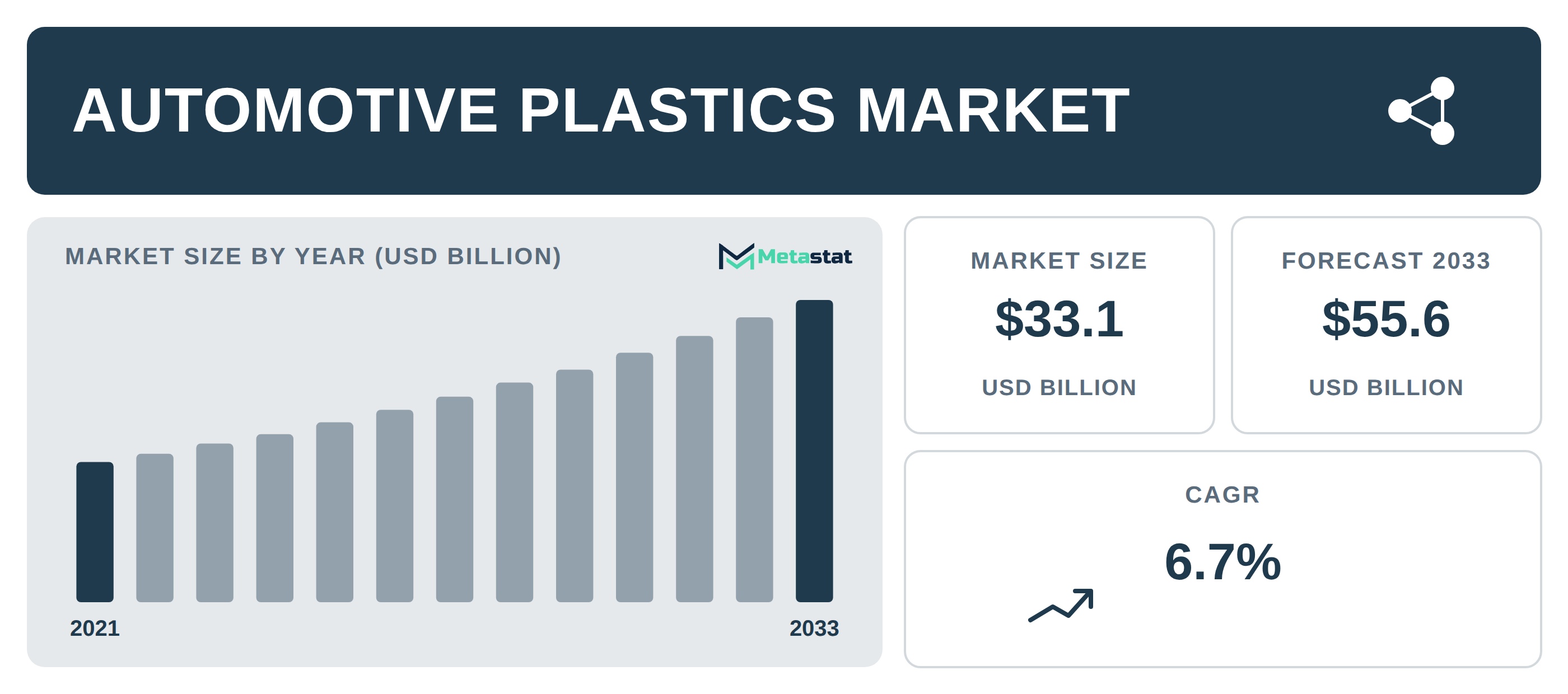
Metastat Insights has published a new report on the Automotive Plastics market, estimating its growth from USD 33.1 billion in 2025 to USD 55.6 billion by 2033, at a CAGR of 6.7%. The report analyzes key drivers, challenges, and major industry players.
Metastat Insights has published "Global Automotive Plastics Market Size, Share, By Material Type (Polypropylene (PP), Polyurethane (PU, excluding TPU), Polyvinyl Chloride (PVC), Acrylonitrile Butadiene Styrene (ABS), Polyamide (PA), Polycarbonate (PC), Polybutylene Terephthalate (PBT), Polymethyl Methacrylate (PMMA), Thermoplastic Elastomers (TPE, including TPU, TPV, TPO and TPS), Others), By Vehicle Type (Passenger Vehicles, Commercial Vehicles, Electric Vehicles (EVs), Hybrid Vehicles), By Processing Technology (Injection Molding, Extrusion, Blow Molding, Thermoforming, Compression Molding, Reaction Injection Molding (RIM), Resin Transfer Molding (RTM), Rotational Molding, Additive Manufacturing), By Application (Interior & Cockpit Components, Exterior Body & Trim Components, Seating & Occupant Comfort Components, Powertrain & Under-the-Hood Components, Electrical & Electronic Components, Lighting & Optical Components, HVAC & Thermal Management Components, EV Battery & High-Voltage Components, Chassis, Structural & Safety Components), Industry Analysis, Growth, Trends, and Forecast, 2026-2033", with key figures indicating a market valued at USD 33.1 billion in 2025 and projected to grow to USD 55.6 billion by 2033, representing a compound annual growth rate (CAGR) of 6.7%.
Growing demand for lightweight materials significantly influences the Automotive Plastics market. Manufacturers prioritize fuel efficiency, leading to an increase in the adoption of advanced polymers that enhance vehicle performance while reducing emissions. The shift towards electric vehicles (EVs) further drives demand for materials that support energy efficiency and contribute to sustainable automotive solutions. Innovations in high-performance polymers shape the market, because manufacturers allocate resources to research and development to create materials meeting stringent performance criteria.
Regulatory compliance challenges present a significant restraint in the Automotive Plastics market. Stringent environmental regulations impose limitations on material selection and processing methods, which increases operational costs. These financial pressures affect smaller firms, restricting competition and innovation. Macroeconomic headwinds, including inflation and fluctuations in raw material prices, further constrain growth. Supply chain disruptions create uncertainties, delaying production timelines and affecting overall customer satisfaction.
The Automotive Plastics market segments include various materials, vehicle types, processing technologies, and applications. Notable material segments encompass Polypropylene (PP), Polyurethane (PU), and Polyvinyl Chloride (PVC), with each contributing to market growth through specific applications in both passenger and commercial vehicles. Regional dynamics highlight significant demand in North America and Asia Pacific, driven by rising vehicle production and infrastructure development.
Leading companies operating within the Automotive Plastics market include BASF SE, SABIC, Covestro AG, Dow Inc., Exxon Mobil Corporation, and LANXESS AG. These organizations focus on innovation and sustainability to maintain competitive positions in the industry. Their investments in advanced processing technologies enhance production efficiency, enabling them to meet evolving consumer demands for high-performance automotive plastics.
For more detailed insights, visit the full report: Global Automotive Plastics Market.
Related Report
View full market research reportLEAD ANALYST
Utkarsh Khirodkar is a Lead Market Research Analyst at MetaStat Insight, specializing in market intelligence, technology sector assessments, and competitive strategy.

ENERGY & INFRASTRUCTURE INDUSTRY CONSULTANT
Automotive and Transportation · Electronics and Semiconductor · Energy and Power · Machinery & Equipment
Saurabh Vasant Ganvir consults for Energy & Infrastructure Industry at MetaStat Insight, specializing in renewable energy, solar EPC, and electric vehicle (EV) infrastructure markets.