
LEAD ANALYST
Utkarsh Khirodkar is a Lead Market Research Analyst at MetaStat Insight, specializing in market intelligence, technology sector assessments, and competitive strategy.

Metastat Insights has released a report detailing the growth of the Battery Energy Management System market, projected to expand from USD 10.2 billion in 2025 to USD 71.5 billion by 2033, at a CAGR of 27.5%. Key drivers include advancements in battery technology and increasing sustainability demands.
Metastat Insights has published "Global Battery Energy Management System Market Size, Share, By Battery Type (Lithium Iron Phosphate (LFP), Lithium Nickel Manganese Cobalt (NMC), Lithium Titanate (LTO), and Lithium Nickel Cobalt Aluminum Oxide (NCA)), By BMS Topology (Centralized BMS, Modular BMS, and Distributed BMS), By Component (Battery Control Unit (BCU), Cell Monitoring Unit (CMU), Current & Voltage Sensors, Temperature Sensors, and Others (Communication Interfaces (CAN, RS485, Ethernet), Battery Management Software & Diagnostics, and Balancing Circuits)), By Application (Electric Forklifts, Automated Guided Vehicles (AGVs), Autonomous Mobile Robots (AMRs), Aerial Work Platforms, Industrial Cleaning Equipment, Terminal Tractors & Port Equipment, and Mining & Construction Electric Equipment), Industry Analysis, Growth, Trends, and Forecast, 2026-2033", followed by the headline figures (USD 10.2 billion in 2025, USD 71.5 billion by 2033, 27.5% CAGR).
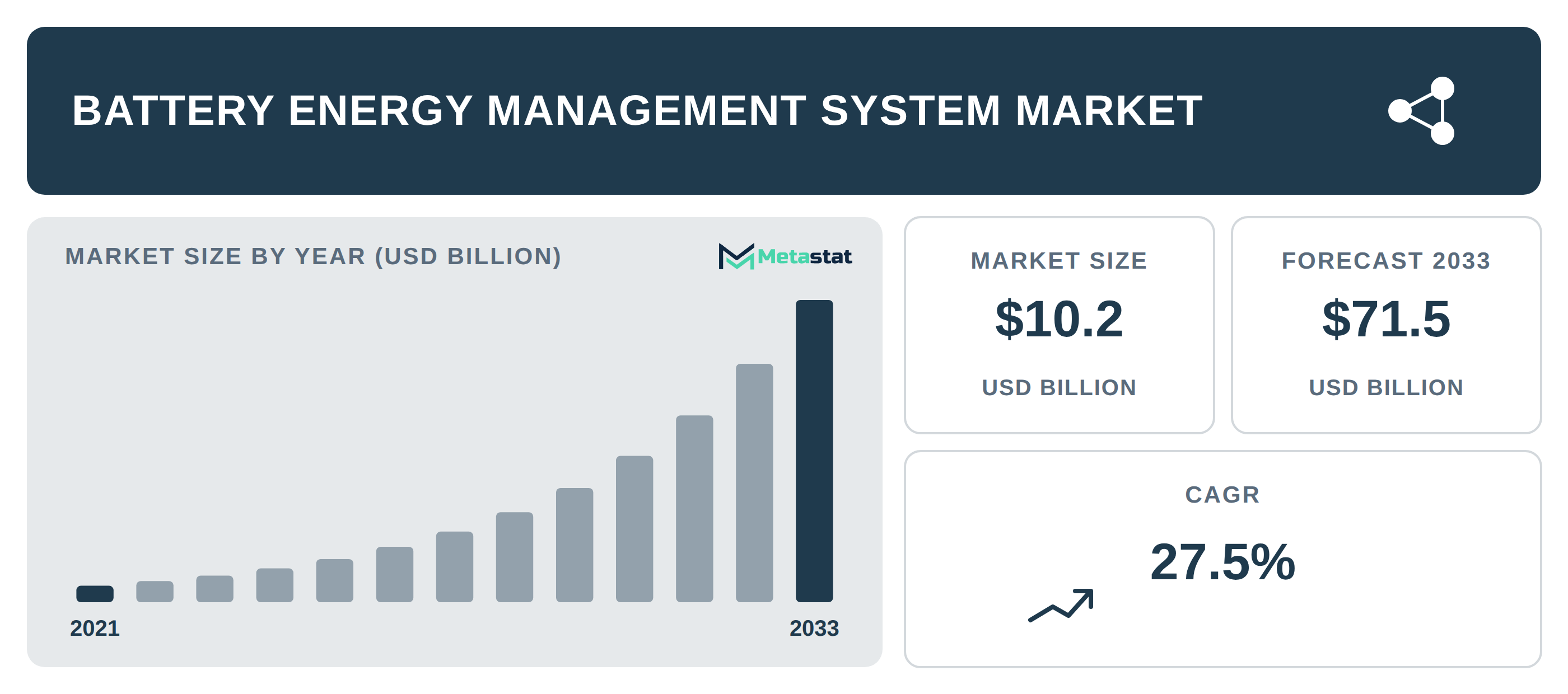
The Battery Energy Management System market experiences substantial expansion fueled by the rising adoption of innovative battery technologies across various sectors, including electric vehicles and renewable energy storage solutions. The increasing focus on sustainable practices and regulatory compliance drives the demand for efficient energy management systems, encouraging companies to invest in advanced solutions that improve operational efficiency. Notable technological advancements in battery types, particularly Lithium Iron Phosphate (LFP) and Lithium Nickel Manganese Cobalt (NMC), significantly influence the market dynamics. The LFP segment is projected to grow at a CAGR of 25.9%, while the NMC segment is anticipated to achieve a CAGR of 31.6% by 2033.
Despite its significant growth potential, the market encounters challenges linked to supply chain dynamics and geopolitical risks. Manufacturers navigate complexities associated with regulatory compliance, inflationary pressures, and currency fluctuations. These factors substantially affect operational expenses and timelines for market entry. Evolving regulatory standards concerning battery safety and efficiency necessitate investments in advanced technology, which imposes financial burdens on smaller businesses. Geopolitical fragmentation complicates the procurement of essential components, resulting in pricing volatility and availability issues that challenge manufacturers and suppliers.
The global Battery Energy Management System market exhibits considerable regional diversity, with Asia Pacific capturing the largest share at 44.4%, followed by North America at 25.8% and Europe at 21.8%. Market segmentation includes battery types including LFP, NMC, LTO, and NCA, alongside BMS topology, which encompasses Centralized, Modular, and Distributed systems. Each segment presents distinct growth opportunities, with the Modular BMS segment expected to reach USD 35 billion by 2033, growing at a CAGR of 29.3%.
Several prominent companies operate within the Battery Energy Management System market, including Lithium Balance A/S, Eberspächer, Nuvation Energy, AVL, Texas Instruments, and Bosch Engineering GmbH. These players prioritize research and development to enhance their technological capabilities, adapt to changing market demands, and sustain competitive positioning. Strategic partnerships and mergers and acquisitions significantly influence the competitive landscape, shaping overall market dynamics.
For further insights and detailed analysis, readers are invited to explore the full report on the Global Battery Energy Management System Market.
Related Report
Global Battery Energy Management System MarketLEAD ANALYST
Utkarsh Khirodkar is a Lead Market Research Analyst at MetaStat Insight, specializing in market intelligence, technology sector assessments, and competitive strategy.

PRINCIPAL CONSULTANT - ENTERPRISE AI & EMERGING TECHNOLOGIES
Banking & Finance · Electronics and Semiconductor · Energy and Power · Healthcare IT · Information & Technology · Professional Services
Vijay Gunti is a Principal Consultant at MetaStat Insight, bringing over two decades of experience across enterprise digital transformation, technology strategy, and intelligent systems.

ENERGY & INFRASTRUCTURE INDUSTRY CONSULTANT
Automotive and Transportation · Electronics and Semiconductor · Energy and Power · Machinery & Equipment
Saurabh Vasant Ganvir consults for Energy & Infrastructure Industry at MetaStat Insight, specializing in renewable energy, solar EPC, and electric vehicle (EV) infrastructure markets.