
LEAD ANALYST
Utkarsh Khirodkar is a Lead Market Research Analyst at MetaStat Insight, specializing in market intelligence, technology sector assessments, and competitive strategy.

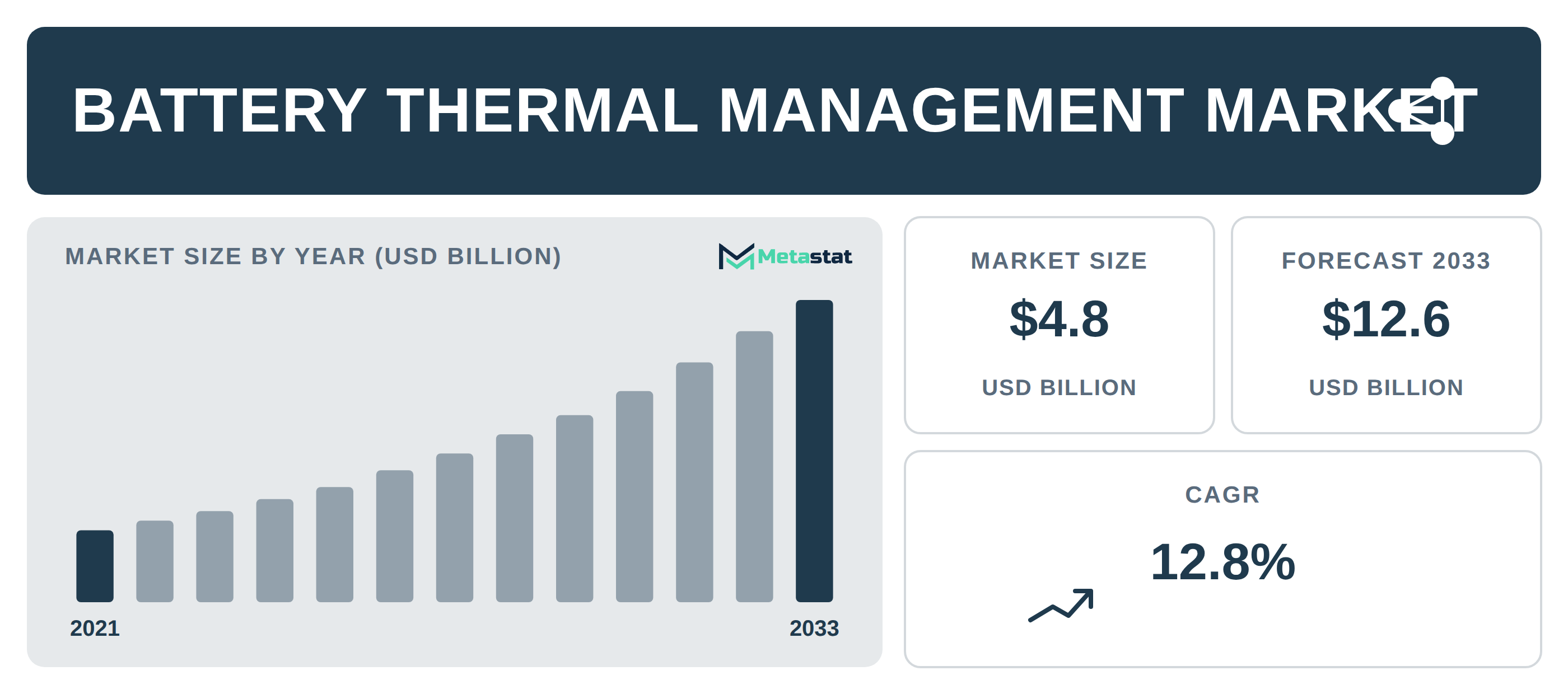
Metastat Insights reveals the Battery Thermal Management market will grow from USD 4.8 billion in 2025 to USD 12.6 billion by 2033, at a CAGR of 12.8%. This report details market drivers, challenges, segments, and key players.
Metastat Insights has published "Global Battery Thermal Management Market Size, Share, By Propulsion Type (BEV, PHEV, FCEV), By Thermal Management Technology (Active, Passive, Hybrid), By Cooling Technology (Air Cooling, Liquid Cooling, Refrigerant-Based Cooling, Immersion Cooling, Phase-Change Material (PCM) Cooling, Thermoelectric Cooling, Heat Pipe Cooling, and Hybrid Cooling), By Vehicle Type (Passenger Cars, Light Commercial Vehicles, Buses, Heavy Trucks, Two- and Three-Wheelers, and Off-Highway and Specialty Vehicles), Industry Analysis, Growth, Trends, and Forecast, 2026-2033", followed by the headline figures (USD 4.8 billion in 2025, USD 12.6 billion by 2033, 12.8% CAGR).
The Battery Thermal Management market experiences significant expansion driven by strong macro-economic factors. Economic growth influences increased investments in electric and hybrid vehicles, enhancing demand for effective thermal management solutions. The global emphasis on sustainable transportation accelerates interest in battery technologies, prompting automotive manufacturers to optimize battery performance. Rising GDP levels across various regions lead to enhanced consumer spending power and increased capital investments in automotive infrastructure, further supporting market growth. Favorable interest rates and venture funding create an environment conducive to innovation within the battery thermal management sector.
High capital investment requirements pose constraints on the Battery Thermal Management market. Manufacturers face substantial initial costs while implementing advanced thermal management systems, deterring smaller players and startups from entering the market. Increased operating costs associated with raw materials, labor, and energy impact profit margins, compelling companies to reassess pricing strategies. Macroeconomic headwinds, including inflationary pressures and geopolitical instability, exacerbate these challenges, leading to unpredictable pricing and availability of essential components.
The global Battery Thermal Management market segments by propulsion type, thermal management technology, cooling technology, and vehicle type. The market is anticipated to grow significantly, with battery electric vehicles (BEVs) leading the way, projected to increase from USD 4.0 billion in 2026 to USD 9.6 billion by 2033, achieving a CAGR of 13.4%. In terms of regional dynamics, Asia Pacific leads with a share of 52.3%, followed by Europe at 22%, North America at 17.9%, South America at 4%, and the Middle East and Africa at 3.9%. North America is expected to reach USD 2.1 billion by 2033, reflecting a CAGR of 12.8%.
Notable companies operating in the Battery Thermal Management market include H.B. Fuller Company, Continental AG, DENSO CORPORATION, BorgWarner Inc., Webasto Group, Valeo, Dana Limited, and MAHLE GmbH. These companies focus on developing advanced thermal management technologies to enhance battery efficiency and performance in electric vehicles.
For a comprehensive analysis, readers access the full report here: Global Battery Thermal Management Market.
Related Report
Global Battery Thermal Management MarketLEAD ANALYST
Utkarsh Khirodkar is a Lead Market Research Analyst at MetaStat Insight, specializing in market intelligence, technology sector assessments, and competitive strategy.

ENERGY & INFRASTRUCTURE INDUSTRY CONSULTANT
Automotive and Transportation · Electronics and Semiconductor · Energy and Power · Machinery & Equipment
Saurabh Vasant Ganvir consults for Energy & Infrastructure Industry at MetaStat Insight, specializing in renewable energy, solar EPC, and electric vehicle (EV) infrastructure markets.