
LEAD ANALYST
Utkarsh Khirodkar is a Lead Market Research Analyst at MetaStat Insight, specializing in market intelligence, technology sector assessments, and competitive strategy.

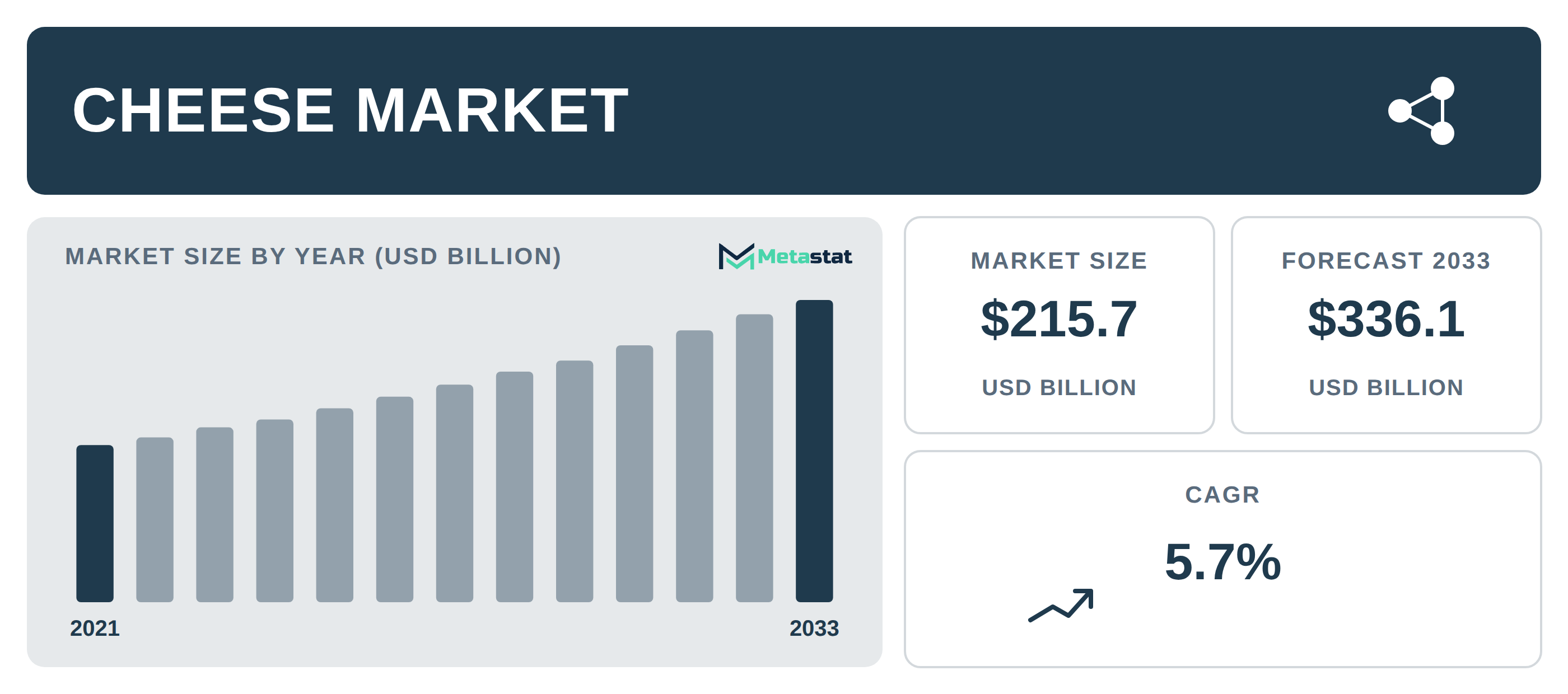
Metastat Insights announces the release of a comprehensive report on the global Cheese market, highlighting significant growth driven by changing consumer preferences and market dynamics. The report forecasts a market value of USD 336.1 billion by 2033, with a CAGR of 5.7%.
Metastat Insights has published "Global Cheese Market Size, Share, By Cheese Type (including Fresh and Cream Cheese, Soft-Ripened Cheese, Blue-Veined Cheese, Feta and Other Brined Cheese, Mozzarella and Other Pasta Filata Cheese, Cheddar Cheese, Gouda, Edam and Swiss-Type Cheese, Hard and Grating Cheese, Processed Cheese), By Milk Source (including Cow Milk, Goat Milk, Sheep Milk, Buffalo Milk, Mixed Milk), By Product Form (including Blocks and Wheels, Slices, Shredded and Grated, Spreads and Tubs, Cubes, Sticks and Portions, Crumbled and Diced, Balls, Logs and Specialty Shapes), By End Use (including Retail and Household Consumption, Foodservice and HoReCa, Food Processing and Industrial Use), Industry Analysis, Growth, Trends, and Forecast, 2026-2033", which indicates a market value of USD 215.7 billion in 2025, projected to reach USD 336.1 billion by 2033, reflecting a compound annual growth rate (CAGR) of 5.7%.
The global Cheese market experiences significant growth driven by shifting consumer preferences towards healthier options. Increasing awareness of nutrition and dietary trends favoring natural and organic products contribute to rising demand for cheeses that offer health benefits. Urbanization plays a critical role, because consumers seek convenient food options, particularly ready-to-eat cheese products. Innovations in cheese formats, including sliced and shredded varieties, cater to convenience-oriented buyers, enhancing market potential.
Regulatory compliance poses substantial challenges for the Cheese market, with stricter food safety and labeling regulations increasing operational complexities for producers. These challenges lead to higher costs and limit pricing flexibility, impacting profit margins. In addition, macroeconomic pressures including inflation and currency fluctuations affect consumer purchasing power, particularly for premium cheese products. Supply chain disruptions have emerged because a major constraint, limiting timely distribution and adversely affecting sales.
The Cheese market is segmented by cheese type, milk source, product form, and end use. In terms of cheese type, segments include Fresh and Cream Cheese, Soft-Ripened Cheese, Blue-Veined Cheese, Feta and Other Brined Cheese, Mozzarella and Other Pasta Filata Cheese, Cheddar Cheese, Gouda, Edam and Swiss-Type Cheese, Hard and Grating Cheese, and Processed Cheese. Cow milk remains the dominant milk source, valued at USD 205.9 billion in 2026, and expected to grow to USD 297.5 billion by 2033. The retail and household consumption segment is projected to reach USD 174.8 billion by 2033, reflecting an increasing trend toward home-cooked meals and snacking.
The market is characterized by numerous players striving for market share, including Agrial Cooperative, Arla Foods amba, and Lactalis Group. These companies focus on compliance strategies, innovation, and sustainability to enhance their competitive positioning. The Cheese market's fragmentation leads to mergers and acquisitions because firms seek consolidation for competitive advantage and to improve operational efficiency.
For more insights, visit the full report: Global Cheese Market.
Related Report
Global Cheese MarketLEAD ANALYST
Utkarsh Khirodkar is a Lead Market Research Analyst at MetaStat Insight, specializing in market intelligence, technology sector assessments, and competitive strategy.

LEAD PRINCIPAL ANALYST, PHARMA AND HEALTHCARE
Food and Beverages · Healthcare · Healthcare IT · Medical Devices
Ajay Devgire is the Lead Healthcare Analyst at MetaStat Insight, leading strategic research and market intelligence initiatives across the global healthcare domain.

SENIOR RESEARCH ANALYST
Biotechnology · Food and Beverages · Medical Devices · Packaging
Snehal Pasalkar is a Research Analyst at MetaStat Insight, operating at the intersection of life sciences research, competitive strategy, and market intelligence.