
LEAD ANALYST
Utkarsh Khirodkar is a Lead Market Research Analyst at MetaStat Insight, specializing in market intelligence, technology sector assessments, and competitive strategy.

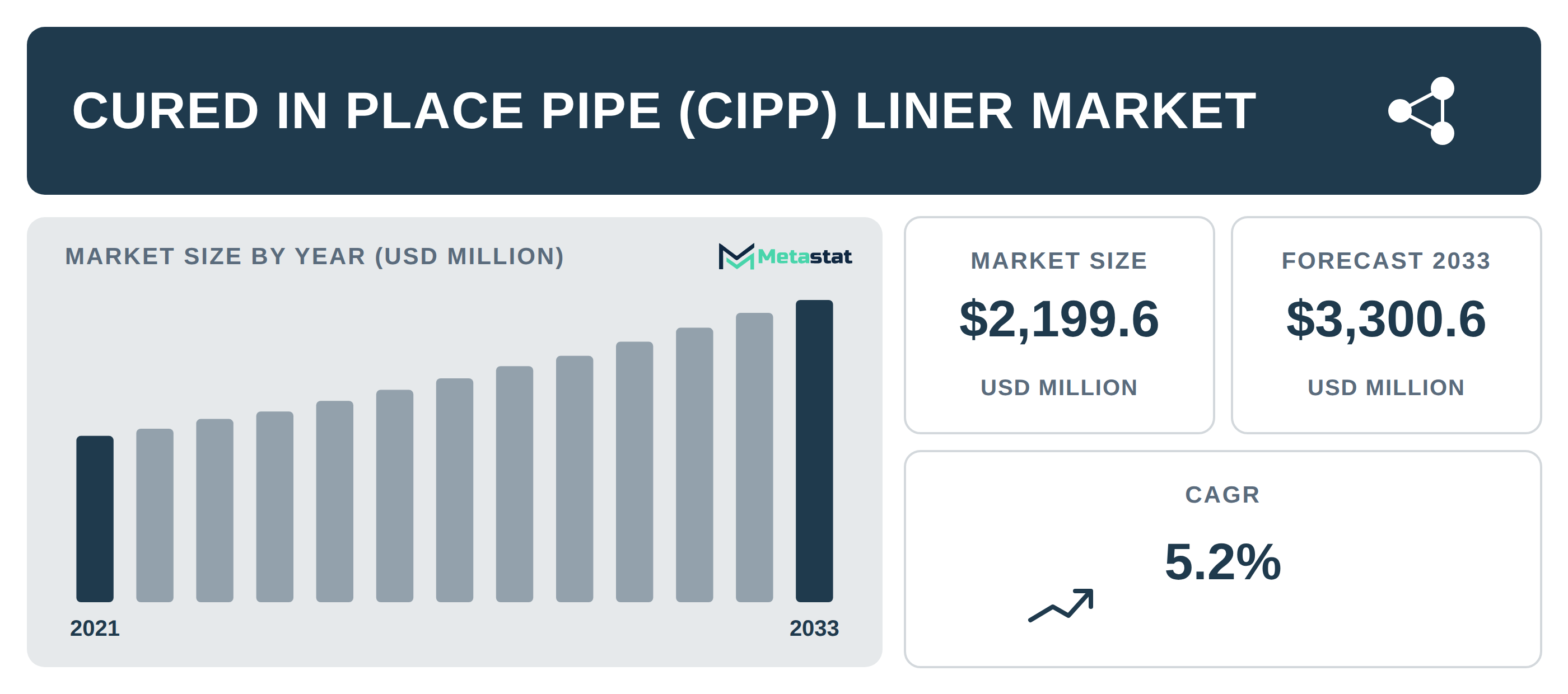
Metastat Insights has released a comprehensive report on the Cured in Place Pipe (CIPP) Liner market, forecasting growth from USD 2,199.6 million in 2025 to USD 3,300.6 million by 2033, driven by increasing municipal sewer rehabilitation efforts.
Metastat Insights has published "Global Cured in Place Pipe (CIPP) Liner Market Size, Share, By Resin Type (Polyester Resin-based CIPP, Vinyl Ester Resin-based CIPP, Epoxy Resin-based CIPP), By Curing Method (Hot Water Curing, Steam Curing, Ultraviolet (UV) Light Curing, LED/Visible-Light Curing, Ambient Curing), By Liner Construction Type (Polyester Felt Liners, Fiberglass-Reinforced (GRP/GFRP) Liners, Knitted/Woven Textile Liners, Hybrid Felt-Fiberglass Liners), By Application (Municipal Gravity Wastewater and Sewer, Stormwater and Drainage, Potable Water Mains, Sewer Force Mains, Industrial and Process Pipelines, Building and Property Drainage, Others), Industry Analysis, Growth, Trends, and Forecast, 2026-2033", with key figures indicating a market value of USD 2,199.6 million in 2025 and a projected increase to USD 3,300.6 million by 2033, reflecting a compound annual growth rate (CAGR) of 5.2%.
Demand for Cured in Place Pipe (CIPP) Liners is primarily supported by municipal sewer rehabilitation projects. Cities are increasingly focusing on efficient and cost-effective solutions for repairing aging infrastructure, which drives investment in trenchless technologies. CIPP technology facilitates quick rehabilitation without extensive excavation, making it attractive to city planners and utilities committed to maintaining service continuity.
Regulatory compliance challenges present significant constraints for the Cured in Place Pipe (CIPP) Liner market. Stringent environmental protection regulations increase operational costs for suppliers, limiting their ability to offer competitive pricing. The industry's response to these regulations often necessitates substantial investments in technology and process improvements, which hinder growth in a competitive market landscape.
The Cured in Place Pipe (CIPP) Liner market is segmented according to resin types, including options based on Polyester Resin, Vinyl Ester Resin, and Epoxy Resin. Each segment displays unique growth patterns driven by specific application demands. For instance, the Polyester Resin-based segment is anticipated to reach USD 1,835.8 million by 2033, while the Vinyl Ester segment is projected to achieve USD 838.7 million, reflecting their durability and efficiency across numerous applications.
Various companies operate in the Cured in Place Pipe (CIPP) Liner market, including Azuria Water Solutions, Inc., IMPREG GmbH, SAERTEX multiCom GmbH, and Trelleborg Water Infrastructure. These firms emphasize delivering innovative solutions that cater to diverse client requirements while competing based on structural performance and cure speed. Their ongoing investments in research and development enhance product offerings, ensuring competitiveness in an evolving market.
For a deeper understanding of trends, forecasts, and key insights, readers are invited to explore the full report: Global Cured in Place Pipe (CIPP) Liner Market.
Related Report
Global Cured in Place Pipe (CIPP) Liner MarketLEAD ANALYST
Utkarsh Khirodkar is a Lead Market Research Analyst at MetaStat Insight, specializing in market intelligence, technology sector assessments, and competitive strategy.

INDUSTRY CONSULTANT - CHEMICALS & ADVANCED MATERIALS
Chemicals and Materials · Machinery & Equipment · Packaging
Amit Gadhekar Consultant for Chemicals and Materials at MetaStat Insight, directing sector-specific intelligence, research, and strategic consulting across global chemical and processing markets.