
LEAD ANALYST
Utkarsh Khirodkar is a Lead Market Research Analyst at MetaStat Insight, specializing in market intelligence, technology sector assessments, and competitive strategy.

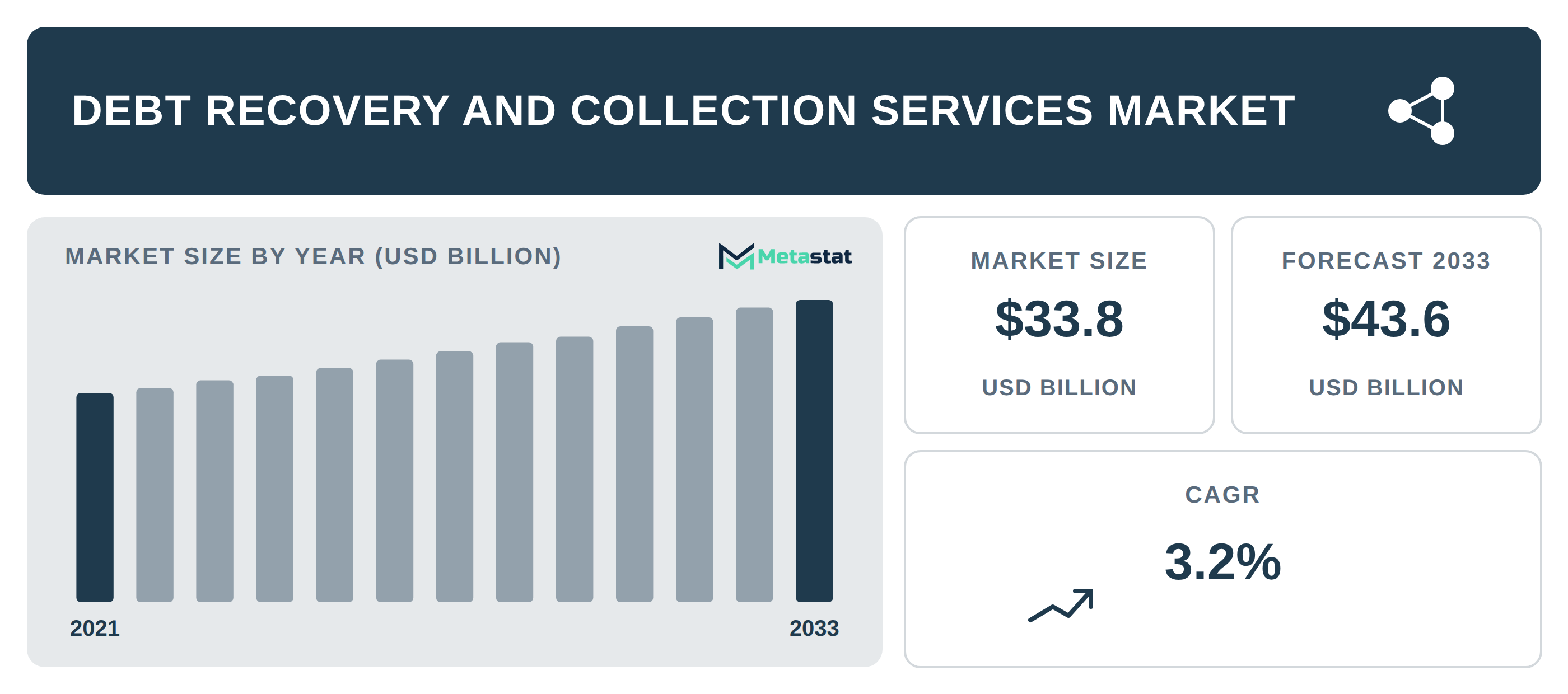
Metastat Insights reports the global Debt Recovery and Collection Services market is expected to grow from USD 33.8 billion in 2025 to USD 43.6 billion by 2033, at a CAGR of 3.2%. The growth is driven by technological advancements and increasing demand for effective debt recovery solutions.
Metastat Insights has published "Global Debt Recovery and Collection Services Market Size, Share, By Service Type (Accounts Receivable Management, Pre-Collection Services, Amicable / Non-Judicial Debt Collection, Debt Settlement, Debt Management Plans, Hardship Program Administration, NPL and Charged-Off Portfolio Servicing, Legal Debt Recovery, Insolvency and Bankruptcy Recovery, Others), By Debt Type (Credit Card and Revolving Credit Debt, Personal and Consumer Loan Debt, Auto Finance Debt, Mortgage Debt, Student Debt, Medical Receivables, Telecom Receivables, Commercial Receivables, Government Receivables), By End-User (Banks, Fintechs, Credit Unions, Healthcare Providers, Telecoms, Retailers, E-commerce, Government Organizations, Households), Industry Analysis, Growth, Trends, and Forecast, 2026-2033", with key figures indicating that the market is valued at USD 33.8 billion in 2025 and is anticipated to achieve USD 43.6 billion by 2033, reflecting a compound annual growth rate (CAGR) of 3.2%.
Increasing demand for effective debt recovery solutions across various sectors significantly shapes the Debt Recovery and Collection Services market. Economic conditions, including rising GDP and consumer expenditure, correlate with elevated borrowing levels, thereby necessitating enhanced debt recovery strategies. Technological innovations, especially in automation and artificial intelligence, streamline operational processes and enhance efficiency. These advancements empower organizations to improve customer interactions and refine collection strategies, resulting in elevated recovery rates.
The market encounters challenges stemming from regulatory compliance and economic pressures. Regulatory requirements impose operational costs on service providers, constraining growth potential. Inflationary factors and economic uncertainties diminish disposable income for consumers, subsequently decreasing demand for debt recovery services. Market fragmentation complicates effective service delivery, because varying regulations across jurisdictions lead to inconsistencies and operational difficulties. Companies navigate these complexities to uphold their competitive standing.
Regionally, North America commands the largest share of the Debt Recovery and Collection Services market, representing 33.6% in 2025, with projections suggesting a market value of USD 13.6 billion by 2033. Europe and Asia Pacific follow closely, with respective market shares of 28.2% and 26%. In terms of service type, Accounts Receivable Management and Pre-Collection Services are expected to rise from USD 5.8 billion in 2026 to USD 7.3 billion by 2033, while the Amicable / Non-Judicial Debt Collection segment is projected to reach USD 9 billion over the same timeframe.
Notable players in the Debt Recovery and Collection Services market include Intrum AB (publ), EOS Holding GmbH, Lowell, Riverty, B2 Impact ASA, Axactor ASA, Myntro AB, KRUK S.A., doValue S.p.A., PAIR Finance GmbH, among others. These firms operate within a competitive arena, emphasizing technological advancements and regulatory compliance to enhance their service offerings.
For deeper insights into the market dynamics, trends, and forecasts, readers are invited to explore the full report: Global Debt Recovery and Collection Services Market.
Related Report
Global Debt Recovery and Collection Services MarketLEAD ANALYST
Utkarsh Khirodkar is a Lead Market Research Analyst at MetaStat Insight, specializing in market intelligence, technology sector assessments, and competitive strategy.

PRINCIPAL CONSULTANT - ENTERPRISE AI & EMERGING TECHNOLOGIES
Banking & Finance · Electronics and Semiconductor · Energy and Power · Healthcare IT · Information & Technology · Professional Services
Vijay Gunti is a Principal Consultant at MetaStat Insight, bringing over two decades of experience across enterprise digital transformation, technology strategy, and intelligent systems.