
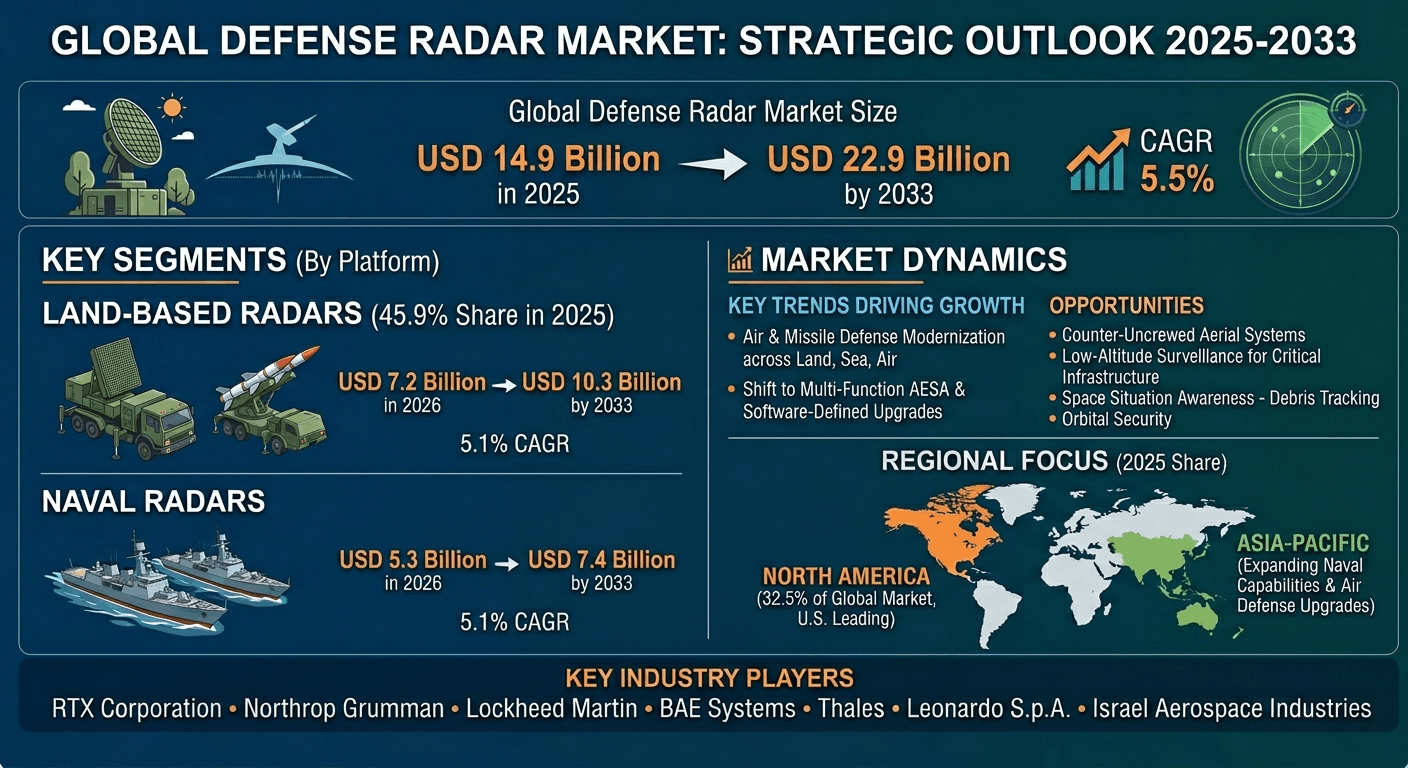
Metastat Insight, a premier provider of comprehensive market intelligence, has released its latest strategic analysis: “Global Defense Radar Market: Data-Driven Market Analysis and Strategic Outlook.” The report reveals that the market is valued at USD 14.9 billion in 2025 and is projected to reach USD 22.9 billion by 2033, growing at a compound annual growth rate (CAGR) of 5.5% over the forecast period.
According to the findings, the Defense Radar market is evolving from traditional surveillance toward integrated digital warfare ecosystems. Modern radar systems are increasingly serving as intelligent nodes within distributed command architectures, facilitating predictive threat assessment and coordinated responses across air, sea, land, space, and cyber domains.
Key Market Drivers and Trends
The sustained growth of the market is primarily attributed to:
-
Air and Missile Defense Modernization: Governments are prioritizing layered detection networks to track ballistic, cruise, and hypersonic threats across all military branches.
-
AESA and Software-Defined Architectures: A significant shift toward multi-function Active Electronically Scanned Array (AESA) architectures allows a single platform to combine surveillance, fire control, and electronic protection.
-
Space Situational Awareness: With rising orbital congestion, next-generation radar arrays are being deployed to monitor debris and protect strategic assets in Low Earth Orbit (LEO).
Segmentation Highlights
-
Platform Leadership:Land-based Radars dominated the market with a 45.9% share in 2025. Valued at USD 7.2 billion in 2026, this segment is expected to reach USD 10.3 billion by 2033 due to border security modernization.
-
Product Innovation: The Multi-Function Radar segment is poised for rapid growth, with a projected revenue of USD 7.3 billion by 2033, driven by the demand for reduced operational complexity and software-defined adaptability.
-
Component Advancements: The Antenna segment is anticipated to reach USD 5 billion by 2033, fueled by advancements in beam steering and durable AESA materials.
Regional Outlook
North America remains the leading regional market, accounting for 32.5% of global revenue in 2025, with the U.S. spearheading regional modernization. Meanwhile, the Asia-Pacific region is witnessing substantial growth driven by expanding naval capabilities and air protection enhancements in the Global Defense Radar market.
Competitive Landscape
The report profiles industry leaders including RTX Corporation, Northrop Grumman, Lockheed Martin, BAE Systems, and Thales, alongside specialized providers like HENSOLDT AG, Saab AB, and Israel Aerospace Industries. These players are focused on R&D to enhance target discrimination and resistance to electronic interference.
Future Outlook
The integration of Artificial Intelligence (AI) is set to revolutionize signal processing, allowing radar systems to identify stealth signatures within complex electromagnetic environments. As geopolitical tensions accelerate demand, the Global Defense Radar market will remain a foundational technology for strategic deterrence and digitally coordinated defense operations.
About Metastat Insight
Metastat Insight provides in-depth market research and strategic consulting across various industries, including Aerospace and Defense. Our data-driven approach helps global organizations navigate complex market dynamics and identify emerging growth opportunities.
Related Report
View full market research reportAbout the Author

LEAD ANALYST
Utkarsh Khirodkar is a Lead Market Research Analyst at MetaStat Insight, specializing in market intelligence, technology sector assessments, and competitive strategy.