
LEAD ANALYST
Utkarsh Khirodkar is a Lead Market Research Analyst at MetaStat Insight, specializing in market intelligence, technology sector assessments, and competitive strategy.

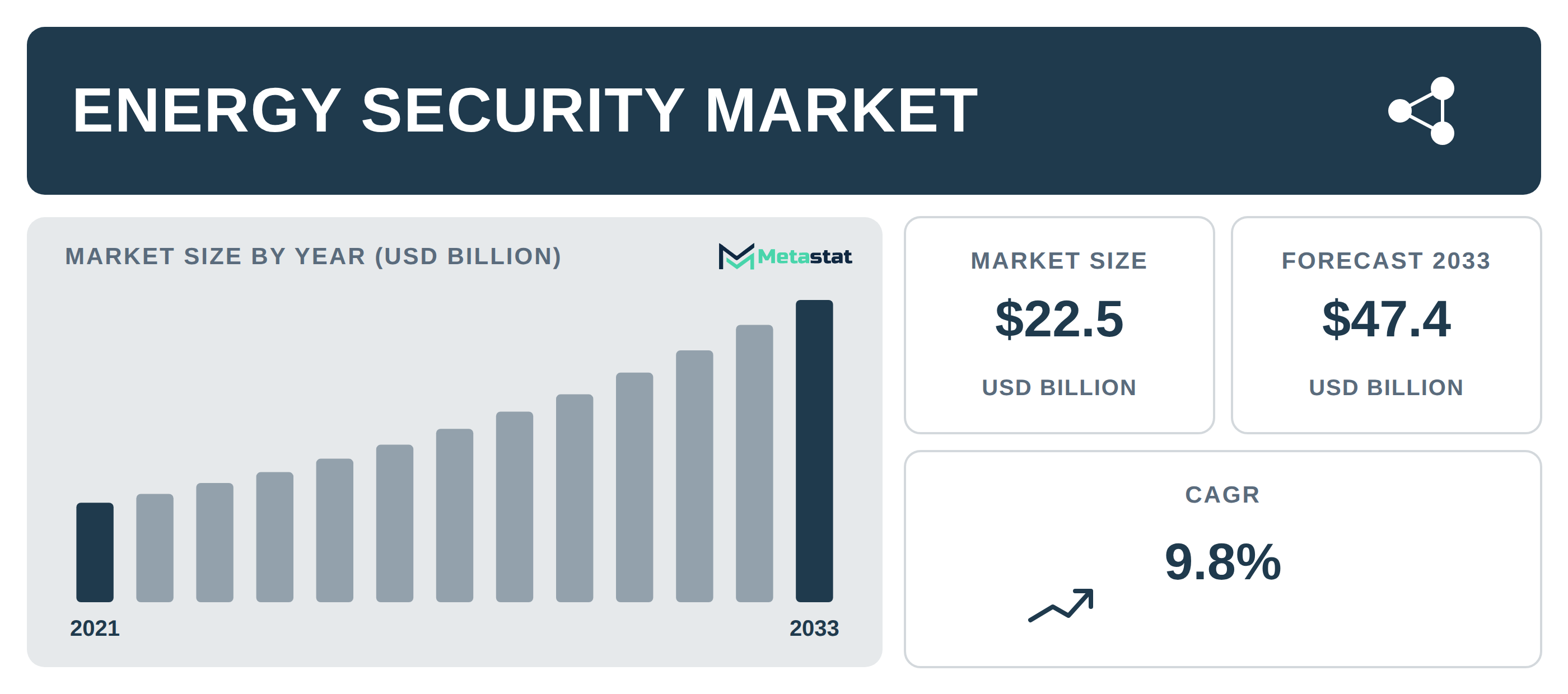
Metastat Insights reports the Energy Security market, valued at USD 22.5 billion in 2025, is projected to grow to USD 47.4 billion by 2033, with a CAGR of 9.8%. The increase is driven by infrastructure investment and heightened security demands across industries.
Metastat Insights has published "Global Energy Security Market Size, Share, By Component (Hardware, Software and Services), By Security Type (Physical Security and Cybersecurity), By Energy Infrastructure (Power Plants, Oil & Gas Infrastructure, Nuclear Facilities, Renewable Energy Infrastructure, Transmission and Distribution Networks and Energy Storage and Microgrids), By Service Type (System Design and Integration, Risk Management and Assessment, Managed Security Services, Professional Consulting and Advisory and Maintenance and Support Services), Industry Analysis, Growth, Trends, and Forecast, 2026-2033", highlighting a market value of USD 22.5 billion in 2025, projected to reach USD 47.4 billion by 2033, reflecting a CAGR of 9.8%.
Investment in infrastructure development significantly contributes to the growth of the Energy Security market. Increased demands for improved energy reliability and resilience prompt both government and private sector entities to allocate considerable funding for upgrading energy infrastructure. This includes enhancements across power generation facilities, oil and gas operations, and renewable energy initiatives, which collectively support energy security efforts. The rising awareness of cyber threats and physical security vulnerabilities further emphasizes the importance of comprehensive security solutions throughout energy infrastructures.
The Energy Security market faces challenges related to regulatory compliance, because various jurisdictions implement stringent standards to enhance national and global security measures. Companies operating within this complex regulatory environment frequently incur significant costs, impacting their operational strategies and delaying project implementations. Geopolitical tensions, climate change, and evolving cyber threats require continuous adaptation and innovation from industry players. These challenges create barriers for smaller firms, restricting their participation and hindering overall market competitiveness.
The Energy Security market is segmented by component, security type, energy infrastructure, and service type. Important segments include hardware, software, and services, with hardware expected to expand from USD 10.9 billion in 2026 to USD 19.3 billion by 2033. Software solutions are projected to reach USD 14.4 billion by 2033. In terms of security type, physical security is anticipated to increase from USD 13.4 billion in 2026 to USD 24.1 billion by 2033, whereas cybersecurity is expected to reach USD 23.4 billion by the end of the forecast period.
Regionally, North America maintains the largest market share at 35.6%, projected to achieve USD 15.9 billion by 2033. Europe follows with a share of 28.3%, while Asia Pacific comprises 22.3%. This regional dominance arises from substantial investments in infrastructure and technology across various sectors, enhancing the demand for energy security solutions.
Noteworthy companies within the Energy Security market include Lockheed Martin Corporation, Siemens, and Honeywell International Inc. These organizations focus on integrating advanced technologies and creating innovative solutions to meet the rising demand for energy security across diverse sectors. Their strategic investments in research and development further enhance their competitive positioning, enabling them to adapt to changing market dynamics.
For more insights and detailed analysis, readers are invited to access the full report: Global Energy Security Market.
Related Report
View full market research reportLEAD ANALYST
Utkarsh Khirodkar is a Lead Market Research Analyst at MetaStat Insight, specializing in market intelligence, technology sector assessments, and competitive strategy.

PRINCIPAL CONSULTANT - ENTERPRISE AI & EMERGING TECHNOLOGIES
Banking & Finance · Electronics and Semiconductor · Energy and Power · Healthcare IT · Information & Technology · Professional Services
Vijay Gunti is a Principal Consultant at MetaStat Insight, bringing over two decades of experience across enterprise digital transformation, technology strategy, and intelligent systems.

ENERGY & INFRASTRUCTURE INDUSTRY CONSULTANT
Automotive and Transportation · Electronics and Semiconductor · Energy and Power · Machinery & Equipment
Saurabh Vasant Ganvir consults for Energy & Infrastructure Industry at MetaStat Insight, specializing in renewable energy, solar EPC, and electric vehicle (EV) infrastructure markets.