
LEAD ANALYST
Utkarsh Khirodkar is a Lead Market Research Analyst at MetaStat Insight, specializing in market intelligence, technology sector assessments, and competitive strategy.

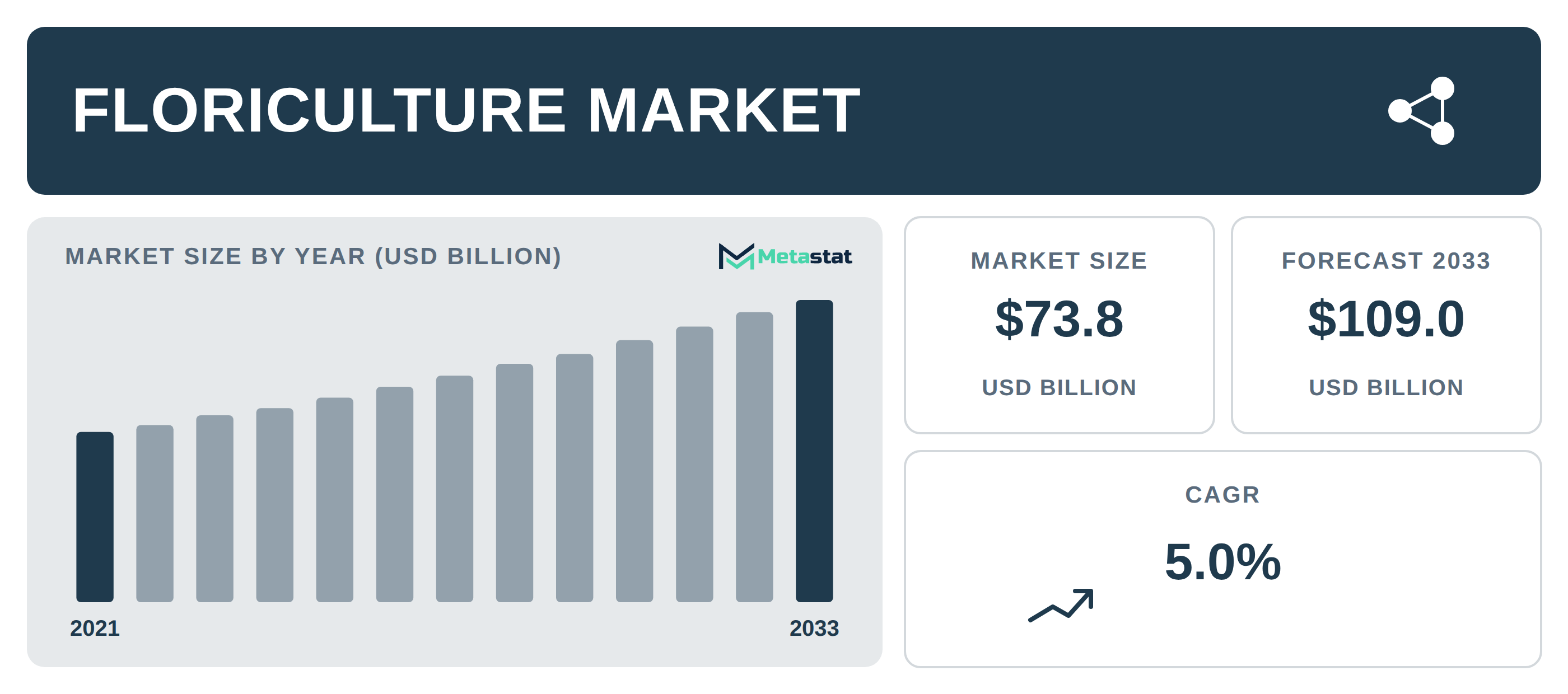
Metastat Insights' latest report outlines the global floriculture market, highlighting a projected growth from USD 73.8 billion in 2025 to USD 109 billion by 2033, at a CAGR of 5.0%. The report details key drivers, restraints, regional insights, and competitive dynamics.
Metastat Insights has published "Global Floriculture Market Size, Share, By Product Type (Bedding and Garden Plants, Potted Flowering Plants, Foliage and Tropical Plants, Cut Flowers and Others), By Flower Type (Rose, Chrysanthemum, Tulip, Lily, Gerbera, Carnations, Texas Bluebell, Freesia and Hydrangea), By Distribution Channel (Direct Sales to Retailers, Wholesale Distributors and Flower Auctions, Specialty Florists and Garden Centers, Online Retail and Direct-to-Consumer Channels), Industry Analysis, Growth, Trends, and Forecast, 2026-2033", detailing a market valued at USD 73.8 billion in 2025, projected to reach USD 109 billion by 2033, growing at a CAGR of 5.0%.
Increasing consumer spending on gardening and home decoration significantly drives growth within the floriculture market. Economic recovery following recent global disruptions has led to a rise in disposable incomes, enabling consumers to invest more in floral products and services. This trend is particularly evident in urban populations, where gardening and indoor plants have become increasingly popular. Demographic shifts, including an aging population and millennial preferences for sustainable, aesthetically pleasing environments, further contribute to this demand. Retailers are adapting their offerings to align with these evolving preferences, leading to improved product availability and competition among suppliers.
Despite positive growth prospects, the floriculture market faces several challenges. Increased regulatory constraints regarding environmental practices impose higher compliance costs on producers, affecting their profitability. Macroeconomic factors including inflation and rising operational costs create a volatile market environment, pressuring pricing strategies and leading to consumer hesitance. Supply chain disruptions, exacerbated by geopolitical tensions, further complicate the market dynamics, impacting timely product delivery and overall market reliability. The combination of these challenges limits growth potential and complicates investment decisions in new product development.
The global floriculture market segments by type of product, type of flower, and distribution channels. The bedding and garden plants category dominates the market, with a projected value of USD 22.8 billion in 2026, expected to grow to USD 33.2 billion by 2033. Potted flowering plants closely follow, anticipated to reach USD 25.1 billion during the same period. Regionally, Europe leads with a 34.7% market share, followed by Asia Pacific at 32.4%. North America, South America, and the Middle East and Africa account for 18%, 8%, and 7% respectively, reflecting varied consumer preferences and market dynamics.
Several companies operate within the floriculture market, focusing on innovative techniques and sustainable practices to enhance market presence. Key players include Altman Plants, Anthura, Bailey Nurseries, Ball Horticultural Company, Beekenkamp Group, and Dümmen Orange, among others. These companies invest in research and development to create unique flower varieties and improve cultivation methods. Their commitment to sustainability and operational efficiency positions them favorably within a competitive market.
For more detailed insights and analysis, readers access the full report: Global Floriculture Market.
Related Report
Global Floriculture MarketLEAD ANALYST
Utkarsh Khirodkar is a Lead Market Research Analyst at MetaStat Insight, specializing in market intelligence, technology sector assessments, and competitive strategy.