
LEAD ANALYST
Utkarsh Khirodkar is a Lead Market Research Analyst at MetaStat Insight, specializing in market intelligence, technology sector assessments, and competitive strategy.

Metastat Insights' latest report forecasts the Healthcare Staffing market to grow from USD 82.6 billion in 2025 to USD 148.4 billion by 2033, at a CAGR of 7.6%. The report covers service types, workforce categories, and competitive dynamics.
Metastat Insights has published "Global Healthcare Staffing Market Size, Share, By Service Type (Permanent Placement, Temporary Staffing, Travel Healthcare Staffing, Locum Tenens Staffing, Per Diem Staffing, Managed Service Programs (MSP), Recruitment Process Outsourcing (RPO)), By Healthcare Workforce Category (Physicians, Registered Nurses & Licensed Practical Nurses, Allied Healthcare Professionals, Behavioral Health Professionals, Pharmacists, Healthcare Administrative & Revenue Cycle Staff, Home Healthcare Professionals, Dental Professionals, Others (Telehealth, Virtual Care Professionals)), By End-user (Hospitals, Ambulatory Surgical Centers (ASCs), Clinics & Physician Practices, Long-term Care & Nursing Facilities, Home Healthcare Providers, Others (Behavioral Health Centers, DSOs, Diagnostic & Imaging Centers)), Industry Analysis, Growth, Trends, and Forecast, 2026-2033", followed by the headline figures (USD 82.6 billion in 2025, USD 148.4 billion by 2033, 7.6% CAGR).
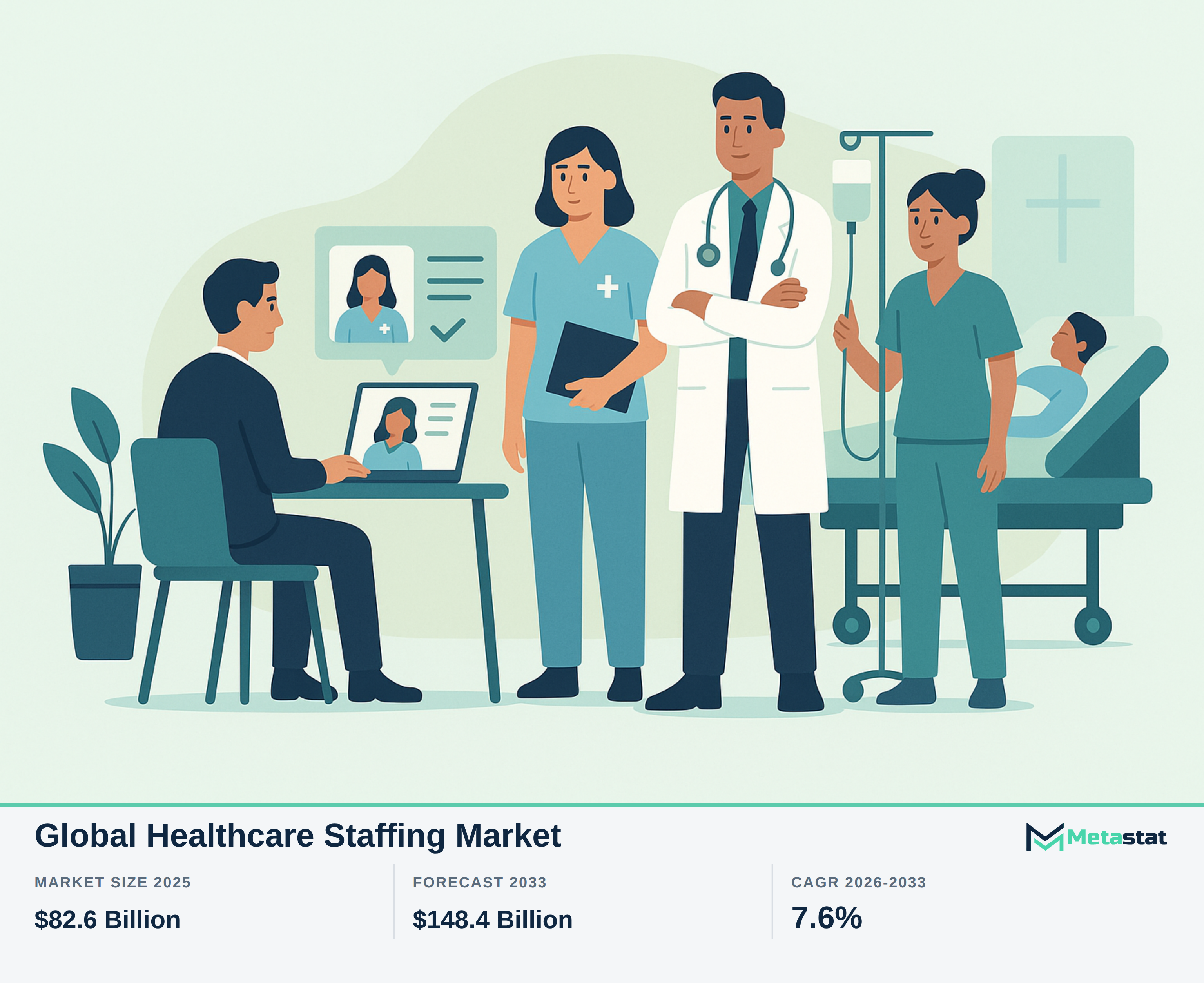
The Healthcare Staffing market is experiencing notable growth, driven by increasing healthcare service requirements and a rising aging population. North America holds a significant share of the market, estimated at 51.5% in 2025, with the United States leading in market share by 2026. This growth correlates with the advanced healthcare infrastructure in the region and the rising prevalence of chronic diseases requiring medical attention. The demand for healthcare professionals across diverse settings supports this expansion.
Regulatory compliance poses significant challenges in the Healthcare Staffing market. Organizations navigate various compliance requirements, which often impacts operational efficiency and financial performance. Geopolitical tensions contribute to sourcing complexities, leading to fluctuations in hiring strategies and increased staffing costs. Macroeconomic headwinds, including inflationary pressures and currency volatility, affect operational costs and talent acquisition, complicating workforce management for staffing agencies.
The Healthcare Staffing market is segmented into various service types and healthcare workforce categories. The service types include Permanent Placement, Temporary Staffing, Travel Healthcare Staffing, Locum Tenens Staffing, Per Diem Staffing, Managed Service Programs (MSP), and Recruitment Process Outsourcing (RPO). Key end-user sectors encompass hospitals, ambulatory surgical centers, clinics, and long-term care facilities. The market anticipates a surge in demand for specialized professionals, including registered nurses and allied healthcare professionals, reflecting evolving healthcare needs.
The competitive environment of the Healthcare Staffing market features a mix of established players and emerging companies. Key participants include AMN Healthcare, CHG Healthcare, Medical Solutions, Healthcare Workforce Logistics, and Supplemental Health Care. These organizations engage in mergers and acquisitions to enhance their service offerings and expand market reach. Continued investment in technology-driven solutions, including telehealth and remote staffing models, supports the evolution of staffing solutions within the sector.
For a comprehensive analysis, readers access the full report at Global Healthcare Staffing Market.
Related Report
Global Healthcare Staffing MarketLEAD ANALYST
Utkarsh Khirodkar is a Lead Market Research Analyst at MetaStat Insight, specializing in market intelligence, technology sector assessments, and competitive strategy.

LEAD PRINCIPAL ANALYST, PHARMA AND HEALTHCARE
Food and Beverages · Healthcare · Healthcare IT · Medical Devices
Ajay Devgire is the Lead Healthcare Analyst at MetaStat Insight, leading strategic research and market intelligence initiatives across the global healthcare domain.