
A newly published in-depth study by MetaStat Insight reveals that the India Naruto Merchandise Market is undergoing a massive transformation, evolving from a segmented subculture into a prominent mainstream youth lifestyle phenomenon. Valued at an estimated USD 25.3 million in 2025, the market is structurally positioned to achieve an impressive compound annual growth rate (CAGR) of 11.8% during the forecast tracking framework, ultimately scaling to USD 61.8 million by 2033.
This operational expansion is heavily anchored by the staggering uptake of specialized anime over-the-top (OTT) streaming platforms among India's youth demographics. The strong emotional alignment that viewers forge with iconic characters yields direct commercial execution, sparking continuous demand for tangible representations of their favorite narratives. Furthermore, the extensive optimization of modern e-commerce marketplaces has leveled logistical barriers, granting nationwide access to affordable items across Tier-2 urban zones and outlying towns.
Apparel and Streetwear Dominate Market Value
An inspection of the structural breakdown highlights that Apparel stands as the primary fiscal block, commanding a notable 38.64% market share in 2025. Valued at USD 10.8 million in 2026, the clothing segment is expected to double to USD 21.7 million by 2033, expanding at a 10.5% CAGR. This sustained traction is fueled by a burgeoning affinity for anime-inspired streetwear, notably graphic hoodies, oversized shirts, and outerwear styled by domestic creators and local startups.
Concurrently, the Toys, Figures, and Collectibles sector represents a vital core for enthusiast groups, projected to scale from USD 5.8 million in 2026 to USD 14.2 million by 2033 at a high 13.5% CAGR. This increase reflects a maturing consumer profile particularly salaried employees and working professionals who possess higher disposable income and actively seek out premium, authenticated collector items.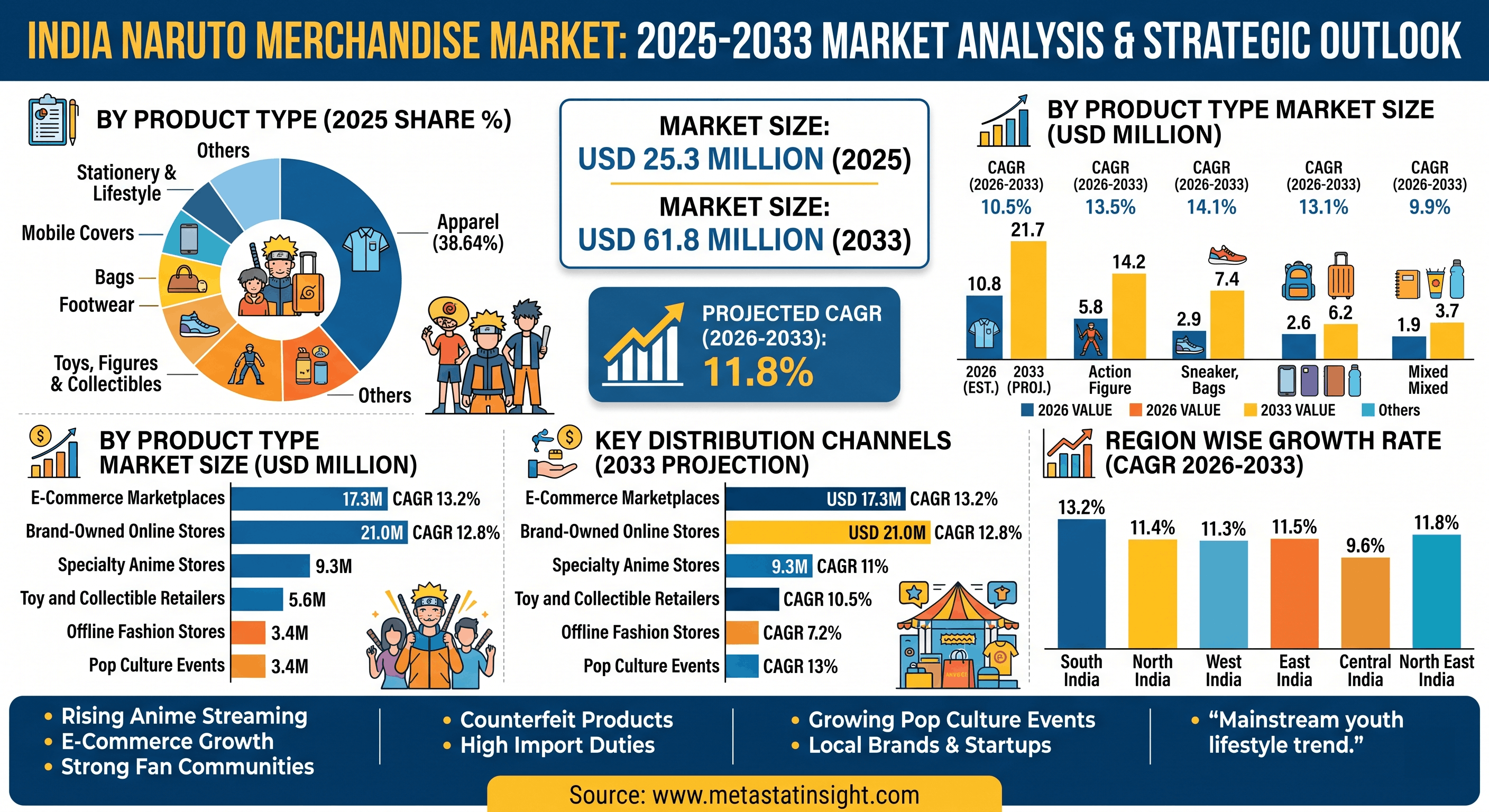
Strategic Channel Analysis: E-Commerce vs. Experiential Pop Culture
Distribution networks are bifurcating into digital convenience and physical experiential channels:
-
Brand-Owned Online Stores: Leading structural change by ensuring supply chain authenticity and direct consumer dialogue, expected to achieve USD 21.0 million by 2033 (12.8% CAGR).
-
E-Commerce Marketplaces: Maintaining immense transaction volume via aggressive promotional campaigns and optimized recommendation mechanics, matching a projected target of USD 17.3 million by 2033.
-
Pop Culture Events and Conventions: Functioning as critical engines for experiential purchases and exclusive products, pacing forward at a robust 13.0% CAGR.
Inherent Market Constraints and Remedial Horizons
Despite unprecedented consumer motivation, MetaStat Insight outlines core regulatory and economic bottlenecks. The persistent influx of unlicensed, counterfeit products presents an ongoing challenge to retail integrity, occasionally damaging buyer confidence via inferior fabrics or inaccurate character layouts. Additionally, stringent import duties applied to specialized international collectibles elevate end-user pricing thresholds, putting items out of reach for students and price-sensitive demographics.
Conversely, these friction points are paving the way for domestic development. Homegrown fashion brands and digital startups are fast-tracking local manufacturing and strategic licensing, allowing them to release high-quality, cost-efficient alternatives that appeal directly to the domestic consumer base.
Regional Breakdown and Competitive Outlines
Geographically, South India leads the growth momentum with an anticipated 13.2% CAGR, propelled by robust technology retail ecosystems in hubs like Bengaluru, Chennai, and Hyderabad. North India (11.4% CAGR) and West India (11.3% CAGR) follow as key pillars of consumer volume, bolstered by major urban demand centers in Delhi, Chandigarh, Mumbai, and Pune. Meanwhile, Northeast India showcases distinctive growth dynamics at an 11.8% CAGR, powered by deep-seated regional affinities for international creative subcultures.
The competitive matrix is populated by highly responsive lifestyle players such as The Souled Store, Bewakoof, Bonkers Corner, Free Authority, Celio India, and Nap Chief alongside prominent hobbyist and toy giants including Hamleys India, Superhero Toy Store, Entertainment Store, Nerd Arena, Otaku Island, Blue Balloon Toys, and Macmerise. These entities are consistently relying on specialized drop models, influencer activations, and direct lifestyle integrations to retain consumer loyalty.
About MetaStat Insight
MetaStat Insight is a premier global market research and strategic consulting firm specializing in consumer trends, retail evolution, and industry forecast metrics. By delivering exact data-driven analyses, we help enterprises locate market opportunities, navigate competitive landscapes, and design long-term corporate roadmaps.
Related Report
View full market research reportAbout the Author

LEAD ANALYST
Utkarsh Khirodkar is a Lead Market Research Analyst at MetaStat Insight, specializing in market intelligence, technology sector assessments, and competitive strategy.