
LEAD ANALYST
Utkarsh Khirodkar is a Lead Market Research Analyst at MetaStat Insight, specializing in market intelligence, technology sector assessments, and competitive strategy.

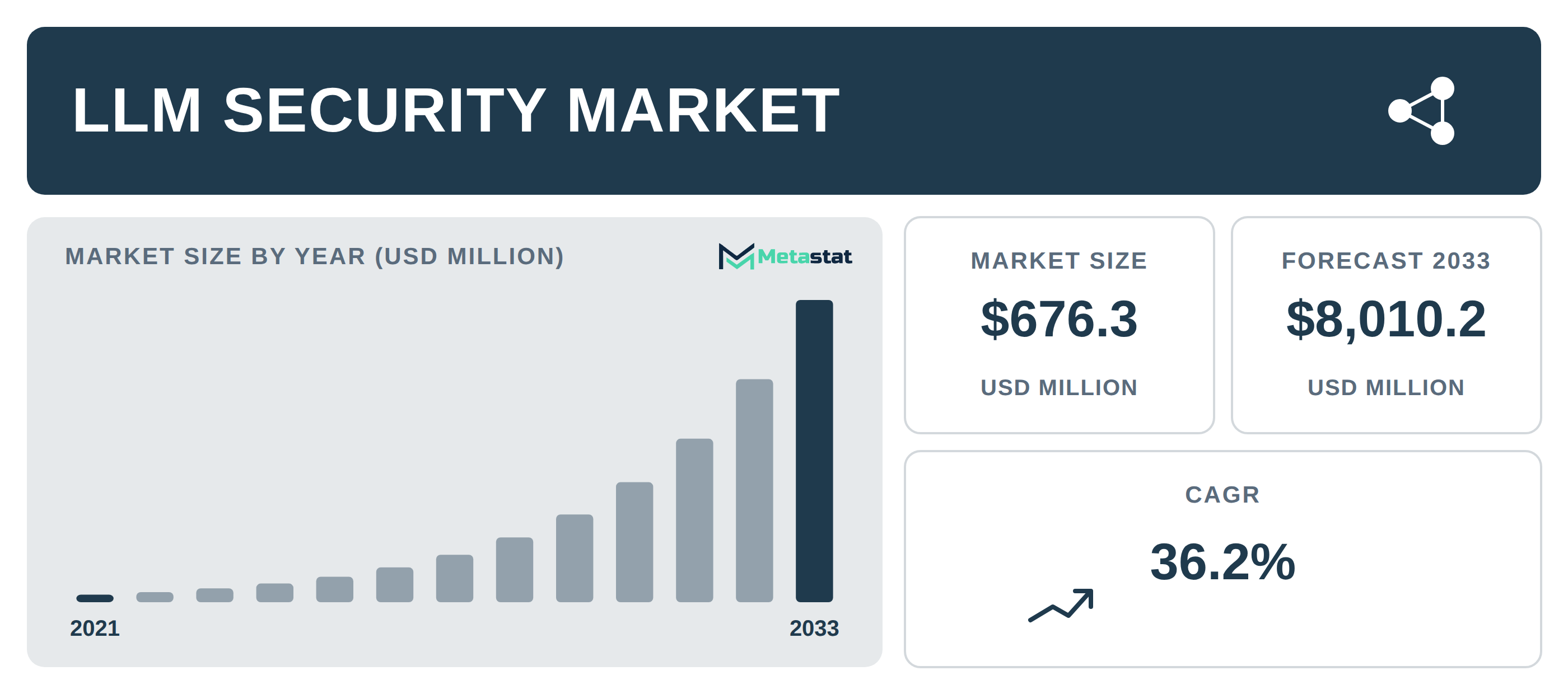
Metastat Insights reports that the global LLM Security market is expected to grow from USD 676.3 million in 2025 to USD 8,010.2 million by 2033, reflecting a CAGR of 36.2%. Demand is driven by the need for advanced security solutions across various sectors.
Metastat Insights has published "Global LLM Security Market Size, Share, By Solution Type (LLM Firewall and Runtime Protection, AI Red Teaming and Vulnerability Scanning, AI Security Posture Management, Model and Supply Chain Security, Data Loss Prevention and Sensitive Information Detection, AI Governance and Compliance Management, Shadow AI Discovery and Access Control, Others), By Security Layer (Input/Prompt-Level Security, Output/Response-Level Security, Model-Level Security, Infrastructure and API-Level Security, Agentic and Tool-Use Security), By Deployment Model (Cloud-Native/SaaS, On-Premises, Hybrid), By Organization Size (Large Enterprises and Small and Medium Enterprises), Industry Analysis, Growth, Trends, and Forecast, 2026-2033", followed by the headline figures (USD 676.3 million in 2025, USD 8,010.2 million by 2033, 36.2% CAGR).
The LLM Security market experiences substantial growth due to the increasing integration of advanced security solutions across various industries. Organizations are investing heavily in security technologies to combat the rising threats from cyberattacks, particularly in sectors including finance and healthcare. The market is expected to benefit from ongoing digital transformation initiatives, which further accelerate the demand for LLM security solutions. Firms prioritize operational efficiency and compliance with regulatory standards, making the shift toward comprehensive security measures more pronounced. This trend is reflected in the projected growth of key segments, including LLM Firewall and Runtime Protection, which is expected to expand significantly.
Regulatory hurdles present significant challenges to the LLM Security market. Compliance requirements associated with various legal mandates create barriers for organizations aiming to implement advanced security solutions. These constraints lead to increased operational costs and restrict budget allocations for innovative technologies, ultimately slowing market penetration. Geopolitical factors and macroeconomic headwinds contribute to an uncertain investment landscape, complicating the adoption of LLM security measures. Companies face difficulties accessing the latest technologies due to supply chain disruptions and talent shortages, which hinder their ability to maintain effective security frameworks.
The LLM Security market is segmented by solution type, security layer, deployment model, and organization size. Key segments include AI Red Teaming and Vulnerability Scanning, alongside Model and Supply Chain Security, which are poised for significant growth. Regionally, North America leads with a substantial market share, expected to reach USD 3,003.8 million by 2033. Europe and the Asia Pacific follow, with shares of 25.3% and 24%, respectively. This diversification highlights the market's adaptability to varying regional demands and regulatory environments.
The competitive environment of the LLM Security market features a diverse array of established and emerging players, driving innovation and enhancing service offerings. Companies including Amazon Web Services, IBM, and Palo Alto Networks actively develop solutions to address evolving security challenges. The market encourages strategic partnerships and collaborations, which further strengthen the overall value chain. This dynamic environment ensures that organizations have access to a variety of tailored security solutions designed to meet their specific needs.
For a detailed analysis of the market dynamics and forecasts, readers are invited to explore the full report: Global LLM Security Market.
Related Report
Global LLM Security MarketLEAD ANALYST
Utkarsh Khirodkar is a Lead Market Research Analyst at MetaStat Insight, specializing in market intelligence, technology sector assessments, and competitive strategy.

PRINCIPAL CONSULTANT - ENTERPRISE AI & EMERGING TECHNOLOGIES
Banking & Finance · Electronics and Semiconductor · Energy and Power · Healthcare IT · Information & Technology · Professional Services
Vijay Gunti is a Principal Consultant at MetaStat Insight, bringing over two decades of experience across enterprise digital transformation, technology strategy, and intelligent systems.

LEAD CONSULTANT - COMMUNICATION, TELECOM, AND IT
Electronics and Semiconductor · Information & Technology · Machinery & Equipment · Professional Services
Ravindra Sathe Consultants for Communication, Telecom, and IT at MetaStat Insight. He leads the firm's industry research initiatives across telecommunications infrastructure, digital connectivity, enterprise networking, and emerging information technology domains.