
LEAD ANALYST
Utkarsh Khirodkar is a Lead Market Research Analyst at MetaStat Insight, specializing in market intelligence, technology sector assessments, and competitive strategy.

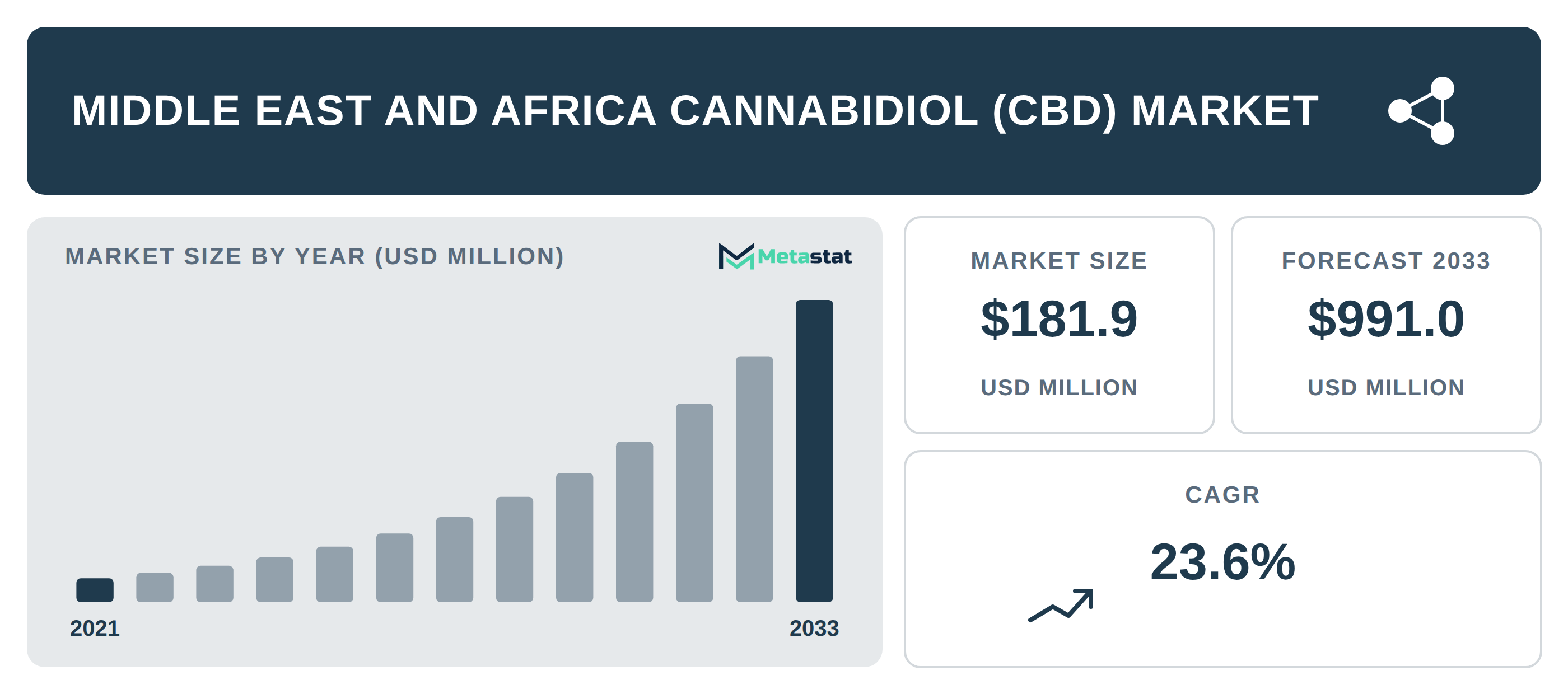
Metastat Insights has released a new report on the Middle East and Africa Cannabidiol (CBD) market, projecting growth from USD 181.9 million in 2025 to USD 991 million by 2033, with a CAGR of 23.6%. The report analyzes key drivers, challenges, market segmentation, and prominent players in the region.
Metastat Insights has published "Middle East and Africa Cannabidiol (CBD) Market Size, Share, By Product Type (CBD Oils and Tinctures, CBD Capsules and Tablets, CBD Edibles, CBD Topicals, CBD Beverages, CBD Vapes and Inhalation Products, CBD Pet Products, CBD Teas and Infusions), By CBD Formulation (Full-Spectrum CBD, Broad-Spectrum CBD, CBD Isolate, CBD-Dominant Cannabinoid Blends), By Application (Pharmaceutical and Medical, Nutraceuticals and Dietary Supplements, Personal Care and Cosmetics, Food and Beverages, Pet Care), By Region (South Africa, Zimbabwe, Morocco, United Arab Emirates, Rest of Middle East and Africa), Industry Analysis, Growth, Trends, and Forecast, 2026-2033", indicating that the Middle East and Africa Cannabidiol (CBD) market was valued at USD 181.9 million in 2025 and is expected to reach USD 991 million by 2033, growing at a compound annual growth rate (CAGR) of 23.6%.
Increasing consumer awareness of the health benefits associated with CBD is a major factor driving market growth. Individuals focused on health and wellness are seeking products that promote well-being, leading to a surge in interest surrounding CBD's therapeutic properties. Enhanced access to information through digital platforms contributes to informed consumer choices regarding health products. The shift towards natural alternatives to conventional pharmaceuticals leads to increased acceptance of CBD-infused items, appealing to a broad range of consumers.
Regulatory obstacles present significant challenges to market growth. A complex regulatory framework complicates product approval processes, impacting new entrants' ability to meet compliance standards. These challenges result in substantial financial burdens for companies aiming to launch CBD products, which in turn raises operational costs. Geopolitical instability in certain regions disrupts supply chains, causing uncertainty and deterring potential investments.
The market for Cannabidiol (CBD) in the Middle East and Africa is categorized by product type into CBD oils and tinctures, CBD capsules and tablets, CBD edibles, CBD topicals, CBD beverages, CBD vapes and inhalation products, CBD pet products, and CBD teas and infusions. CBD oils and tinctures hold the largest market share at 27.7%, followed by CBD topicals at 15% and CBD capsules and tablets at 14%. Regionally, significant growth opportunities exist in South Africa, Zimbabwe, Morocco, and the United Arab Emirates, where consumer demand aligns closely with product availability.
Several companies operate within the Middle East and Africa Cannabidiol (CBD) market, including Elixinol, Medical Marijuana, Inc., Progress Biolabs, Canna Mist, The Cannabis Co., Palesa CBD, Nativa, and Vondi's Holistic Pet Care. These companies contribute to a diverse range of products and actively pursue strategic partnerships and innovations to improve their market presence. Firms that prioritize sustainable practices and technological advancements are positioned to gain a competitive advantage in this evolving sector.
To explore the comprehensive insights and detailed analysis of the Middle East and Africa Cannabidiol (CBD) market, visit the full report: Middle East and Africa Cannabidiol (CBD) Market.
Related Report
Middle East and Africa Cannabidiol (CBD) MarketLEAD ANALYST
Utkarsh Khirodkar is a Lead Market Research Analyst at MetaStat Insight, specializing in market intelligence, technology sector assessments, and competitive strategy.

SENIOR RESEARCH ANALYST
Biotechnology · Food and Beverages · Medical Devices · Packaging
Snehal Pasalkar is a Research Analyst at MetaStat Insight, operating at the intersection of life sciences research, competitive strategy, and market intelligence.