
LEAD ANALYST
Utkarsh Khirodkar is a Lead Market Research Analyst at MetaStat Insight, specializing in market intelligence, technology sector assessments, and competitive strategy.

Metastat Insights' report reveals the Mobility Technologies market is expected to grow from USD 7 billion in 2025 to USD 30.5 billion by 2033, driven by urbanization and advancements in technology.
Metastat Insights has published "Global Mobility Technologies Market Size, Share, By Technology Type (Connected Vehicle Solutions, Telematics and Fleet Management Solutions, Mobility-as-a-Service Technologies, Autonomous Driving Solutions, Artificial Intelligence and Mobility Analytics, Digital Mapping and Navigation Solutions, Digital Payment Solutions, and Vehicle-to-Everything Communication Technologies), By Mobility Solution Type (Ride-Hailing Services, Vehicle Rental, Leasing and Subscription Services, Car-Sharing Services, Carpooling Services, Micromobility Solutions, Parking Solutions, and Fleet Mobility Solutions), By Deployment Model (Cloud-Based, On-Premise, Hybrid, and Embedded), By End User (Individual Consumers, Corporate and Enterprise Customers, Fleet Operators, Transportation and Logistics Companies, Government and Public-Sector Organizations, and Travel and Hospitality Providers), Industry Analysis, Growth, Trends, and Forecast, 2026-2033", followed by the headline figures (USD 7 billion in 2025, USD 30.5 billion by 2033, 20.2% CAGR).
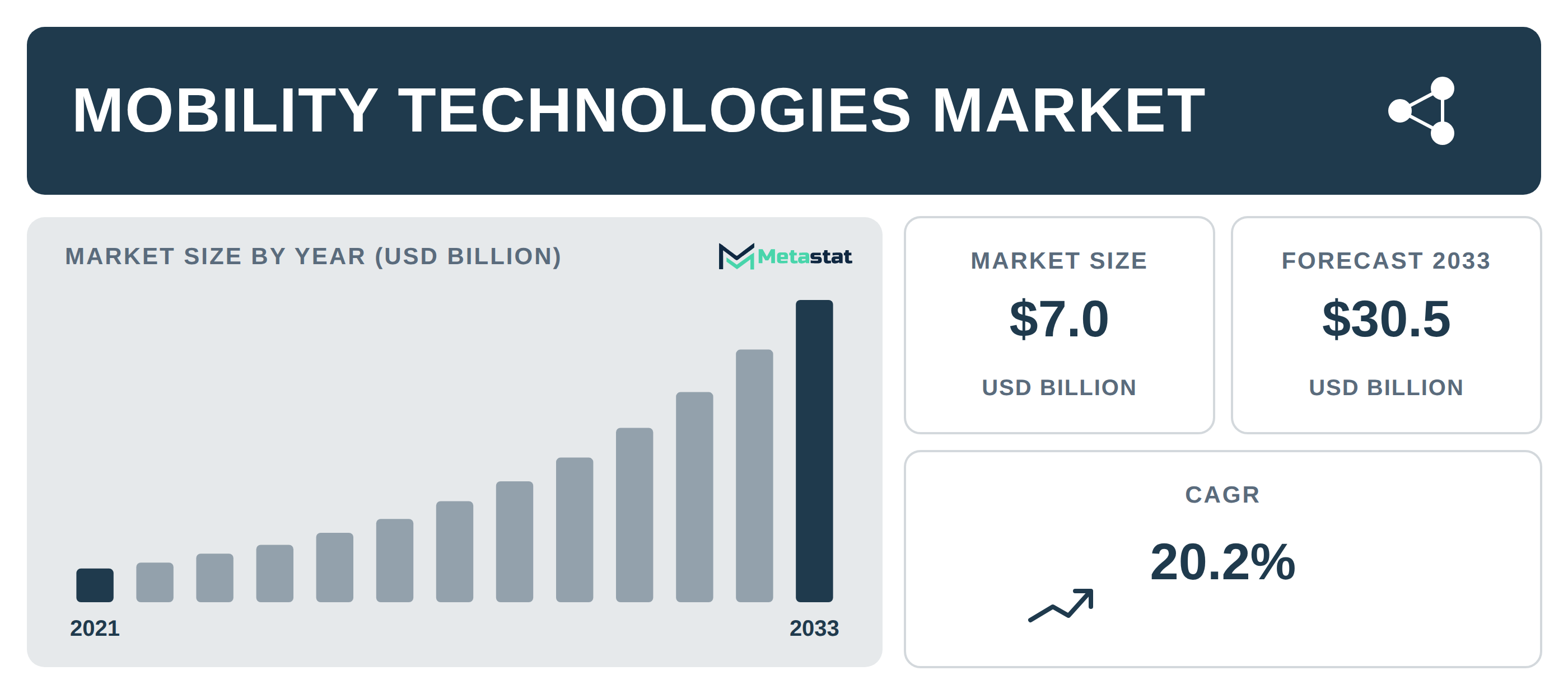
The Mobility Technologies market is experiencing significant expansion, driven by increasing urbanization and heightened consumer demand for effective transportation solutions. The market reached a valuation of USD 7 billion in 2025, with projections indicating a rise to USD 30.5 billion by 2033. Enhanced integration of artificial intelligence and machine learning within mobility solutions further stimulates market growth. Companies allocate substantial resources to research and development, focusing on innovation and user experience improvements, intensifying competition.
Regulatory compliance presents notable challenges in the Mobility Technologies sector. Stringent regulations require businesses to invest heavily in compliance measures, which restrict smaller firms from entering the market. Supply chain disruptions and increasing material costs complicate operational processes, impacting overall market growth. Geopolitical factors contribute to trade deficits, making global supply chains more complex and driving up costs, which adversely affects market performance.
The Mobility Technologies market is divided into segments based on technology type, mobility solution type, deployment model, and end user. Notable segments include Connected Vehicle Solutions, projected to grow from USD 1.9 billion in 2026 to USD 6.6 billion by 2033, and Telematics and Fleet Management Solutions, expected to reach USD 4.3 billion by 2033. North America currently leads the market with a 38.4% share, followed by Asia Pacific and Europe at 34.7% and 21.8% respectively.
Numerous companies operate within the Mobility Technologies market, including Tesla, BMW Group, Ford Motor Company, and Toyota, Inc. These organizations invest in innovative technologies to maintain a competitive edge. Continued collaboration and strategic partnerships among these players enhance growth and help tackle market challenges, including compliance and operational efficiency.
For more detailed insights and comprehensive analysis, readers access the full report: Global Mobility Technologies Market.
Related Report
Global Mobility Technologies MarketLEAD ANALYST
Utkarsh Khirodkar is a Lead Market Research Analyst at MetaStat Insight, specializing in market intelligence, technology sector assessments, and competitive strategy.

ENERGY & INFRASTRUCTURE INDUSTRY CONSULTANT
Automotive and Transportation · Electronics and Semiconductor · Energy and Power · Machinery & Equipment
Saurabh Vasant Ganvir consults for Energy & Infrastructure Industry at MetaStat Insight, specializing in renewable energy, solar EPC, and electric vehicle (EV) infrastructure markets.