
LEAD ANALYST
Utkarsh Khirodkar is a Lead Market Research Analyst at MetaStat Insight, specializing in market intelligence, technology sector assessments, and competitive strategy.

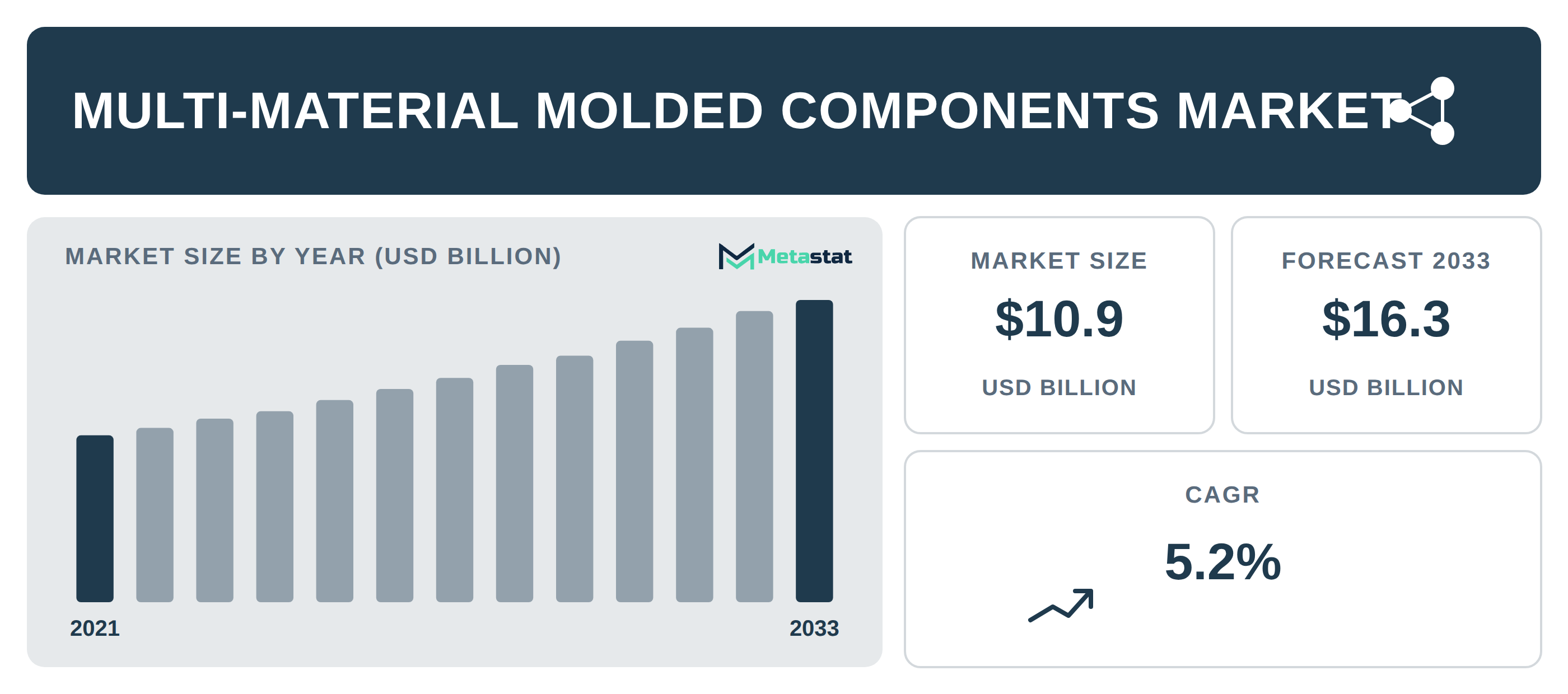
Metastat Insights announces the release of the Global Multi-Material Molded Components market report. The market is projected to grow from USD 10.9 billion in 2025 to USD 16.3 billion by 2033, at a CAGR of 5.2%. Key drivers include advancements in molding processes and material combinations across various industries.
Metastat Insights has published "Global Multi-Material Molded Components Market Size, Share, By Molding Process (Multi-Shot and Multi-Component Injection Molding, Sequential Overmolding, Insert Molding, In-Mold Assembly, Other Methods), By Material Combination (Thermoplastic with Thermoplastic, Thermoplastic with TPE/TPU, Thermoplastic with Silicone/LSR, Plastic with Metal, Rubber/Elastomer with Metal, Plastic with Glass/Ceramic, Others), By Component Function (Sealing and Fluid Management Components, Electrical and Electronic Components, Structural Components, Ergonomic Components, Impact-Damping Components, Optical and Display Components, Decorative Components, Thermal Management Components, Others), By End-Use Industry (Automotive, Medical, Electrical, Consumer Products, Industrial Equipment, Packaging, Construction, Aerospace, Others), Industry Analysis, Growth, Trends, and Forecast, 2026-2033", highlighting key figures of USD 10.9 billion in 2025 and projected growth to USD 16.3 billion by 2033, reflecting a CAGR of 5.2%.
The Multi-Material Molded Components market experiences significant growth driven by advancements in molding processes and material combinations. These innovations enhance product capabilities while reducing manufacturing costs, making it attractive to various industries, particularly automotive and healthcare. The automotive sector is set to expand from USD 3.4 billion in 2026 to USD 4.5 billion by 2033, reflecting strong demand for lightweight and durable components. The healthcare industry increasingly adopts multi-material components for specialized applications, further contributing to overall market growth.
Despite the growth potential, the Multi-Material Molded Components market faces challenges including supply chain disruptions and inflationary pressures that impact material costs. These challenges compel companies to adapt through strategic investments in research and development to create innovative solutions. Regulatory compliance and geopolitical risks introduce further complexity, necessitating agile responses from manufacturers to ensure stability in sourcing and logistics. Such factors inhibit growth trajectories, particularly for smaller firms that struggle with high compliance costs and funding.
The market segmentation reveals various dynamics across different molding processes, material combinations, and component functions. The Multi-Shot and Multi-Component Injection Molding segment is projected to lead with a growth from USD 3.6 billion in 2026 to USD 5.5 billion by 2033. Regionally, the Asia Pacific holds the largest market share at 38.4%, followed by North America at 28.8% and Europe at 23.8%. North America is anticipated to reach a market value of USD 4.4 billion by 2033, supported by continuous investments in manufacturing technology.
Several key players influence the Multi-Material Molded Components market, including MI Integration, Techniplas, and the Röchling Group. These companies focus on innovation and strategic partnerships, enhancing their competitive positioning. Their investments in advanced manufacturing technologies align with the market's shift towards sustainability and efficiency, positioning them well for future growth.
For in-depth insights, readers are invited to explore the full report at Global Multi-Material Molded Components Market.
Related Report
Global Multi-Material Molded Components MarketLEAD ANALYST
Utkarsh Khirodkar is a Lead Market Research Analyst at MetaStat Insight, specializing in market intelligence, technology sector assessments, and competitive strategy.

INDUSTRY CONSULTANT - CHEMICALS & ADVANCED MATERIALS
Chemicals and Materials · Machinery & Equipment · Packaging
Amit Gadhekar Consultant for Chemicals and Materials at MetaStat Insight, directing sector-specific intelligence, research, and strategic consulting across global chemical and processing markets.