
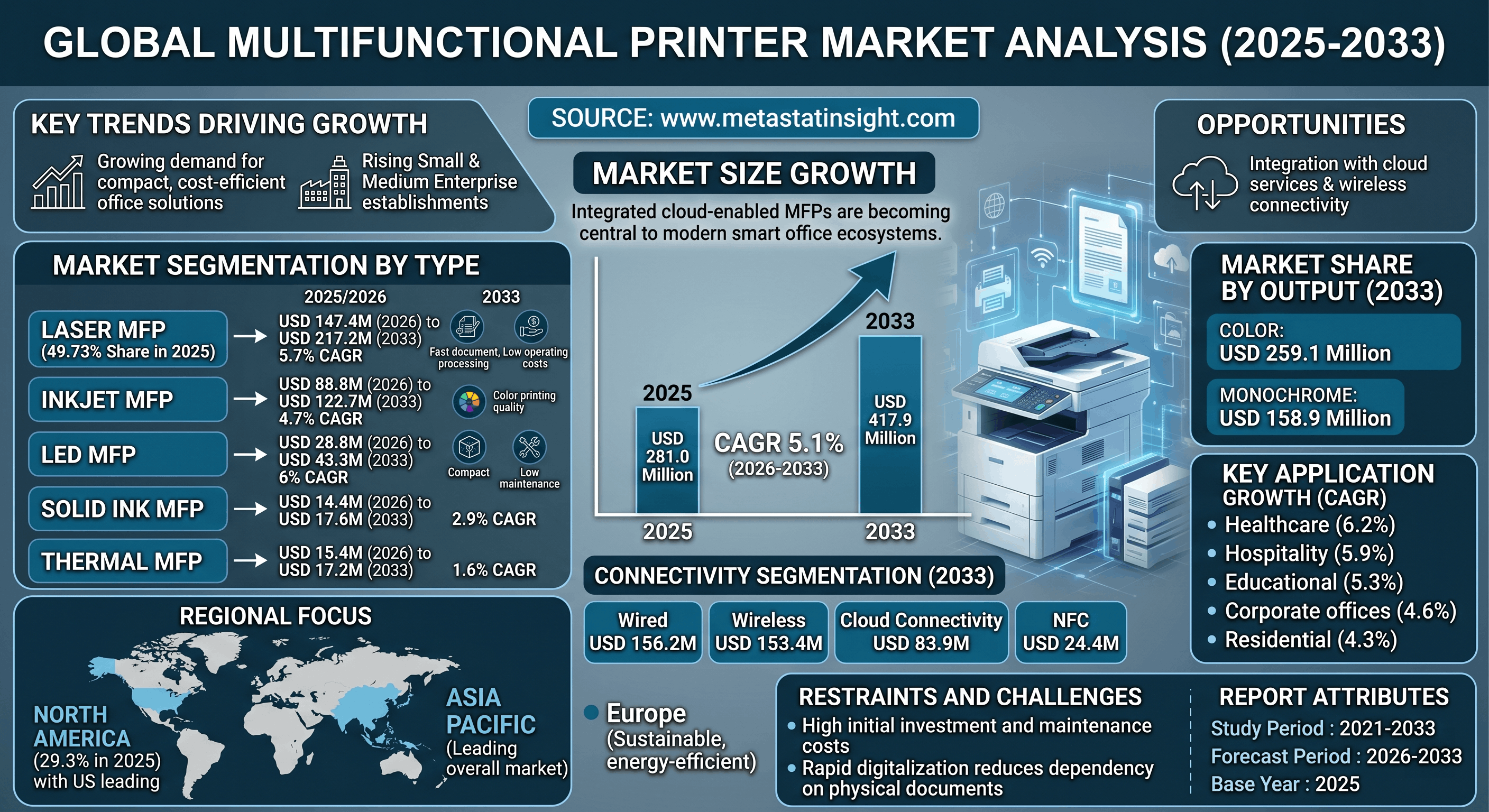
The global landscape for office automation is undergoing a significant transformation, with the Global Multifunctional Printer Market valued at USD 281.0 million in 2025. According to a comprehensive data-driven analysis published by Metastat Insights, this industry is on a definitive trajectory to achieve a valuation of USD 417.9 million by 2033. This growth represents a steady Compound Annual Growth Rate (CAGR) of 5.1% during the forecast timeline spanning from 2026 to 2033.
The comprehensive strategic outlook emphasizes that modern corporate environments are shifting rapidly toward versatile, consolidated documentation hardware. By integrating printing, photocopying, document scanning, and archival tracking into unified physical frameworks, organizations are realizing significant space optimizations and severe operational cost savings.
Dominant Architectures and Growth Formats
The research segmentations provide deep financial insights into specific device topologies shifting within the ecosystem:
-
Laser Multifunctional Printers: Holding a commanding presence, this segment secured a 49.73% market share in 2025. It is projected to scale from USD 147.4 million in 2026 to USD 217.2 million by 2033 at a notable CAGR of 5.7%. This sustained traction is heavily supported by large corporate entities, financial institutions, and logistics firms that demand uninterrupted document processing speeds and minimal per-page expenses.
-
Inkjet Multifunctional Printers: Valued at USD 88.8 million in 2026, this trajectory is expected to scale to USD 122.7 million by 2033 at a CAGR of 4.7%, satisfying the color-accuracy expectations of boutique studios, residential workspaces, and small-scale operations.
-
LED Multifunctional Printers: Emerging as an efficient alternative, this category is expected to surge from USD 28.8 million in 2026 to USD 43.3 million by 2033, reflecting the fastest segment growth at a CAGR of 6.0%.
-
Solid Ink & Thermal Technology: The solid ink category will expand modestly from USD 14.4 million in 2026 to USD 17.6 million by 2033 (2.9% CAGR) due to its sustainable footprint. Meanwhile, specialized thermal systems integral to retail barcode generation and medical invoicing will scale from USD 15.4 million to USD 17.2 million by 2033 (1.6% CAGR).
Core Market Dynamics & Evolution Markers
-
Catalysts for Advancement: A key factor driving this sector forward is the expanding footprint of startups, co-working environments, and small-to-medium enterprises (SMEs) that necessitate multi-role document infrastructure. Furthermore, severe workspace limits across bustling urban business hubs are forcing a migration toward hyper-compact, versatile setups.
-
Industry Constraints: Conversely, upfront procurement capital and lingering maintenance contract expenses pose adoption challenges for small, budget-conscious groups. Concurrently, the pervasive rise of electronic signatures, paperless archival systems, and cloud storage structures reduces standard print volume dependencies, pushing manufacturers to invent cross-functional digital-to-analog hybrids.
-
Avenues of Opportunity: Future expansion will rely on sophisticated internal engineering. The integration of advanced cloud storage synchronization, secure wireless hubs, artificial intelligence-driven document handling, and automated predictive maintenance loops are presenting new, high-value avenues for market participants.
Output, Connectivity, and End-User Frameworks
The shift in deployment metrics is heavily impacting output variants. While monochrome systems are projected to climb to USD 158.9 million by 2033 at a 3.9% CAGR, the demand for vibrant corporate branding and marketing materials will drive the color output sector to USD 259.1 million by 2033 at a faster 5.9% CAGR.
From a network connectivity perspective, physical infrastructures remain highly relevant due to secure, centralized data management pipelines, with wired setups forecasted to hit USD 156.2 million by 2033. However, mobile workspaces are narrowing the gap; wireless architectures are slated to reach USD 153.4 million, while standalone cloud connectivity modules will touch USD 83.9 million, and close-range Near Field Communication (NFC) protocols will account for USD 24.4 million by 2033.
On the application front, healthcare networks are leading deployment growth with an estimated 6.2% CAGR, driven by strict patient record management demands. This is closely followed by the hospitality sector at a 5.9% CAGR, educational centers at a 5.3% CAGR, corporate offices at a 4.6% CAGR, and home/residential users tracking at a 4.3% CAGR.
Geographic Landscape
Geographically, North America held a prominent 29.3% market share in 2025, with the United States positioned to spearhead regional developments by 2026 via rapid cloud infrastructure transitions. Europe is steering its market expansion toward ecologically sound, energy-compliant hardware alternatives. Concurrently, the Asia-Pacific region stands as a dominant manufacturing hub, actively propelled by massive public sector digitization programs across India, China, and Southeast Asian business blocks. Emerging territories across South America, the Middle East, and Africa are tracking continuous, steady growth supported by SME infrastructure investments.
About Metastat Insights
Metastat Insights is a premier global market research and strategic consulting firm specializing in data-driven industry intelligence. By delivering comprehensive, highly accurate market studies across various industrial sectors, Metastat Insights empowers enterprises, corporate decision-makers, and global innovators to devise calculated, long-term expansion strategies.
Related Report
View full market research reportAbout the Authors

LEAD ANALYST
Utkarsh Khirodkar is a Lead Market Research Analyst at MetaStat Insight, specializing in market intelligence, technology sector assessments, and competitive strategy.

PRINCIPAL CONSULTANT - ENTERPRISE AI & EMERGING TECHNOLOGIES
Banking & Finance · Electronics and Semiconductor · Energy and Power · Healthcare IT · Information & Technology · Professional Services
Vijay Gunti is a Principal Consultant at MetaStat Insight, bringing over two decades of experience across enterprise digital transformation, technology strategy, and intelligent systems.

PRINCIPAL CONSULTANT - QUALITY SYSTEMS & COMPLIANCE
Electronics and Semiconductor · Machinery & Equipment · Professional Services
Omkar Phadtare is an Industry Consultant at MetaStat Insight, specializing in quality systems, regulatory compliance, and standards benchmarking to drive data-driven market intelligence and strategic industry research.

ENERGY & INFRASTRUCTURE INDUSTRY CONSULTANT
Automotive and Transportation · Electronics and Semiconductor · Energy and Power · Machinery & Equipment
Saurabh Vasant Ganvir consults for Energy & Infrastructure Industry at MetaStat Insight, specializing in renewable energy, solar EPC, and electric vehicle (EV) infrastructure markets.

LEAD CONSULTANT - COMMUNICATION, TELECOM, AND IT
Electronics and Semiconductor · Information & Technology · Machinery & Equipment · Professional Services
Ravindra Sathe Consultants for Communication, Telecom, and IT at MetaStat Insight. He leads the firm's industry research initiatives across telecommunications infrastructure, digital connectivity, enterprise networking, and emerging information technology domains.