
LEAD ANALYST
Utkarsh Khirodkar is a Lead Market Research Analyst at MetaStat Insight, specializing in market intelligence, technology sector assessments, and competitive strategy.

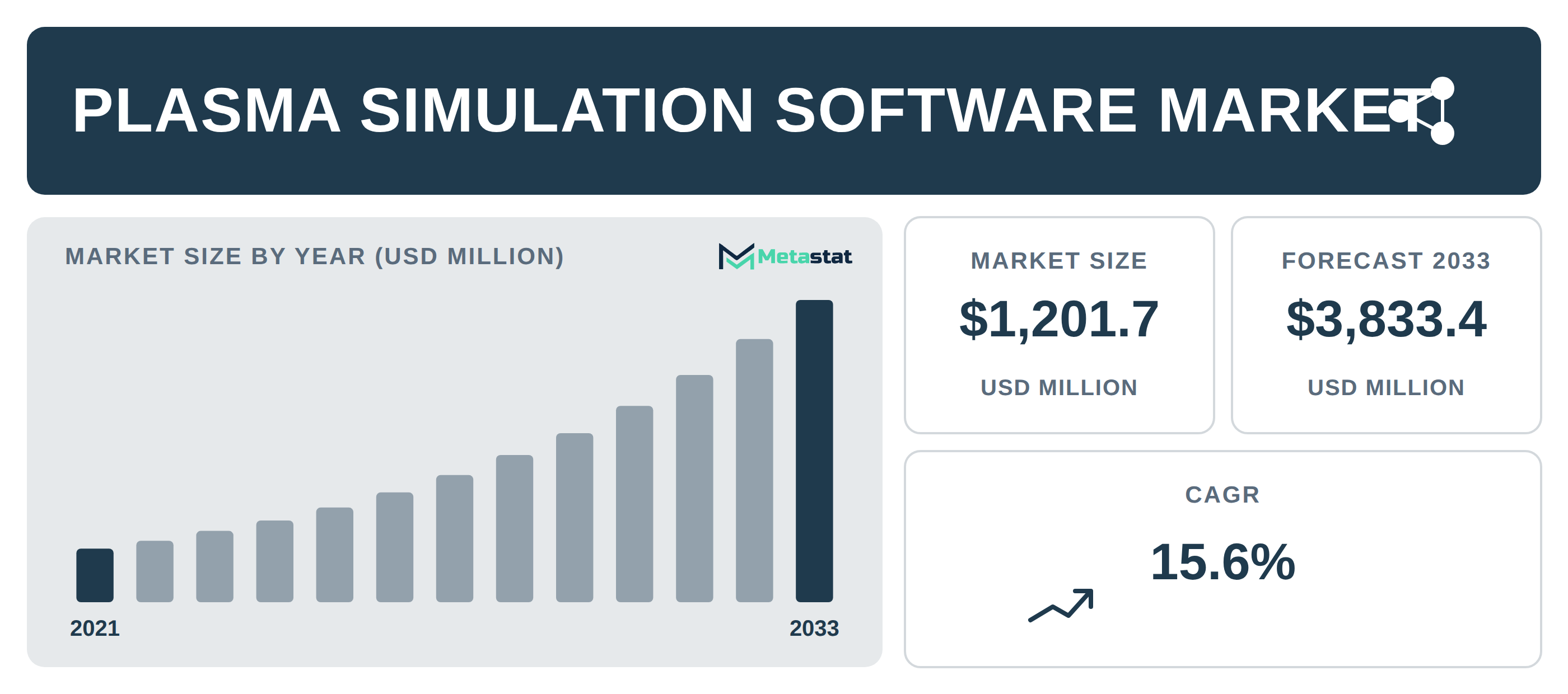
Metastat Insights reveals the Plasma Simulation Software market is valued at USD 1,201.7 million in 2025 and expected to grow at a CAGR of 15.6% to USD 3,833.4 million by 2033. Key drivers include advancements in semiconductor and aerospace industries.
Metastat Insights has published "Global Plasma Simulation Software Market Size, Share, By Simulation Method (Fluid-Based Simulation, Particle-in-Cell (PIC) Simulation, Hybrid Fluid-Kinetic Simulation, and Magnetohydrodynamic (MHD) Simulation), By Deployment Model (On-Premises, Cloud-Based, and Hybrid), By Application (Semiconductor, Aerospace, Scientific Research, and Industrial Processing), By End User (Semiconductor Companies, Aerospace & Defense Companies, Research Institutions, and Industrial Companies), Industry Analysis, Growth, Trends, and Forecast, 2026-2033", highlighting a market value of USD 1,201.7 million in 2025 and a projection to reach USD 3,833.4 million by 2033, expanding at a CAGR of 15.6%.
Demand for Plasma Simulation Software experiences considerable momentum due to technological advancements in the semiconductor and aerospace sectors. These industries are increasingly utilizing advanced simulation software for design, testing, and optimization. Continuous investment in research and development enhances the capabilities of plasma simulation tools, allowing for more accurate modeling of plasma dynamics. This trend is anticipated to improve operational efficiency and lower costs for organizations, positioning simulation software because essential for process optimization.
Despite robust growth, the Plasma Simulation Software market encounters significant challenges related to regulatory compliance and high initial capital investment requirements. Stricter regulations necessitate comprehensive documentation and validation processes, which hinder broader adoption. Economic uncertainties affect capital investment levels, limiting funding availability for new projects. A shortage of skilled professionals complicates implementation efforts, resulting in increased operational costs and extended project timelines.
The Plasma Simulation Software market is categorized by simulation method, deployment model, application, and end user. Key simulation methods include Fluid-Based Simulation, Particle-in-Cell (PIC) Simulation, and Hybrid Fluid-Kinetic Simulation, all experiencing substantial growth driven by technological advancements. Regionally, North America holds the largest share at 39.9%, followed by Europe at 25.7% and Asia Pacific at 24.6%. This distribution highlights the varying dynamics across regions that influence demand and investment strategies.
Significant participants in the Plasma Simulation Software market include Lam Research Corporation, Applied Materials, Inc., COMSOL, Synopsys, Inc. (ANSYS, Inc.), Tech-X Corporation, FAR-TECH INC., Scion Plasma LLC, Wave Front Co., Ltd., boltzplatz - numerical plasma dynamics GmbH, and Redero Trionics Pvt. Ltd. These firms focus on innovation and strategic partnerships to strengthen their competitive positions.
For more in-depth insights, readers access the full report on the Global Plasma Simulation Software Market.
Related Report
Global Plasma Simulation Software MarketLEAD ANALYST
Utkarsh Khirodkar is a Lead Market Research Analyst at MetaStat Insight, specializing in market intelligence, technology sector assessments, and competitive strategy.

PRINCIPAL CONSULTANT - ENTERPRISE AI & EMERGING TECHNOLOGIES
Banking & Finance · Electronics and Semiconductor · Energy and Power · Healthcare IT · Information & Technology · Professional Services
Vijay Gunti is a Principal Consultant at MetaStat Insight, bringing over two decades of experience across enterprise digital transformation, technology strategy, and intelligent systems.

LEAD CONSULTANT - COMMUNICATION, TELECOM, AND IT
Electronics and Semiconductor · Information & Technology · Machinery & Equipment · Professional Services
Ravindra Sathe Consultants for Communication, Telecom, and IT at MetaStat Insight. He leads the firm's industry research initiatives across telecommunications infrastructure, digital connectivity, enterprise networking, and emerging information technology domains.