
LEAD ANALYST
Utkarsh Khirodkar is a Lead Market Research Analyst at MetaStat Insight, specializing in market intelligence, technology sector assessments, and competitive strategy.

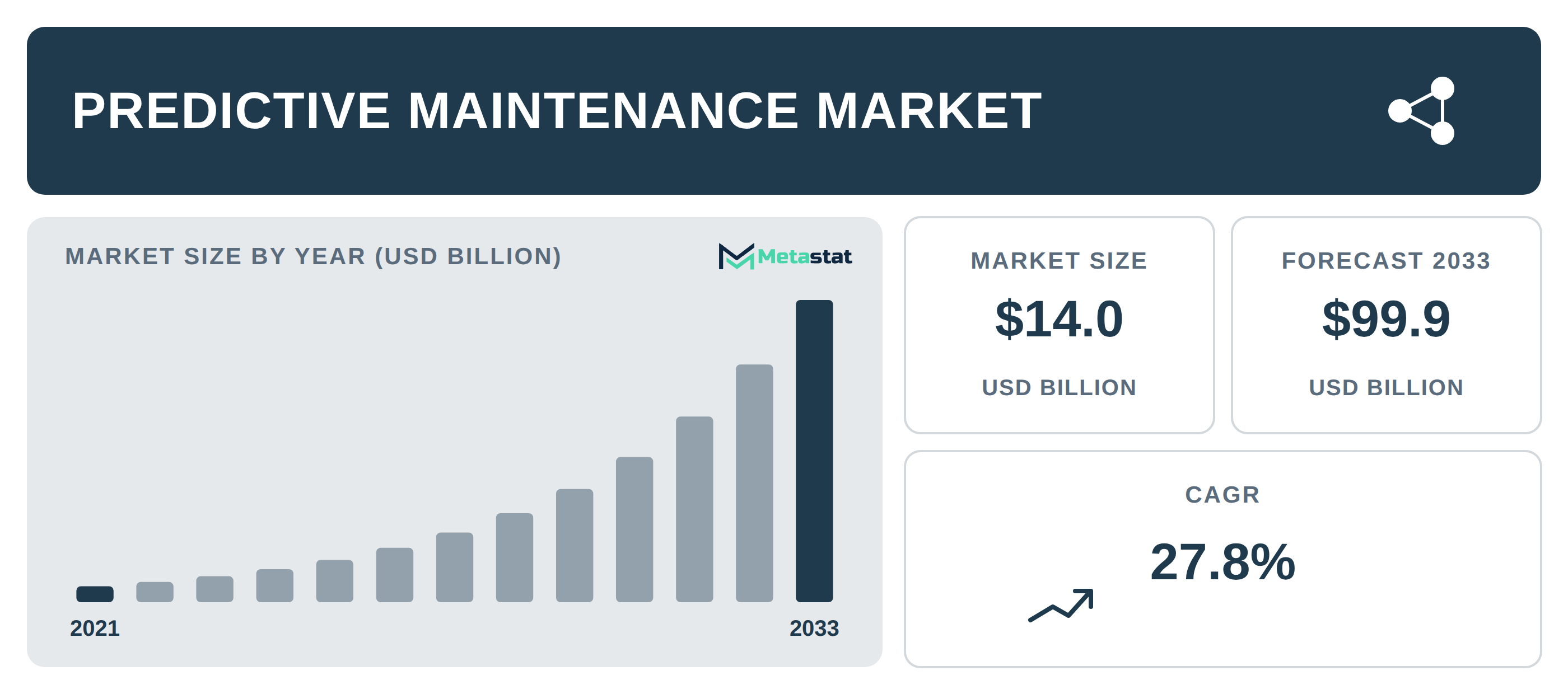
Metastat Insights announces the release of its latest report on the Predictive Maintenance market, forecasting a rise from USD 14 billion in 2025 to USD 99.9 billion by 2033, growing at a CAGR of 27.8%. The report covers market dynamics, segmentation, and key players.
Metastat Insights has published "Global Predictive Maintenance Market Size, Share, By Component (Hardware, Software, and Services), By Deployment Model (Cloud, On-premises, and Hybrid), By Monitoring Technology (Vibration Monitoring, Temperature Monitoring, Acoustic & Ultrasonic Monitoring, Electrical Condition Monitoring, and Others), By End-Use Industry (Discrete Manufacturing, Process Manufacturing, Energy & Utilities, Oil & Gas, Mining & Metals, Transportation & Logistics, Food & Beverage, Water & Wastewater, and Others), Industry Analysis, Growth, Trends, and Forecast, 2026-2033", indicating that the market reached a valuation of USD 14 billion in 2025 and is expected to grow to USD 99.9 billion by 2033, achieving a compound annual growth rate (CAGR) of 27.8% during this period.
Several factors contribute to the expansion of the Predictive Maintenance market, including a growing reliance on AI-driven maintenance procedures and the incorporation of industrial IoT technologies across various sectors. North America represents the largest market share, accounting for 36.2% of the total value in 2025, largely driven by significant investment in advanced manufacturing technologies aimed at improving operational efficiency. Europe and Asia Pacific follow closely, stimulated by increasing demand for predictive maintenance solutions in fields including energy, manufacturing, and transportation.
Challenges related to regulatory compliance heavily impact the Predictive Maintenance market. Stringent regulations elevate both the complexity and cost of implementation for organizations, particularly in sectors like energy and transportation. Macroeconomic pressures, including inflation and resource scarcity, further hinder market growth due to rising operational expenses. Supply chain disruptions stemming from geopolitical factors complicate the availability of essential components, delaying the deployment of predictive maintenance solutions.
The Predictive Maintenance market is segmented by components, deployment models, monitoring technologies, and end-use industries. The software segment is projected to experience the highest growth, reaching USD 42.9 billion by 2033. The hardware segment is anticipated to expand from USD 6.7 billion in 2026 to USD 30 billion by 2033. Cloud deployment models are gaining popularity due to their scalability and accessibility, while on-premises solutions appeal to organizations that prioritize data security. Regionally, North America, Europe, and Asia Pacific collectively dominate the market, showcasing a diverse array of growth opportunities.
Prominent companies operating in the Predictive Maintenance market include Treon, Siemens AG, ABB, Schneider Electric, Emerson Electric Co., Honeywell International Inc., Rockwell Automation, IBM Corporation, SAP SE, and Oracle Corporation. These firms emphasize research and development to innovate and produce next-generation solutions that enhance operational performance and reduce costs.
For further insights and a comprehensive analysis, readers access the full report at Global Predictive Maintenance Market.
Related Report
Global Predictive Maintenance MarketLEAD ANALYST
Utkarsh Khirodkar is a Lead Market Research Analyst at MetaStat Insight, specializing in market intelligence, technology sector assessments, and competitive strategy.

INDUSTRY CONSULTANT - CHEMICALS & ADVANCED MATERIALS
Chemicals and Materials · Machinery & Equipment · Packaging
Amit Gadhekar Consultant for Chemicals and Materials at MetaStat Insight, directing sector-specific intelligence, research, and strategic consulting across global chemical and processing markets.

PRINCIPAL CONSULTANT - QUALITY SYSTEMS & COMPLIANCE
Electronics and Semiconductor · Machinery & Equipment · Professional Services
Omkar Phadtare is an Industry Consultant at MetaStat Insight, specializing in quality systems, regulatory compliance, and standards benchmarking to drive data-driven market intelligence and strategic industry research.

ENERGY & INFRASTRUCTURE INDUSTRY CONSULTANT
Automotive and Transportation · Electronics and Semiconductor · Energy and Power · Machinery & Equipment
Saurabh Vasant Ganvir consults for Energy & Infrastructure Industry at MetaStat Insight, specializing in renewable energy, solar EPC, and electric vehicle (EV) infrastructure markets.

LEAD CONSULTANT - COMMUNICATION, TELECOM, AND IT
Electronics and Semiconductor · Information & Technology · Machinery & Equipment · Professional Services
Ravindra Sathe Consultants for Communication, Telecom, and IT at MetaStat Insight. He leads the firm's industry research initiatives across telecommunications infrastructure, digital connectivity, enterprise networking, and emerging information technology domains.