
LEAD ANALYST
Utkarsh Khirodkar is a Lead Market Research Analyst at MetaStat Insight, specializing in market intelligence, technology sector assessments, and competitive strategy.

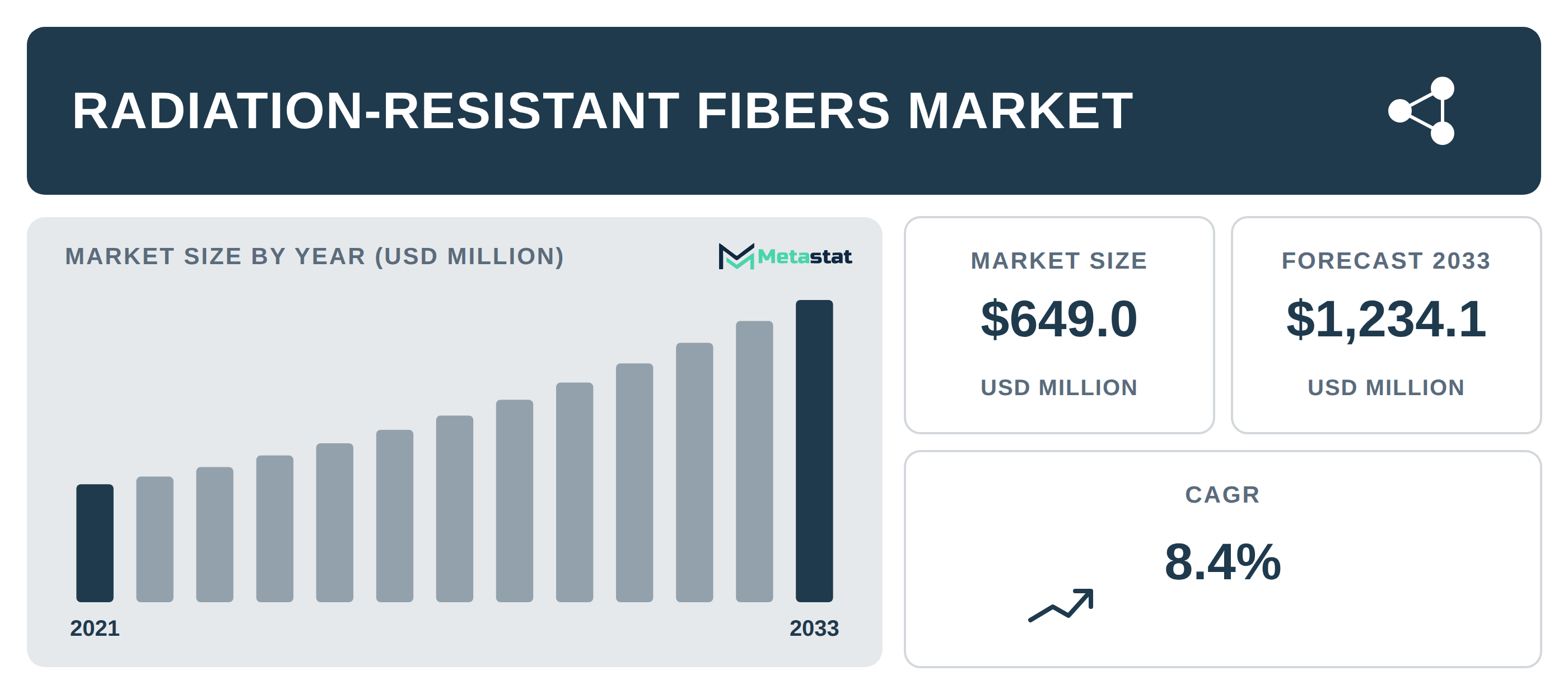
Metastat Insights has released a report on the global Radiation-resistant Fibers market, projecting growth from USD 649 million in 2025 to USD 1,234.1 million by 2033, at a CAGR of 8.4%. The report analyzes key drivers, challenges, segments, and competitive players in the market.
Metastat Insights has published "Global Radiation-resistant Fibers Market Size, Share, By Types (Single-mode Fibers and Multi-mode Fibers), By Applications (Data Transmission and Optical Communications, Distributed Temperature, Strain and Acoustic Sensing, Fiber-Optic Gyroscopes and Navigation, Radiation Dosimetry and Beam Monitoring, Imaging, Inspection and Illumination, Laser Delivery and Optical Amplification, Spectroscopy and Scientific Instrumentation), By End-Use Industry (Nuclear Power and Fuel Cycle, Space and Satellite Systems, Defense and Aerospace Platforms, High-Energy Physics and Research Facilities, Medical and Radiation Therapy Equipment, Oil and Gas and Geophysical Operations, Industrial Processing and Semiconductor Manufacturing), Industry Analysis, Growth, Trends, and Forecast, 2026-2033", followed by the headline figures (USD 649 million in 2025, USD 1,234.1 million by 2033, 8.4% CAGR).
The Radiation-resistant Fibers market experiences growth, driven by increasing demand for high-performance applications across various sectors including nuclear power, aerospace, defense, and medical technology. These industries require specialized fibers that withstand significant levels of radiation and extreme thermal conditions. Continuous advancements in technology contribute to the adoption of these materials, alongside a focus on safety and reliability. Substantial investment in research and development enhances product performance, allowing manufacturers to meet specific customer needs more effectively.
Regulatory challenges and compliance issues present significant obstacles for the Radiation-resistant Fibers market. Stringent environmental and safety regulations impose additional costs and complexities on manufacturers, often requiring extensive testing and certification procedures that delay product development. Smaller companies, in particular, struggle with these requirements, hindering their competitiveness in the market. Macroeconomic factors, including inflation and supply chain disruptions, exacerbate these compliance challenges, leading to increased operational expenses and reduced overall market growth.
The Radiation-resistant Fibers market is segmented by types, including Single-mode and Multi-mode Fibers. The Single-mode Fibers segment is anticipated to grow from USD 432.2 million in 2026 to USD 766.1 million by 2033. Meanwhile, Multi-mode Fibers are projected to reach USD 468 million by 2033. The market divides by applications, which encompass Data Transmission and Optical Communications, Fiber-Optic Gyroscopes, Radiation Dosimetry, and more. Geographically, North America holds a leading position with 40.8% of market share, followed by Europe at 28.4% and Asia Pacific at 25.5%. North America is expected to reach USD 502.2 million by 2033, supported by technological advancements and increased investment in research and development.
The market features numerous players, including AFL Global, Amphenol Fiber Systems International, art photonics GmbH, and Prysmian S.p.A., which contribute to ongoing innovation. The competitive environment encourages strategic mergers and acquisitions among companies aiming to enhance their market position and product offerings. Investment in advanced manufacturing technologies and sustainable practices is essential, enabling firms to optimize costs and improve service delivery while navigating an increasingly complex market landscape.
For an in-depth exploration of the findings, visit the full report: Global Radiation-resistant Fibers Market.
Related Report
Global Radiation-resistant Fibers MarketLEAD ANALYST
Utkarsh Khirodkar is a Lead Market Research Analyst at MetaStat Insight, specializing in market intelligence, technology sector assessments, and competitive strategy.

INDUSTRY CONSULTANT - CHEMICALS & ADVANCED MATERIALS
Chemicals and Materials · Machinery & Equipment · Packaging
Amit Gadhekar Consultant for Chemicals and Materials at MetaStat Insight, directing sector-specific intelligence, research, and strategic consulting across global chemical and processing markets.