
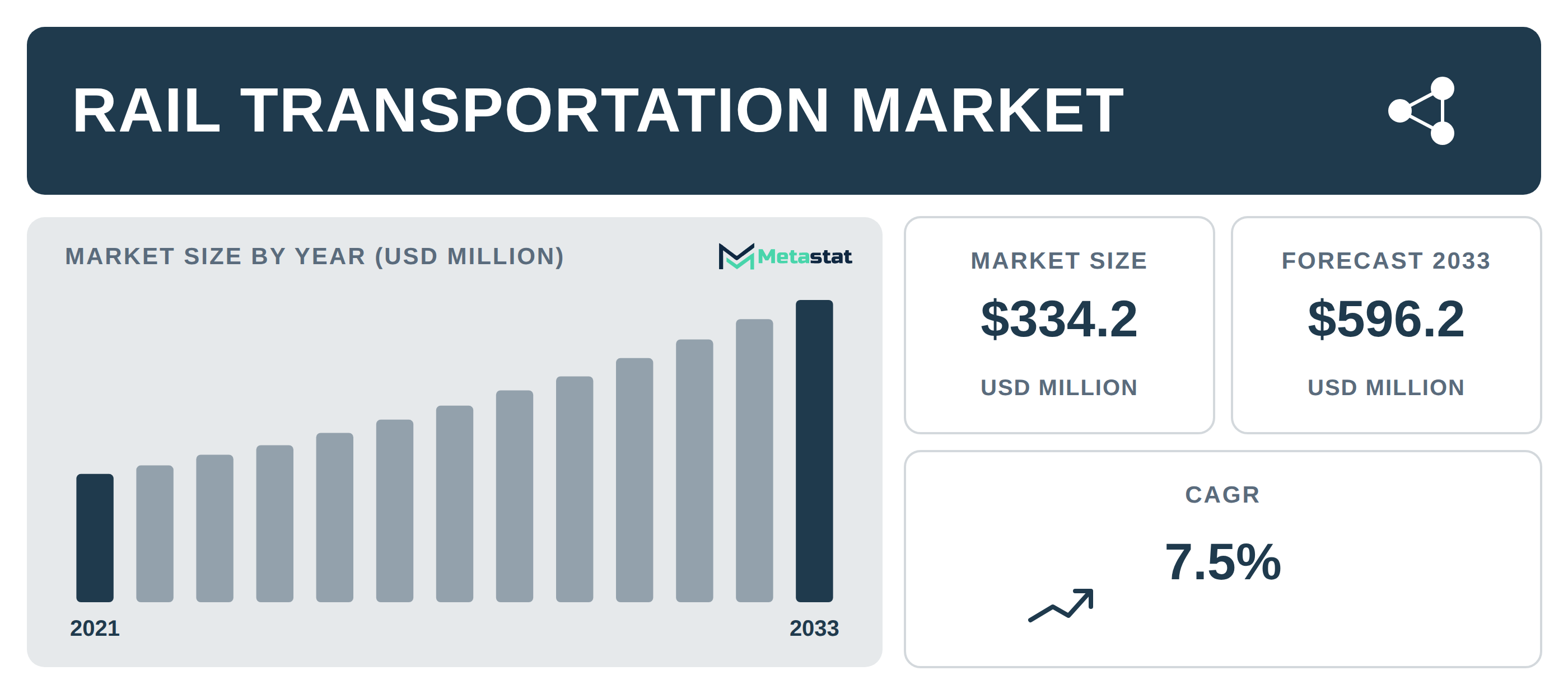
Metastat Insights' latest report reveals the Rail Transportation market, valued at USD 334.2 million in 2025, is projected to grow at a CAGR of 7.5% to USD 596.2 million by 2033, driven by infrastructure investments and urbanization trends.
Metastat Insights has published "Global Rail Transportation Market Size, Share, By Type (Passenger Rail Transport and Rail Freight), By Distance (Long-Distance and Short-Distance), By Destination (Domestic and International), By End-User (Mining, Construction, Agriculture, and Others), Industry Analysis, Growth, Trends, and Forecast, 2026-2033". The Rail Transportation market reached a valuation of USD 334.2 million in 2025 and is anticipated to increase to USD 596.2 million by 2033, reflecting a compound annual growth rate (CAGR) of 7.5% during the forecast period.
What is driving Rail Transportation demand
Investment in modernizing infrastructure significantly contributes to the growth of the Rail Transportation market. Policymakers and private sector entities prioritize enhancements to rail networks, which improve operational safety and efficiency. This focus on infrastructure supports economic growth initiatives and aids the expansion of urban rail systems. Urbanization trends lead to rising demand for effective public transportation options, with rail services presenting a viable alternative amid increasing road congestion. Investments in advanced digital transformation technologies, including automation and integrated software systems, enhance service delivery and attract further investment by lowering operational expenditures.
What is holding back market growth
Challenges within the Rail Transportation market arise from stringent regulatory compliance and geopolitical uncertainties. Increasing regulatory requirements related to safety and emissions add complexity and costs, particularly for smaller market entrants. Broader economic pressures, including inflation and fluctuations in currency, create challenges for industry stakeholders, necessitating flexible strategies to adapt to changing conditions. Risks associated with technological obsolescence are significant, because firms that do not keep pace with innovations lose competitive advantages. The rise of alternative transportation modes introduces substitution risks, complicating the competitive environment.
Market segmentation and regional analysis
The Rail Transportation market is segmented into passenger rail transport, rail freight, long-distance and short-distance services, and both domestic and international destinations. By 2026, the passenger rail segment is projected to be valued at USD 217.8 million, growing to USD 348.7 million by 2033, achieving a CAGR of 7%. In contrast, rail freight is estimated to reach USD 247.4 million by 2033, with an 8.2% CAGR. Regionally, the Asia Pacific area leads the market, accounting for 50.2% of the total share, followed by Europe at 23.8% and North America at 19.9%. Each region demonstrates distinct characteristics influenced by local infrastructure readiness and economic conditions.
Key players in the Rail Transportation market
Competitive dynamics in the Rail Transportation market involve significant players including Deutsche Bahn, BNSF, JSC Russian Railways, Indian Railways, SNCF, Union Pacific Corporation, East Japan Railway Company, and CSX Corporation. These companies engage in various strategies to enhance their capabilities and expand their market presence. Mergers and acquisitions are important in shaping the competitive landscape, because firms seek strategic partnerships to bolster their positions. Companies focus on optimizing their value chains and enhancing customer experiences through technological investments and improved logistics.
For more detailed insights and analysis, readers access the full report on the Global Rail Transportation Market.
Related Report
Global Rail Transportation Market