
LEAD ANALYST
Utkarsh Khirodkar is a Lead Market Research Analyst at MetaStat Insight, specializing in market intelligence, technology sector assessments, and competitive strategy.

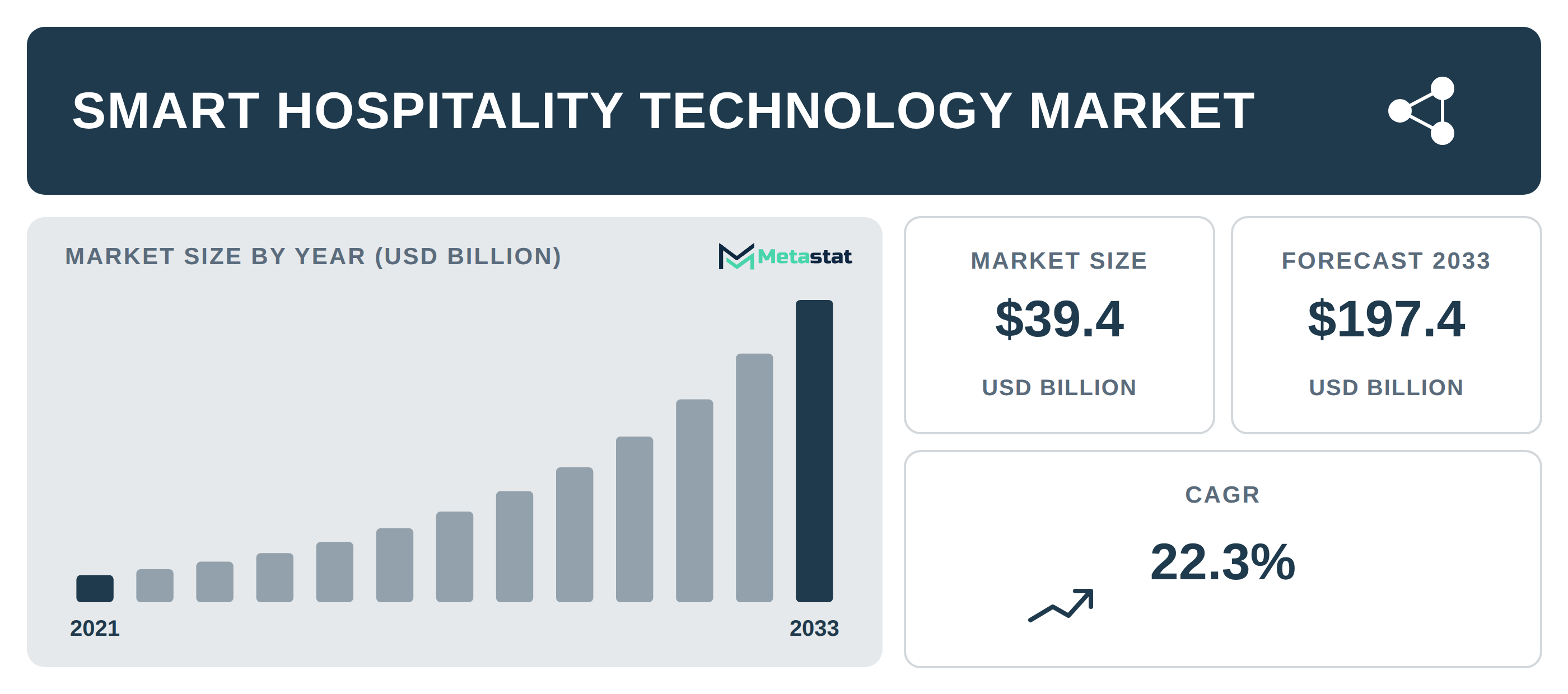
Metastat Insights announces the release of its latest report on the Smart Hospitality Technology market, projected to grow from USD 39.4 billion in 2025 to USD 197.4 billion by 2033, at a CAGR of 22.3%. The report covers key components, segmentation, and market drivers.
Metastat Insights has published "Global Smart Hospitality Technology Market Size, Share, By Component (Software Platforms, Hardware & Connected Devices, Services), By Solution Type (Property Management Systems (PMS), Central Reservation, Booking & Distribution Systems, Revenue Management Systems (RMS), Guest Experience, CRM & Engagement Platforms, Smart Room & In-Room Automation, Access Control & Digital Key Systems, Energy & Building Management Systems, Hotel Connectivity & Network Management, Others (Hospitality POS, Payment Systems, Housekeeping & Service Optimization)), By Accommodation Type (Hotels, Resorts, Serviced Apartments & Aparthotels, Vacation Rentals & Short-Term Rentals, Hostels & Budget Lodging, Other Lodging Properties (Guesthouses, Lodges, Campsites)), Industry Analysis, Growth, Trends, and Forecast, 2026-2033", with key figures indicating the market was valued at USD 39.4 billion in 2025 and is projected to reach USD 197.4 billion by 2033, reflecting a CAGR of 22.3%.
Advancements in technology significantly influence the Smart Hospitality Technology market. The integration of artificial intelligence and automation into hospitality platforms enhances operational efficiency and improves guest interactions. This trend leads to increased satisfaction and loyalty among customers. Hotels increasingly adopt cloud-based property management systems, enabling real-time data access and streamlined operations. Technologies including smart room automation and digital key systems are gaining traction, providing guests with personalized experiences that enhance comfort and security.
Despite the positive trajectory, regulatory challenges present obstacles for the Smart Hospitality Technology market. Compliance with evolving legal mandates requires substantial investments in infrastructure and expertise, diverting resources from innovative projects. Data protection and privacy issues necessitate robust security protocols, which increase operational costs and complicate technology implementation. Inflationary pressures and supply chain disruptions impact capital investments, creating uncertainty and reluctance among businesses to commit to long-term technology strategies.
The Smart Hospitality Technology market is segmented based on components into software platforms, hardware and connected devices, and services. The software platforms segment is projected to grow significantly, driven by the increasing demand for advanced digital solutions that enhance operational efficiency. Hardware and connected devices are expected to experience robust growth, driven by the adoption of smart technologies to optimize guest experiences. Regionally, North America and Europe lead in smart hotel technology adoption, while the Asia Pacific region presents substantial growth opportunities due to rising consumer demand for technology-driven experiences.
Several key players operate within the Smart Hospitality Technology market, including Oracle Corporation, Amadeus IT Group, S.A., and Sabre Corporation. These companies focus on innovating their offerings to meet evolving consumer expectations and enhance service delivery. Other notable players include Infor, Mews Systems B.V., and Cloudbeds. The competitive dynamics among these organizations shape the market, driving advancements that cater to the diverse needs of hospitality providers.
For more insights, visit the full report titled Global Smart Hospitality Technology Market.
Related Report
Global Smart Hospitality Technology MarketLEAD ANALYST
Utkarsh Khirodkar is a Lead Market Research Analyst at MetaStat Insight, specializing in market intelligence, technology sector assessments, and competitive strategy.

PRINCIPAL CONSULTANT - ENTERPRISE AI & EMERGING TECHNOLOGIES
Banking & Finance · Electronics and Semiconductor · Energy and Power · Healthcare IT · Information & Technology · Professional Services
Vijay Gunti is a Principal Consultant at MetaStat Insight, bringing over two decades of experience across enterprise digital transformation, technology strategy, and intelligent systems.

LEAD CONSULTANT - COMMUNICATION, TELECOM, AND IT
Electronics and Semiconductor · Information & Technology · Machinery & Equipment · Professional Services
Ravindra Sathe Consultants for Communication, Telecom, and IT at MetaStat Insight. He leads the firm's industry research initiatives across telecommunications infrastructure, digital connectivity, enterprise networking, and emerging information technology domains.