
LEAD ANALYST
Utkarsh Khirodkar is a Lead Market Research Analyst at MetaStat Insight, specializing in market intelligence, technology sector assessments, and competitive strategy.

Metastat Insights has published a comprehensive report on the Smart Utility Metering market, anticipating growth from USD 30.9 billion in 2025 to USD 58.5 billion by 2033, driven by digitization and sustainability initiatives.
Metastat Insights has published "Global Smart Utility Metering Market Size, Share, By Meter Type (Smart Electricity Meters, Smart Gas Meters, Smart Water Meters, Smart Heat and Cooling Meters and Others), By Component (Smart Meter Hardware, Communication Modules and Data Concentrators, Head-End Systems and Meter Data Management Software, Installation, Integration and Managed Services and Others), By Communication Technology (Radio Frequency Mesh, Cellular, LTE-M and NB-IoT, Power Line Communication, LoRaWAN and Wireless M-Bus), By End-user Application (Residential, Commercial Buildings, Industrial Facilities, Municipal and Public Infrastructure and Others), Industry Analysis, Growth, Trends, and Forecast, 2026-2033", followed by the headline figures (USD 30.9 billion in 2025, USD 58.5 billion by 2033, 8.3% CAGR).
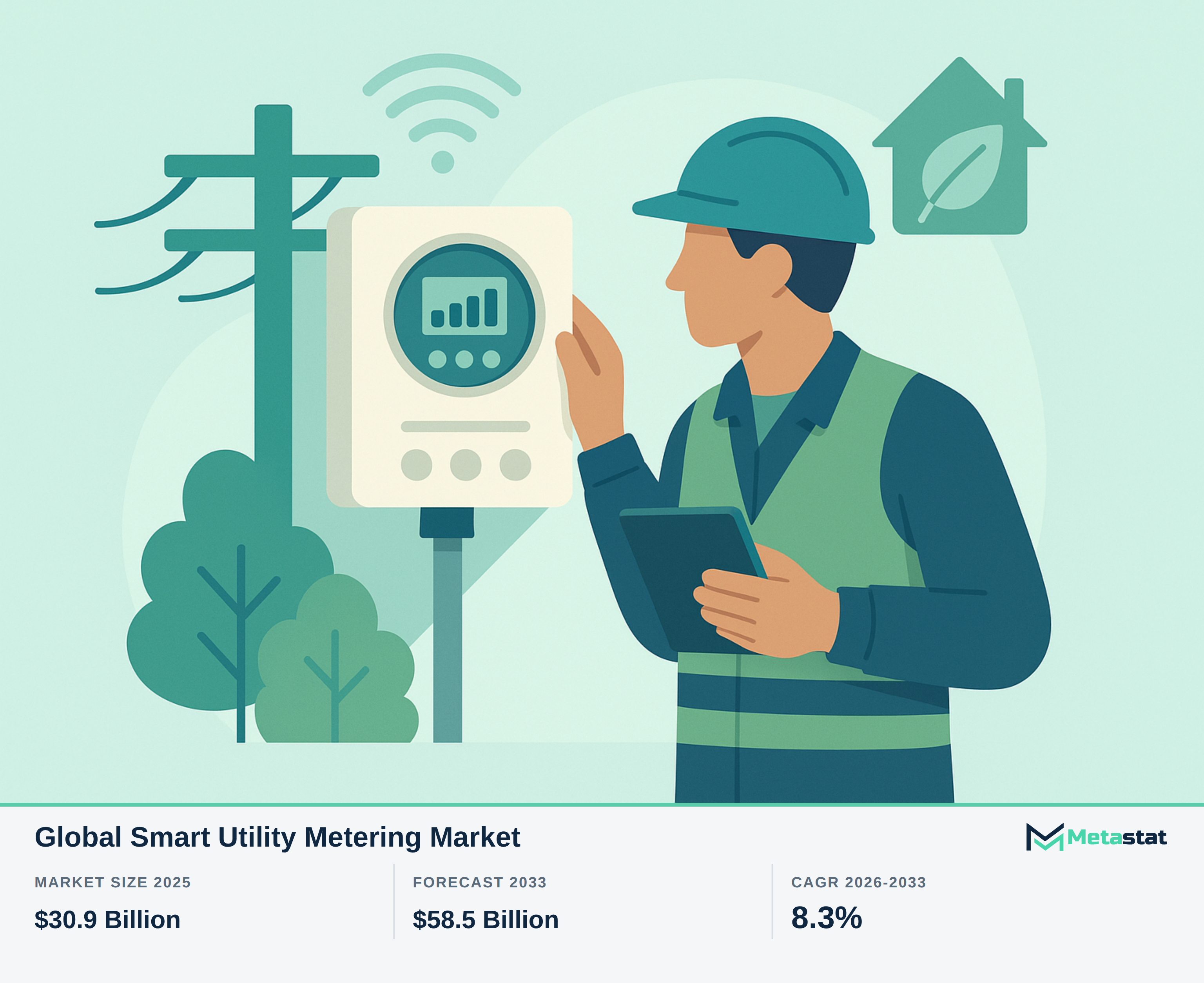
The Smart Utility Metering market experiences significant growth, primarily driven by the increasing digitization of utility operations. Utilities increasingly demand accurate, real-time data on energy and resource consumption. This trend enhances operational efficiency and customer engagement. The adoption of smart metering technologies supports utilities in addressing aging infrastructure challenges and meeting the needs of growing urban populations. Investment in advanced technologies, including artificial intelligence and automation, transforms traditional utility practices, positively impacting operational costs.
Despite growth prospects, the market encounters several challenges. Regulatory tightening often requires substantial investments in technology and infrastructure, which deters smaller players from entering the market. Inflationary pressures contribute to rising operating costs, limiting capital expenditure on new smart metering technologies. Supply chain disruptions hinder manufacturers' ability to meet demand efficiently, affecting project timelines and potential revenue generation. Concerns regarding data security and privacy limit consumer willingness to adopt new solutions.
The Smart Utility Metering market is segmented by meter type, component, communication technology, and end-user application. By meter type, the categories include smart electricity meters, smart gas meters, smart water meters, and smart heat and cooling meters. The market is expected to see substantial growth across these segments, with the smart electricity meters segment projected to grow from USD 18.3 billion in 2026 to USD 30.4 billion by 2033, at a CAGR of 7.6%.
Regional dynamics play a crucial role, with the Asia Pacific leading with a 32.3% market share, followed by North America at 29.8% and Europe at 26.8%. Emerging economies in Asia are rapidly adopting smart utility metering technologies due to urbanization and infrastructure development.
Key players operating in the Smart Utility Metering market include Siemens AG, Itron, Inc., Landis+Gyr Group AG, Honeywell International Inc., Xylem Inc. - Sensus, Kamstrup A/S, and Diehl Metering GmbH. These companies focus on product innovation and strategic partnerships to enhance their market positioning and meet evolving consumer demands.
For a detailed analysis and insights into the Smart Utility Metering market, visit the full report: Global Smart Utility Metering Market.
Related Report
Global Smart Utility Metering MarketLEAD ANALYST
Utkarsh Khirodkar is a Lead Market Research Analyst at MetaStat Insight, specializing in market intelligence, technology sector assessments, and competitive strategy.

PRINCIPAL CONSULTANT - ENTERPRISE AI & EMERGING TECHNOLOGIES
Banking & Finance · Electronics and Semiconductor · Energy and Power · Healthcare IT · Information & Technology · Professional Services
Vijay Gunti is a Principal Consultant at MetaStat Insight, bringing over two decades of experience across enterprise digital transformation, technology strategy, and intelligent systems.

ENERGY & INFRASTRUCTURE INDUSTRY CONSULTANT
Automotive and Transportation · Electronics and Semiconductor · Energy and Power · Machinery & Equipment
Saurabh Vasant Ganvir consults for Energy & Infrastructure Industry at MetaStat Insight, specializing in renewable energy, solar EPC, and electric vehicle (EV) infrastructure markets.