
LEAD ANALYST
Utkarsh Khirodkar is a Lead Market Research Analyst at MetaStat Insight, specializing in market intelligence, technology sector assessments, and competitive strategy.

Metastat Insights reports significant growth in the Smart Waste Management market, projected to reach USD 10.9 billion by 2033, driven by urbanization and technological advancements.
Metastat Insights has published "Global Smart Waste Management Market Size, Share, By Solution Type (Fleet Management, Asset Management, Analytics & Reporting, Customer Management, Smart Bins and Containers, IoT Sensors and RFID, Waste Management Software, Smart Collection & Route Optimization, Automated Sorting & Recycling, and System Integration & Services), By Waste Type (Solid Waste, Hazardous Waste, E-Waste, Organic Waste, Medical Waste, and Others), By Treatment Method (Collection & Transportation, Sorting & Processing, Recycling & Material Recovery, Waste-to-Energy, Biological Treatment, and Landfill & Final Disposal), By End User (Industrial, Commercial, and Residential), Industry Analysis, Growth, Trends, and Forecast, 2026-2033", followed by the headline figures (USD 3.4 billion in 2025, USD 10.9 billion by 2033, 15.4% CAGR).
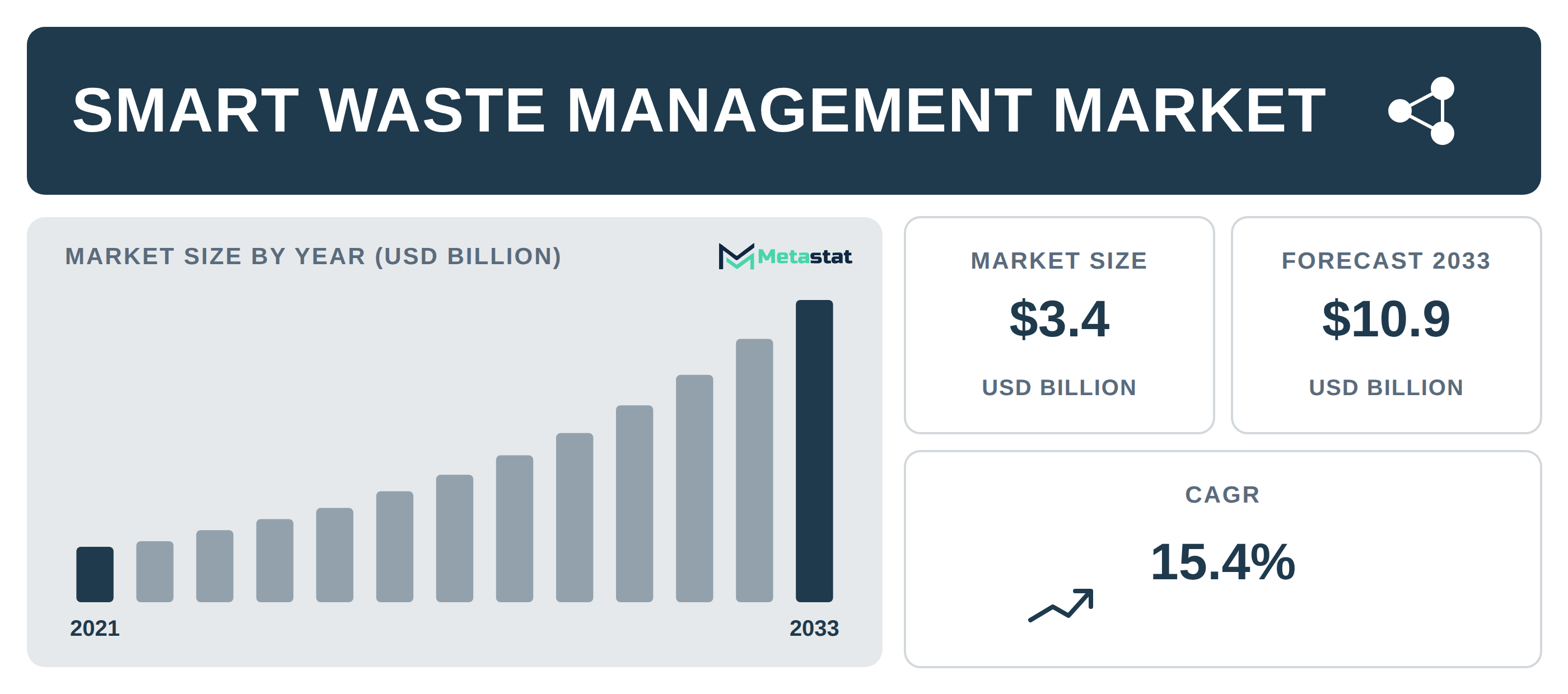
The Smart Waste Management market is experiencing robust demand due to rapid urbanization and increasing population densities. While urban areas expand, the necessity for efficient waste management systems rises significantly. Investment in smart infrastructure, which includes advanced technologies like IoT sensors and data analytics, enhances operational efficiency. Organizations recognize that integrating these technologies streamlines waste collection processes while contributing to sustainability goals, creating substantial growth opportunities.
Regulatory compliance challenges hinder growth in the Smart Waste Management market. Increasing environmental regulations add operational complexity for companies, requiring extensive investments in compliance systems. This situation escalates costs for both new entrants and established players, limiting their competitiveness. Economic fluctuations further complicate the landscape, creating uncertainty that affects capital availability for investment in innovative waste management technologies.
The Smart Waste Management market segments into various categories including solution type, waste type, treatment method, and end user. Regional dynamics significantly influence market performance, with North America holding the largest share at 37.2%, followed by Europe at 30.1% and the Asia Pacific region at 20.8%. The Fleet Management segment demonstrates notable growth, projected to increase from USD 0.7 billion in 2026 to USD 1.5 billion by 2033. Solid Waste management is expected to grow from USD 2.3 billion in 2026 to USD 5.6 billion by 2033.
Several companies are actively participating in the Smart Waste Management market. Key players include Veolia, Bigbelly, Enevo, Inc., Sensoneo j.s.a., Waste Robotics Inc., Ecube Labs, Nordsense, SAP, Rubicon Technologies, Inc., and SUEZ. These organizations focus on innovative solutions that enhance operational efficiency and sustainability in waste management practices.
To explore the detailed insights, challenges, and opportunities within the market, readers access the full report: Global Smart Waste Management Market.
Related Report
Global Smart Waste Management MarketLEAD ANALYST
Utkarsh Khirodkar is a Lead Market Research Analyst at MetaStat Insight, specializing in market intelligence, technology sector assessments, and competitive strategy.

INDUSTRY CONSULTANT - CHEMICALS & ADVANCED MATERIALS
Chemicals and Materials · Machinery & Equipment · Packaging
Amit Gadhekar Consultant for Chemicals and Materials at MetaStat Insight, directing sector-specific intelligence, research, and strategic consulting across global chemical and processing markets.

PRINCIPAL CONSULTANT - QUALITY SYSTEMS & COMPLIANCE
Electronics and Semiconductor · Machinery & Equipment · Professional Services
Omkar Phadtare is an Industry Consultant at MetaStat Insight, specializing in quality systems, regulatory compliance, and standards benchmarking to drive data-driven market intelligence and strategic industry research.

ENERGY & INFRASTRUCTURE INDUSTRY CONSULTANT
Automotive and Transportation · Electronics and Semiconductor · Energy and Power · Machinery & Equipment
Saurabh Vasant Ganvir consults for Energy & Infrastructure Industry at MetaStat Insight, specializing in renewable energy, solar EPC, and electric vehicle (EV) infrastructure markets.

LEAD CONSULTANT - COMMUNICATION, TELECOM, AND IT
Electronics and Semiconductor · Information & Technology · Machinery & Equipment · Professional Services
Ravindra Sathe Consultants for Communication, Telecom, and IT at MetaStat Insight. He leads the firm's industry research initiatives across telecommunications infrastructure, digital connectivity, enterprise networking, and emerging information technology domains.