
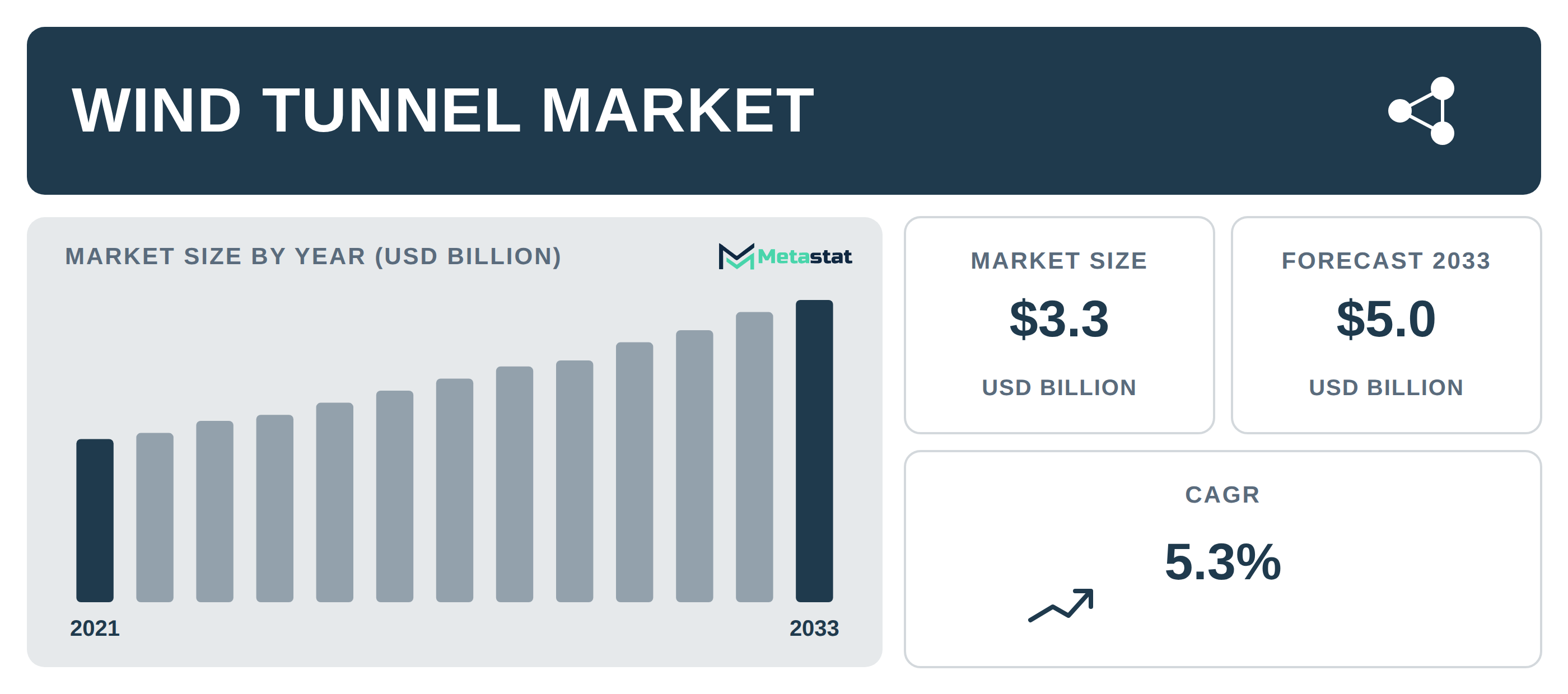
Metastat Insights reveals the Wind Tunnel market will grow from USD 3.3 billion in 2025 to USD 5 billion by 2033, driven by aerospace and defense investments. The report covers key segments, regional insights, and major players in the industry.
Metastat Insights has published "Global Wind Tunnel Market Size, Share, By Type (Open Circuit Wind Tunnel and Closed Circuit Wind Tunnel), By Airspeed Type (Subsonic Wind Tunnels, Transonic Wind Tunnels, Supersonic Wind Tunnels and Hypersonic Wind Tunnels), By Application (Aerospace and Defense, Automotive, Civil Engineering and Construction, Marine, Sports and Olympics, Renewable Energy and Others), By End User (Research Institutions and Universities, Government and Defense Organizations, Automotive and Transportation Companies, Aerospace and Aircraft Manufacturers, Commercial Testing and Engineering Companies and Other Industrial Users), Industry Analysis, Growth, Trends, and Forecast, 2026-2033", highlighting the market's value of USD 3.3 billion in 2025 and its projection to reach USD 5 billion by 2033, reflecting a CAGR of 5.3%.
What is driving Wind Tunnel demand
Several factors contribute to the increasing demand for wind tunnel technology. Significant investments in the aerospace and defense sectors propel market development, because countries enhance their national defense capabilities. This trend prompts manufacturers to upgrade wind tunnel facilities that improve performance, safety, and efficiency. Technological integration, including automation and artificial intelligence, enhances testing processes, leading to operational efficiencies. Research institutions and engineering companies pursue advanced wind tunnel solutions to validate designs and optimize performance, contributing to market expansion.
Challenges for the Wind Tunnel market
Despite growth prospects, the wind tunnel market faces significant challenges. Regulatory compliance requirements concerning emissions and environmental standards necessitate investments in closed circuit systems, which in turn raise operational costs. Broader economic factors, including inflationary pressures and complications in supply chains, create a complex market landscape. Such challenges result in diminished investment in research and development, hindering technological advancement in wind tunnel designs. Talent gaps and skilled labor shortages further restrict growth, because operators experience difficulties in finding qualified personnel able to manage sophisticated systems.
Wind Tunnel market segmentation and regional analysis
The wind tunnel market is segmented by type, airspeed type, application, and end user. The Open Circuit Wind Tunnel segment is expected to expand from USD 1.1 billion in 2026 to USD 1.5 billion by 2033, while the Closed Circuit Wind Tunnel segment is projected to reach USD 3.5 billion by 2033. Regionally, North America leads the market with a 37.5% share, driven by advancements in aerospace and defense applications, followed by Europe at 28.5% and Asia Pacific at 25.8%. Each region presents unique dynamics influencing adoption and growth.
Key players in the Wind Tunnel market
Key players in the wind tunnel market include The Boeing Company, Lockheed Martin Corporation, and Airbus. These companies contribute to the competitive environment and are expected to enhance innovation through strategic investments and collaborations. The ongoing focus on research and development within aerospace and automotive sectors influences the market's evolution, supporting sustained demand.
For an in-depth analysis, readers access the full report on the Global Wind Tunnel Market.
Related Report
Global Wind Tunnel Market