
LEAD ANALYST
Utkarsh Khirodkar is a Lead Market Research Analyst at MetaStat Insight, specializing in market intelligence, technology sector assessments, and competitive strategy.

Global Active Fire Safety Market Size, Share, By Type (Fire Detection Systems, Fire Suppression Systems, Integrated Fire, Gas Monitoring Panels, Alarm System, Emergency Communication Systems, and Battery-Specific Fire Safety Solutions), By Battery-Specific Fire Safety Applications (Utility-Scale Battery Energy Storage Systems, Commercial, Industrial Battery Storage Installations, Residential Battery Storage Units, Microgrid, Off-Grid Battery Storage, and Others), Industry Analysis, Growth, Trends, and Forecast, 2026-2033
Report ID
MSI-4555
Published
February, 2026
Pages
310 Pages
Format
Report Details
Choose Your License
Active Fire Safety Market
The global Active Fire Safety market size was valued at USD 41.9 billion in 2025. The market is projected to grow from USD 44.6 billion in 2026 to USD 70.2 billion by 2033, exhibiting a CAGR of 6.7% during the forecast period.
The global Active Fire Safety market was valued at USD 41.9 billion in 2025 and is projected to reach USD 70.2 billion by 2033, at a CAGR of 6.7% during the forecast period.
North America accounted for 25% in 2025, with the United States leading the region.
Fire Detection Systems segment accounted for a market share of 55.8% in 2026, propelled by increased deployments across battery storage sites and electrical infrastructure.
Key trends driving growth: Stricter codes, insurance requirements, and ESG risk mandates are pushing new installs and upgrades across commercial, industrial, and high-rise assets.
Key opportunity involves smart, connected suppression and detection paired with analytics-led compliance-as-a-service, including remote testing and predictive maintenance, unlocking recurring revenue and retrofit demand across emerging and aging assets.
Key insight: Regulatory pressures and battery storage expansion are accelerating adoption of intelligent active fire safety systems, with cost and retrofit complexity remaining key friction points.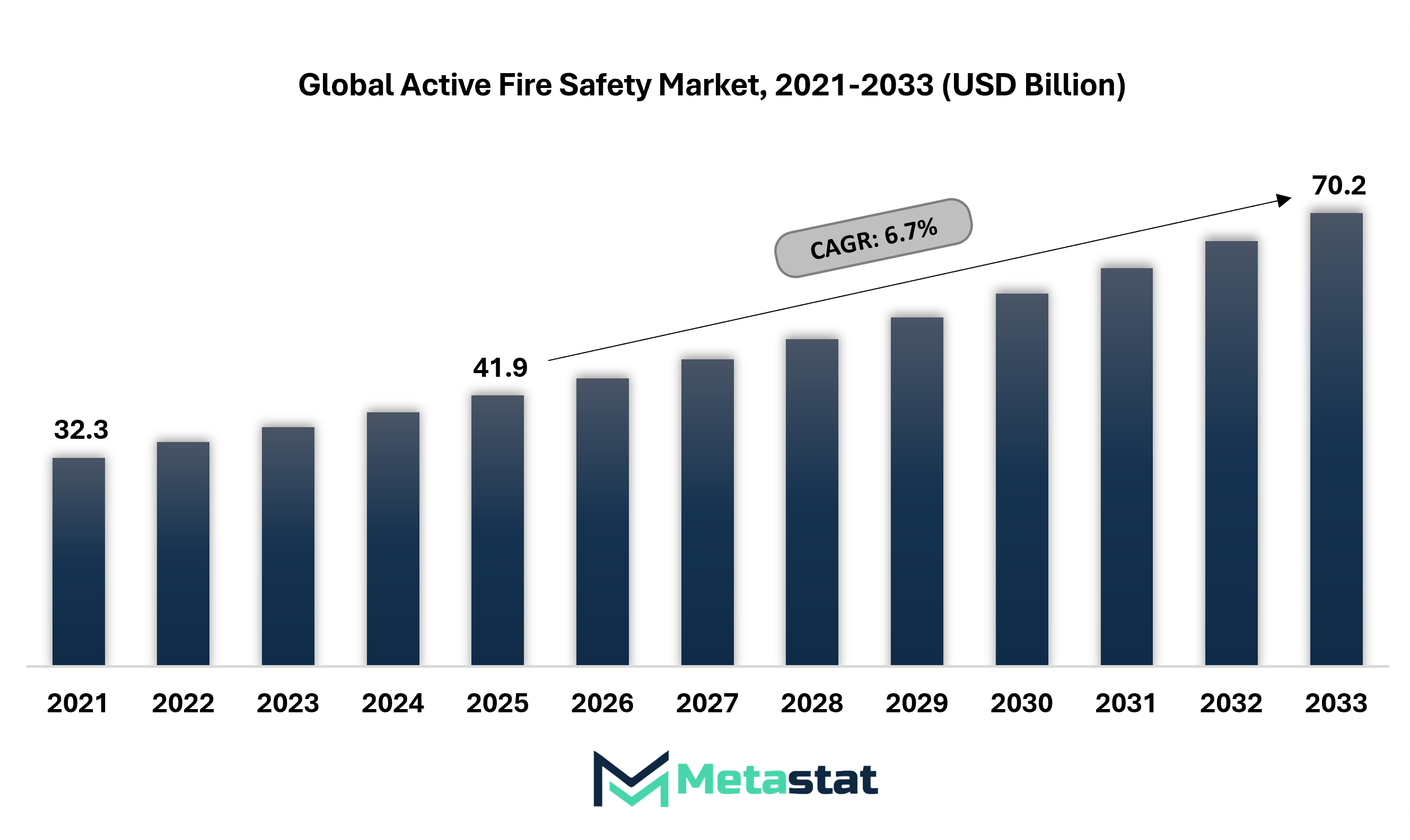
The global Active Fire Safety market for battery energy storage systems will expand during the coming decade, moving into a phase shaped by intelligent response, regulatory readiness, and cross-system integration. Future developments will extend beyond alarm initiation and suppression response, enabling predictive safety environments that anticipate ignition risk patterns, material behavior under thermal stress, and incident propagation pathways across storage racks and enclosures.
Proactive fire protection solutions will increasingly align with digital twins of energy storage sites and industrial facilities, enabling simulated emergency scenarios long before physical risks emerge. These platforms will allow security architectures to be adjusted in advance, reducing uncertainty during actual incidents. Compliance frameworks will shift from static certification to continuous verification, supported by embedded diagnostics, remote auditing protocols, and automated performance reporting.
Strict safety codes, evolving insurance frameworks and ESG-focused risk mandates will accelerate system installation in commercial complexes, industrial areas and vertical residential developments. Regulatory enforcement will raise compliance standards, encouraging modernization of aging fire protection infrastructure. Future construction pipelines will prioritize certified active safety systems to meet governance expectations and reduce long-term liability risk.
Digitalization through IoT-enabled sensors, building management system connectivity, and remote monitoring platforms will increase detection accuracy and response efficiency. Data-driven alerting mechanisms will reduce the timeline for incident escalation. Asset owners will recognize improved operational returns through reduced damage severity, coordinated emergency response, and enhanced continuity planning supported by an intelligent fire protection ecosystem.
High upfront capital expenditure and complex retrofit requirements in legacy facilities will continue to limit adoption. Brownfield facilities with legacy layouts will face integration challenges, discouraging investment among cost-sensitive small and mid-sized enterprises. Budget limitations will delay enhancements no matter improved attention of security compliance obligations.
Workforce skills gaps, routine maintenance needs, and frequent false-alarm disruptions will increase operating costs. Insufficient technical expertise will compromise device calibration and reliability. Repeated nuisance alerts will undermine stakeholder confidence, leading to procurement resistance and raising concerns about long-term system performance and operational reliability.
Advanced connected detection and suppression systems supported by analytics-led compliance services will open recurring revenue channels. Remote diagnostics, automated testing, and predictive maintenance frameworks will support compliance while minimizing manual intervention. Emerging economies and aging infrastructure will expand retrofit demand, supporting scalable service-based business models.
The global Active Fire Safety for Battery Energy Storage Systems market is primarily segmented by Type and Application.
Fire Detection Systems segment is valued at USD 24.9 Billion in 2026 and is projected to reach USD 38.9 Billion by 2033, at a CAGR of 6.6% during the forecast period.
Fire detection systems will move toward sensor-driven intelligence supported by real-time analytics and environmental adaptability. Advanced smoke, heat and gas detection technologies will enable rapid incident identification in complex battery environments. Future deployments will focus on reducing false alerts while supporting seamless integration with centralized security networks.
Fire Suppression Systems segment is valued at USD 10.4 Billion in 2026 and is projected to reach USD 16.2 Billion by 2033, at a CAGR of 6.5% during the forecast period.
Fire suppression systems will evolve through cleaner agents and quick-response mechanisms designed for battery-related thermal incidents. Aerosol, inert gas and water mist solutions will gain prominence due to minimal equipment impact. Future strategies will emphasize containment efficiency, reduced downtime, and compatibility with enclosed energy storage installations.
Integrated Fire & Gas Monitoring Panels segment is valued at USD 4.4 Billion in 2026 and is projected to reach USD 6.7 Billion by 2033, at a CAGR of 6.2% during the forecast period.
The integrated fire and gas monitoring panels will act as a unified command interface for security management. Centralized data interpretation will improve coordinated responses during hazardous scenarios. Forward-looking developments will support interoperability across digital platforms, enabling predictive alerts and automated system coordination across large-scale battery infrastructure.
Alarm and Emergency Communication Systems segment is valued at USD 1.9 Billion in 2026 and is projected to reach USD 3.5 Billion by 2033, at a CAGR of 9.2% during the forecast period.
Alarm and emergency communications systems will strengthen situational awareness through immediate alerts and directed response protocols. Visual, audio and digital information will support rapid evacuation and intervention measures. Future enhancements will ensure redundancy, network resiliency and uninterrupted communications during high-risk battery events.
Battery-Specific Fire Safety Solutions segment is valued at USD 3.0 Billion in 2026 and is projected to reach USD 4.9 Billion by 2033, at a CAGR of 7.3% during the forecast period.
Battery-specific fire protection solutions will address the chemical instability and thermal runaway risks unique to energy storage technologies. The optimized suppression and monitoring designs will align with lithium-ion and next-generation battery chemistries. The future framework will emphasize lifecycle safety management from installation to decommissioning phases.
Utility-Scale Battery Energy Storage Systems segment is projected to reach USD 37.7 Billion by 2033, at a CAGR of 7.1% during the forecast period.
Utility-scale battery energy storage systems will demand higher capacity fire protection due to the concentrated energy density. Advanced zoning, automated suppression and remote diagnostics will define the security model of the future. Infrastructure planners will prioritize scalable security architectures that support grid stability and uninterrupted power delivery.
Commercial & Industrial Battery Storage Installations segment is projected to reach USD 18.7 Billion by 2033, at a CAGR of 5.7% during the forecast period.
Commercial and industrial battery storage installations will integrate layered fire protection designs commensurate with operational complexity. Detection accuracy and speed of suppression will become central investment priorities. Facilities of the future will adopt compliance-driven security automation to protect assets, personnel, and continuous production processes.
Residential Battery Storage Units segment is projected to reach USD 4 Billion by 2033, at a CAGR of 6.7% during the forecast period.
Residential battery storage units will adopt compact fire protection technologies to meet space constraints and user safety expectations. Smart alarms and localized suppression solutions will support home-level security. Future adoption will depend on standardized security certifications and simplified maintenance requirements.
Microgrid And Off-Grid Battery Storage segment is projected to reach USD 6.9 Billion by 2033, at a CAGR of 6.7% during the forecast period.
Microgrid and off-grid battery storage environments will require autonomous fire protection systems capable of independent operation. Remote monitoring and self-activated suppression technologies will gain relevance. Future deployments will focus on reliability in isolated conditions and minimal dependence on external connectivity.
Others (Renewable Energy Integration, etc.) segment is projected to reach USD 2.8 Billion by 2033, at a CAGR of 7.4% during the forecast period.
Other applications involving renewable energy integration will expand fire safety requirements in hybrid energy platforms. Wind and solar storage combinations will drive demand for adaptive security solutions. Future safety planning will align fire prevention strategies with sustainable infrastructure expansion objectives.
Based on geography, the global Active Fire Safety market is divided into North America, Europe, Asia-Pacific, South America, Middle East, and Africa.
North America Active Fire Safety market is projected to reach a market size (TAM) of USD 15.9 billion by 2033.
Stringent fire safety policies in industrial and commercial centers will propel demand for certified active fire safety systems in North America.
Increasing investments in smart homes and critical infrastructure upgrades will accelerate adoption of automated fire detection and response solutions across North America.
Rapid grid expansion and large-scale energy storage deployments will open strong opportunities for active fire safety system deployment in emerging Asia-Pacific economies.
Increasing awareness of life safety compliance among governments and private developers will create long-term potential for technologically advanced fire safety solutions in the Asia Pacific region.
Middle East, Africa, and South America will show uneven yet promising demand, propelled by infrastructure modernization, evolving regulations, and selective adoption of high-performance fire safety technologies.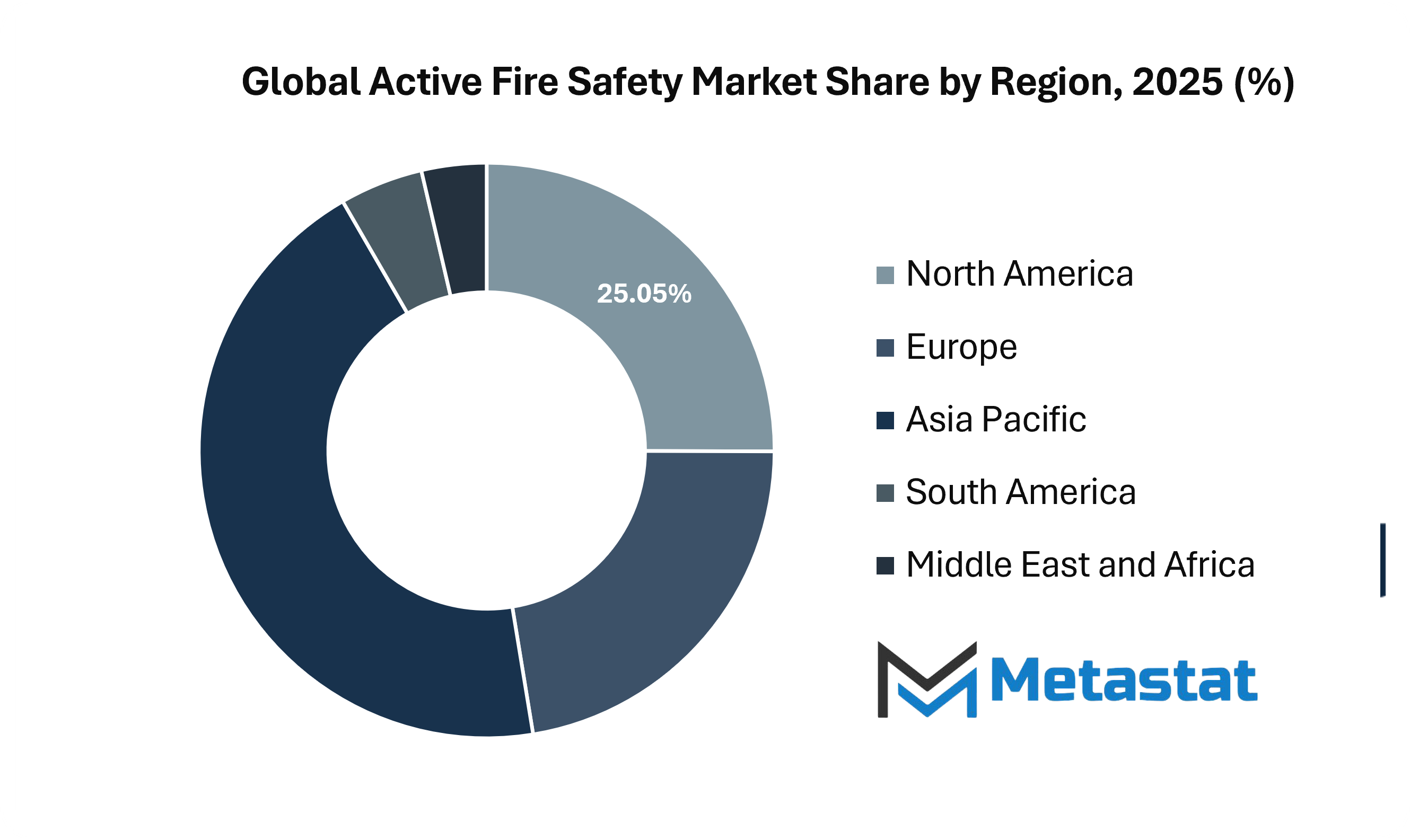
The global active fire safety market is attracting sustained attention, propelled by the need for rapid detection and immediate response systems across residential, commercial, and industrial settings. Fire risk remains a critical challenge in modern infrastructure, where dense layouts and advanced electrical systems increase exposure to potential hazards. Proactive active fire safety solutions focus on early alerting, rapid suppression, and damage control to reduce loss of life and property.
Technology plays a major role in shaping this market, making systems smarter, reliable, and easier to integrate into existing infrastructure. Modern systems rely on sensors, alarms, and automated suppression devices to respond within seconds of detecting smoke, heat, or gas leaks. These advancements will support industries that operate in high-risk environments such as manufacturing facilities, data centers and energy facilities. Emphasis is placed on systems that provide accuracy, minimal false alarms, and fast maintenance cycles, strengthening confidence among end users.
Some of the already established brands that fuel innovation and competition in the Global Active Fire Safety Market include Johnson Controls, Siemens AG, and Honeywell International Inc., which have been some of the most acclaimed brands for their sophisticated detection and suppression capabilities. Kidde-Fenwal, LLC and Minimax Fire Solutions International GmbH are also rapidly increasing their market share through their niche-defined fire protection solutions offered for more complex spaces. Fike Corporation, Firetrace International, and Saval (SK FireSafety Group) strengthen the market through specialized solutions for complex fire suppression requirements.
Other key companies in the community are SFFECO Global, Hochiki America Corporation, and Fireaway Inc. (Stat-X), with each company providing a different method of fire suppression and detection. SEVO Systems, Inc. and The Protectowire Co., Inc. bring other advanced perspectives with linear heat detection and sophisticated response systems.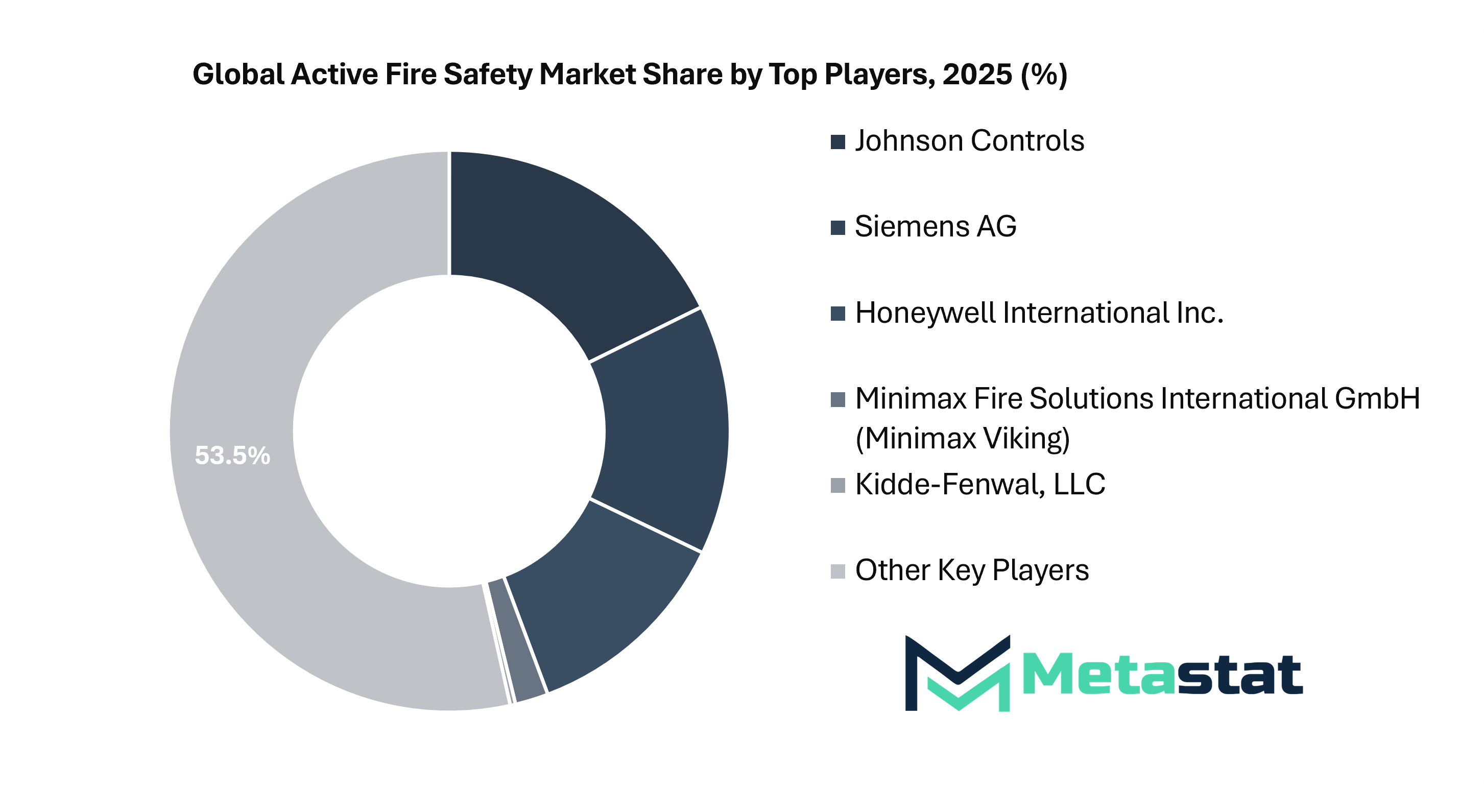
Market size is forecast to rise from USD 41.9 billion in 2025 to over USD 70.2 billion by 2033.
With detectors calibrated for mixed materials, lithium-based storage areas, and modular construction formats, materials science will influence future system design. Fire protection engineering will therefore expand to include collaborative planning stages, architects, automation engineers and municipal officials during early design stages rather than post-construction retrofits. Beyond device deployment, the market will shift toward a long-term service ecosystem. Providers will deliver lifecycle assurance, data management, and scenario optimization rather than standalone hardware. This direction will place strategic emphasis on resilience planning, where security will operate not only during moments of crisis but also throughout the operational lifetime of complex structures.
This research report categorizes the Active Fire Safety market based on key segments and regions, forecasts revenue growth, and analyzes trends in each submarket. The report analyses the key growth drivers, opportunities, and challenges influencing the Active Fire Safety market. Recent market developments and competitive strategies such as expansion, product launch, partnership, merger, and acquisition have been included to map the competitive landscape.
The report strategically identifies and profiles the key market players and analyses their core competencies in each sub-segment of the Active Fire Safety market.
|
Report Attributes |
Details |
|
Study Period |
2021-2033 |
|
Base Year |
2025 |
|
Estimated Year |
2026 |
|
Forecast Period |
2026-2033 |
|
Historical Period |
2021-2025 |
|
Growth Rate |
CAGR 6.7% from 2026 to 2033 |
|
Revenue Unit |
USD Billion |
|
Sales Volume Unit |
Units |
|
Segmentation |
By Type, Battery-Specific Fire Safety Applications, and Region |
|
By Region |
North America (By Type, Battery-Specific Fire Safety Applications, and Country)
|
|
Europe (By Type, Battery-Specific Fire Safety Applications, and Country)
|
|
|
Asia Pacific (By Type, Battery-Specific Fire Safety Applications, and Country)
|
|
|
South America (By Type, Battery-Specific Fire Safety Applications, and Country)
|
|
|
Middle East and Africa (By Type, Battery-Specific Fire Safety Applications, and Country)
|
Find answers to common questions about this report
The Metastat Insight study shows that the global Active Fire Safety market size was USD 41.9 billion in 2025.
The global Active Fire Safety market is likely to grow at a CAGR of 6.7% over the forecast period (2026-2033).
The Metastat Insights analysis shows that the North America Active Fire Safety market size is estimated to be USD 15.9 billion by 2033.
The Fire Detection Systems is the leading type segment in the global market.
Stricter codes, insurance requirements, and ESG risk mandates are pushing new installs and upgrades across utility-scale storage sites, C&I facilities, and residential energy systems. Digitization via IoT sensors, BMS integration, and remote monitoring improves detection speed and response coordination, enhancing ROI for asset owners.
Asia Pacific region dominates the market.
High upfront capex and complex retrofits in brownfield facilities slow adoption, especially for small and mid-size enterprises will hamper the market growth within the forecast period.
Global Active Fire Safety market is estimated to reach USD 70.2 billion by 2033.
Top players operating in the Active Fire Safety industry include Johnson Controls, Siemens AG, Honeywell International Inc., Kidde-Fenwal, LLC, and Minimax Fire Solutions International GmbH (Minimax Viking).
The analysts below cover Machinery & Equipment research at Metastat Insights.
LEAD ANALYST
Utkarsh Khirodkar is a Lead Market Research Analyst at MetaStat Insight, specializing in market intelligence, technology sector assessments, and competitive strategy.

INDUSTRY CONSULTANT - CHEMICALS & ADVANCED MATERIALS
Chemicals and Materials · Machinery & Equipment · Packaging
Amit Gadhekar Consultant for Chemicals and Materials at MetaStat Insight, directing sector-specific intelligence, research, and strategic consulting across global chemical and processing markets.

PRINCIPAL CONSULTANT - QUALITY SYSTEMS & COMPLIANCE
Electronics and Semiconductor · Machinery & Equipment · Professional Services
Omkar Phadtare is an Industry Consultant at MetaStat Insight, specializing in quality systems, regulatory compliance, and standards benchmarking to drive data-driven market intelligence and strategic industry research.

ENERGY & INFRASTRUCTURE INDUSTRY CONSULTANT
Automotive and Transportation · Electronics and Semiconductor · Energy and Power · Machinery & Equipment
Saurabh Vasant Ganvir consults for Energy & Infrastructure Industry at MetaStat Insight, specializing in renewable energy, solar EPC, and electric vehicle (EV) infrastructure markets.

LEAD CONSULTANT - COMMUNICATION, TELECOM, AND IT
Electronics and Semiconductor · Information & Technology · Machinery & Equipment · Professional Services
Ravindra Sathe Consultants for Communication, Telecom, and IT at MetaStat Insight. He leads the firm's industry research initiatives across telecommunications infrastructure, digital connectivity, enterprise networking, and emerging information technology domains.
Floating offshore wind feasibility relies heavily on specialized installation vessel availability and port crane limits, which most broad renewable energy forecasts ignore. The report delivered a thorough analysis of dry dock capacity, mooring chain supply constraints, and raw material pricing trends for deepwater anchor installations. It served as a solid independent sanity check for our offshore project capital expenditure assumptions.
Assessing commercial microgrid software adoption requires looking past top-level installation numbers and examining utility interconnection queues. The research provided verifiable data on average permitting timelines, tariff structures, and battery storage integration costs across regional utility territories. That grounded perspective was valuable for our team when building five-year demand projections for industrial microgrid controllers.
Ambulatory surgical centers have very different purchasing cycles for robotic-assisted surgery platforms than major hospital networks. The MetaStat Insight study focused squarely on capital expenditure depreciation, procedural reimbursement pathways, and surgeon training overhead. That operational clarity made it much simpler to validate multi-year procedure growth forecasts against actual ambulatory center adoption patterns.
Explore related market intelligence reports worth reading alongside this one.