
LEAD ANALYST
Utkarsh Khirodkar is a Lead Market Research Analyst at MetaStat Insight, specializing in market intelligence, technology sector assessments, and competitive strategy.

AI Agents Market Size, Share, By Agent System (Single Agent Systems and Multi Agent Systems), By Type (Ready-to-Deploy Agents and Build-Your-Own Agents), By Technology (Machine Learning, Natural Language Processing (NLP), Deep Learning, Computer Vision, and Others), By Application (Customer Service, Virtual Assistants, Robotics, Automation, Healthcare, Financial Services, Security, Surveillance, Gaming, Entertainment, and Others), Industry Analysis, Growth, Trends, and Forecast, 2026-2033
Report ID
MSI-4656
Published
April, 2026
Pages
313 Pages
Format
Report Details
Choose Your License
AI Agents Market
Global AI Agents market size is valued at USD 7.5 billion in 2025 and projected to grow at a CAGR of 47.1% during the forecast period, reaching USD 164.8 billion by 2033.
Global AI Agents market valued at USD 7.5 billion in 2025, growing at a CAGR of 47.1% through 2033, with potential to exceed USD 164.8 billion.
North America held 33.1% of the global AI Agents market in 2025, with the U.S. leading regional revenue generation.
Single Agent Systems segment accounts for a 61.4% market share in 2025.
Key trends driving growth: Enterprise shift toward end-to-end workflow automation and productivity uplift, Expansion of agent engineering stacks across orchestration, tool access, and evaluation.
Opportunities include Domain-specific agents embedded into systems of record with auditable governance.
Key insight: Rapid enterprise integration of autonomous AI-driven workflows positions the Global AI Agents Market for accelerated competitive differentiation across industries.
The Global AI Agents Market within the artificial intelligence and enterprise software industry is moving well beyond task automation and scripted chat interfaces, driving a structural shift in how digital systems support business operations. Over the coming years, AI agents will increasingly function as autonomous digital systems capable of coordinating workflows, supporting decision-making, executing transactions, and managing cross-platform processes with limited human intervention. Such transformation is set to redefine operating models across sectors that rely on data-driven decision cycles.
Healthcare organizations will deploy advanced AI agents to monitor longitudinal patient records, recommend treatment adjustments, and coordinate diagnostics with claims processing in near real time. Financial institutions will integrate multi-agent frameworks to evaluate portfolio exposure, detect anomalous trading patterns, and initiate compliance checks before regulatory thresholds are breached. In manufacturing, interconnected AI agents will support predictive maintenance scheduling, raw material procurement, and distribution planning across decentralized operating environments. These systems will move beyond data analysis to trigger action across digital infrastructures.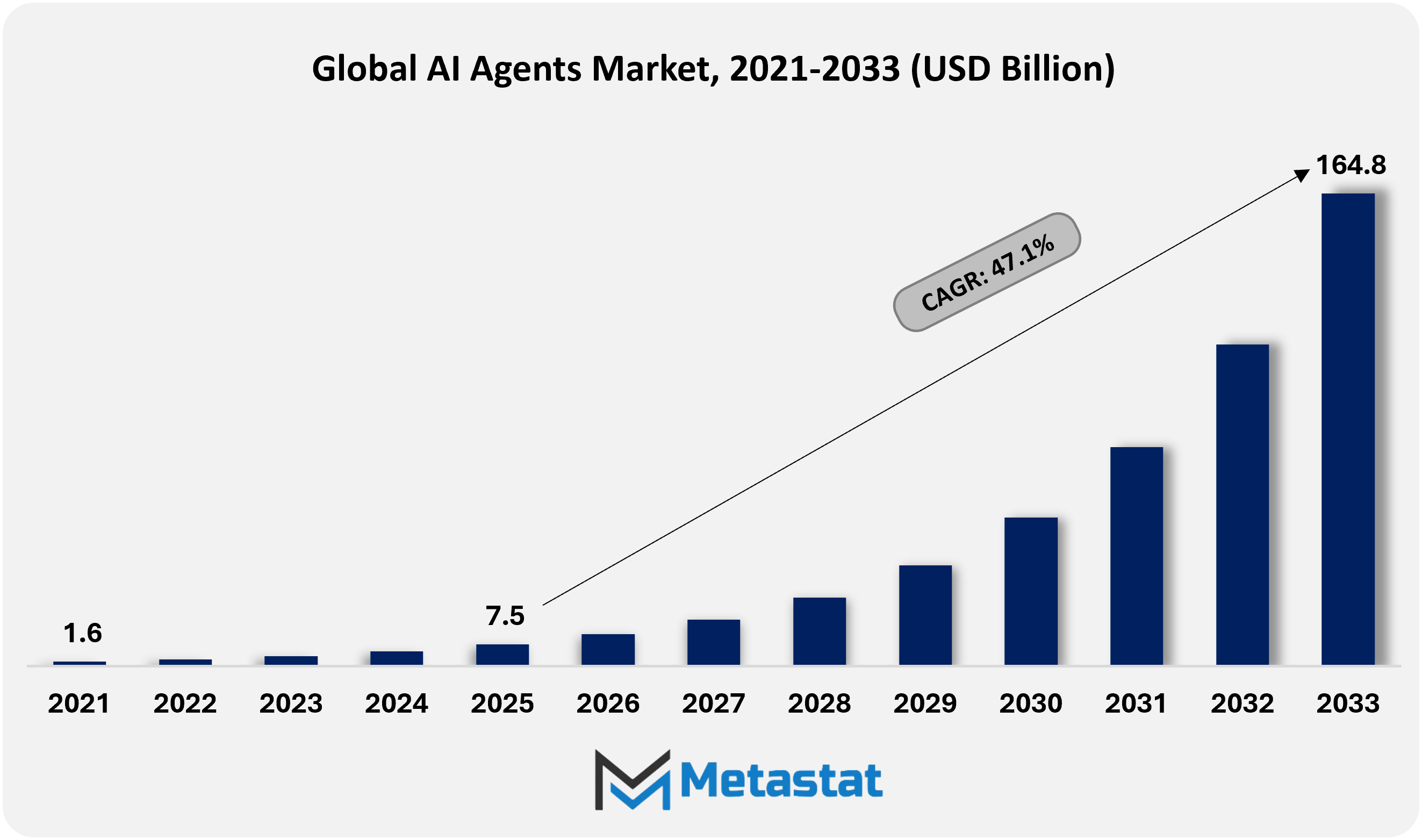
Enterprise shift toward end-to-end workflow automation and productivity uplift.
Rising enterprise focus on integrated workflow automation is accelerating adoption across the Global AI Agents Market. Organizations are investing in agent-based systems capable of handling planning, execution, monitoring, and reporting within unified environments. Operational efficiency goals, cost optimization, and the need for measurable productivity gains are positioning intelligent agents at the core of digital operating models across industries.
Expansion of agent engineering stacks across orchestration, tool access, and evaluation
Advances in agent engineering stacks are strengthening the technical foundation of the Global AI Agents Market. Structured orchestration layers, secure tool integration frameworks, and continuous evaluation pipelines are enabling scalable deployment. Standardized testing environments and performance benchmarking practices are improving output quality, allowing enterprises to operationalize intelligent agents with greater confidence and governance clarity.
Reliability gaps in long-horizon task execution and multi-step reasoning
Performance variability in long-horizon task execution remains a major restraint for the Global AI Agents Market. Multi-step reasoning errors, context drift, and dependency mismanagement continue to limit deployment in high-stakes environments. Mission-critical sectors require more deterministic performance, transparent decision tracing, and stronger validation protocols before large-scale adoption across regulated and sensitive operations.
Data security, compliance, and access-control constraints across connected systems
Data security, compliance requirements, and access-control limitations across connected systems remain major barriers for the Global AI Agents Market. AI agents operating across enterprise applications and data environments must comply with strict governance frameworks, identity controls, and audit requirements. These constraints are particularly significant in regulated sectors such as finance, healthcare, manufacturing, and public administration, where trust, traceability, and policy alignment are critical.
Domain-specific agents embedded into systems of record with auditable governance
Verticalized deployment strategies will unlock significant growth opportunities in the Global AI Agents Market. Industry-specific agents integrated directly into systems of record will support structured decision-making, traceable outputs, and policy-aligned execution. Built-in audit trails, compliance monitoring dashboards, and configurable governance frameworks will strengthen enterprise trust while supporting broader adoption across finance, healthcare, manufacturing, and public administration.
The Global AI Agents market is classified based on Agent System, Type, Technology, and Application.
Single Agent Systems segment is valued at USD 6.8 billion in 2026 and is projected to reach USD 76.4 billion by 2033, at a CAGR of 41.3% during the forecast period.
Single Agent Systems operate through independently structured architectures designed to complete defined tasks without collaborative nodes. Future deployment will center on task precision, faster decision cycles, and optimized computational efficiency. Enterprises will adopt these systems for controlled environments where accountability, traceability, and streamlined governance remain key operational priorities.
Multi Agent Systems segment is valued at USD 4.3 billion in 2026 and is projected to reach USD 88.4 billion by 2033, at a CAGR of 54.2% during the forecast period.
Multi Agent Systems are evolving toward coordinated intelligence networks in which multiple agents interact, negotiate, and adapt within shared digital ecosystems. Distributed problem-solving, resilience against system failure, and dynamic workload distribution will strengthen enterprise-scale automation. Cross-agent communication protocols will support adaptive strategies across complex business infrastructures.
Ready-to-Deploy Agents segment is projected to reach USD 74.0 billion by 2033, at a CAGR of 42.2% during the forecast period.
Ready-to-Deploy Agents will provide pre-configured frameworks tailored for rapid enterprise integration. Standardized architectures, embedded analytics, and predefined workflows will accelerate digital transformation across industries. Organizations seeking immediate productivity gains and lower customization complexity will rely on these agents for scalable operational deployment.
Build-Your-Own Agents segment is projected to reach USD 90.8 billion by 2033, at a CAGR of 52.4% during the forecast period.
Build-Your-Own Agents will support modular development environments where enterprises design agents aligned with internal data models and strategic goals. Custom training pipelines, configurable rule engines, and domain-specific intelligence layers will enable deeper personalization.
Machine Learning segment is projected to reach USD 30.2 billion by 2033.
Machine Learning technologies will enhance predictive capabilities through training on structured and unstructured data. Adaptive algorithms will improve decision accuracy, pattern recognition, and behavioral forecasting. Continuous model optimization through feedback loops will strengthen performance across enterprise analytics, automation systems, and strategic planning functions.
Natural Language Processing (NLP) segment is projected to reach USD 83.6 billion by 2033.
Natural Language Processing will strengthen contextual understanding, sentiment interpretation, and multilingual interaction across digital interfaces. Conversational intelligence systems will improve dialogue management and semantic accuracy. Enterprise communication platforms are increasingly integrating NLP-driven agents to streamline knowledge retrieval and improve human-machine collaboration.
Deep Learning segment is projected to reach USD 36.4 billion by 2033.
Deep Learning frameworks will enable layered neural architectures capable of complex reasoning and anomaly detection. High-volume data processing will improve autonomous adaptation across enterprise environments. Strategic industries will adopt deep learning agents to manage complex datasets requiring multi-level abstraction and advanced pattern recognition.
Computer Vision segment is projected to reach USD 8.4 billion by 2033.
Computer Vision applications will transform visual data into actionable intelligence through object recognition, scene interpretation, and real-time monitoring systems. Industrial operations, smart city projects, and infrastructure management platforms will integrate vision-enabled agents to improve safety standards and operational accuracy.
Others segment is projected to reach USD 6.2 billion by 2033.
Other emerging technologies include reinforcement learning models, domain intelligence systems, and hybrid cognitive architectures. Integration of decentralized processing and advanced simulation tools will strengthen autonomous agent ecosystems. Innovation pipelines will broaden the technology landscape, supporting specialized deployment across multiple industry verticals.
Customer Service and Virtual Assistants segment is projected to grow at a CAGR of 43.1% during the forecast period.
Customer Service and Virtual Assistants will transform enterprise engagement models through predictive interaction management and automated resolution systems. Advanced response engines will reduce operational delays and improve service continuity. Intelligent escalation frameworks will support consistent digital communication across global customer networks.
Robotics and Automation segment is projected to grow at a CAGR of 50.8% during the forecast period.
Robotics and Automation will integrate intelligent agents into manufacturing, logistics, and infrastructure systems. Autonomous coordination between mechanical components and digital control layers will improve operational efficiency. Smart production facilities will rely on adaptive agent systems to maintain optimized output under variable operating conditions.
Healthcare segment is projected to grow at a CAGR of 50.2% during the forecast period.
Healthcare adoption will enhance diagnostic analytics, patient monitoring systems, and clinical workflow management. Intelligent agents will process medical imaging, electronic health records, and predictive health indicators to improve treatment precision. Data-driven healthcare ecosystems will strengthen preventive care and operational transparency across medical institutions.
Financial Services segment is projected to grow at a CAGR of 48.4% during the forecast period.
Financial Services will use agent-driven risk modeling, fraud detection, and algorithmic advisory systems. Real-time transaction monitoring and predictive compliance tools will improve institutional governance. Financial institutions will rely on intelligent automation to improve portfolio management accuracy and regulatory reporting efficiency.
Security and Surveillance segment is projected to grow at a CAGR of 49.1% during the forecast period.
Security and Surveillance applications will integrate autonomous monitoring agents capable of anomaly detection and rapid threat assessment. Advanced analytics engines will interpret behavioral patterns across physical and digital environments. Proactive risk mitigation strategies will improve infrastructure resilience and public safety systems.
Gaming and Entertainment segment is projected to grow at a CAGR of 44.6% during the forecast period.
Gaming and Entertainment sectors will deploy adaptive non-player intelligence, immersive simulation control, and personalized content generation systems. Intelligent agents will improve user engagement metrics and behavioral prediction models. Interactive digital platforms will rely on advanced agent logic to support long-term audience retention.
Others segment is projected to grow at a CAGR of 44.1% during the forecast period.
Other application areas connected to the AI Agents Market will expand into education technology, smart cities, and energy management platforms. Intelligent agents will support predictive infrastructure maintenance and adaptive learning environments. Cross-industry digital transformation strategies will rely increasingly on scalable agent-driven architectures.
Based on geography, the Global AI Agents market is divided into North America, Europe, Asia-Pacific, South America, Middle East, and Africa.
North America AI Agents Market is set to expand at a CAGR of 47.1% within the forecast period, reaching a market size (TAM) of USD 48.5 billion by the end of 2033.
North America drives the market through strong enterprise investment in automation and rapid integration of generative AI across customer service, finance, and healthcare applications.
Europe is witnessing steady expansion, driven by rising enterprise focus on intelligent workflow automation, regulatory alignment for trustworthy AI adoption, and stronger investment in digital transformation across core industries.
Asia Pacific creates major growth opportunities for the AI Agents Market owing to rising digital transformation initiatives and increasing demand for AI-powered business process optimization among SMEs and large enterprises.
Across the Middle East, Africa, and South America, the AI Agents Market gains momentum through increasing digital infrastructure, rising startup ecosystems, and developing organisation interest in cost-efficient AI-driven automation solutions.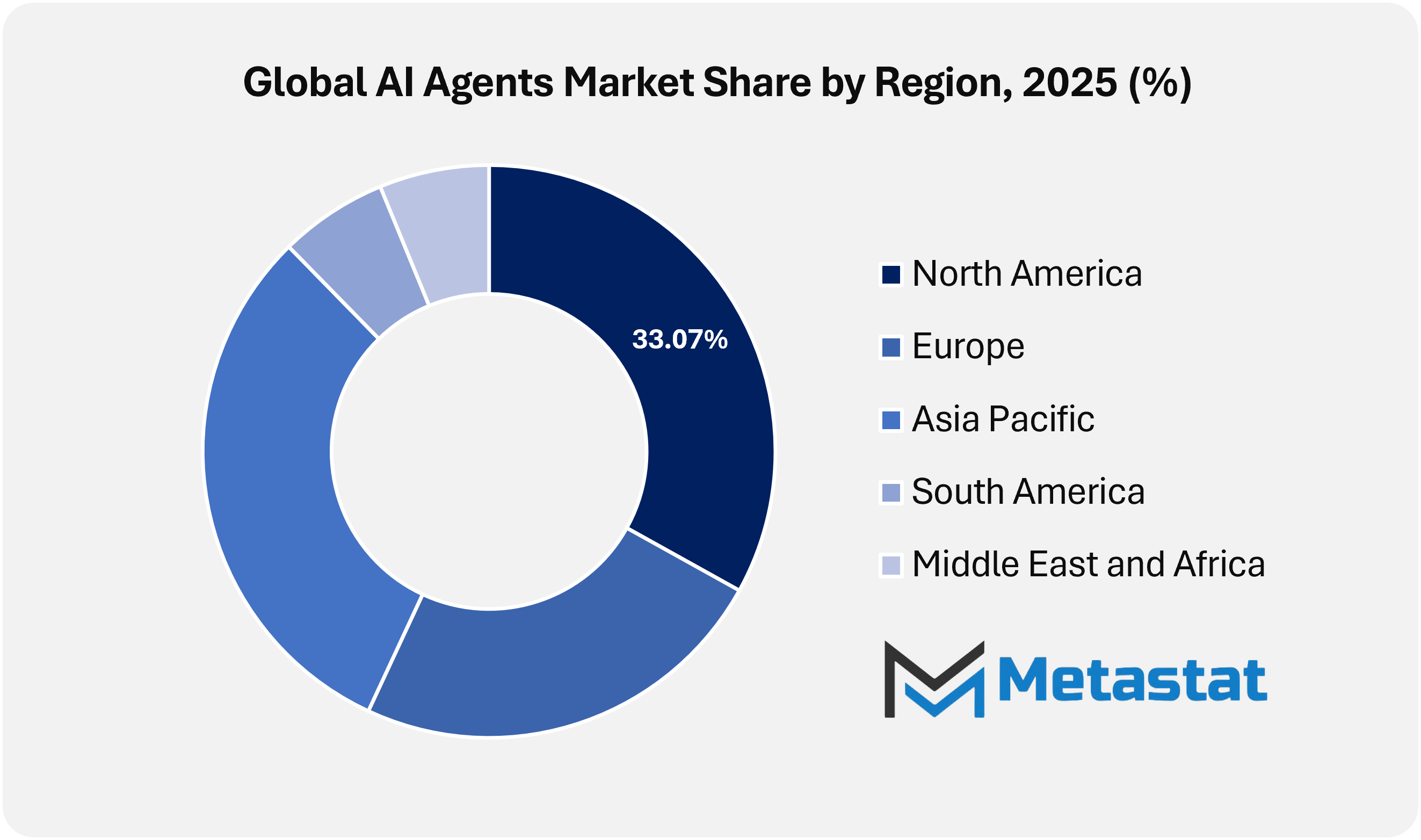
The Global AI Agents Market is gaining strong enterprise attention as organizations seek systems that can operate with a greater level of autonomy and decision-making capability than conventional software tools. AI agents are designed to understand instructions, analyze data, take action, and improve performance over time. Unlike basic automation tools, these systems can interpret context and respond dynamically, making them valuable in sectors that require speed, precision, and adaptability. Organizations across industries are evaluating how AI agents can reduce manual workloads, improve response times, and support strategic decision-making.
Technology leaders are shaping the market through heavy investment in research, infrastructure, and enterprise solutions. Companies such as OpenAI, Inc. and Anthropic PBC are developing advanced large language models that power many AI agent applications. Major cloud providers such as Amazon.com, Inc., IBM Corporation, Oracle Corporation, and NVIDIA Corporation are delivering the computing backbone and AI frameworks required to support deployment at scale. Their platforms enable organizations to integrate AI agents into existing systems without rebuilding their technology stack from the ground up.
Enterprise software companies are also embedding AI agents into business applications to improve productivity and workflow automation. Salesforce, Inc. and SAP SE are incorporating intelligent agents into customer relationship management and enterprise resource planning platforms. Workday, Inc., ServiceNow, Inc., and Appian Corporation are using AI agents to automate HR, IT, and finance operations. Automation-focused companies such as UiPath, Inc. and Automation Anywhere, Inc. are expanding robotic process automation into more intelligent and adaptive systems capable of handling complex, multi-step tasks.
A growing group of specialized companies is focused on conversational AI, employee support, and knowledge management. Moveworks, Inc., Kore.ai, Inc., Cognigy GmbH, Intercom, Inc., Zendesk, Inc., and Ada Support Inc. are developing AI agents that will transform how enterprises engage with customers and employees. Infrastructure- and data-driven companies such as Databricks, Inc., Snowflake Inc., DataRobot, Inc., and Dataiku, Inc. are ensuring that AI agents have access to clean, structured data for accurate outputs.
In addition, integration and consulting firms are helping enterprises deploy these systems responsibly and effectively. Capgemini SE and Emerline support implementation across industries, while Workato specializes in connecting AI agents with enterprise applications. Innovation-driven firms such as LangChain, Inc., Beam AI, The Augmented 4, and Glean Technologies, Inc. are building frameworks to make AI agents more reliable and easier to customize. Together, these companies will push the market toward broader enterprise adoption, stronger governance models, and more outcome-oriented applications over the coming years.
Market size is forecast to rise from USD 7.5 billion in 2025 to over USD 164.8 billion by 2033.
Workforce structures and enterprise operating models will evolve alongside this shift. Human professionals will increasingly move toward supervisory, strategic, and ethical oversight roles while AI agents manage greater operational complexity. The Global AI Agents Market will extend beyond software deployment metrics and reshape enterprise architecture, governance frameworks, and digital trust models. Its trajectory will influence how organizations define accountability, productivity, and collaboration in increasingly autonomous digital environments.
This research report categorizes the AI Agents market based on key segments and regions, forecasts revenue growth, and analyses trends in each submarket. The report analyses the key growth drivers, opportunities, and challenges influencing the AI Agents market. Recent market developments and competitive strategies such as expansion, product launch, partnership, merger, and acquisition have been included to draw the competitive landscape in the market.
The report strategically identifies and profiles the key market players and analyses their core competencies in each sub-segment of the AI Agents market.
|
Report Attributes |
Details |
|
Study Period |
2021-2033 |
|
Base Year |
2025 |
|
Estimated Year |
2026 |
|
Forecast Period |
2026-2033 |
|
Historical Period |
2021-2025 |
|
Growth Rate |
CAGR 47.1% from 2026 to 2033 |
|
Revenue Unit |
USD billion |
|
Sales Volume Unit |
Thousand Units, Kilotons, Units |
|
Segmentation |
By Agent System, Type, Technology, Application, and Region |
|
By Region |
North America (By Agent System, Type, Technology, Application, and Country)
|
|
Europe (By Agent System, Type, Technology, Application, and Country)
|
|
|
Asia Pacific (By Agent System, Type, Technology, Application, and Country)
|
|
|
South America (By Agent System, Type, Technology, Application, and Country)
|
|
|
Middle East and Africa (By Agent System, Type, Technology, Application, and Country)
|
WHAT REPORT PROVIDES
Find answers to common questions about this report
Top players operating in the AI Agents industry include OpenAI, Inc., Anthropic PBC, Amazon.com, Inc., Salesforce, Inc. And IBM Corporation.
Global AI Agents market is estimated to reach USD 164.8 billion by 2033.
Reliability gaps in long-horizon task execution and multi-step reasoning will hamper the market growth within the forecast period.
North America region dominates the market.
Enterprise shift toward end-to-end workflow automation and productivity uplift and Expansion of agent engineering stacks across orchestration, tool access, and evaluation are key driving factors, boosting the market.
The Ready-to-Deploy Agents is the leading type segment in the Global market.
The Metastat Insights analysis shows that the North America AI Agents market size is estimated to be USD 48.5 billion by 2033.
The Global AI Agents market is expected to row at a CAGR of 47.1% over the forecast period (2026-2033).
The Metastat Insights study shows that the Global AI Agents market size was USD 7.5 billion in 2025.
Reliability gaps in long-horizon task execution and multi-step reasoning will hamper the market growth within the forecast period.
North America region dominates the market.
The Metastat Insights analysis shows that the North America AI Agents market size is estimated to be USD 48.5 billion by 2033.
Enterprise shift toward end-to-end workflow automation and productivity uplift and Expansion of agent engineering stacks across orchestration, tool access, and evaluation are key driving factors, boosting the market.
The Ready-to-Deploy Agents is the leading type segment in the Global market.
The Metastat Insights study shows that the Global AI Agents market size was USD 7.5 billion in 2025.
The Global AI Agents market is expected to row at a CAGR of 47.1% over the forecast period (2026-2033).
The analysts below cover Information & Technology research at Metastat Insights.
LEAD ANALYST
Utkarsh Khirodkar is a Lead Market Research Analyst at MetaStat Insight, specializing in market intelligence, technology sector assessments, and competitive strategy.

PRINCIPAL CONSULTANT - ENTERPRISE AI & EMERGING TECHNOLOGIES
Banking & Finance · Electronics and Semiconductor · Energy and Power · Healthcare IT · Information & Technology · Professional Services
Vijay Gunti is a Principal Consultant at MetaStat Insight, bringing over two decades of experience across enterprise digital transformation, technology strategy, and intelligent systems.

LEAD CONSULTANT - COMMUNICATION, TELECOM, AND IT
Electronics and Semiconductor · Information & Technology · Machinery & Equipment · Professional Services
Ravindra Sathe Consultants for Communication, Telecom, and IT at MetaStat Insight. He leads the firm's industry research initiatives across telecommunications infrastructure, digital connectivity, enterprise networking, and emerging information technology domains.
Replacing petrochemical surfactants with bio-based alternatives requires realistic timelines on industrial precision fermentation scaling. The market research broke down commercialization timelines, feedstock sugar price sensitivities, and regional cosmetic ingredient regulatory approvals in Europe and East Asia. That supplier readiness mapping gave our formulations team reliable context when comparing renewable chemical sourcing roadmaps.
Tracking ceramic matrix composite adoption in high-bypass aero engines requires strict attention to material qualification cycles and FAA airworthiness testing milestones. The MetaStat Insight team provided a detailed timeline of silicon carbide fiber manufacturing capacity and commercial foundry lead times. Having clear visibility into upstream thermal barrier coating supply helped us stress-test our long-term component procurement strategy.
Transitioning ultra-class mining haul trucks to alternative power requires concrete data on remote hydrogen refueling infrastructure economics. The report evaluated megawatt-scale electrolyzer installation expenses, onsite storage safety mandates, and heavy-duty fuel cell stack degradation under continuous duty cycles. That technical rigor helped our engineers benchmark realistic total operating cost horizons for off-highway fleet decarbonization.
Explore related market intelligence reports worth reading alongside this one.