
LEAD ANALYST
Utkarsh Khirodkar is a Lead Market Research Analyst at MetaStat Insight, specializing in market intelligence, technology sector assessments, and competitive strategy.

Automotive LED Lighting Market By Automotive Utility Lighting (Daytime Running Lights (DRL), Directional Signal Lights, Headlights, Reverse Light, Stop Light, Tail Light, and Others), By Automotive Vehicle Lighting (Two Wheelers, Commercial Vehicles, and Passenger Cars), Industry Analysis, Size, Share, Growth, Trends, and Forecast, 2033
Report ID
MSI-4244
Published
October, 2025
Pages
255 Pages
Format
Report Details
Choose Your License
Automotive LED Lighting Market
Global automotive LED lighting market valued at approximately USD 9.4 billion in 2025, growing at a CAGR of around 6.3% through 2032, with potential to exceed USD 14.4 billion.
Daytime Running Lights (DRL) account for a market share of 18.5% in 2024, driving innovation and expanding applications through intense research.
Key trends driving growth: Increasing demand for energy-efficient and long-lasting vehicle lighting solutions, Rising adoption of advanced driver-assistance systems (ADAS) and smart lighting features
Opportunities include: Growing trend of electric and autonomous vehicles boosts demand for advanced LED lighting solutions
Key insight: The market is set to grow exponentially in value over the next decade, highlighting significant growth opportunities.
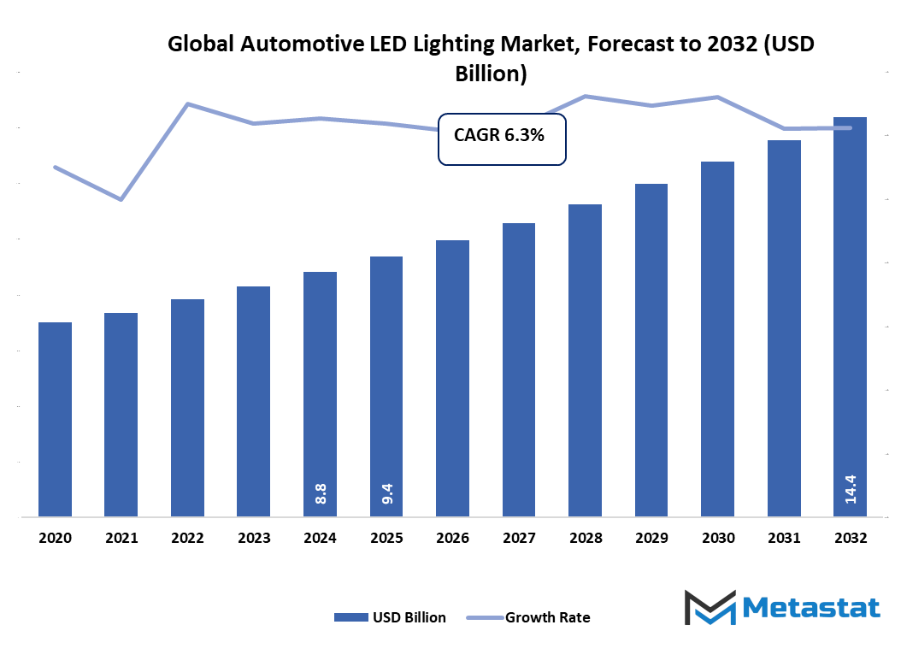
The global automotive LED lighting market is basically a sub-category of the automotive industry which is going to be the major factor in vehicle design, performance and driver experience in the future. This market is all about lighting systems that totally rely on LED technology for vehicle functions lightings like headlight, tail lamp, interior ambient lighting and signaling systems etc. As the automotive design will be more inclined towards efficiency and style, LED technology will be at the forefront of the whole development which will be the case for both passenger and commercial vehicles, thus bringing with it the advanced solutions for visibility, safety, and energy management.
The market will gradually change to cater to the increasing demand for the use of proper illumination that would be able to show the road clearly without exhausting much energy or ruining the vehicle in terms of its aesthetics. Manufacturers in the automotive sector will use LED-based systems for electrification of vehicles and for the purpose of meeting up with the set regulations on energy efficiency and safety. The need for LED technology in basic lighting will be just a phase as the technology can make vehicles aesthetically pleasing.
The global automotive LED lighting market is mainly classified based on Automotive Utility Lighting, Automotive Vehicle Lighting.
Daytime Running Lights (DRL): Daytime Running Lights are becoming more popular, as they are playing an important role in making the vehicle more visible on the road and, thereby, reducing accidents that occur in daylight. OEMs are not only putting in advanced LED DRLs for safety but also as a design signature with the light patterns that are emerging becoming a brand differentiator.
Directional Signal Lights: Directional signal lights (turn indicators) are a must-have in all markets and are currently on their way to sequential LED indicators in high-end models. This market is profiting from the development of connected vehicles trend that leads to the possibility of signals getting synchronized with vehicle-to-vehicle (V2V) communication systems in the future.
Headlights: Headlights are one of the major segments that bring in high revenues for utility lighting. In developed markets, the transition from halogen and HID to LED is almost done and adaptive LED and matrix headlamps are becoming popular. These systems allow features like automatic beam adjustment, cornering lights, and glare-free high beams, which not only enhance driver comfort but also safety.
Reverse Light: LED reverse lights offer better illumination and consume less energy, which is very important in electric vehicles where energy efficiency is a priority. Besides, the development of backup cameras and parking sensors has also made reverse lighting with higher brightness and longer lifespan necessary.
Stop Light: LED stop lights have almost replaced incandescent ones in most vehicles as they can illuminate much faster than traditional bulbs, thus the reaction time for drivers behind is shortened and road safety improved. The concept of smart brake lights, which may rapidly flash or change intensity depending on braking force, is becoming more widespread and this trend is most likely to lead to further innovation in the area.
Tail Light: OEMs are using tail lights as an opportunity to make vehicles look different. The use of LED in tail lights makes it possible for carmakers to come up with thinner designs and more distinctive looks which are very important features to attract passenger car buyers. The use of dynamic lighting and animations during starting or shutdown of the vehicle is also becoming more popular.
Others: It refers to fog lamps, license plate lights, cabin lighting, and ambient lighting systems. The interior lighting segment is experiencing rapid innovation especially with the introduction of customizable colours, mood lighting, and even human-centric lighting that automatically adjusts brightness depending on the time of day or driving conditions.
Two Wheelers: Major parts of two-wheeler lighting systems are being converted to LED among which are LED headlamps, tail lamps, and turn signals. The growth of electric scooters and motorcycles is the main factor behind the increasing LED adoption since LEDs are not only energy efficient but also are trendy and futuristic in appearance.
Commercial Vehicles: LEDs are taking over the lighting market for vehicles such as trucks, buses, and vans because of their long life, low energy consumption, and less downtime due to fewer replacements. Fleet operators are big fans of LED because they have a longer life and can also handle harsher conditions better than traditional lighting systems.
Passenger Cars: Passenger cars are the most popular and that is the reason why they set the trend concerning LED usage. There will always be a market for basic cars but they will become more competitive with offering LED DRLs and taillights as standard equipment. While mid-range and premium vehicles also rely on the development of advanced adaptive LED headlamps and ambient lighting to attract the customer, the emphasis on one-of-a-kind aspects is even generating demand for personalized lighting solutions.
|
Forecast Period |
2025-2032 |
|
Market Size in 2025 |
$9.4 Billion |
|
Market Size by 2032 |
$14.4 Billion |
|
Growth Rate from 2025 to 2032 |
6.3% |
|
Base Year |
2025 |
|
Regions Covered |
North America, Europe, Asia-Pacific, South America, Middle East & Africa |
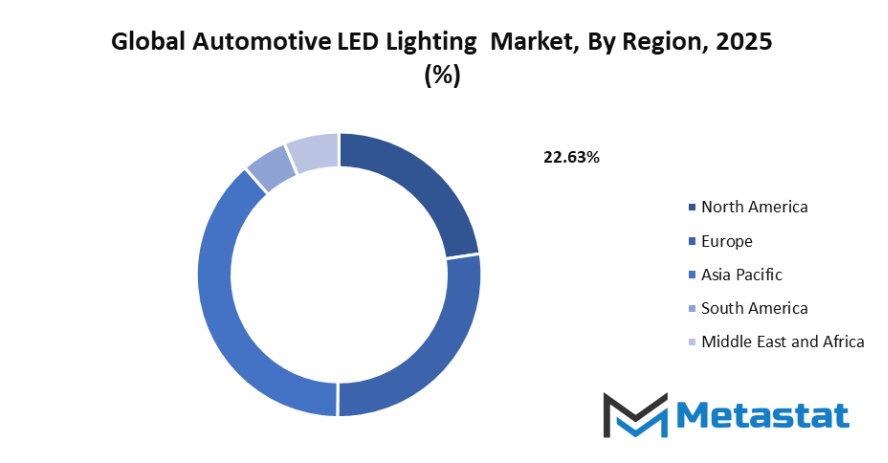
Regional segmentation based on geographical data depicts the global automotive LED lighting market as consisting of North America, Europe, Asia-Pacific, South America, and the Middle East & Africa. Every area will be leading the trend of this market in its own way, depending on the three factors of automotive production capacities, regulations, and customer preferences.
North America is going to be made up of the U.S., Canada, and Mexico, where the use of the only cutting-edge technology in the field of lighting will be completely in line with the rising concentration on energy-saving and the making of premium vehicles. The European Union, made up of the UK, Germany, France, Italy, and the Rest of Europe, will continue to be the main center of technical progress with its car manufacturers who are putting emphasis on design-led lighting systems and the satisfying of the safety regulations.
Asia-Pacific (with the biggest markets such as India, China, Japan, South Korea, and the Rest of Asia-Pacific) will be a major player in the world due to its solid vehicle-making ecosystem and the rising need for passenger and commercial vehicles. South America, with Brazil and Argentina at its forefront, will be using LED lighting technology more and more as its regional automotive industries update and shift towards energy-efficient solutions.
Middle East & Africa (made up of GCC Countries, Egypt, South Africa, and the Rest of the region) will start the use of LED technology at an increasing rate, supported by the building of infrastructure and the growing liking for high-performance vehicles. This wide regional segmentation will thus be essentially guaranteeing that the global automotive LED lighting market keeps changing and thereby meeting the very different requirements of the developed and the emerging economies.
Increasing demand for energy-efficient and long-lasting vehicle lighting solutions: The need for energy-efficient and long-lasting vehicle lighting solutions has substantially increased – Both the automakers and the consumers are opting for LED lights as they consume less power, need less maintenance, and have a longer life span, which is in line with the global sustainability goals.
Rising adoption of advanced driver-assistance systems (ADAS) and smart lighting features: Moreover, the rising acceptance of advanced driver-assistance systems (ADAS) and smart lighting features has also been a significant growth driver – The safety on the road is increased by the use of adaptive headlights, matrix LEDs, and automatic beam control, which at the same time, facilitates the shift towards intelligent vehicle systems.
High initial cost of LED lighting systems compared to traditional halogen lights: The cost of LED lighting systems is quite high initially compared to traditional halogen lights – The high price can act as a barrier in cost-sensitive markets where the adoption rate is limited, especially in entry-level passenger vehicles and less developed regions.
Complex integration and design challenges in retrofitting older vehicles: In addition, the complexity of integration and design issues in retrofitting older vehicles has also been a challenge – Retrofitting needs compatibility checks and technical expertise which makes it a tough sell in the aftermarket for existing fleets.
Growing trend of electric and autonomous vehicles boosts demand for advanced LED lighting solutions: The trend of electric and autonomous vehicles getting more popular is a good thing for advanced LED lighting solutions as it leads to the higher demand of such solutions – EVs need energy-efficient systems while autonomous vehicles are dependent on advanced external and internal lighting for communication, signaling, and passenger experience.
The global automotive LED lighting market will be characterized by the influence of a varied group of global leaders and nimble local competitors, each of them adding to the technological and design changes of the industry. The role of established producers is still distinctly forecast as they will continue to assert their position with forays into R&D, product innovation, and synergy with automakers, thus while some crowdfunded start-ups will be looking to market penetration strategies featuring the lowest of the already modest setups.
The main rivals in this sector come from GRUPO ANTOLIN IRAUSA, SA, HELLA GmbH & Co KGaA (FORVIA), Hyundai Mobis, KOITO MANUFACTURING CO., LTD, Marelli Holdings Co Ltd, Nichia Corporation, OSRAM GmbH, Signify (Philips), Stanley Electric Co, Ltd, and Valeo Corporation. The metrics they will continue to compete on include energy efficiency, design flexibility, integration of advanced driver assistance systems, and adherence to safety regulations in various markets.
Their future intentions would be the enlargement of the product suites to cover the adaptive lighting systems, OLED, intelligent lighting platforms that improve road visibility and user experience. This is one of the reasons why mergers, acquisitions, and partnerships with automobile OEMs will be crucial to strengtheing supply chain and market penetration initiatives particularly in high-growth areas like Asia-Pacific and Middle East.
global automotive LED lighting market competition will consequently continue to be innovation-led with an increasing emphasis on the sustainability, digital integration, and differentiation by way of stylish and luxurious products. The ones that invest in the synchronisation of technology with the spread of consumers' taste and use preferences will be the ones to have a higher level of success in such a global competitive market.
Market size is forecast to rise from USD 9.4 billion in 2025 to over USD 14.4 billion by 2032. Automotive LED Lighting will maintain dominance but face growing competition from emerging formats.
Within a span of time, the global automotive LED lighting market will have set new standards of Trust, Usefulness and Design Flexibility. Industries will still seek to go beyond the limits of technological innovations and computer integration to the extent of making light not a simple user-friendly feature but a central element of automotive identity and user experience globally.
This research report categorizes the global automotive LED lighting market based on various segments and regions, forecasts revenue growth, and analyzes trends in each submarket. The report analyses the key growth drivers, opportunities, and challenges influencing the global automotive LED lighting market. Recent market developments and competitive strategies such as expansion, type launch, development, partnership, merger, and acquisition have been included to draw the competitive landscape in the market. The report strategically identifies and profiles the key market players and analyses their core competencies in each sub-segment of the global automotive LED lighting market.
Find answers to common questions about this report
Global Automotive LED Lighting market is valued at $9.4 billion in 2025.
Global Automotive LED Lighting market is estimated to grow with a CAGR of 6.3% from 2025 to 2032.
Global Automotive LED Lighting market is estimated to reach $14.4 billion by 2032.
Top players operating in the Automotive LED Lighting industry includes GRUPO ANTOLIN IRAUSA, SA, HELLA GmbH & Co KGaA (FORVIA), Hyundai Mobis, KOITO MANUFACTURING CO., LTD, and Others.
The analysts below cover Automotive and Transportation research at Metastat Insights.
LEAD ANALYST
Utkarsh Khirodkar is a Lead Market Research Analyst at MetaStat Insight, specializing in market intelligence, technology sector assessments, and competitive strategy.

ENERGY & INFRASTRUCTURE INDUSTRY CONSULTANT
Automotive and Transportation · Electronics and Semiconductor · Energy and Power · Machinery & Equipment
Saurabh Vasant Ganvir consults for Energy & Infrastructure Industry at MetaStat Insight, specializing in renewable energy, solar EPC, and electric vehicle (EV) infrastructure markets.
Transitioning ultra-class mining haul trucks to alternative power requires concrete data on remote hydrogen refueling infrastructure economics. The report evaluated megawatt-scale electrolyzer installation expenses, onsite storage safety mandates, and heavy-duty fuel cell stack degradation under continuous duty cycles. That technical rigor helped our engineers benchmark realistic total operating cost horizons for off-highway fleet decarbonization.
Enterprise zero-trust network rollouts are often slowed down by multi-cloud transit latency and proprietary hardware retirement schedules. This study provided realistic total cost of ownership models comparing cloud-delivered security edge solutions against traditional hardware refreshes. The analysis of contract renewal lengths and software maintenance fees gave us clear visibility into enterprise replacement cycles over the next three to five years.
Scaling antibody-drug conjugate manufacturing hinges on contract manufacturing availability for high-potency active ingredients. The MetaStat Insight analysis looked closely at global cleanroom slot constraints, bioconjugation batch failure rates, and supply chain redundancies between the US, Europe, and India. The supplier capability matrix proved genuinely useful for our team when mapping secondary source options across our clinical pipeline.
Explore related market intelligence reports worth reading alongside this one.