
LEAD ANALYST
Utkarsh Khirodkar is a Lead Market Research Analyst at MetaStat Insight, specializing in market intelligence, technology sector assessments, and competitive strategy.

Global Executive Search (Headhunting) Market Size, Share, By Search Type (Retained Search, Contingency Search and Engaged / Hybrid Search), By Executive Level (C-Suite & Board-Level Executives, EVP / SVP / VP & Senior Functional Leaders, Director-Level & Business Unit Leaders and Other Senior Management Roles), By Industry Vertical (Technology, Software & Digital Services, Financial Services & Private Capital, Healthcare, Life Sciences & Medical Technology, Industrial, Engineering & Manufacturing, Energy, Chemicals & Natural Resources, Consumer, Retail & Food, Transportation, Automotive & Mobility and Professional & Business Services), By End-User Organization Type (Large Enterprises & Multinational Corporations, Mid-Market & Growth Companies, Private Equity-Backed Portfolio Companies, Venture Capital-Backed Companies, Family-Owned & Privately Held Businesses and Government & Public-Sector Organizations), Industry Analysis, Growth, Trends, and Forecast, 2026-2033
Report ID
MSI-5211
Published
September, 2026
Pages
264 Pages
Format
Historical
Base year
Forecast
Forecast period
Report Details
Choose Your License
Global Executive Search (Headhunting) Market
The global Executive Search (Headhunting) market was valued at USD 22.3 billion in 2025 and is projected to reach USD 38.2 billion by 2033, growing at a CAGR of 6.9% over the forecast period.
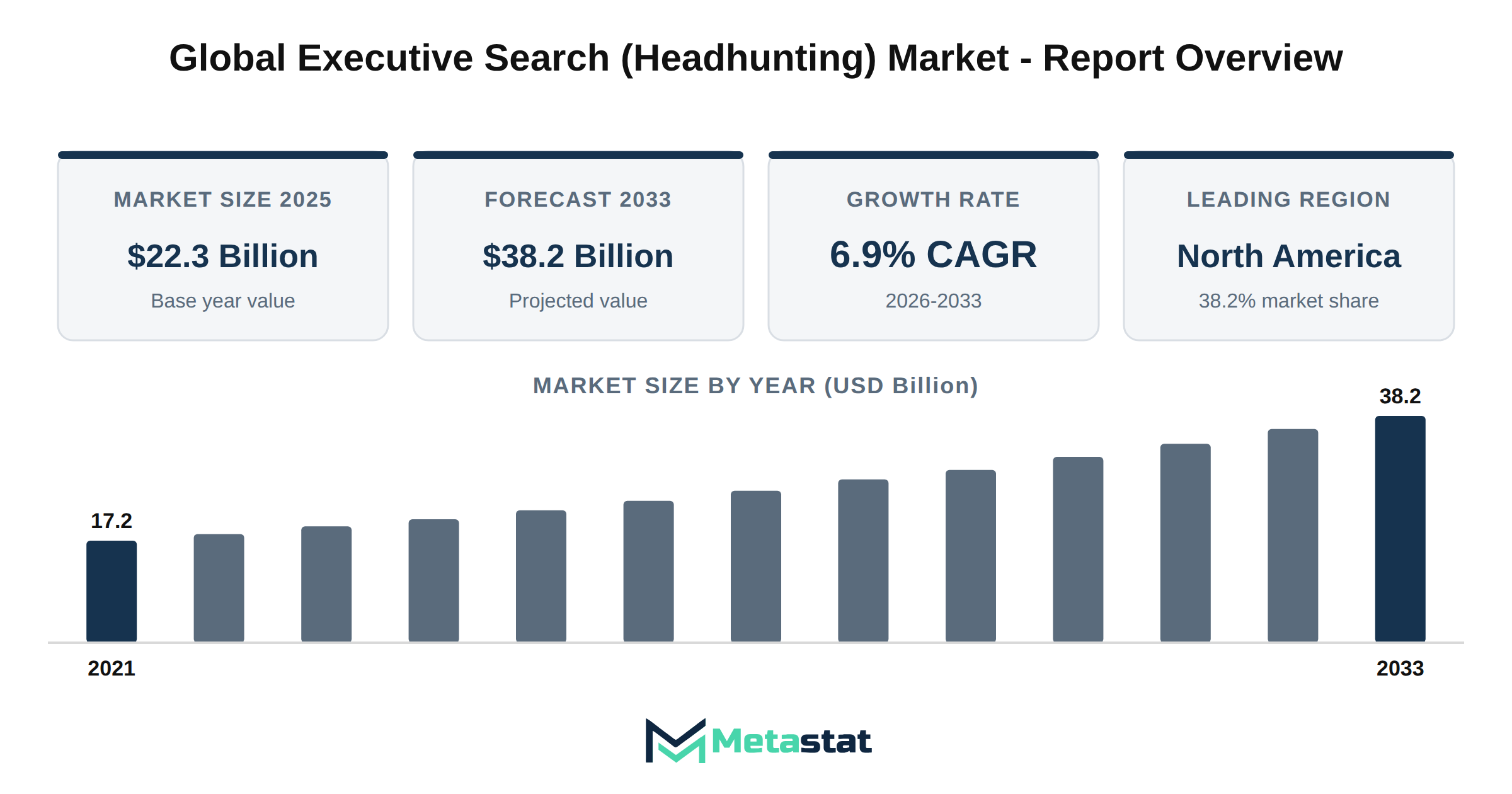
The Executive Search (Headhunting) market reached a base value of USD 22.3 billion in 2025, demonstrating significant growth since 2021 when it stood at USD 17.2 billion. Projections indicate the market is expected to achieve a value of USD 38.2 billion by 2033, representing a compound annual growth rate (CAGR) of 6.9% during the forecast period from 2026 to 2033.
Demand for executive search services varies by leadership level and function, with C-Suite and Board-Level Executives representing a notable segment. The market anticipates an increase from USD 8.2 billion in 2026 to USD 12 billion in 2033 for this category, reflecting a CAGR of 5.6%. In contrast, the EVP/SVP/VP & Senior Functional Leaders segment is projected to reach USD 11.8 billion by 2033, with a CAGR of 7.3%. The market for Director-Level & Business Unit Leaders is expected to grow significantly.
Retained search services generate significant revenue, with forecasts showing growth from USD 11.3 billion in 2026 to USD 16.8 billion by 2033, achieving a CAGR of 5.9%. Contingency search services are set to reach USD 13 billion by 2033, with an impressive CAGR of 8%. Engaged or hybrid search services will add further diversity to the market, with projected growth reinforcing the dynamic nature of the industry.
Technological advancements, particularly in AI and generative AI, are reshaping the executive search landscape. Organizations increasingly adopt these technologies for talent acquisition and candidate evaluation, enhancing efficiency and precision in the recruitment process. This trend strongly impacts industries, driven by firms striving to attract top-tier talent in an increasingly competitive market.
Executive talent shortages and candidate scarcity challenge organizations globally. Companies face difficulties sourcing qualified candidates, particularly for senior leadership roles. This scarcity drives demand for executive search services, compelling organizations to seek specialized firms with a robust network and expertise in identifying suitable candidates.
The influence of private equity and venture capital on the executive search market remains significant. Investment firms frequently engage search firms to identify and recruit top executives for their portfolio companies, driving revenue in the sector. This dynamic increases competition among search firms to secure exclusive partnerships and enhance their service offerings to meet the specific needs of these clients.
The demand for executive search services aligns closely with different leadership levels and organizational functions. C-Suite and board-level executive searches exhibit significant growth, driven by heightened competition for top talent. In the executive level segment, the market anticipates an increase from USD 8.2 billion in 2026 to USD 12 billion by 2033, reflecting a CAGR of 5.6. Similarly, EVP, SVP, VP, and senior functional leader searches are projected to reach USD 11.8 billion by 2033, demonstrating a CAGR of 7.3.
Shifts in executive search dynamics show a divergence between retained and contingency search models. Retained searches, which guarantee a commitment from clients, are expected to grow from USD 11.3 billion in 2026 to USD 16.8 billion by 2033, indicating a CAGR of 5.9. In contrast, contingency searches are forecasted to achieve a value of USD 13 billion by 2033, driven by a CAGR of 8.
The rapid adoption of AI and generative AI technologies is reshaping the executive search landscape. These advancements enhance candidate sourcing, assessment, and engagement processes, leading to increased efficiency and effectiveness in matching clients with suitable candidates. Firms leveraging AI technologies are positioned to capture a larger share of the market, driven by clients demanding more data-driven insights during the recruitment process.
Executive talent shortages continue to challenge global markets, creating a scarcity of qualified candidates. This scarcity is especially pronounced in sectors including technology, healthcare, and financial services, where demand for skilled leaders outpaces supply. Organizations face increasing pressure to secure top executives, prompting a surge in executive search activity.
Private equity and venture capital firms drive demand for executive search services, particularly focused on identifying strategic talent for their portfolio companies. The heightened emphasis on growth and innovation within these firms necessitates effective leadership recruitment strategies, further stimulating market growth.
Board and C-Suite succession planning significantly impacts executive search demand. Companies recognize the importance of proactive leadership transitions to maintain operational stability and strategic alignment. This trend highlights the necessity of engaging executive search firms to facilitate smooth transitions and ensure the continued success of organizations.
Digital transformation initiatives influence technology leadership hiring trends, with organizations seeking executives who navigate complex digital landscapes. The Executive Search (Headhunting) market sees increased demand for leaders adept in technology strategy, digital innovation, and data analytics, positioning firms to capitalize on this trend.
Emerging opportunities within the market stem from various growth drivers, including increased investment in leadership development and organizational restructuring. Firms that adapt to these changes and align their services with client needs are likely to experience enhanced growth and market penetration.
Pricing models within the executive search domain continue to evolve, influenced by market demands and client expectations. Organizations increasingly seek transparency in fees and flexible pricing structures, prompting firms to adapt their commercial strategies. This evolution influences competitive dynamics within the market.
Technological advancements in executive search platforms enable data-driven candidate mapping, enhancing the recruitment process. Firms using these platforms gain a competitive edge, driven by their ability to provide clients with more precise and informed candidate recommendations.
Diversity, equity, and inclusion trends play a critical role in executive leadership recruitment. Organizations prioritize diverse leadership teams to promote innovation and reflect their customer base, leading to an increased focus on inclusive recruitment practices.
Cross-border executive search activities rise due to globalization shaping leadership mobility. Organizations increasingly seek talent across international markets, driving demand for firms with global reach and expertise in navigating different regulatory environments.
Sector-specific demands for executive search services highlight opportunities across technology, healthcare, financial services, and industrial sectors. Each sector presents unique challenges and requirements, necessitating tailored recruitment strategies to attract the right leaders.
Regional opportunities for executive search services differ across North America, Europe, and Asia Pacific. Each region exhibits distinct market characteristics, influenced by local economic conditions, industry demands, and cultural factors, creating a diverse environment for executive search firms.
The competitive landscape of the Executive Search (Headhunting) market features numerous firms striving to differentiate their offerings. Partnerships, acquisitions, and investment activities within the sector reflect an ongoing effort to enhance capabilities and expand service portfolios.
Regulatory and data privacy developments increasingly affect executive search practices. Firms navigate complex compliance requirements while ensuring the protection of candidate and client data, influencing operational strategies within the market.
Innovation in assessment, leadership intelligence, and candidate engagement continues to shape the executive search landscape. Firms that embrace new methodologies and tools enhance their ability to deliver value to clients and secure top talent.
Emerging opportunities in high-growth industries and functions present a fertile ground for executive search firms. While markets evolve, organizations seek leaders equipped to drive innovation and lead significant initiatives, reinforcing the importance of effective recruitment strategies.
Global executive talent mobility trends reflect shifting patterns in international leadership recruitment. Organizations increasingly look beyond domestic borders for talent, necessitating strategic partnerships and insights into global hiring practices.
Challenges, risks, and competitive barriers persist within the executive search market. Firms address evolving client expectations, economic uncertainties, and changing regulatory landscapes to maintain their competitive position.
The future of AI-powered executive headhunting and leadership recruitment promises significant potential. Regulatory compliance, standards, and emerging technologies will dictate the trajectory of the market, influencing how firms engage with clients and candidates alike.
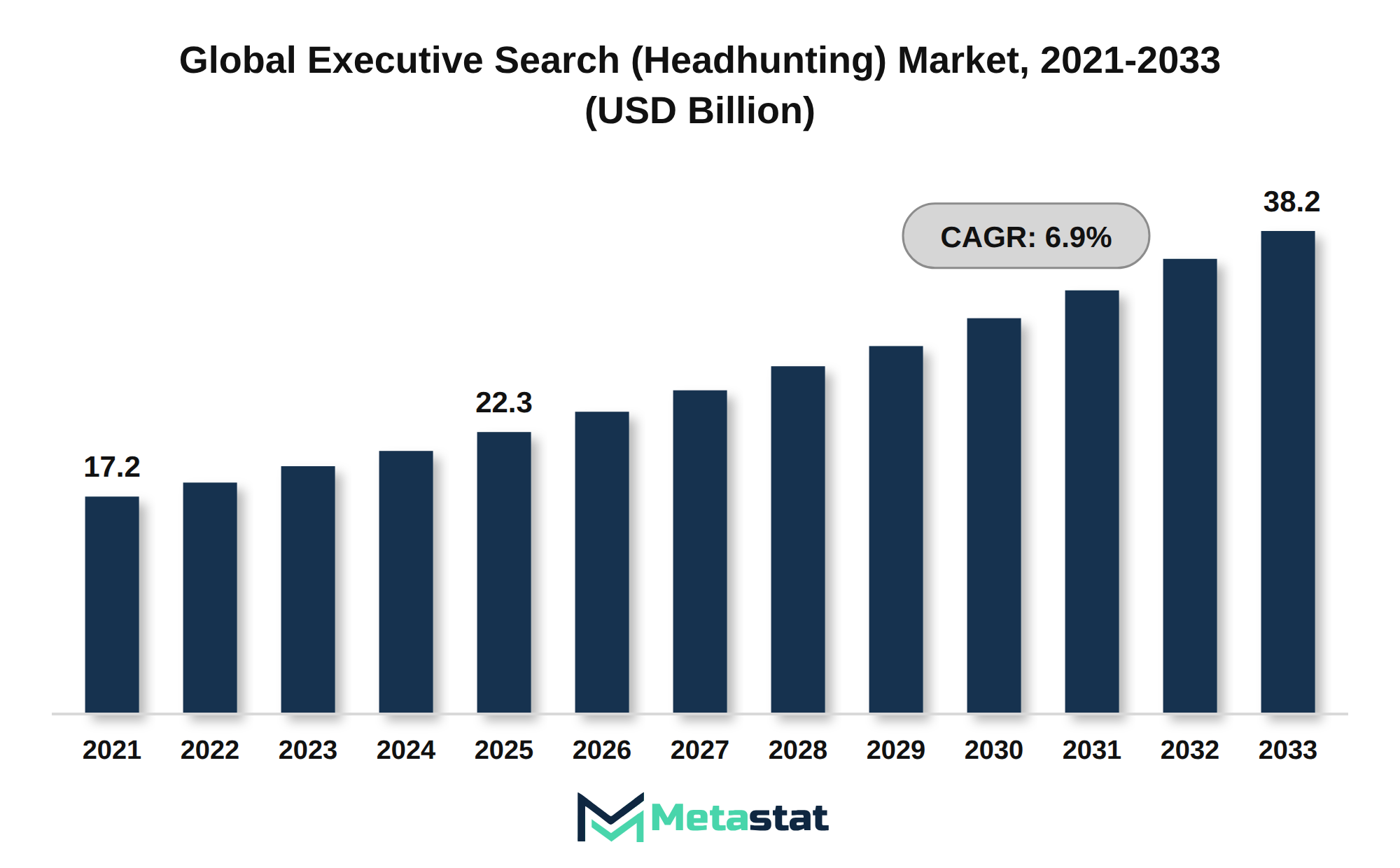
Growing macro-economic factors significantly influence the Executive Search (Headhunting) market. Economic stability and expansion, indicated by rising GDP growth, attract increased capital investments in various sectors. This trend fuels demand for executive search services, driven by organizations seeking skilled leaders to navigate complex business environments. Enhanced public-private spending power further supports this demand, creating a conducive environment for talent acquisition.
Digital transformation efforts across industries necessitate the hiring of executives adept in managing technology-driven change. Companies increasingly invest in automation and artificial intelligence integration, driving the requirement for leaders with the capabilities to steer such initiatives. While firms prioritize digital solutions, the executive search sector experiences heightened demand for professionals who lead these transformations effectively.
The evolving landscape of consumer behaviors and shifting demographic patterns, including urbanization and an aging population, contribute to market dynamics. Organizations require strategic talent to adapt to these changes, which strengthens the Executive Search (Headhunting) market. The need for executives who address new market realities enhances the focus on recruitment strategies aimed at attracting top-tier talent across various industries.
Rapid advancements in technology significantly influence the Executive Search (Headhunting) market by enhancing operational efficiency and productivity. The integration of automation, artificial intelligence, and advanced software tools streamlines recruitment processes, enabling firms to source and engage candidates more effectively. Organizations adopting these technologies experience improved accuracy in candidate selection and reduced time-to-hire, resulting in better alignment between client expectations and talent acquisition outcomes.
Digital transformation initiatives reshape how executive search firms operate, emphasizing the importance of data analytics and insights to drive decision-making. Leveraging these tools enables organizations to gain a competitive edge, allowing them to respond swiftly to changing market demands and client needs. This shift is particularly evident among firms targeting C-suite and board-level executives, where precision in candidate matching is critical.
The focus on technological integration extends to addressing the evolving preferences of clients and candidates alike. Organizations pursue digital solutions that enhance user experience, resulting in increased overall satisfaction for both clients and candidates. In this context, the Executive Search (Headhunting) market is projected to experience sustained growth, fueled by the continuous pursuit of innovation and efficiency.
The Executive Search (Headhunting) market faces significant restraints due to regulatory compliance challenges that hinder operational efficiency. Compliance with various employment laws and regulations incurs substantial costs for recruitment firms, affecting their service offerings and pricing strategies. Organizations prioritize adherence to these regulations, leading to extended recruitment timelines and increased operational complexity.
Legal mandates regarding equal employment opportunities and data protection enhance the burden on firms, necessitating comprehensive training for staff to navigate compliance requirements effectively. These factors contribute to rising overhead costs, reducing profitability for companies operating in the market. Challenges associated with maintaining compliance with diverse regulations across different regions create barriers for firms aiming to expand their services globally.
Macroeconomic headwinds further complicate the situation. Inflationary pressures and capital stagnation impact businesses' hiring budgets. This environment leads to cautious spending on executive search services, ultimately slowing market growth. Geopolitical instability influences recruitment patterns, prompting companies to reassess their talent acquisition strategies based on shifting political landscapes.
Investment in technologies aimed at streamlining recruitment processes remains essential; however, gaps in infrastructure and connectivity pose obstacles. Deployment bottlenecks arise, particularly in regions where technological adoption experiences delays. Consequently, these factors limit the ability of firms to compete effectively within the Executive Search (Headhunting) market.
The Executive Search (Headhunting) market faces challenges stemming from geopolitical fragmentation and trade deficits, which generate uncertainty in hiring processes and candidate availability. This instability impacts organizations' ability to attract top talent, particularly across borders. Compounding this issue, tariff friction disrupts international collaborations, raising costs for firms seeking to expand their talent pools globally.
Technological disruptions present another significant challenge. Rapid advancements in technology necessitate continuous adaptation by executive search firms, which integrate new tools while maintaining effective recruitment strategies. The complexity of research and development (R&D) integrations contributes to this challenge, because organizations require candidates with specialized skills in emerging technologies.
Market saturation intensifies pressures on pricing, leading to margin compressions for firms operating within the Executive Search (Headhunting) market. This scenario drives organizations to refine their value propositions and differentiate their services to retain clients. In parallel, rising input costs further strain profitability, compelling firms to reassess their pricing strategies to remain competitive.
Talent retention pressures continue to escalate, particularly in high-demand sectors. Organizations struggle to maintain skilled workforces amid increasing competition for top talent. Environmental lifecycle footprints and sustainability demands increasingly influence hiring processes, because candidates seek employers with strong commitments to corporate responsibility.
Intellectual property protection deficits and cybersecurity risks pose threats to firms involved in the market. While organizations increasingly rely on digital platforms for recruitment, vulnerabilities in data security present significant risks to both candidates and employers. This situation necessitates robust cybersecurity measures, which impose additional costs and operational complexities.
Overall, these challenges collectively shape the landscape of the Executive Search (Headhunting) market, demanding strategic adaptations from firms to navigate the evolving environment effectively.
The Executive Search (Headhunting) market experiences significant opportunities driven by emerging regional demands and infrastructure modernization. Various regions exhibit increasing requirements for specialized talent, particularly in technology, healthcare, and financial services. This trend prompts executive search firms to adapt their strategies and expand their geographical reach to meet local market needs effectively, resulting in strengthened long-term demand.
Technological disruptions and digital transformation enhance market dynamics. The integration of advanced technologies streamlines recruitment processes, enabling firms to identify and engage top-tier candidates swiftly. Digital procurement shifts reflect evolving buying behaviors of organizations, pushing them towards more agile and data-driven recruitment solutions, thereby increasing operational efficiency.
Sustainability imperatives influence corporate strategies, prompting organizations to align with environmental, social, and governance (ESG) standards. This alignment creates a demand for executive talent specializing in sustainable practices, thereby expanding opportunities for firms focused on green transformations and niche application growth, reinforcing the segment's position.
Strategic consolidation and cross-industry mergers reshape the competitive landscape. Organizations seek synergies through collaborations, while executive search firms gain leverage in sourcing leaders with diverse skill sets that cater to the evolving demands of various industries. This shift impacts the market by diversifying the types of roles firms recruit for and enhancing the overall value chain, increasing compliance costs for participants.
Value-chain optimization and operational yield maximization remain central themes within the market, leading to increased investment in process automation. This emphasis enables firms to enhance their service offerings, driving operational efficiency and expanding their client base. Consequently, the Executive Search (Headhunting) market is positioned for sustained growth through evolving opportunities and demands.
The Global Executive Search (Headhunting) market is segmented based on Search Type, Executive Level, Industry Vertical, and End-User Organization Type.
Valued at USD 11.3 billion in 2026, the Retained Search segment is projected to reach USD 16.8 billion by 2033, at a CAGR of 5.9% during the forecast period. This segment benefits significantly from the increasing demand for highly specialized executive talent, particularly in the technology, healthcare, and financial services sectors. Organizations prioritize strategic hires that align with their long-term goals, thus driving the demand for retained search services. The need for tailored recruitment solutions that address specific organizational challenges enhances the attractiveness of this segment within the Executive Search (Headhunting) market.
Technological maturation in the recruitment process facilitates efficiency and effectiveness in identifying top-tier candidates. Advanced data analytics and AI-driven tools support recruiters in sourcing candidates who best fit organizational culture and competencies. This evolution in recruitment practices aligns with ongoing shifts in consumption patterns, influencing how companies engage with executive search firms. The market's growth trajectory reflects this transformation, with organizations increasingly recognizing the importance of investing in strategic talent acquisition to drive organizational performance.
Firms within this segment face pressure related to pricing volatility, requiring them to balance competitive pricing with maintaining service quality. Economic conditions and changes in client demand affect pricing strategies and overall margins. Nevertheless, the growing focus on executive talent acquisition continues to present opportunities for retained search firms, encouraging them to innovate and adapt their service offerings to meet evolving client needs. The emphasis on high-level recruitment strategies positions the retained search segment because a critical component of the broader Executive Search (Headhunting) market.
Significant growth characterizes the Contingency Search segment within the Executive Search (Headhunting) market, projected to reach USD 13 billion by 2033, at a CAGR of 8% during the forecast period. This expansion results from increasing demand for flexible recruitment solutions, allowing organizations to fill positions without committing to retained search fees upfront. Companies across various industries, particularly in technology and healthcare, show heightened interest in identifying talent swiftly to adapt to market changes and competition.
Technological advancements play a crucial role in the evolution of the Contingency Search segment. The integration of artificial intelligence and data analytics aids recruiters in enhancing candidate matching and streamlining the hiring process. Companies benefit from these tools, because they reduce time-to-hire and improve the quality of candidates presented, driving market growth. Ongoing shifts in employment dynamics, including the rise of remote work and gig economies, fuel the demand for contingency search services to source diverse talent efficiently.
Growing competition among recruitment firms intensifies the focus on delivering rapid, cost-effective solutions. The segment attracts investment aimed at improving service offerings and expanding geographical reach. Increased regulatory compliance standards and shifting labor market conditions require recruitment agencies to adapt quickly to remain relevant. These factors collectively contribute to the segment's positive growth outlook within the broader Executive Search (Headhunting) market.
Revenue from the Engaged / Hybrid Search segment shows a strong growth trajectory, reaching USD 8.4 billion by 2033. This surge results from evolving organizational needs for more flexible recruitment options that blend the attributes of both retained and contingency searches. Various sectors, particularly technology and healthcare, increasingly prioritize hybrid approaches to attract top talent effectively.
Heightened competition for skilled executives drives demand for tailored recruitment methodologies, enhancing the segment's appeal. Adoption of advanced recruitment technologies and platforms accelerates this shift, enabling firms to streamline hiring processes while maintaining personalized engagement with candidates. Improved talent acquisition outcomes directly correlate with organizations' competitive positioning in the market.
The Engaged / Hybrid Search segment aligns with broader market trends emphasizing adaptability and efficiency in executive hiring. Increased funding in technology and digital services further supports this segment's growth, driven by demand for specialized executives who navigate complex business environments. Companies focusing on executive search services are set to capitalize on this trend, creating a more dynamic recruitment environment within the Executive Search (Headhunting) market.
Valued at USD 8.2 billion in 2026, the C-Suite & Board-Level Executives segment is projected to reach USD 12 billion by 2033, at a CAGR of 5.6% during the forecast period. Demand arises from the necessity for organizations to secure top-tier leadership to navigate complex business environments. Companies prioritize executive search services to effectively fill crucial roles that drive strategic objectives and support growth.
Factors contributing to market expansion include heightened competition for talent and evolving corporate governance standards emphasizing the importance of capable leadership. Multinational corporations and large enterprises lead the demand within this segment, focusing on attracting executives who exhibit the skills necessary to adapt and thrive in dynamic markets. Sourcing talent for C-Suite and board-level positions involves intricate strategies that leverage extensive networks and market insights, enhancing the efficacy of the recruitment process.
Technological advancements, particularly in data analytics and artificial intelligence, enhance the efficiency of candidate identification and evaluation processes. These tools enable search firms to provide tailored solutions aligning with client needs, driving market growth. Executive search firms are increasingly expected to demonstrate a deep understanding of industry-specific challenges, ensuring that selected candidates possess the requisite expertise and cultural fit for the organizations they represent.
The regulatory environment surrounding executive hiring continues to evolve, impacting recruitment practices. Compliance with policies related to diversity and inclusion mandates organizations to adopt broader strategies for sourcing talent. This shift encourages a more comprehensive approach to candidate evaluation, driving growth in the C-Suite & Board-Level Executives segment of the Executive Search (Headhunting) market.
Growth in the EVP / SVP / VP & Senior Functional Leaders segment reflects a strong demand for top-tier executive talent in response to evolving organizational needs. Organizations increasingly prioritize experienced leaders capable of navigating complex challenges, driving strategic initiatives, and encouraging innovation. This shift towards higher-level executive recruitment significantly enhances the segment's value proposition, positioning it because a critical component of the Executive Search (Headhunting) market.
Adoption of advanced recruitment methodologies and technologies contributes to the segment's anticipated growth, with organizations seeking specialized skills in leadership transformation. While businesses focus on aligning their strategic goals with talent acquisition, the need for experienced executives who adapt to industry disruptions grows. The segment is expected to reach USD 11.8 billion by 2033, at a CAGR of 7.3% during the forecast period.
Market dynamics reflect a transition in leadership requirements across various sectors, with companies increasingly recognizing the importance of strong executive leadership in driving competitive advantage. This awareness drives increased investment in executive search services, resulting in enhanced operational effectiveness and organizational resilience. The ongoing evolution of the Executive Search (Headhunting) market positions the EVP / SVP / VP & Senior Functional Leaders segment for significant success over the next several years.
Growth in the Director-Level & Business Unit Leaders segment reflects increasing demand for skilled professionals who drive organizational strategy and operational effectiveness. Companies prioritize leadership roles that influence target markets, enhancing competitive positioning and operational agility. This trend signifies a robust need for executive search firms that specialize in identifying candidates capable of fulfilling these critical leadership functions.
Growth in this segment aligns with broader economic trends, driven by organizations undergoing digital transformation and seeking leaders adept at navigating complex business environments. By 2033, the segment is projected to reach USD 9.5 billion, supported by increasing focus on executive talent acquisition and retention strategies. The demand for high-caliber leadership roles stems from the evolving dynamics within various industries, which emphasize innovation and adaptability.
To capitalize on these dynamics, executive search firms strategically enhance their service offerings, focusing on industry-specific expertise and tailored recruitment processes. The emphasis on specialized knowledge enables firms to provide clients with candidates who fit corporate culture and possess the necessary skills to lead in rapidly changing environments. Thus, the executive search (headhunting) market continues to adapt, reflecting the growing complexity of leadership roles across sectors.
Growth in the Other Senior Management Roles segment results from increasing demand for leadership talent across multiple industries. Organizations recognize the value of strong management teams, particularly in navigating complex market dynamics and driving innovation. This segment is projected to grow at a CAGR of 7.5% during the forecast period, reflecting a heightened focus on strategic hiring practices.
Executive Search (Headhunting) market dynamics highlight a shift towards more specialized roles, with companies seeking candidates who possess not only relevant skills but cultural fit and strategic vision. The rise of remote work and digital transformation influences hiring practices, compelling firms to adapt their recruitment strategies and focus on diverse leadership capabilities. While businesses strive for agility and resilience, the importance of effective management increases, driving recruitment efforts in this segment.
Market participants actively invest in technology to enhance sourcing and assessment processes. The integration of artificial intelligence and data analytics within recruitment practices enables more precise candidate matching and reduces time-to-hire. Consequently, firms investing in these technologies gain a competitive advantage, allowing them to meet the evolving needs of their clients.
The intensifying competition for top management talent reinforces the significance of the Other Senior Management Roles segment within the Executive Search (Headhunting) market. Organizations prioritizing robust executive search strategies are better positioned to attract and retain high-caliber candidates, ultimately leading to improved organizational performance and long-term success.
Valued at USD 6.5 billion in 2026, the Technology, Software & Digital Services segment is projected to reach USD 10.8 billion by 2033, at a CAGR of 7.4% during the forecast period. Expansion of this segment stems from increasing reliance on digital transformation and technological advancements across various industries. Organizations prioritize securing top talent in technology and digital services to maintain competitive advantages, prompting heightened demand for executive search services in this area.
Adoption of innovative technologies drives companies to seek specialized executive search partners capable of identifying leaders who navigate complex environments and lead digital initiatives. Accelerating digital trends, including artificial intelligence and cloud computing, enhance the urgency for organizations to recruit qualified executives with the necessary expertise. While firms increasingly focus on technology-driven growth, the significance of leadership in these sectors becomes critical, fueling demand for executive search services.
Investment in technology firms continues to surge, reflecting robust interest in digital solutions across the market and leading to greater opportunities for executive search providers. While organizations undergo digital transformations, they require leaders who possess a deep understanding of technological landscapes and business dynamics. This need highlights the importance of specialized recruitment strategies tailored to the nuances of the Technology, Software & Digital Services segment within the broader Executive Search (Headhunting) market.
Growth in the Financial Services & Private Capital segment reflects strong demand for specialized executive search services within a changing market environment. This segment is estimated to reach USD 6.9 billion by 2033, at a CAGR of 6.3% during the forecast period. Factors including increasing competition for top talent and the necessity for organizations to attract skilled executives drive this growth. Regulatory compliance and the need for high-level executives with niche expertise in finance and investment further fuel demand.
Investment in technology and digital transformation initiatives within financial institutions influences the market, driven by firms seeking leaders who navigate complex challenges. The ongoing shift toward data-driven decision-making and innovative financial products requires executives capable of leading in these areas. Consequently, executive search firms focusing on the Financial Services & Private Capital segment adapt their strategies to address the unique requirements of this sector.
Increased capital investment in financial services and a growing number of private equity firms enhance the environment for executive search services. The market responds to heightened competition, because companies seek to differentiate themselves by securing strong leadership talent. This dynamic environment presents opportunities for growth within the Executive Search (Headhunting) market, particularly for firms that deliver tailored solutions aligned with industry needs.
Demand for executive search services in the Healthcare, Life Sciences & Medical Technology segment stems from rapid advancements in medical technology and an increasing focus on healthcare innovation. Investment in research and development by pharmaceutical companies and healthcare providers drives the need for highly specialized talent, reflecting the segment's significant role in shaping the future of healthcare delivery.
Healthcare organizations increasingly seek top-tier executives to lead important projects. This trend creates competition among firms specializing in executive search, particularly in identifying candidates with a blend of technical expertise and strategic vision. The segment experiences sustained growth driven by organizations prioritizing leadership that addresses the complexities of modern healthcare systems.
Regulatory compliance standards and the need for adherence to industry certifications impact hiring dynamics within the sector. Organizations face pressures related to regulatory changes, necessitating the recruitment of executives equipped to align company strategies with evolving compliance requirements. The demand for skilled professionals who drive organizational change amid stringent regulations remains strong.
Valued at USD 6.5 billion by 2033, the Healthcare, Life Sciences & Medical Technology segment illustrates the market's expansion within the Executive Search (Headhunting) market. Strong demand for specialized leadership talent positions this segment for continued growth, with organizations recognizing the importance of strategic hires in maintaining a competitive edge.
Growth in the Industrial, Engineering & Manufacturing segment is expected to benefit from increasing demand for skilled labor and executive talent. Ongoing digital transformation across industries drives this demand, requiring leaders with expertise in both traditional engineering practices and modern technological advancements. Industries including manufacturing and engineering are evolving, necessitating specialized talent acquisition to adapt to changing market dynamics.
Technological maturation influences hiring practices, prompting organizations to seek candidates with comprehensive knowledge of innovative technologies. Investments in automation and advanced manufacturing processes create a need for executives who guide companies through complex transformations. Segment expansion catalysts include rising adoption of smart manufacturing principles, which enhance operational efficiency and productivity.
Regulatory compliance standards play a vital role in shaping hiring trends within this segment. Companies prioritize candidates with experience in navigating regulatory frameworks, ensuring business operations align with evolving regulations. Investing in compliance-focused talent reduces legal risks and enhances operational integrity.
Cost structures and pricing volatility impact market dynamics, with fluctuations in raw material prices influencing organizational budgets. Companies experiencing margin pressures seek headhunting services to identify cost-effective leadership solutions, ensuring alignment with financial objectives. The Industrial, Engineering & Manufacturing segment is projected to grow at a CAGR of 5.9% during the forecast period.
Strategic opportunity windows arise from demand for executives capable of driving sustainable practices in manufacturing and engineering. Organizations prioritizing environmentally responsible leadership differentiate themselves in the market, enhancing competitiveness. Capital investment outlook remains strong, reflecting confidence in long-term growth across the Industrial, Engineering & Manufacturing vertical, supported by robust demand for specialized talent to lead significant initiatives.
Adoption within the Energy, Chemicals & Natural Resources sector relies heavily on evolving technologies, regulatory compliance standards, and changing consumer preferences. Companies in this industry increasingly prioritize sustainable practices, which drives demand for executive search services that identify leaders equipped to navigate these complexities. The ongoing shift towards renewable energy sources fuels competition for talent, necessitating specialized recruitment efforts to fill critical roles with skilled professionals.
Investment in digital transformation within this sector highlights the need for executives who possess technological expertise and strategic vision. Executives with experience in integrating new technologies into traditional operations become valuable assets for organizations aiming to stay competitive. Regulatory compliance increasingly influences hiring practices, driven by firms seeking leaders familiar with the latest standards and policies governing the energy and chemicals industries.
Economic pressures, including fluctuations in commodity prices, create margin pressures that compel organizations to carefully assess their talent acquisition strategies. This scrutiny results in a heightened focus on finding executives who drive efficiency and innovation while maintaining compliance. The evolving dynamics of the Executive Search (Headhunting) market reflect these factors, with firms responding to the increasing complexity of the market environment.
Strategic opportunity windows arise because the industry adapts to external pressures, including environmental regulations and shifts in consumer demand. Organizations that successfully recruit leaders capable of managing these changes are positioned for growth and resilience. The increasing importance of sustainability within the Energy, Chemicals & Natural Resources segment highlights the necessity for tailored executive search services that align with the market's emerging requirements.
In the Consumer, Retail & Food segment of the Executive Search (Headhunting) market, demand arises from the ongoing evolution of consumer preferences and the pressing need for organizations to adapt swiftly. This segment experiences significant activity due to the continuous transformation within retail environments, driven by technological advancements and changing consumer behavior. Companies prioritize talent acquisition to enhance customer engagement and streamline operations, influencing their choice of executive search services.
Technological maturation significantly shapes this segment. Organizations increasingly invest in next-gen upgrades that optimize supply chain processes and enhance customer experiences. While e-commerce expands, companies in this sector require skilled executives who navigate digital transformation effectively and lead innovative strategies that respond to market demands. Downstream applications of executive search services focus on identifying leaders capable of driving growth and operational efficiency.
Consumption shifts toward sustainable practices and personalized services significantly impact the hiring landscape within the Consumer, Retail & Food segment. Regulatory compliance standards concerning product sourcing and environmental impact necessitate leaders with expertise in these areas. The segment faces unique cost structures, including pressures from pricing volatility and margin constraints, which affect decision-making in talent acquisition. This dynamic environment creates strategic opportunity windows for headhunting firms specialized in this sector.
Supply chain resilience remains critical, particularly given the recent disruptions experienced globally. Organizations in this segment actively seek talent that enhances their supply chain capabilities, ensuring they remain competitive in an evolving market. The exploration of substitution risks and disruptive alternatives drives companies to focus on recruiting innovative leaders who effectively manage challenges. Overall, the Consumer, Retail & Food segment presents a complex landscape where executive search services are essential for addressing contemporary challenges and capitalizing on emerging opportunities within the Executive Search (Headhunting) market.
In the Executive Search (Headhunting) market, the segment focusing on Transportation, Automotive & Mobility experiences demand driven by the rapid evolution of this sector. Factors contributing to growth include increased investments in electric vehicles, advancements in mobility solutions, and the need for talent equipped with skills in automation and digitalization. Organizations seek executives with expertise in these areas to navigate the complexities of emerging technologies and changing consumer preferences.
Expansion in this segment arises from strategic partnerships among automotive companies, technology firms, and mobility service providers. Collaboration enhances innovation, leading to new product offerings and improved operational efficiencies. This dynamic encourages firms to seek specialized talent capable of addressing challenges including sustainability, regulatory compliance, and market competition.
Technological maturation within the Transportation, Automotive & Mobility sector drives demand for experienced leaders adept at implementing next-generation solutions. Companies increasingly prioritize candidates with a robust understanding of digital transformation, data analytics, and supply chain optimization. The focus on these skill sets aligns with the industry's shift towards more integrated and efficient operations.
End-use dynamics reflect increased consumer expectations for personalized experiences and sustainable practices. Organizations within this segment adapt to these changes by recruiting top-tier talent that leads initiatives in customer engagement and operational excellence. The evolution of electric and autonomous vehicles necessitates a workforce proficient in advanced technologies, further influencing hiring practices within the market.
Consumption shifts towards mobility-as-a-service models highlight the importance of strategic talent acquisition. Companies face pressure to innovate and deliver value-added services while managing costs effectively. Identifying leaders who enhance operational agility and drive profitability becomes a central focus.
Regulatory compliance standards significantly impact hiring strategies in the Transportation, Automotive & Mobility sector. Adherence to environmental regulations and safety standards requires organizations to employ executives knowledgeable about compliance requirements. This need shapes the executive search landscape, creating opportunities for headhunting firms specializing in this niche market.
Strategic opportunity windows arise from emerging trends including shared mobility and connected vehicles. Firms that identify and capitalize on these trends through targeted talent acquisition are likely to gain a competitive edge. The Executive Search (Headhunting) market continues to evolve, reflecting the dynamic nature of the Transportation, Automotive & Mobility sector.
Utilization of executive search services in the Professional & Business Services sector stems from the increasing complexity of organizational structures and the competitive landscape. Companies in this sector prioritize talent acquisition to address skill shortages and maintain operational efficiency, prompting heightened demand for specialized headhunting services. The push for innovative solutions and strategic leadership within these organizations drives the necessity for experienced executive search partners.
Technological advancements influence the segment, particularly through the integration of data analytics and artificial intelligence in recruitment processes. These technologies enhance candidate sourcing and evaluation, allowing firms to identify suitable candidates swiftly. Firms that leverage these tools improve their hiring timelines and reduce associated costs, positioning themselves favorably within the market.
Competition among service providers intensifies owing to firms seeking to differentiate themselves through specialized offerings tailored to the unique needs of Professional & Business Services clients. Relationships with industry-specific candidates and an understanding of market trends become critical factors for success. This specialization creates long-term partnerships between organizations and executive search firms, ultimately benefiting both parties.
Regulatory compliance and workforce diversity initiatives shape the recruitment strategies of firms within this sector. Organizations increasingly prioritize inclusive hiring practices, necessitating the involvement of executive search firms that demonstrate expertise in attracting diverse talent pools. This trend contributes to the evolution of the segment, creating opportunities for firms to develop new service offerings that align with these market demands.
Overall, the Professional & Business Services segment within the Executive Search (Headhunting) market represents a dynamic environment where demand for skilled talent continues to grow. The intersection of technology, regulatory frameworks, and competitive pressures drives the evolution of this segment, creating opportunities for innovative solutions and strategic partnerships. Companies that adapt to these factors position themselves for sustained growth within the market.
Demand for executive search services targeting Other Industries, including Infrastructure, Education, Media & Entertainment, and Public & Social Sector, stems from various factors influencing organizational growth and operational efficiency. These sectors increasingly require specialized talent to navigate complexities, enhance service delivery, and drive innovation in response to evolving societal needs.
Adoption in this segment relies on awareness of the importance of leadership roles that align with mission-driven objectives. Organizations seek executives with the skills to address unique challenges, particularly in education reform, media transformation, and public service optimization. Such targeted searches enhance organizational effectiveness and support strategic initiatives across various areas.
Segment expansion catalysts encompass technological advancements that reshape operational frameworks and service offerings. The emergence of digital platforms enables organizations in these industries to identify and attract qualified candidates through innovative sourcing methods. Compliance with regulatory standards in education and public sectors encourages organizations to engage executive search services to ensure leadership aligns with governance requirements.
End-use dynamics reflect a growing focus on diversity and inclusion within leadership roles. Organizations recognize that varied perspectives drive innovation and solutions to complex challenges. Consequently, demand for executive search services supporting the recruitment of diverse candidate pools intensifies within the Other Industries segment of the Executive Search (Headhunting) market.
Consumption shifts indicate a greater emphasis on sustainable practices and corporate responsibility, further influencing the profiles of sought-after executives. Organizations prioritize leaders who navigate the intersection of profitability and social impact, thus shaping strategic direction and stakeholder engagement.
Investment in these sectors aligns with a broader trend towards enhancing institutional resilience and capability. Organizations adapt to fluctuating market conditions, and the need for skilled executives equipped to lead transformational efforts becomes critical, reinforcing the strategic relevance of the executive search process in the Other Industries segment.
Valued at USD 9.8 billion in 2026, the Large Enterprises & Multinational Corporations segment is projected to reach USD 14.3 billion by 2033, with a CAGR of 5.5% during the forecast period. Demand for executive search services within this segment stems from the need for specialized talent acquisition to navigate complex organizational structures. Large enterprises frequently seek top-level executives capable of driving strategic initiatives and fostering innovation. This trend is particularly pronounced in industries undergoing transformation, where companies require leaders with expertise in emerging technologies and market dynamics.
Increased competition within global markets compels large enterprises to enhance their leadership capabilities. Adoption of advanced executive search solutions facilitates access to a broader talent pool, ensuring organizations secure high-caliber candidates. The rise in digital transformation initiatives encourages firms to prioritize executive search services tailored to evolving business models. Executive search firms provide insights into market trends, enabling large corporations to refine their talent strategies and align with industry demands.
While organizations face pressures from regulatory compliance and shifting market conditions, effective talent acquisition becomes critical. The executive search landscape reflects this urgency, with firms developing innovative methodologies to identify and engage potential leaders. The emphasis on cultural fit and leadership attributes further influences the selection process, enhancing the alignment between candidates and organizational values. Consequently, investments in executive search services yield significant returns, positioning large enterprises for sustained success in the competitive environment.
Overall, the Executive Search (Headhunting) market for Large Enterprises & Multinational Corporations demonstrates strong growth potential. Ongoing shifts in leadership requirements and strategic priorities underline the importance of targeted executive search initiatives. While organizations continue to adapt to changing environments, the demand for specialized talent acquisition services is expected to expand, driving further investments in this segment of the market.
Valued at USD 8.8 billion by 2033, the Mid-Market & Growth Companies segment demonstrates strong potential within the Executive Search (Headhunting) market, supported by a robust CAGR of 8.6% during the forecast period. Factors driving demand include an increasing focus on talent acquisition and retention strategies among mid-market firms aiming to compete effectively against larger enterprises. These companies emphasize the need for specialized skills and leadership to navigate market challenges.
Adoption of executive search services is influenced by the growing complexity of business operations, requiring expert guidance in identifying and securing top executives. The segment expansion is driven by the rise of emerging industries, which increases competition for leadership talent. Mid-market firms recognize the strategic advantage of employing experienced executives, further driving demand for specialized search services.
Technological advancements in recruitment processes enhance the efficiency and effectiveness of executive search firms. Data analytics and artificial intelligence enable recruiters to better match candidates with organizational needs. This evolution contributes to improved outcomes for mid-market companies, ultimately supporting their growth initiatives and strengthening their competitive edge.
In the context of consumption shifts, mid-market and growth companies increasingly prioritize high-quality talent, considering it essential for achieving operational excellence. Regulatory compliance standards and organizational certifications further influence the search process, driven by firms seeking candidates familiar with industry regulations. The overall environment within the Executive Search (Headhunting) market continues to evolve, with mid-market organizations actively seeking tailored solutions to meet their specific leadership needs.
Valued at USD 5.3 billion by 2033, the Private Equity-Backed Portfolio Companies segment reflects a growing need for specialized executive search services. This demand arises from the unique challenges faced by these firms in sourcing top talent for their portfolio companies, particularly in a competitive market. The segment experiences increased adoption driven by private equity firms seeking to enhance their investment outcomes through effective leadership placements. Strategic hiring has become critical for these organizations, influencing their operational success and overall market performance.
Industry dynamics indicate an ongoing trend toward securing executives with experience in specific sectors, particularly technology, finance, and healthcare. This focus aligns with shifts in consumer behavior and market needs, requiring leadership that navigates evolving landscapes. While private equity firms expand their portfolios, the demand for high-caliber executives intensifies, pushing the executive search (headhunting) market to adapt rapidly to these conditions.
In terms of cost structures, private equity-backed companies face margin pressures that compel them to invest strategically in leadership talent. The importance of executive search services becomes evident, because these firms prioritize hiring leaders who drive value creation and operational efficiency. Consequently, the segment experiences significant growth potential, aligning with the broader trends in the executive search (headhunting) market.
Investment in Venture Capital-Backed Companies drives strong demand for executive search services, particularly driven by these organizations seeking top-tier talent to fuel growth and innovation. This segment is projected to grow at a CAGR of 8.3% during the forecast period. Companies in this sector often experience rapid scaling, requiring specialized recruitment strategies to secure skilled executives who align with their dynamic objectives.
Technological advancements in recruitment processes aid these companies in identifying and attracting high-caliber candidates. Enhanced digital platforms facilitate efficient candidate engagement and assessment, thus streamlining the hiring process. Increased competition for technological talent within the market intensifies the emphasis on effective headhunting strategies.
Market expansion reflects a broader trend toward prioritizing strategic leadership roles in Venture Capital-Backed Companies. These organizations recognize the critical impact of executive leadership on performance and innovation, prompting increased investment in executive search services. The market for headhunting tailored to these organizations experiences notable growth.
Family-owned and privately held businesses increasingly rely on executive search services to find qualified candidates for leadership roles. This reliance stems from their unique operational structures and the necessity for tailored leadership solutions that align with their strategic goals. These organizations often face distinct challenges in attracting top talent, particularly owing to their navigation of succession planning and transformation initiatives. The recruitment process becomes crucial for maintaining stability and driving growth, leading to heightened demand for specialized search services.
Adoption of executive search services within this segment reflects broader trends in organizational development and investment in human capital. Family-owned businesses recognize the value of securing leaders with the right fit for their corporate culture, which drives collaboration and innovation. The market facilitates these needs by providing tailored search strategies, ensuring that firms find executives who understand and enhance their unique business ethos.
Expansion within this segment hinges on several factors, including the increasing importance of leadership continuity and the rising complexity of business environments. While competition intensifies, family-owned businesses focus on strategic hires that ensure sustained growth and operational excellence. This focus influences investment decisions in executive search services, reinforcing the market's critical role in supporting these organizations.
Technological advancements further enhance the executive search process, enabling better candidate assessments and streamlined recruitment strategies. Tools leveraging data analytics and AI assist in identifying potential leaders who align with the specific values and vision of family-owned enterprises. Adoption of these technologies reflects a significant shift in how organizations approach talent acquisition within the Executive Search (Headhunting) market.
Overall, the emphasis on finding the right leaders for family-owned and privately held businesses highlights their significance in the wider market. Their unique characteristics drive demand for specialized search services that cater to their specific needs, reinforcing the executive search sector's role in shaping successful leadership for these organizations.
Executive search services for Government and Public-Sector Organizations present unique dynamics shaped by the specific needs of governmental entities. Demand drivers include the necessity for specialized leadership roles, emphasizing compliance, governance, and public accountability. Hiring trends reflect an increasing focus on candidates with extensive experience in public administration and regulatory environments, aligning with the heightened scrutiny faced by public-sector agencies.
Segment expansion catalysts involve ongoing reforms in government operations, necessitating adaptable leadership capable of navigating complex regulatory frameworks and public expectations. Technological maturation within public-sector systems influences the hiring profile, driven by organizations pursuing candidates proficient in digital transformation and data-driven decision-making. Enhanced public engagement and transparency create new expectations for leadership, shifting the focus towards executives skilled in communication and stakeholder management.
Strategic opportunity windows arise from ongoing investment in infrastructure and public services, creating demand for executives with expertise in project management and multi-agency collaboration. End-use dynamics highlight the critical role of skilled leadership in ensuring effective implementation of policies and programs within the public sector. Consumption shifts reflect a growing trend towards diversity and inclusion, prompting organizations to prioritize candidates from varied backgrounds and experiences.
Regulatory compliance standards and certifications specific to the sector shape hiring requirements, influencing the selection criteria for candidates. Cost structures and pricing volatility remain critical considerations, owing to budget constraints impacting hiring capabilities while requiring a focus on cost-effective talent acquisition strategies. The Executive Search (Headhunting) market for Government and Public-Sector Organizations adapts to these challenges, continuously evolving to meet the demands of a rapidly changing landscape.
Nonprofit organizations increasingly seek specialized executive search services to identify leaders who align with their mission-driven objectives. Unique challenges faced by these organizations, including the necessity for strong cultural fit and alignment with values, drive demand for tailored recruitment strategies. These entities prioritize candidates who possess the required skills and demonstrate a commitment to social impact, enhancing their capacity to fulfill organizational goals.
Investment in nonprofit sectors fuels a growing interest in executive search services, particularly in areas requiring specialized expertise, including fundraising, governance, and program management. The market has observed an uptick in demand for executives capable of navigating complex regulatory environments and managing stakeholder expectations effectively. This heightened focus on leadership capabilities correlates with the operational success of nonprofit organizations.
While nonprofit organizations confront competition for talent, strategic opportunities arise within the executive search landscape. Adapting recruitment strategies to attract mission-driven candidates presents significant advantages. Organizations that successfully integrate these strategies into their search processes position themselves to achieve greater organizational resilience and success in their initiatives.
The Executive Search (Headhunting) market recognizes the importance of understanding the nuances of nonprofit organizations. Specialized firms provide tailored solutions that cater to the distinct hiring needs of this segment, enhancing their ability to deliver value. By focusing on the specific requirements of nonprofit organizations, executive search firms expand their service offerings and create deeper connections within the sector.
Continued emphasis on leadership development within nonprofits highlights the critical role of executive search services. Organizations increasingly seek partnerships with experienced search firms that understand the unique dynamics and challenges of the nonprofit sector. This collaboration facilitates the identification of candidates who will lead effectively and drive change, reinforcing the role of executive search in supporting nonprofit success.
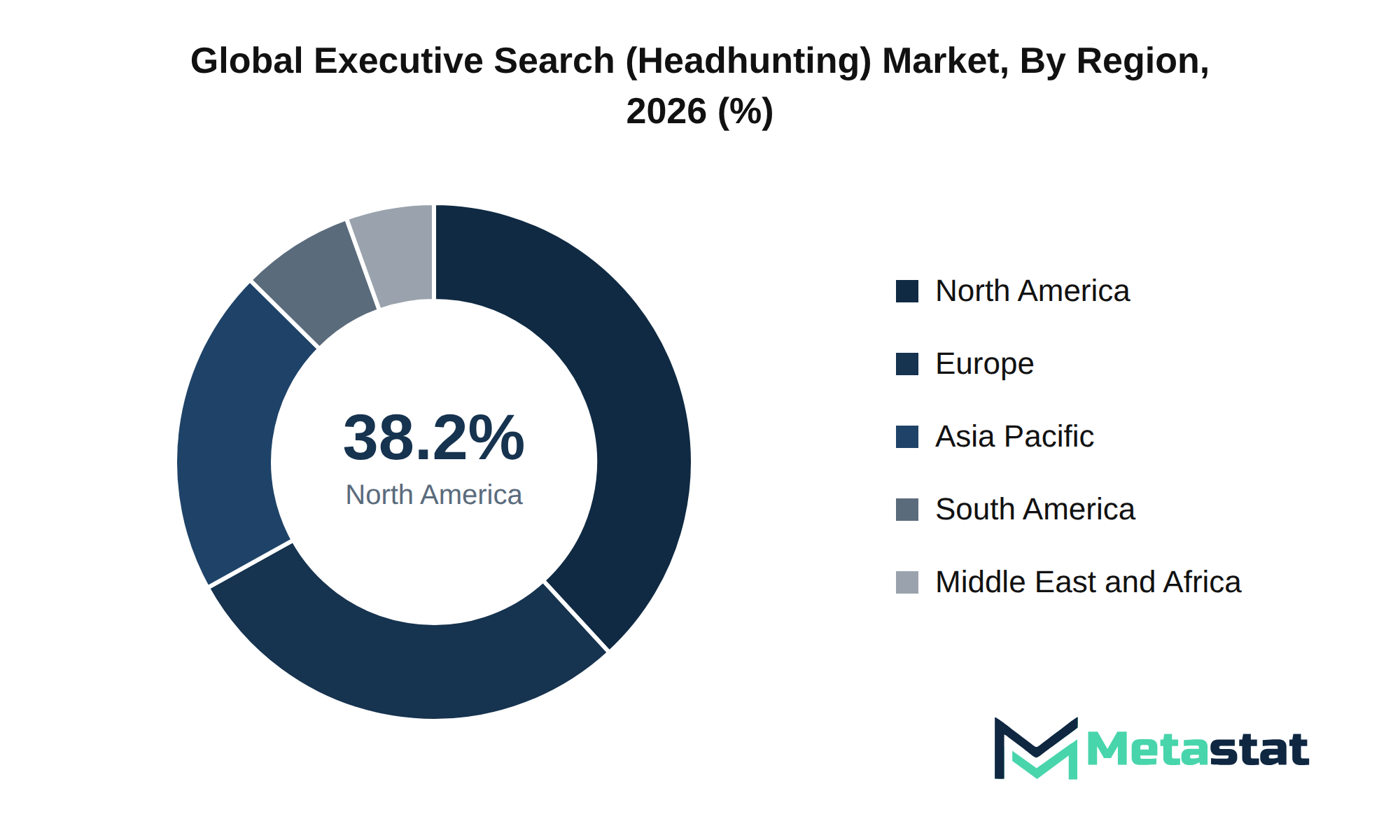
Based on geography, the Global Executive Search (Headhunting) market is divided into North America, Europe, Asia-Pacific, South America, Middle East, and Africa.
Expansion of the Executive Search (Headhunting) market in North America is driven by a strong demand for specialized talent in key sectors including technology, healthcare, and financial services. This demand is fueled by ongoing digital transformation and innovation across industries, which require highly skilled professionals to navigate complex challenges. The market is projected to reach a size of USD 13.3 billion by the end of 2033, expanding at a CAGR of 6.9% during the forecast period.
The region is characterized by mature market dynamics and high-value replacement cycles, with businesses increasingly focusing on leadership transformation to remain competitive. Several domestic market participants, including firms like Korn Ferry and Heidrick & Struggles, contribute significantly to the executive search landscape by offering tailored solutions to clients. The prevalence of large enterprises and multinational corporations in the United States, Canada, and Mexico drives substantial investments in executive search services.
Localized procurement dynamics and cultural nuances impact the buying behaviors of organizations in North America. This region possesses a robust infrastructure that supports delivery models, further enhancing the efficiency of executive search services. Emerging market front-runners in various sectors leverage localized insights to make strategic hiring decisions, resulting in growth vectors for the market.
The share of North America in the global executive search market stands at 38.2% in 2025, highlighting its critical role in shaping overall market trends. With increasing foreign direct investment flows and nearshoring initiatives, businesses seek to enhance operational efficiencies while maintaining access to top-tier talent. This strategic approach continues to strengthen North America's position because a hub for executive search services.
European countries including Germany, France, the UK, Italy, Spain, and Russia play important roles in the Executive Search (Headhunting) market, contributing significantly to the overall demand for these services. The market in this region is projected to reach USD 1,004.1 million by 2025, driven by robust economic activity and a growing emphasis on leadership acquisition across various sectors.
The competitive landscape features prominent players who adapt to unique regional dynamics, emphasizing localized procurement dynamics and cultural nuances in B2B buying behavior. The presence of established domestic market participants facilitates strategic vendor consolidation trends, enhancing service offerings and improving client outcomes.
Strong demand for executive search services stems from high-value replacement cycles, particularly within sectors including technology and healthcare. Companies in Europe increasingly seek qualified C-suite and senior executives to navigate complex market landscapes and drive organizational growth.
Investment in infrastructure modernization supports the expansion of the market, increasing the demand for specialized recruitment that aligns with evolving industry needs. This investment reflects the commitment of organizations to secure top talent in a competitive environment, ensuring adaptability to changing market conditions.
The ongoing geopolitical fragmentation presents both challenges and opportunities, influencing cross-border trade corridors and compliance mandates that affect operational strategies for executive search providers. Proactive engagement with geopolitical shifts will enhance market players' positioning, allowing them to better serve their clients in this dynamic environment.
Asia-Pacific accounted for USD 1,004.1 million of the global Executive Search (Headhunting) market in 2025, comprising 20.5%. The region's growth is driven by strong demand stemming from key markets including China, Japan, India, and South Korea, all of which exhibit increasing investments in executive search services. The rise of technology firms in these countries highlights the need for specialized search services to secure top-tier talent, impacting overall market dynamics.
Investment in infrastructure modernization further drives market expansion. Countries including India and China focus on enhancing local capabilities, which reflects the growing trend of localized manufacturing. This trend creates a competitive environment, encouraging domestic firms to seek assistance from executive search providers to attract skilled professionals.
Emerging players within Southeast Asia exhibit promising growth trajectories. The region's economic development leads to heightened competition among industries, increasing the demand for executive search services that cater to specific local needs. Cultural nuances play a crucial role in the executive search process, influencing procurement dynamics and shaping client-vendor relationships.
Overall, the Asia-Pacific Executive Search (Headhunting) market displays considerable potential for future growth. With ongoing investments in various sectors and a focus on talent acquisition, the region is poised for increased engagement in executive search services throughout the forecast period.
The Executive Search (Headhunting) market in South America shows potential for growth, driven primarily by increasing corporate activity in Brazil and Argentina. A growing number of multinational corporations operate within this region, seeking specialized talent to support their expansion strategies. The competitive landscape features both local firms and established global players, enhancing service offerings across various sectors.
Investments in sectors including technology and finance fuel demand for executive search services, emphasizing the need for high-caliber executive placements. The market's share is projected to reach 7.1% of the global executive search landscape in 2025, reflecting a marked interest in professional recruitment solutions. Local cultural nuances and regional purchasing behaviors influence how companies approach talent acquisition, highlighting the importance of tailored strategies.
Emerging companies within South America increasingly recognize the value of engaging executive search firms to secure top-level management, driving market dynamics. The ongoing modernization of infrastructure and regulatory frameworks supports business operations, further enhancing recruitment capabilities across the region. Overall, the Executive Search (Headhunting) market in South America is anticipated to experience steady expansion through 2033.
The Executive Search (Headhunting) market in the Middle East and Africa demonstrates significant growth potential, driven by increasing demand for skilled executives across various sectors. Saudi Arabia and the UAE emerge because key players, with robust investments in diverse industries including technology, healthcare, and finance. These nations focus on enhancing their workforce capabilities, leading to a rise in executive search activities aimed at sourcing top-tier talent.
South Africa contributes to the market with its growing corporate sector, where organizations seek specialized recruitment services to fill higher-level positions. The region's unique cultural nuances influence B2B buying behaviors, emphasizing the need for tailored executive search approaches. Local compliance mandates and regulatory frameworks necessitate a thorough understanding of the market dynamics to attract foreign direct investment and facilitate growth opportunities.
The market reflects a share of the global executive search services, indicating underpenetrated territories with potential for expansion. Geographic regulatory frameworks and investment in infrastructure modernization further support the market's growth trajectory. Domestic market leaders leverage localized procurement dynamics to navigate supply chain regionalization, ensuring that executive search offerings align with the evolving needs of businesses in the region.
Emerging trends including nearshoring initiatives and localized manufacturing densities contribute to increased demand for executive search services. The strategic entry barriers and geopolitical fragmentation present challenges and opportunities for players in the market, requiring a thorough analysis of cross-border trade corridors and tariff impacts to optimize business strategies. Overall, the Middle East and Africa present a dynamic environment for the Executive Search (Headhunting) market, fueled by a combination of investment, regulatory considerations, and cultural insights.
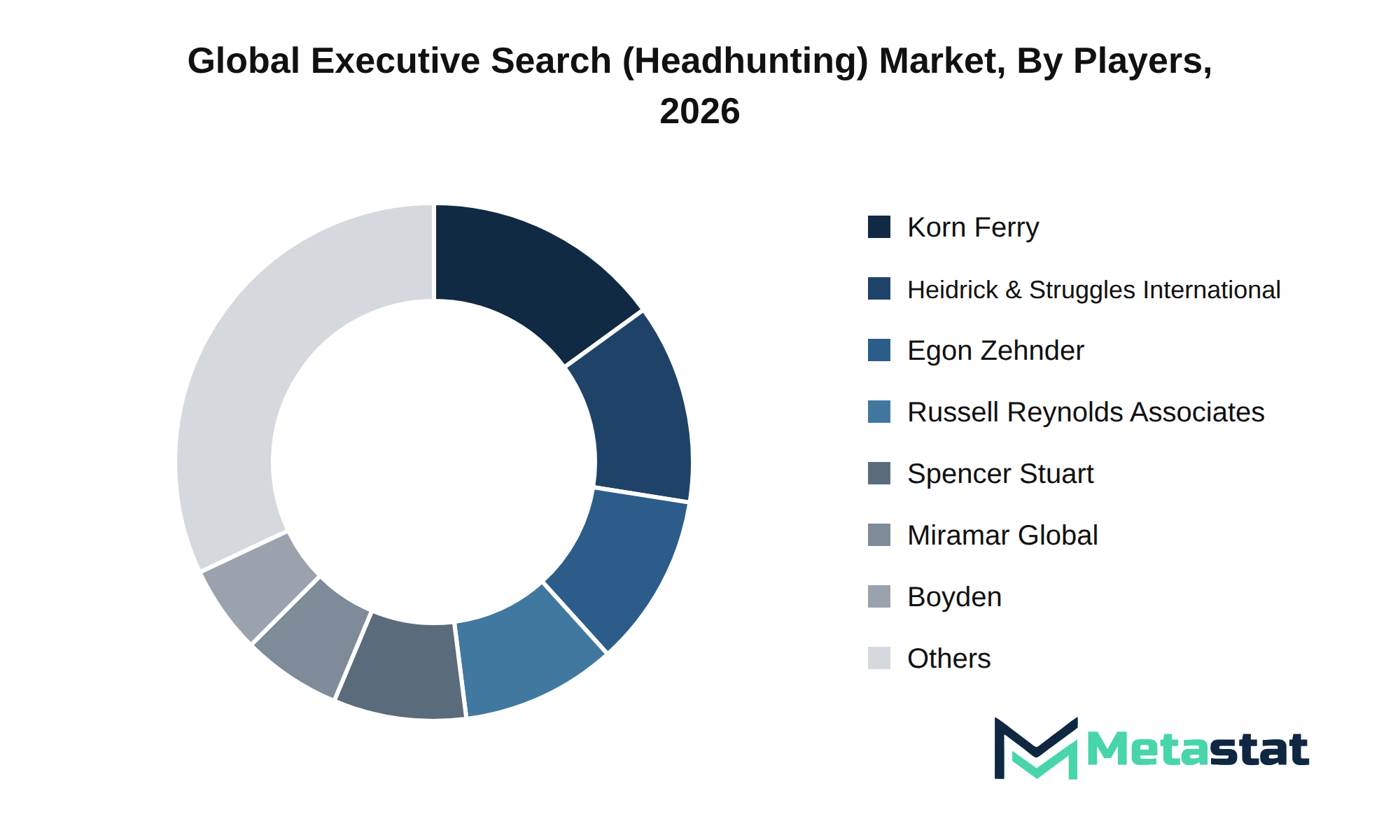
The Executive Search (Headhunting) market experiences intense competition characterized by strategic consolidation and partnerships among key players. Companies including Korn Ferry, Heidrick & Struggles International, Inc., and Russell Reynolds Associates pursue mergers and acquisitions to enhance market presence and expand service offerings. This consolidation leads to increased operational capabilities and the ability to cater to diverse client needs.
Strategic alliances and joint ventures shape competitive dynamics. Firms like Spencer Stuart and Egon Zehnder collaborate with technology providers to integrate advanced tools into their recruitment processes, enabling faster and more accurate candidate placement. This integration enhances customer retention strategies, reinforcing brand equity and creating high switching costs for clients.
Innovation in product differentiation remains a focus for many players. Organizations including Miramar Global and DHR invest in proprietary technologies to streamline their recruitment processes, enhancing their value propositions in the market. This investment in research and development creates a competitive advantage by establishing technological defensibility in a changing environment.
The future competitive outlook for the Executive Search (Headhunting) market indicates growth driven by evolving client expectations and the demand for specialized recruitment services. Companies will prioritize defensive imperatives and strategic growth vectors, ensuring robust positioning against new entrants and industry disruptors.
Market size is forecast to rise from USD 22.3 billion in 2025 to over USD 38.2 billion by 2033. The executive search (headhunting) market experiences a range of influences shaped by macroeconomic scenarios, including economic cycles and downstream demand changes. These factors contribute to structural consumption shifts that necessitate ongoing adjustment in strategic planning.
Next-generation technology integration enhances operational efficiency and drives demand for innovative solutions. Rapid development within research and development (R&D) commercialization timelines impacts market growth, influencing product life-cycles and creating opportunities for executive search firms to align with emerging trends. Regulatory evolution and imminent compliance milestones create both challenges and opportunities, prompting firms to adapt swiftly to new policies.
Geopolitical realignments and evolving trade corridors significantly affect global supply chain dynamics. This landscape creates opportunities for strategic capital allocation directives and infrastructure commitments. Firms focusing on capital expenditures (CapEx) capitalize on investment vectors that align with evolving market needs.
The executive search (headhunting) market presents emerging white-space opportunities, addressing unmet enterprise needs while identifying high-growth pockets. Emphasizing executive-level strategic imperatives ensures firms maintain competitiveness. Defensibility roadmaps and targeted future growth recommendations serve because essential elements for navigating the complexities of this evolving market.
The report strategically identifies and profiles the key market players and analyses their core competencies in each sub-segment of the Executive Search (Headhunting) market.
Report Attributes | Details |
Study Period | 2021-2033 |
Base Year | 2025 |
Estimated Year | 2026 |
Forecast Period | 2026-2033 |
Historical Period | 2021-2025 |
Growth Rate | CAGR 6.9% from 2026 to 2033 |
Revenue Unit | USD billion |
Segmentation | By Search Type, Executive Level, Industry Vertical, End-User Organization Type, and Region |
By Region | North America (By Search Type, Executive Level, Industry Vertical, End-User Organization Type, and Country)
|
Europe (By Search Type, Executive Level, Industry Vertical, End-User Organization Type, and Country)
| |
Asia Pacific (By Search Type, Executive Level, Industry Vertical, End-User Organization Type, and Country)
| |
South America (By Search Type, Executive Level, Industry Vertical, End-User Organization Type, and Country)
| |
Middle East and Africa (By Search Type, Executive Level, Industry Vertical, End-User Organization Type, and Country)
|
Find answers to common questions about this report
The Executive Search (Headhunting) market size was valued at USD 22.3 billion in 2025.
The Executive Search (Headhunting) market is projected to grow at a CAGR of 6.9% during the forecast period from 2026 to 2033.
The North America Executive Search (Headhunting) market size is estimated to reach USD 13.3 billion by 2033.
The Retained Search segment leads the Executive Search (Headhunting) market, with a projected value of USD 16.8 billion by 2033. This segment's growth reflects a compound annual growth rate of 5.9% from 2026 to 2033.
Key drivers for the Executive Search (Headhunting) market include rising GDP growth, which attracts capital investment, and increased public-private spending power that supports talent acquisition. the demand for executives skilled in managing digital transformations and addressing evolving consumer behaviors further fuels market growth.
North America holds the dominant share of the Executive Search (Headhunting) market, with a value of USD 13.3 billion projected for 2033, representing 38.2 percent of the total market.
The Executive Search (Headhunting) market faces restraints from regulatory compliance challenges that increase operational costs and complexity. macroeconomic headwinds, including inflation and geopolitical instability, lead to cautious spending on recruitment services, further slowing market growth. These factors collectively hinder the ability of firms to compete effectively.
Growing macro-economic factors, including economic stability and rising GDP, drive demand for executive search services because organizations seek skilled leaders. digital transformation initiatives necessitate hiring executives adept in managing technology-driven change, further enhancing product adoption in the Executive Search (Headhunting) market.
The Executive Search (Headhunting) market is estimated to reach a valuation of USD 38.2 billion by 2033.
Top players operating in the Executive Search (Headhunting) market include Korn Ferry, Heidrick & Struggles International, Inc., Russell Reynolds Associates, Egon Zehnder, Spencer Stuart, and Robert Half Inc.
The analysts below cover Professional Services research at Metastat Insights.
LEAD ANALYST
Utkarsh Khirodkar is a Lead Market Research Analyst at MetaStat Insight, specializing in market intelligence, technology sector assessments, and competitive strategy.

PRINCIPAL CONSULTANT - ENTERPRISE AI & EMERGING TECHNOLOGIES
Banking & Finance · Electronics and Semiconductor · Energy and Power · Healthcare IT · Information & Technology · Professional Services
Vijay Gunti is a Principal Consultant at MetaStat Insight, bringing over two decades of experience across enterprise digital transformation, technology strategy, and intelligent systems.

PRINCIPAL CONSULTANT - QUALITY SYSTEMS & COMPLIANCE
Electronics and Semiconductor · Machinery & Equipment · Professional Services
Omkar Phadtare is an Industry Consultant at MetaStat Insight, specializing in quality systems, regulatory compliance, and standards benchmarking to drive data-driven market intelligence and strategic industry research.

LEAD CONSULTANT - COMMUNICATION, TELECOM, AND IT
Electronics and Semiconductor · Information & Technology · Machinery & Equipment · Professional Services
Ravindra Sathe Consultants for Communication, Telecom, and IT at MetaStat Insight. He leads the firm's industry research initiatives across telecommunications infrastructure, digital connectivity, enterprise networking, and emerging information technology domains.
Tracking ceramic matrix composite adoption in high-bypass aero engines requires strict attention to material qualification cycles and FAA airworthiness testing milestones. The MetaStat Insight team provided a detailed timeline of silicon carbide fiber manufacturing capacity and commercial foundry lead times. Having clear visibility into upstream thermal barrier coating supply helped us stress-test our long-term component procurement strategy.
Transitioning ultra-class mining haul trucks to alternative power requires concrete data on remote hydrogen refueling infrastructure economics. The report evaluated megawatt-scale electrolyzer installation expenses, onsite storage safety mandates, and heavy-duty fuel cell stack degradation under continuous duty cycles. That technical rigor helped our engineers benchmark realistic total operating cost horizons for off-highway fleet decarbonization.
Enterprise zero-trust network rollouts are often slowed down by multi-cloud transit latency and proprietary hardware retirement schedules. This study provided realistic total cost of ownership models comparing cloud-delivered security edge solutions against traditional hardware refreshes. The analysis of contract renewal lengths and software maintenance fees gave us clear visibility into enterprise replacement cycles over the next three to five years.
Explore related market intelligence reports worth reading alongside this one.