Aerospace and Defense
Explosives Weapons and Contraband Detection Equipment Market
Starting from
$2950

Global Airport Transport and Mobility Infrastructure Market Size, Share, By Airport Type (Commercial Airport, Military Airport, and General Aviation Airport), By Infrastructure Type (Terminal & Concourse Infrastructure, Landside & Intermodal Infrastructure, Baggage & Cargo Handling Infrastructure, Airport Ground-Service Infrastructure, and Others), By Solution Type (Automated People Movers, Airport Rail & Metro Link Systems, Passenger Boarding Bridges, Vertical & Horizontal Passenger Mobility Systems, Baggage Handling & Cargo Transport Systems, Airport Ground Support & Transport Equipment, Aircraft Service & Ground Power Equipment, and Others), By End User (Airport Operators and Airport Authorities, Airlines, Ground Handling Companies, Air Cargo and Freight Operators, Defense and Military Airport Operators, and Others), Industry Analysis, Growth, Trends, and Forecast, 2026-2033
MSI-4995
August 20, 2026
Updated
298 Pages
Historical
Base year
Forecast
Forecast period
Report Details
Comprehensive Market Analysis And Insights
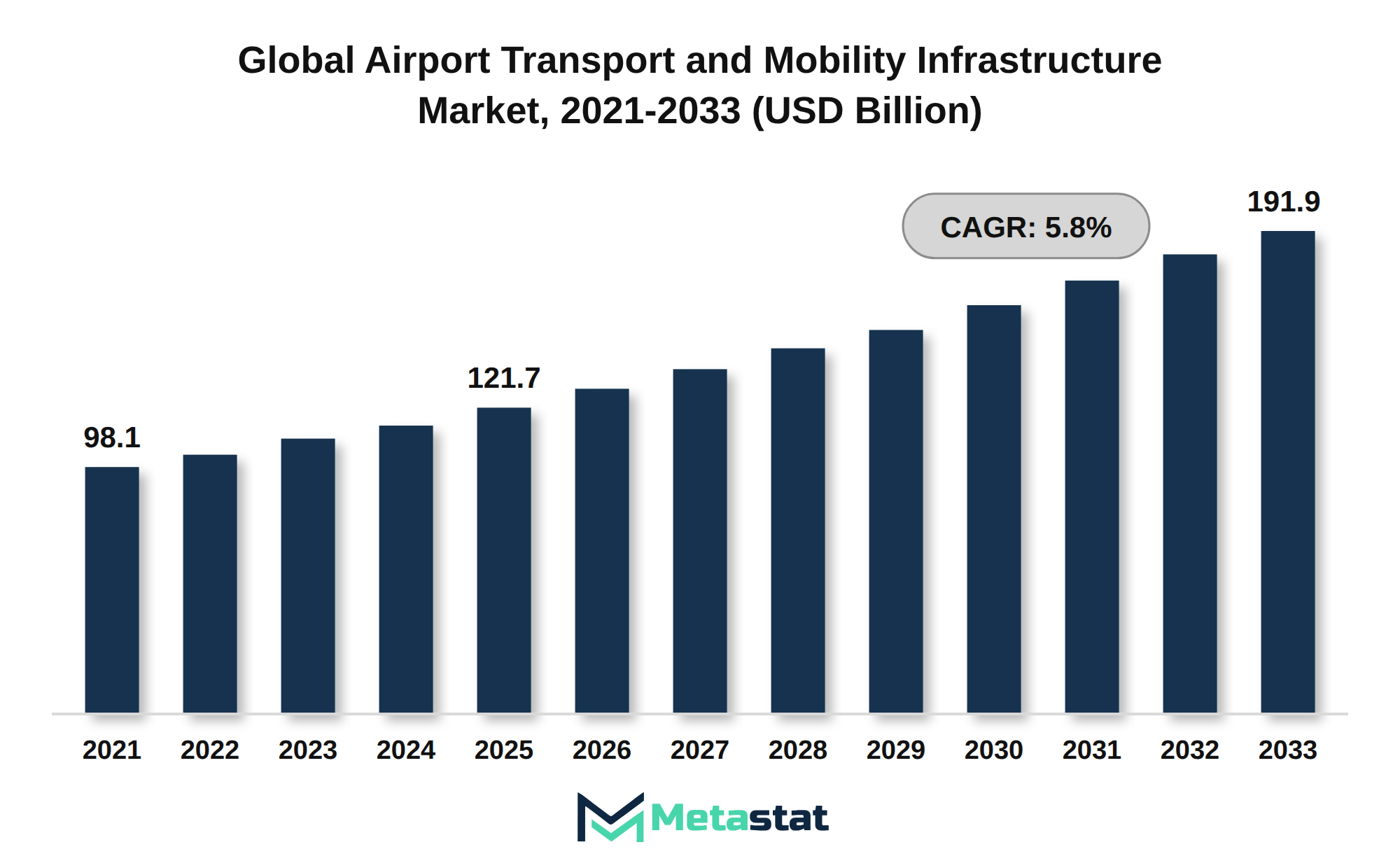
The global Airport Transport and Mobility Infrastructure market was valued at USD 121.7 billion in 2025 and is projected to reach USD 191.9 billion by 2033, growing at a CAGR of 5.8% over the forecast period.
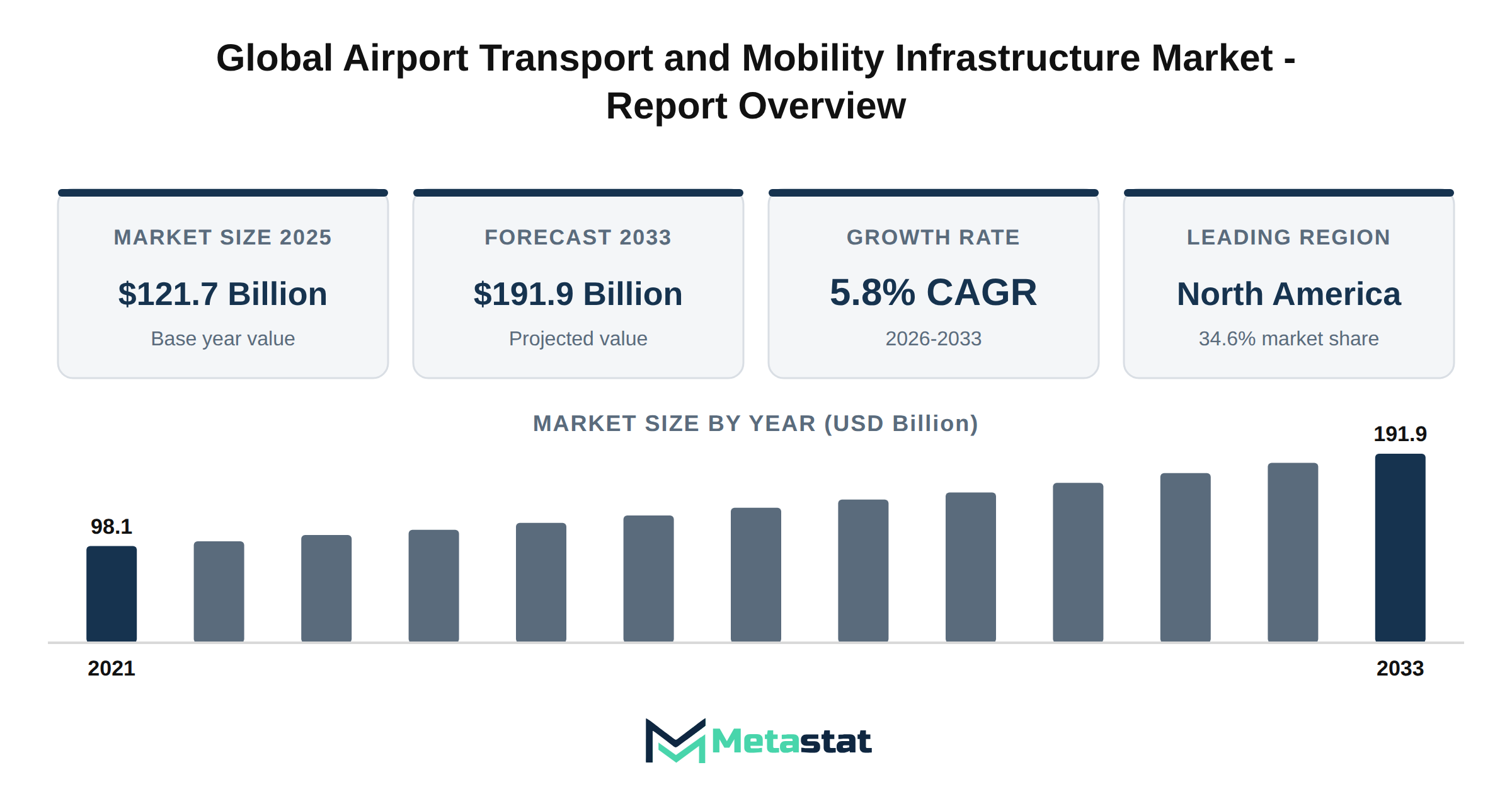
The Airport Transport and Mobility Infrastructure market reached a valuation of USD 121.7 billion in the base year of 2025. Projections indicate that the market expands to USD 191.9 billion by the end of the forecast period in 2033, reflecting a compound annual growth rate (CAGR) of 5.8%. This growth trajectory is underpinned by several factors influencing investment and development within the sector.
In recent years, the market has experienced an upward trend in demand driven by increasing global air travel, necessitating enhanced airport facilities and services. A significant portion of this demand arises from commercial airports, which are expected to grow from USD 100.7 billion in 2026 to USD 145.7 billion by 2033, representing a CAGR of 5.4%. Military airports and general aviation airports contribute to the market, with military airports projected to reach USD 28.8 billion by 2033.
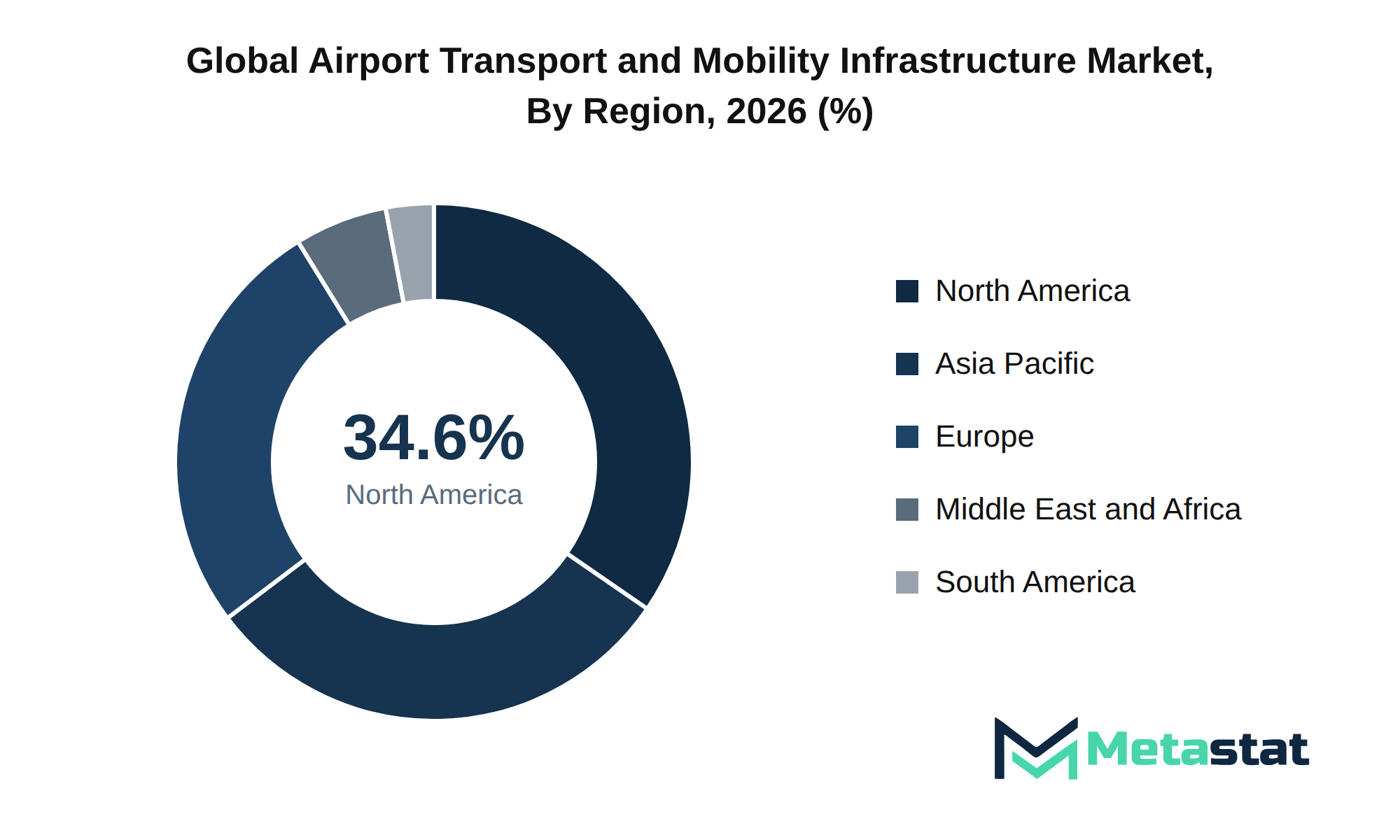
Regional dynamics play a crucial role in shaping the airport transport and mobility infrastructure landscape. North America retains the largest share of the market, accounting for 34.6% of the global total. This region's infrastructure investments are expected to reach USD 56.6 billion by 2033, supported by a CAGR of 5.8%. Europe and Asia Pacific follow, holding 26.5% and 30.1% of the market share, respectively, influenced by improving air connectivity and government initiatives aimed at enhancing airport infrastructure.
Challenges related to supply chain logistics, capital allocation, and inflationary pressures have emerged owing to critical factors affecting the market. Increasing operational costs and currency volatility present obstacles to investment strategies, influencing procurement and customer journey dynamics. Companies operating in this sector navigate a complex environment shaped by these economic realities while pursuing strategic growth initiatives.
The Airport Transport and Mobility Infrastructure market faces various influences that shape its trajectory. Regulatory compliance and standards play a crucial role in structuring operational frameworks across different regions. Geopolitical risks introduce complexities, impacting investment decisions and operational strategies among key stakeholders.
Disruption within the market arises from technological advancements and shifting consumer preferences. Research and development trajectories continue to evolve, focusing on next-generation innovations that enhance efficiency and user experience. Sustainable transformation, alongside decarbonization efforts, drives investments into eco-friendly infrastructure, aligning with global climate goals.
Supply chain dynamics demonstrate significant evolution, with logistics architecture adapting to accommodate changing demands. The sourcing landscape reflects heightened competition for materials and services, influencing procurement strategies among players in the market. Fragmentation remains a characteristic of the market, with numerous participants vying for market share, reflecting diverse operational capabilities and specialties.
Mergers and acquisitions serve strategic moves aimed at consolidating resources and enhancing market positioning. Value chain optimization emerges because a critical focus, with stakeholders seeking to streamline processes and improve profitability. Capital allocation decisions reflect a growing emphasis on infrastructure investments, recognizing the need for modernization and expansion to meet future demands.
CapEx and OpEx realities weigh heavily on operational strategies, with rising inflationary pressures and currency volatility affecting cost structures. Macroeconomic headwinds challenge growth, requiring stakeholders to adopt agile strategies to navigate uncertainties. The future strategic outlook for the Airport Transport and Mobility Infrastructure market hinges on corporate imperatives that prioritize innovation, sustainability, and resilience in evolving market conditions.
High-value recommendations emphasize the importance of aligning operational strategies with broader market trends. Stakeholders should focus on enhancing customer journey dynamics, ensuring a smooth experience from arrival to departure. Partnerships within the ecosystem drive collaborative solutions that address emerging challenges and capitalize on growth opportunities.
Capital investment in the Airport Transport and Mobility Infrastructure market significantly influences growth trajectories and infrastructure enhancements. The increasing need for modernization in airport facilities and systems has led to heightened public and private sector investments. These investments are driven by factors including GDP growth, interest rates, and available venture funding, which create a favorable environment for stakeholders seeking to expand operational capabilities.
Public-private partnerships play an essential role in funding major infrastructure projects. Enhanced collaboration between governmental bodies and private enterprises leads to successful project implementation, enabling more efficient use of resources and shared financial responsibilities. This collaborative framework creates an environment where innovation in technology and efficient capital allocation are prioritized, directly impacting market growth.
The market is expected to benefit from ongoing advancements in automation and technological integration. Increased investment in digital transformation initiatives facilitates the adoption of advanced technologies, streamlining operations and improving overall productivity. Such technological shifts contribute to cost-efficiency initiatives, allowing operators to optimize labor and reduce operational overhead, which strengthens long-term demand.
While airport authorities and operators seek to enhance customer experience and operational efficiency, investment strategies increasingly focus on sustainable development. The push for environmentally friendly practices, aligned with global trends, positions the Airport Transport and Mobility Infrastructure market for significant growth. A greater commitment to sustainability translates into innovative projects that prioritize resource stewardship and reduce carbon footprints across airport infrastructure, reinforcing the segment's position in the market.
Digital transformation significantly influences the Airport Transport and Mobility Infrastructure market by streamlining operations and improving service delivery. The integration of advanced technologies, including automation and artificial intelligence, facilitates legacy process digitization, leading to enhanced efficiency and reduced operational costs. This trend attracts investment from airport operators and authorities focused on optimizing their facilities and services.
Increased automation in equipment and systems contributes to faster and more reliable operations, directly impacting passenger experience and satisfaction. Automated baggage handling systems and passenger boarding bridges reduce turnaround times and enhance overall airport efficiency. Adoption of these technologies aligns with growing consumer expectations for efficient travel experiences, driving innovation within the market.
Investment in digital infrastructure provides opportunities for airport operators to modernize their operations and service offerings. Enhanced data analytics capabilities enable better decision-making, allowing stakeholders to identify trends, optimize resource allocation, and improve operational productivity. This emphasis on digital transformation creates a competitive environment where companies in the Airport Transport and Mobility Infrastructure market strive to innovate and differentiate their service offerings.
Regulatory compliance challenges impose significant hurdles for the Airport Transport and Mobility Infrastructure market. Stringent legal mandates require substantial investments in technology and infrastructure upgrades, deterring new entrants and restraining existing operators' expansion plans. Throughout the forecast period, these compliance hurdles impact capital allocation, limiting funds available for other critical areas including innovation and service enhancement.
Inflationary pressures contribute to rising operational costs, further complicating compliance efforts. Supplies essential for infrastructure development face increasing costs, affecting the overall market financial landscape. Geopolitical instability introduces uncertainty in supply chains, resulting in delays and increased expenses that adversely affect project timelines and budgets.
Skill shortages among the workforce present obstacles to effective deployment and implementation of new systems. The inability to secure qualified personnel hampers operational efficiency and slows progress in adopting advanced technologies, contributing to delays in infrastructure projects. In combination, these factors create a challenging environment for the Airport Transport and Mobility Infrastructure market, ultimately influencing growth and competitiveness.
The Airport Transport and Mobility Infrastructure market encounters challenges arising from geopolitical fragmentation, leading to trade deficits and tariff friction. These factors disrupt supply chains, increase costs, and create uncertainties among stakeholders. Companies involved in the market face rising input costs and margin pressures, particularly due to fluctuating feedstock and component availability. This situation complicates project financing, resulting in reduced investment activities across various segments.
Technological disruptions further contribute to the challenges within the market, driven by rapid advancements that demand continuous adaptation from firms. Complex research and development integrations require substantial resources, while interoperability friction among different technologies hinders operations. Such barriers impede efficiency and raise operational costs for firms, impacting overall market growth.
In addition, workforce skill gaps and talent retention pressures present significant obstacles for companies striving to maintain competitive advantages in the Airport Transport and Mobility Infrastructure market. The need for specialized skills in advanced technologies exacerbates these gaps. Environmental lifecycle footprints and decarbonization mandates impose additional compliance overhead on firms, creating further complexities in their operations.
Market saturation and evolving downstream demands influence strategic decision-making among industry players. Companies navigate competitive pressures while addressing diverse customer expectations, which divert focus from long-term growth strategies. Consequently, these interconnected challenges necessitate adaptive approaches for firms to thrive in the Airport Transport and Mobility Infrastructure market.
Growing regional demands significantly enhance opportunities within the Airport Transport and Mobility Infrastructure market. Increased air travel and urbanization in emerging economies stimulate infrastructure modernization, leading to investments in new airport facilities and upgrades to existing assets. This trend attracts airport operators, airlines, and ground handling companies focusing on improving passenger experiences and operational efficiencies, strengthening long-term demand.
Technological disruptions create avenues for innovation across various airport segments, including automated systems and advanced mobility solutions. Integration of these technologies optimizes operations, drives down costs, and enhances service delivery. The market experiences a shift towards environmentally sustainable practices, aligning with global sustainability imperatives. These initiatives not only meet regulatory expectations but cater to evolving consumer preferences for greener travel options, reinforcing the segment's position.
Geographical expansion into underserved regions presents significant revenue opportunities for stakeholders. Localized supply chains and strategic partnerships strengthen market resilience and adaptability. Emerging buying behaviors prioritize digitization and streamlined procurement processes, leading to increased investments in integrated systems that support operational efficiency, widening commercial adoption.
Next-generation innovations, characterized by automation and data-driven decision-making, further enhance competitive positioning within the market. Strategic consolidation among key players encourages collaboration and resource sharing, while cross-industry mergers facilitate access to new technologies and expertise. This dynamic environment positions the Airport Transport and Mobility Infrastructure market for sustained growth through 2033, increasing investment across the value chain.
The Global Airport Transport and Mobility Infrastructure market is segmented based on Airport Type, Infrastructure Type, Solution Type, and End User.
Valued at USD 100.7 billion in 2026, the Commercial Airport segment is projected to reach USD 145.7 billion by 2033, achieving a CAGR of 5.4% during the forecast period. Demand for commercial airports stems from the resurgence of air travel and increased passenger volumes, spurred by economic recovery and expanding urban populations. Airlines invest in expanding their fleets and improving service quality, influencing infrastructure upgrades at commercial airports globally.
Technological maturation facilitates the adoption of advanced solutions, including automated people movers and enhanced baggage handling systems, driving operational efficiency and improving passenger experiences. Next-gen upgrades emphasize sustainability and energy efficiency, aligning with regulatory compliance standards aimed at reducing carbon footprints, impacting investment decisions within the market.
Cost structures remain a significant consideration for airport authorities and operators. Rising capital expenditures related to infrastructure and technology investments, along with pricing volatility for materials, affect overall project budgets. Margins experience pressure due to intensifying competition among airport service providers, necessitating strategic cost management to maintain profitability.
Supply chain resilience becomes crucial, with raw material sourcing challenges highlighting the need for diversification in supplier networks. Disruptive alternatives, including electric ground support equipment, emerge because viable options for reducing emissions and operational costs. The strategic opportunity window for investment expands, aligning with trends in digitalization and automation, enhancing operational capabilities and catering to evolving consumer expectations in the Airport Transport and Mobility Infrastructure market.
Military airport infrastructure experiences significant growth driven by heightened defense budgets and modernization programs globally. Nations prioritize the enhancement of military capabilities, resulting in increased investments in airport facilities and technologies. The ongoing need for strategic airlift and rapid deployment capabilities increases demand for advanced military airport solutions.
Technological maturation influences the military airport segment through next-generation upgrades in ground support equipment and passenger mobility systems. Integration of automated people movers and advanced baggage handling systems enhances operational efficiency and improves service delivery in military airports. These innovations provide a competitive edge, aligning with the strategic objectives set by various governments.
End-use dynamics reflect the diverse needs of military airport operators, including defense forces and governmental agencies. Increasing reliance on air transport for defense logistics necessitates robust infrastructure to accommodate military aircraft and personnel. Adoption of advanced systems addresses these needs, ensuring efficient operations and improved resource allocation.
Military airport segment is estimated to reach USD 28.8 billion by 2033, at a CAGR of 6.6% during the forecast period. The market outlook indicates a favorable trajectory driven by investments in defense infrastructure becoming a priority for many nations, contributing to sustained growth in the military airport segment.
Expansion within the General Aviation Airport segment reflects a broadened interest in private and business aviation, driven by increasing demand for flexible travel options. This trend stems from changing consumer preferences, with more individuals seeking alternatives to commercial aviation for reasons of convenience and time efficiency.
The expected reach of USD 17.5 billion by 2033 indicates significant growth potential, supported by advancements in aviation technology and infrastructure improvements. Enhanced accessibility to general aviation facilities, alongside developments in aircraft technology, improves operational efficiency and enhances user experience.
Investment in next-generation upgrades, including improved safety and regulatory compliance measures, reinforces consumer confidence in general aviation. The segment benefits from rising investments in regional airports, which support enhanced connectivity and expand operational capacity.
Factors influencing downstream applications include the increasing utilization of general aviation for medical emergencies, cargo transport, and leisure travel, thereby expanding the scope of service offerings within the market. Overall, the General Aviation Airport segment positions itself because a critical component of the Airport Transport and Mobility Infrastructure market, driven by demand for personalized transportation solutions and the ongoing evolution of aviation services.
Increasing passenger traffic drives investment in Terminal & Concourse Infrastructure, enhancing overall airport efficiency. The focus on improving the passenger experience motivates airports to adopt advanced technologies and streamlined processes. Enhancements in automation and digital solutions lead to significant upgrades in operational capabilities, creating a need for innovative infrastructure solutions.
Regulatory compliance standards impact the development of this infrastructure, pushing airport operators to adopt eco-friendly solutions. Adherence to sustainability practices aligns with global environmental policies, encouraging investments in green technologies. The market experiences a shift towards energy-efficient designs and sustainable materials, responding to regulatory pressures and consumer preferences.
Cost structures remain a critical consideration within this segment. Operators face challenges related to pricing volatility in construction materials and technological components. Strategic sourcing and supply chain resilience play essential roles in mitigating risks, ensuring that projects remain within budget while maintaining quality standards.
Emerging technologies, including biometrics and IoT applications, reshape passenger flow management, contributing to operational efficiency. Airports leverage these advancements to enhance security and streamline processes, resulting in improved end-user satisfaction. Investments in next-generation upgrades enhance the competitive position of the market.
Strategic opportunity windows arise from the ongoing demand for modernization in Terminal & Concourse Infrastructure. Urbanization accelerates and air travel continues to expand, positioning the market for significant growth. Forward-thinking players recognize the potential for innovation and investment across various infrastructure types, driving the evolution of airport facilities.
Significant investment in Landside & Intermodal Infrastructure emerges from the imperative to enhance connectivity and passenger experience at airports. Expanding urban populations and increased air travel demand drive the need for efficient transport solutions linking airports with surrounding areas. Enhanced public transportation options and intermodal facilities increasingly contribute to smooth transitions for passengers, stimulating investment from airport operators and authorities.
The evolution of technology further shapes the market, with advancements in automated systems and smart infrastructures enhancing operational efficiency. Next-gen upgrades, including real-time tracking and integrated payment systems, improve user experience while optimizing resource allocation. This technological progression attracts capital investments from stakeholders seeking to modernize existing facilities and expand capacity.
Regulatory compliance standards significantly influence the development of landside infrastructure. Governments increasingly emphasize sustainable practices, prompting airport authorities to adopt eco-friendly solutions. The pressure to implement such standards drives innovation and creates strategic opportunity windows for companies specializing in sustainable technologies.
End-use dynamics within the market indicate a shift toward integrated transport solutions. Airport operators prioritize multi-modal transport hubs offering diverse connectivity options, enhancing attractiveness to travelers. This growing preference for comprehensive travel experiences compels infrastructure development that accommodates evolving consumer demands.
Challenges including pricing volatility and margin pressures remain prominent. Fluctuating material costs impact project budgets, necessitating strategic planning and robust supply chain resilience. Consequently, stakeholders focus on sourcing reliable raw materials while maintaining cost-effective operations, ensuring the market remains competitive.
Overall, heightened focus on innovative transport solutions and regulatory compliance drives expansion within the Airport Transport and Mobility Infrastructure market, positioning stakeholders to capitalize on emerging opportunities that align with changing consumer preferences and technological advancements.
Advancements within the baggage and cargo handling infrastructure segment contribute significantly to efficiency and effectiveness in airport operations. Increased passenger traffic and heightened cargo demands enhance the necessity for robust handling systems in the airport transport and mobility infrastructure market. Integration of automation technology streamlines processes, reducing turnaround times and optimizing resource efficiency. Transitioning to next-generation upgrades including automated handling systems and real-time tracking solutions improves reliability and accuracy, reducing the risk of lost or mishandled baggage.
Technological maturation within the sector drives innovation, leading to the emergence of smart baggage handling systems that incorporate Internet of Things (IoT) connectivity and artificial intelligence. These innovations enhance monitoring and tracking capabilities, aligning with the growing consumer expectation for transparency and timely updates. The evolution of products within this segment emphasizes sustainability, with eco-friendly materials and energy-efficient systems gaining traction, which further aligns with global environmental initiatives.
Competition within the market intensifies due to companies seeking to differentiate their offerings through enhanced features and smart technology integration. Regulatory compliance standards governing safety and efficiency in baggage handling drive investment in advanced solutions, ensuring adherence to international best practices. Cost structures within this segment reflect pressures from rising raw material prices and labor costs, prompting suppliers to innovate and optimize supply chain processes. This dynamic environment necessitates continuous adaptation to maintain competitiveness.
Strategic opportunity windows arise from shifting consumption patterns toward more efficient and automated baggage handling solutions. The focus on enhancing passenger experiences pushes airport operators to invest in state-of-the-art infrastructure. While airlines continue to expand their networks and services, the demand for sophisticated baggage and cargo handling systems within the airport transport and mobility infrastructure market remains robust.
Investment in Airport Ground-Service Infrastructure experiences growth driven by increasing passenger volumes and the need for efficient airport operations. Enhanced focus on customer experience prompts airports to improve ground services, leading to the adoption of advanced technologies and service models. Heightened competition among airports encourages the development of state-of-the-art ground-service facilities, reflecting a commitment to operational excellence within the Airport Transport and Mobility Infrastructure market.
Strategic opportunities arise from technological maturation, with automation and real-time data integration streamlining ground operations. The introduction of next-generation upgrades, including automated baggage handling systems and integrated communication platforms, enhances service efficiency and minimizes errors. Regulatory compliance standards impose requirements on ground-service providers to adopt environmentally friendly practices, leading to investment in sustainable technologies.
Cost structures within this sub-segment remain fluid, influenced by fluctuating demand and technological advancements. Pricing volatility occurs due to competitive pressures and the evolving landscape of service offerings. Strategic investments in infrastructure and equipment ensure that ground-service providers maintain a competitive edge while adapting to shifting market dynamics.
Challenges related to raw material sourcing and logistics vulnerabilities impact the supply chain for ground-service infrastructure. Disruptive alternatives, including shared or community-based services, challenge traditional models, pushing operators to innovate continuously. Maintaining supply chain resilience becomes crucial owing to market participants navigating these complexities while capitalizing on emerging trends within the Airport Transport and Mobility Infrastructure market.
Investment in airside, apron, taxiway, and runway infrastructure enhances operational efficiency and safety within airport environments. Demand for this infrastructure stems from the need for reliable and efficient air traffic management systems, which support a growing volume of air traffic. Regulatory compliance standards, focused on safety and operational efficiency, drive investments in upgrades and enhancements of existing infrastructure.
Technological maturation and next-generation upgrades, including automated air traffic control systems and advanced runway surface materials, promote efficiency and safety. These advancements reduce operational delays and improve the overall passenger experience. End-use dynamics reflect a strong focus on optimizing the flow of aircraft and passengers, with airports prioritizing enhancements to airside operations to accommodate increasing air traffic volumes.
Investment opportunities arise from the need for sustained improvements in operational capacity, positioning the airside infrastructure segment because an essential component of the Airport Transport and Mobility Infrastructure market. With ongoing pressure to meet growing air travel demands, strategic planning for airside enhancements shapes future infrastructure developments.
Supply chain resilience, raw material sourcing, and logistics vulnerabilities remain critical considerations in the development of this infrastructure. Disruptive alternatives, including emerging technologies and innovative materials, present opportunities for airports seeking to enhance their airside capabilities. These factors collectively influence investment strategies aimed at improving the operational effectiveness of airside, apron, taxiway, and runway infrastructure.
Investment in Automated People Movers (APMs) reflects a growing demand for efficient passenger transport solutions within airports. Expanding passenger volumes and the need for effective mobility between terminals and concourses drive this demand. Airports increasingly adopt APMs to enhance the travel experience and alleviate congestion, recognizing their effectiveness in improving operational efficiency.
Technological maturation supports the evolution of APMs, with advancements in automation, safety features, and energy efficiency. Newer models offer enhanced integration with existing airport infrastructure, facilitating smoother transitions for passengers. This evolution aligns with regulatory compliance standards emphasizing safety and sustainability, pushing airports towards adopting innovative mobility solutions.
End-use dynamics indicate that both airport operators and airlines prioritize the implementation of APM systems. These stakeholders recognize the strategic advantage of improving customer satisfaction through enhanced accessibility and reduced waiting times. Consequently, investment in this segment contributes positively to the overall growth trajectory of the Airport Transport and Mobility Infrastructure market.
Consumption shifts towards more automated solutions signify a broader trend within the industry. Passengers increasingly expect tech-driven conveniences during their travel experience. This shift influences airports to prioritize APM systems in their infrastructure development strategies, further reinforcing the segment's role in the market.
Strategic opportunity windows emerge for suppliers of APM systems, driven by the ongoing modernization of airport facilities. Suppliers positioned to provide innovative and adaptable solutions stand to capture significant market share. This competitive environment encourages continuous improvement and investment in R&D to meet evolving customer expectations.
Overall, the focus on APMs within the Airport Transport and Mobility Infrastructure market reflects a commitment to operational excellence and enhanced passenger experiences. Continued investment in this segment supports growth and strengthens the infrastructure necessary to meet future demands.
Investment in Airport Rail & Metro Link Systems reflects a strategic response to increasing passenger traffic and urbanization, which require effective connectivity solutions within the Airport Transport and Mobility Infrastructure market. Enhanced public transportation accessibility reduces congestion and improves the overall efficiency of airport operations.
Demand for this segment stems from numerous factors, including the necessity for sustainable transport solutions and the growing emphasis on reducing carbon footprints. Urban planners and airport operators recognize the integration of rail links because a critical component in modern airport design, promoting smooth transitions between air travel and public transport.
Technological advancements support segment evolution, with innovations including automated systems, real-time tracking, and advanced signaling improving operational efficiency. Adoption of next-generation upgrades enhances user experience by streamlining passenger flows, ultimately increasing capacity and optimizing resource utilization.
Regulatory compliance surrounding emissions and passenger safety shapes the development of Airport Rail & Metro Link Systems. Adhering to stringent standards not only drives market growth but ensures alignment with government initiatives aimed at promoting public transport.
Cost structures associated with implementing these systems vary, influenced by factors including technology selection, infrastructure requirements, and regional economic conditions. Pricing volatility, driven by fluctuating material costs and labor rates, presents challenges but opens opportunities for innovation and efficiency enhancements.
Market stakeholders face supply chain resilience and raw material sourcing challenges, especially amid global uncertainties. Strategic partnerships with manufacturers and innovation in sourcing materials improve overall supply chain efficiency.
Strategic opportunity windows arise from increasing investments in smart city initiatives, which prioritize integrated transport solutions. The shifting consumption patterns towards sustainable and efficient transport options, driven by consumer preferences and government policies, continue to shape the dynamics within the market.
Demand for passenger boarding bridges within the Airport Transport and Mobility Infrastructure market correlates with the rise in global air travel. Increasing passenger throughput at airports drives the requirement for efficient boarding systems that enhance the overall travel experience. Technological advancements in design and functionality contribute significantly to segment expansion. Next-generation upgrades focus on improving safety features and streamlining operations, reflecting evolving industry standards.
Downstream applications of passenger boarding bridges extend to enhancing airport efficiency and passenger flow management. End-use dynamics emphasize the need for reliable and user-friendly systems that facilitate smooth transitions between aircraft and terminal facilities. Regulatory compliance standards dictate specifications for safety and accessibility, resulting in continuous innovation and adherence to best practices.
Cost structures within the segment reflect the need for durable materials and advanced technologies, influencing pricing strategies. Margin pressures arise from competitive pricing and the necessity for ongoing maintenance and upgrades to keep pace with evolving airport infrastructure needs. Strategic opportunity windows exist for companies that innovate and adapt to changing consumer expectations and regulatory requirements.
Supply chain resilience remains critical in ensuring timely delivery and installation of passenger boarding bridges. Raw material sourcing and logistics vulnerabilities impact project timelines and costs, requiring effective management strategies. The potential for disruptive alternatives, including mobile boarding solutions, presents both challenges and strategic considerations for manufacturers. Overall, the passenger boarding bridges segment plays a crucial role in enhancing operational efficiencies within the Airport Transport and Mobility Infrastructure market.
Investment in Vertical & Horizontal Passenger Mobility Systems experiences growth driven by the increasing need for efficient passenger transport solutions within airports. Key demand drivers include rising passenger traffic and the need for effective connectivity between various transportation modes. Airports invest in advanced mobility systems to enhance the passenger experience, reduce wait times, and streamline operations.
Technological advancements facilitate the evolution of these systems, with innovations in automation and digital solutions enhancing operational efficiency. The integration of smart technologies, including real-time tracking and predictive maintenance, supports the market by improving service reliability and reducing downtime. Airports adopt these next-gen upgrades to maintain competitive operations and meet the expectations of tech-savvy travelers.
End-use dynamics play a crucial role in shaping the market landscape. Airport operators prioritize the implementation of mobility systems that optimize passenger flow while ensuring safety and compliance with regulatory standards. Regulatory compliance standards mandate adherence to safety protocols and environmental guidelines, influencing investment decisions and operational practices.
Cost structures associated with the deployment and maintenance of mobility systems impact pricing strategies. Variability in raw material sourcing and supply chain resilience contributes to pricing volatility, necessitating strategic planning to manage margins effectively. Disruptive alternatives, including ride-sharing services, pose competitive challenges, prompting airport operators to innovate and enhance their mobility offerings.
Strategic opportunity windows emerge for suppliers focusing on product evolution and technological obsolescence mitigation. Investment in research and development drives the introduction of innovative solutions that cater to evolving market demands. The Airport Transport and Mobility Infrastructure market anticipates the continuous evolution of passenger mobility systems driven by airports adapting to future challenges and opportunities.
The growing complexity of air travel and cargo logistics drives demand for advanced Baggage Handling & Cargo Transport Systems within the Airport Transport and Mobility Infrastructure market. Efficiency and security in baggage handling directly influence airline operations and customer satisfaction, prompting airports to invest in modern technologies that streamline these processes.
Innovative technological solutions, including automated sorting systems and smart tracking, enhance the effectiveness of baggage handling operations. These advancements facilitate faster processing times and reduce the likelihood of lost or mishandled luggage, a critical aspect for airlines and airport authorities focused on maintaining high service standards.
Market expansion results from rising passenger volumes and increasing cargo traffic, particularly in regions with growing air travel hubs. Airports adapt to these changes by upgrading existing systems or implementing new technologies that address evolving industry needs, ensuring efficient baggage flow and compliance with regulatory standards.
Investment in these systems reflects a strategic opportunity for stakeholders aiming to improve operational efficiencies and enhance revenue generation. Prioritizing the development of sophisticated baggage handling solutions positions airports favorably within the competitive landscape of the Airport Transport and Mobility Infrastructure market. This focus on innovation drives growth and strengthens market presence.
Increased focus on sustainability influences the evolution of baggage handling technologies. Airports seek to minimize environmental impacts while enhancing operational performance. This shift towards greener technologies aligns with global efforts to reduce carbon footprints within the aviation sector.
Investment in Airport Ground Support & Transport Equipment aligns with the increasing focus on operational efficiency and reliability within the aviation sector. The sector experiences heightened demand driven by the necessity for streamlined airport operations, particularly in the context of rising passenger volumes and cargo handling requirements. Technological advancements in ground support equipment facilitate improved performance, enhancing turnaround times and service quality for airlines and ground handling companies.
Shifts in consumption patterns towards more automated and efficient solutions reflect broader trends in the aviation industry. Adoption of next-generation equipment designed for energy efficiency and lower operational costs contributes to overall market growth. Regulatory compliance standards surrounding environmental impact and safety influence investment decisions, pushing operators to upgrade their existing fleets.
Strategic opportunity windows for manufacturers arise from the innovate and adapt to changing market landscapes. Suppliers face pressure to enhance product offerings through technology integration, including IoT capabilities for real-time monitoring and predictive maintenance. These developments enhance resilience in supply chains while addressing potential risks associated with technological obsolescence.
The Airport Transport and Mobility Infrastructure market shows a clear trajectory towards smarter, more sustainable operations. This evolution opens pathways for new market entrants focused on disruptive alternatives and improved cost structures, ensuring competitiveness in the growing landscape.
Investment in Aircraft Service & Ground Power Equipment reflects a critical aspect of operational efficiency within the Airport Transport and Mobility Infrastructure market. Key drivers include a rise in air traffic, which necessitates improved ground support capabilities and efficient aircraft servicing processes. Airlines and airport operators emphasize reliability and performance in these systems, influencing demand for advanced technologies.
Technological maturation has introduced next-generation upgrades that streamline operations, enhance safety, and reduce environmental impact. Innovations in electric ground support equipment align with sustainability initiatives, driving adoption among airport authorities and ground handling companies. These advancements significantly influence consumption patterns, with stakeholders prioritizing energy-efficient solutions.
Regulatory compliance standards continue to shape market dynamics, driven by operators seeking equipment that meets stringent safety and environmental regulations. The evolving landscape of certifications impacts procurement strategies, prompting investments in state-of-the-art systems while ensuring adherence to operational mandates. This regulatory environment creates strategic opportunity windows for manufacturers to demonstrate their capabilities.
Cost structures within the segment reflect the pressures of pricing volatility and margin constraints, necessitating a focus on supply chain resilience. Raw material sourcing becomes crucial in maintaining competitiveness, particularly amid global disruptions. Manufacturers face challenges from logistics vulnerabilities and potential substitution risks, emphasizing the need for strategic partnerships and innovative solutions.
Disruptive alternatives pose a significant consideration within the market, pushing traditional ground power solutions towards modernization. Continuous investment in product evolution and technological obsolescence mitigation remains essential for suppliers aiming to capture market share. Overall, the Aircraft Service & Ground Power Equipment segment enhances operational capabilities, contributing to the overall growth of the Airport Transport and Mobility Infrastructure market.
Investment in deicing equipment and specialized ground vehicles influences operational efficiency within airport operations. Harsh weather conditions necessitate reliable deicing solutions, ensuring safety and compliance with aviation regulations. Operators focus on enhancing service quality and minimizing delays, which directly benefits passenger experiences and operational timelines. The trend towards efficiency drives the adoption of advanced deicing technologies, including environmentally friendly solutions, which align with growing regulatory requirements for sustainability in the aviation sector.
Specialized ground vehicles evolve to meet increasing demands in airport logistics. Applications range from transporting personnel to cargo handling, impacting overall operational capabilities of airports. While dynamics in the airport transport and mobility infrastructure market shift, investment in innovative vehicles supports improved performance levels and enhances service offerings across diverse airport environments.
Investment by Airport Operators and Airport Authorities reflects the necessity for enhanced infrastructure to accommodate increasing passenger volumes and the rising expectations for service quality. This segment experiences significant traction owing to advancements in technology, which enable more efficient operations and improved customer experiences. The demand for modernized facilities and systems drives investment, particularly in automated solutions and advanced security measures.
Technological maturation facilitates the integration of next-generation upgrades, enabling operators to optimize their services. Adoption of smart technologies, including real-time data analytics and Internet of Things (IoT) applications, enhances operational efficiency and passenger satisfaction. The focus on sustainability and regulatory compliance further increases the need for innovation within the market.
End-use dynamics highlight the evolving landscape of air travel, where efficient processes and connectivity are essential. Regulatory compliance and new certifications necessitate investments in infrastructure that meets safety and environmental standards. These factors create strategic opportunities for investment and expansion among operators, contributing to the overall growth of the Airport Transport and Mobility Infrastructure market.
Cost structures remain a critical consideration, with pressure on pricing volatility impacting decision-making for capital investments. Economic shifts and changing consumer behaviors influence consumption patterns, prompting operators to adapt their strategies for service delivery. Supply chain resilience becomes essential in mitigating risks associated with raw material sourcing and logistics vulnerabilities, ensuring the timely completion of projects.
In response to disruptive alternatives and technological obsolescence, operators emphasize the importance of continuous improvement and innovation. Strategic opportunity windows emerge because market players seek to enhance their competitive positions through investments in innovative solutions and infrastructure upgrades. This proactive approach positions Airport Operators and Airport Authorities to effectively navigate the complexities of the market and capitalize on growth potential.
Airlines represent a crucial end-user group within the Airport Transport and Mobility Infrastructure market, influenced by various demand drivers including rising passenger numbers and evolving travel preferences. Increased air travel frequency fuels investments in infrastructure aimed at enhancing operational efficiency and passenger experience. Adoption of advanced technologies, including automated systems for ticketing and baggage handling, enhances service delivery, leading airlines to focus on connectivity and rapid turnaround times at airports.
Segment expansion catalysts for airlines include global economic growth, increased disposable income, and the expansion of low-cost carriers. These factors drive demand for enhanced mobility solutions and encourage airlines to invest in airport infrastructure to accommodate growing passenger volumes. Regulatory compliance standards and environmental considerations prompt airlines to adopt more sustainable practices, further influencing their investment strategies in infrastructure and technology.
Cost structures and pricing volatility pose challenges, with fluctuating fuel prices and operational expenses impacting profitability. Airlines redirect investment towards technologies that improve operational efficiency and reduce costs in the long term. Competitive pressures necessitate continuous product evolution, prompting airlines to upgrade their infrastructure to remain relevant in a rapidly changing market environment.
Supply chain resilience becomes a focal point for airlines, driven by logistical vulnerabilities that affect service delivery. Airlines increasingly seek to mitigate risks associated with supply chain disruptions through strategic partnerships and investments in capacity-building initiatives. Strategic opportunity windows arise in markets with underdeveloped infrastructure, presenting airlines with potential for growth and market penetration.
The outlook for airlines reflects ongoing investments in modernizing airport transport and mobility infrastructure, supported by the need for enhanced operational capabilities and improved customer experiences. Continuous advancements in technology and infrastructure development will influence the market's trajectory, shaping a dynamic environment for airlines and other stakeholders involved in the Airport Transport and Mobility Infrastructure market.
Growth in the Airport Transport and Mobility Infrastructure market reflects evolving demands for efficiency and service quality from Ground Handling Companies. Increased air traffic and cargo volumes drive these companies to seek advanced solutions for handling baggage, cargo, and passenger services, resulting in higher operational demands. The adoption of automation and real-time data analytics within ground handling operations enhances service delivery, contributing to operational efficiency and customer satisfaction.
Technological maturation plays a critical role in the evolution of solutions used by Ground Handling Companies. Innovations including automated baggage handling systems and smart passenger boarding bridges improve turnaround times and reduce labor costs. These developments lead to significant capital investments aimed at upgrading existing infrastructure and embracing next-generation technologies within the Airport Transport and Mobility Infrastructure market.
Regulatory compliance standards increasingly influence the operational dynamics of Ground Handling Companies. Adherence to safety and efficiency regulations encourages the adoption of modern technologies, aligning with industry best practices. Such compliance enhances reputation and supports long-term contracts with airlines and airport operators, ensuring steady revenue streams.
Cost structures within this segment remain under pressure due to rising labor costs and equipment maintenance expenses. Ground Handling Companies continuously seek to optimize operational efficiency to mitigate these pressures. This optimization enables competitive pricing strategies within the market. Strategic opportunity windows arise from investments in training and upskilling workforce capabilities, helping to maintain service quality while managing costs.
Supply chain resilience remains a priority for Ground Handling Companies, particularly regarding sourcing raw materials and equipment. Logistics vulnerabilities lead to delays and increased costs, compelling companies to diversify suppliers and implement robust inventory management systems. Disruptive alternatives, including the rise of drone technology for baggage handling, present both challenges and opportunities for innovation within the segment.
In the context of the Airport Transport and Mobility Infrastructure market, evolving consumer expectations and travel behaviors necessitate a shift towards sustainable practices. Ground Handling Companies increasingly adopt environmentally friendly solutions, including electric ground support equipment, to reduce their carbon footprint and align with global sustainability goals. This alignment not only meets regulatory demands but enhances brand value, appealing to environmentally conscious customers.
Demand for air cargo and freight services experiences upward pressure due to the expanding e-commerce sector and rising consumer expectations for rapid delivery. Investment in advanced logistics technology supports operational efficiency, enabling Air Cargo and Freight Operators to streamline processes and enhance service offerings. The integration of automation and data analytics into freight operations facilitates improved tracking and management of shipments, reinforcing competitiveness within the market.
Regulatory compliance standards, including those related to safety and environmental sustainability, shape operational frameworks for Air Cargo and Freight Operators. Adherence to these standards influences operational costs and impacts pricing strategies. Strategic partnerships with technology providers enhance supply chain resilience, reducing vulnerabilities arising from fluctuating cargo volumes and shifting regulatory landscapes.
Next-gen upgrades in cargo handling infrastructure, including automated sorting systems and advanced transportation vehicles, lead to significant enhancements in operational capacity. These advancements support increased throughput, aligning with growing demands within the Airport Transport and Mobility Infrastructure market. Continuous investment in these technologies positions operators to respond effectively to evolving market dynamics and customer requirements.
Investment in defense and military airport operations reflects heightened national security concerns and increasing defense budgets across various countries. Governments prioritize infrastructure enhancement to support military logistics, operational readiness, and rapid response capabilities. This focus drives demand for innovative solutions tailored to specific military needs, including advanced surveillance, communication systems, and specialized ground support equipment.
Technological maturation influences the segment, with next-generation upgrades in equipment and systems enhancing operational efficiency. Integration of automated systems within military airports streamlines processes, reduces personnel requirements, and enhances safety protocols. Advances in drone technology and automated ground vehicles contribute to operational versatility, enabling military airport operators to adapt to shifting operational demands.
Regulatory compliance standards play a significant role in shaping investment strategies for defense and military airport operators. Adherence to stringent safety regulations and security protocols necessitates ongoing upgrades and infrastructure development. Governments drive investments in certified equipment, ensuring alignment with international standards while enhancing the overall security posture of military facilities.
Cost structures present challenges within the segment, with fluctuating prices for materials and advanced technologies impacting overall expenditures. Operators face pressures to maintain budgetary constraints while investing in necessary upgrades. Supply chain resilience remains critical, with operators focusing on partnerships with reliable suppliers and manufacturers to mitigate potential disruptions in raw material sourcing.
Strategic opportunity windows arise from the ongoing evolution of military operations and defense capabilities. Increased emphasis on hybrid warfare and joint operations drives demand for flexible airport infrastructure capable of supporting diverse mission profiles. This trend encourages collaboration with technology providers, promoting innovation and ensuring alignment with contemporary military requirements.
The Airport Transport and Mobility Infrastructure market experiences continual evolution driven by the specific needs of defense and military airport operators. Understanding these dynamics allows stakeholders to capitalize on emerging opportunities and enhance operational capabilities while adhering to the regulatory landscape.
Investment by public transit and intermodal transport authorities enhances airport connectivity and accessibility. Integration of various transport modes improves the overall passenger experience, facilitating smoother transitions from air travel to ground transportation. Increased urbanization and population growth drive demand for efficient public transit systems, necessitating upgrades and expansions within this segment. Technological advancements in smart transit solutions contribute to operational efficiency, further attracting investments in this area.
Regulatory compliance standards and policy initiatives focused on sustainable transport solutions encourage public transit authorities to adopt innovative technologies. The transition towards eco-friendly transport alternatives aligns with broader environmental goals, presenting strategic opportunities for investment in cleaner technologies. The evolving mobility solutions landscape encourages collaboration between public transit authorities and airport operators, improving overall service delivery in the Airport Transport and Mobility Infrastructure market.
Cost pressures impact funding allocations for public transit projects, prompting authorities to seek partnerships and grants to support necessary upgrades. Strategic investment in infrastructure enhances service quality and addresses the increasing demand for efficient intermodal transport solutions. Prioritizing improvements in this segment positions authorities to meet the evolving needs of travelers while contributing to the overall growth of the market.
Based on geography, the Global Airport Transport and Mobility Infrastructure market is divided into North America, Europe, Asia-Pacific, South America, Middle East, and Africa.
Growth in the North America Airport Transport and Mobility Infrastructure market stems from various factors, including the ongoing modernization of existing airport facilities and infrastructure. The region's airports, particularly in the United States, Canada, and Mexico, face increasing demand for improved connectivity and enhanced passenger experiences. Investment in commercial airport infrastructure plays an essential role in addressing this demand, with a market size projected to reach USD 56.6 billion by the end of 2033, expanding at a CAGR of 5.8% during the forecast period.
The regional landscape displays a high concentration of airport operators and authorities focused on improving efficiency and service quality. This focus drives competition among key players, which include Siemens Mobility, ALSTOM SA, and MITSUBISHI HEAVY INDUSTRIES, LTD. The commitment to innovation in automated people movers and baggage handling systems supports the sector's growth, reinforcing the importance of advanced solutions in the market.
Increased cross-border trade corridors and regional supply chain regionalization efforts contribute to the growth trajectory of the market. The stability of local economies enhances investment attractiveness, driven by infrastructure readiness in North America that ensures effective execution of new projects. Domestic market leaders capitalize on these conditions, driving further expansion and enhancing their competitive positions.
The presence of localized procurement dynamics significantly influences the purchasing behaviors of stakeholders within the market. Understanding cultural nuances facilitates better alignment with regional demands, ensuring that offerings meet the unique needs of airport operators and airlines. Overall, these factors collectively shape the evolving landscape of the North America Airport Transport and Mobility Infrastructure market.
Europe holds a share of the Airport Transport and Mobility Infrastructure market, accounting for 26.5% in 2025. The region benefits from a well-established aviation sector, with countries including Germany, France, the UK, Italy, Spain, Russia, and the Rest of Europe driving demand through ongoing investments in infrastructure modernization. This modernization focuses on enhancing passenger experience and operational efficiency.
Investment in commercial airports remains robust, supported by growth in air travel and passenger volumes. Several nations actively upgrade terminal infrastructure, aiming to streamline operations and reduce congestion. This investment aligns with the broader trend toward automated systems, which improve service delivery and operational capabilities.
High-value replacement cycles contribute to market dynamics, particularly in aging infrastructure that requires updates or replacement. The emphasis on sustainability and energy efficiency in new projects enhances the appeal of modernized facilities. Initiatives like localized manufacturing and nearshoring enhance supply chain resilience and promote regional cooperation and efficiency.
Geopolitical factors influence procurement strategies, with regional competitive landscapes evolving due to trade dynamics and local compliance requirements. Domestic market participants adapt to these changes by consolidating operations and forming strategic partnerships to enhance regional competitiveness. This trend of vendor consolidation aids in streamlining supply chains and improving response times to market demands.
Overall, the Airport Transport and Mobility Infrastructure market in Europe benefits from a combination of regulatory support, robust investment, and a desire for modernization. These factors are expected to drive growth and improve the competitive landscape throughout the forecast period.
The Asia-Pacific region represents a significant opportunity in the Airport Transport and Mobility Infrastructure market, accounting for 30.1% of the global share in 2025. Rapid urbanization and increasing air traffic contribute to heightened demand for advanced airport infrastructure solutions across major markets, including China, Japan, India, South Korea, and Australia.
Infrastructure modernization efforts in the region focus on enhancing passenger experience and operational efficiency. Countries are investing heavily in automated people movers, baggage handling systems, and airport ground support equipment. These upgrades aim to accommodate growing passenger volumes and improve overall service quality, resulting in strengthened long-term demand for infrastructure investments.
Emerging market front-runners, particularly in Southeast Asia, present growth potential driven by expanding middle-class populations and rising disposable incomes. This demographic shift leads to increased travel demand, necessitating investments in airport infrastructure to support long-term growth and enhance regional connectivity.
High-value replacement cycles represent a critical growth vector within the market. Aging airport infrastructure in several countries requires timely upgrades, influencing procurement decisions among airport operators and authorities. Localized manufacturing densities further enhance supply chain resiliency, reducing reliance on external suppliers and supporting operational efficiency.
Geopolitical factors and regional trade corridors influence strategic investments within the region. Cross-border trade initiatives stimulate demand for efficient air cargo solutions, emphasizing the need for integrated airport transport and mobility infrastructure. Domestic market participants leverage competitive advantages to expand their presence and capture emerging opportunities.
The market dynamics in Asia-Pacific are marked by a mix of mature and developing segments. Mature markets, particularly in Japan and South Korea, experience steady growth driven by high replacement rates and ongoing modernization efforts. In contrast, developing markets, including India and Southeast Asia, display accelerated adoption rates fueled by infrastructure expansion and increased foreign direct investment flows.
Regional compliance mandates and regulatory frameworks shape procurement strategies within the market. Stakeholders prioritize local compliance, aligning infrastructure projects with national standards and sustainability goals. This regulatory environment encourages competitive dynamics among domestic players, driving innovation and investment in state-of-the-art solutions.
Brazil and Argentina emerge because key players in the Airport Transport and Mobility Infrastructure market, representing significant opportunities for growth. Infrastructure modernization efforts in these countries support the demand for upgraded airport facilities, facilitating enhanced passenger experiences and operational efficiencies. The market experiences a growth trajectory driven by increasing air travel, because national and international airlines expand their flight networks to meet rising passenger demand.
Investment in commercial airports remains focused on enhancing terminal and concourse infrastructure, baggage handling systems, and automated people movers. Countries in South America, particularly Brazil, see a growing emphasis on developing efficient landside and intermodal infrastructure to improve connectivity between airports and surrounding areas. Local procurement dynamics, influenced by cultural nuances, impact purchasing decisions, because regional vendors often collaborate with international suppliers to optimize infrastructure projects.
The market shares regional characteristics that include a focus on localized manufacturing densities and foreign direct investment flows. Brazil, because a leading economy, attracts considerable foreign investment that supports airport infrastructure development. Argentina, with its expanding commercial aviation sector, presents opportunities for suppliers of airport ground-service and transport equipment. Overall, the market in South America is anticipated to experience incremental growth, driven by ongoing modernization initiatives and increasing cross-border trade corridors.
Investment in Airport Transport and Mobility Infrastructure in the Middle East and Africa reflects a response to increasing air travel demand, particularly in Saudi Arabia, UAE, and South Africa. The aviation sector in these countries benefits from government initiatives aimed at enhancing connectivity and facilitating tourism, stimulating growth in the market.
Emerging challenges including geopolitical fragmentation and regional compliance mandates shape the competitive environment in this area. Local market participants actively pursue modernization projects, ensuring compliance with regulatory frameworks while advancing infrastructure capabilities.
Demand for infrastructural upgrades arises from high-value replacement cycles. Aging facilities require significant investments for upgrades. This trend aligns with regional growth vectors, encouraging foreign direct investment flows and localized manufacturing initiatives that support supply chain regionalization.
The relatively lower penetration of advanced mobility solutions in South Africa and the Rest of Middle East and Africa suggests opportunities for significant market expansion. Local procurement dynamics reflect unique cultural nuances, influencing decision-making processes among buyers in the Airport Transport and Mobility Infrastructure market.
Investment continues to focus on improving energy grid resiliency and enhancing local infrastructure readiness. These factors are critical for sustaining long-term growth. The anticipated market expansion in this region aligns with broader trends in cross-border trade corridors and nearshoring initiatives, promoting collaborative efforts among stakeholders in the airport sector.
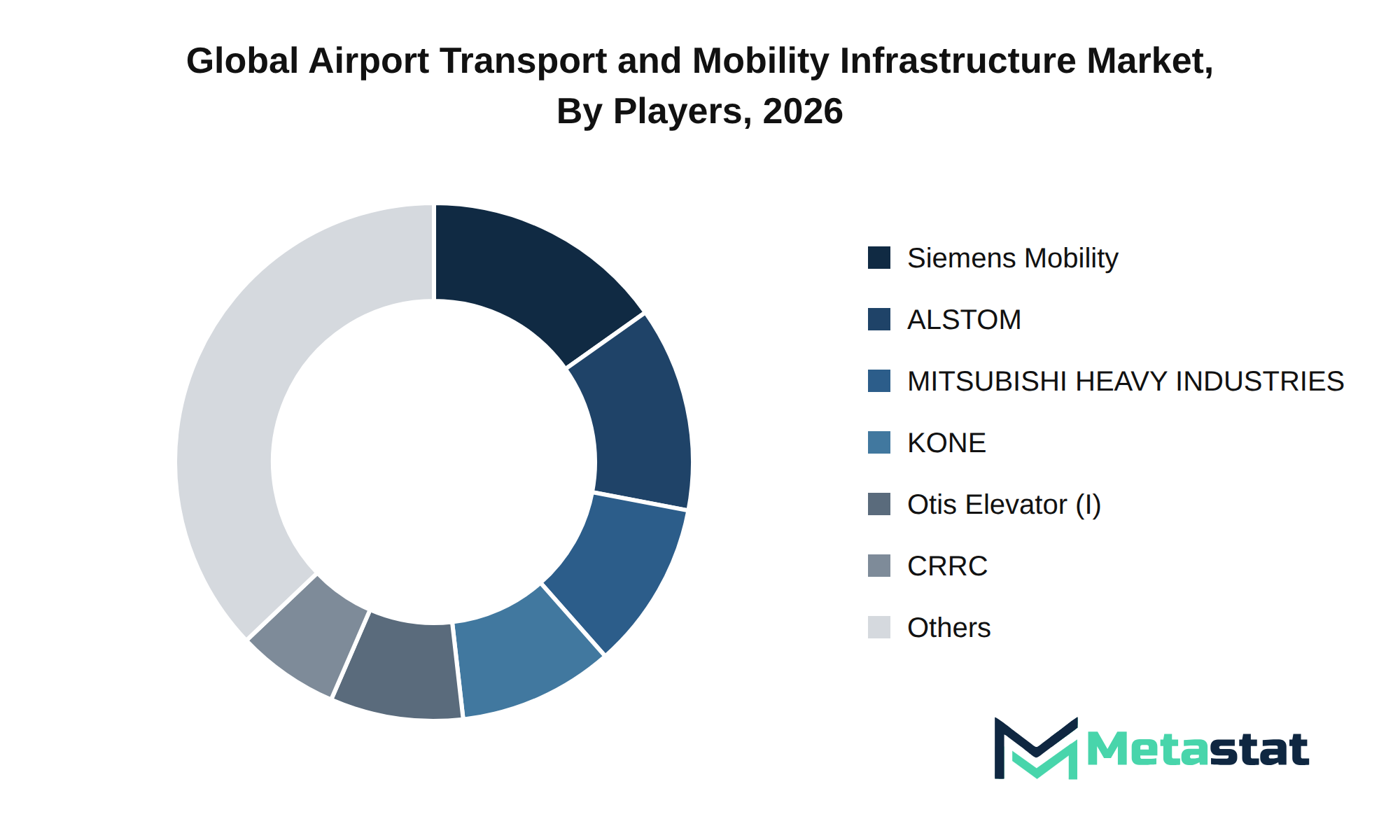
The competitive dynamics within the Airport Transport and Mobility Infrastructure market highlight significant strategic movements among key industry players. Companies including Siemens Mobility, ALSTOM SA, and MITSUBISHI HEAVY INDUSTRIES, LTD., engage in strategic alliances and partnerships, aiming to enhance their service offerings and technological capabilities. Collaborations between these firms and regional players strengthen their market positions and expand their reach.
Market participants, including Doppelmayr Seilbahnen GmbH, POMA, and CRRC Corporation Limited, focus on product differentiation through proprietary technologies and innovative solutions. Investments in research and development enhance their competitive edge, allowing them to deliver advanced mobility solutions tailored to specific customer needs. Such differentiation strategies contribute to customer retention and boost brand equity within the market.
Barriers to entry present challenges for new entrants, owing to established players maintaining significant market share and leveraging their supply chain dominance. The presence of companies like TK Elevator, Schindler, and KONE exemplifies this trend, because they develop robust procurement models that enhance operational efficiency and cost management. Overall, the competitive outlook for the market indicates continued growth, driven by strategic initiatives and investments aimed at innovation and customer satisfaction.
Market size is forecast to rise from USD 121.7 billion in 2025 to over USD 191.9 billion by 2033. The base case anticipates a growth trajectory at a 5.8% CAGR, reflecting the overall health of the Airport Transport and Mobility Infrastructure market. Bull cases indicate heightened demand driven by rapid technological advancements and increased infrastructure investments, while bear cases focus on potential economic slowdowns or geopolitical tensions impacting capital allocation.
Macroeconomic conditions will shape the trajectory of the market. Strategic capital allocation directives emphasize investments in next-generation technologies and infrastructure commitments, aligning with evolving regulatory frameworks and compliance milestones. The maturation of core industries alongside structural consumption shifts creates opportunities for innovation, particularly in automated systems and sustainable practices.
Emerging white-space opportunities exist, particularly where unmet enterprise needs align with high-growth pockets in the market. Companies investing in R&D commercialization timelines benefit from product life-cycle management and the integration of advanced technologies. Geopolitical realignments and evolving trade corridors influence global supply chains, necessitating adaptable strategies for firms operating within the Airport Transport and Mobility Infrastructure market.
Executive-level strategic imperatives drive firms to identify defensibility roadmaps that enhance competitive positioning. Economic cycles and downstream demand changes will continue to influence investment vectors, ensuring that players in the market respond effectively to shifting consumer preferences and operational requirements.
The report strategically identifies and profiles the key market players and analyses their core competencies in each sub-segment of the Airport Transport and Mobility Infrastructure market.
Report Attributes | Details |
Study Period | 2021-2033 |
Base Year | 2025 |
Estimated Year | 2026 |
Forecast Period | 2026-2033 |
Historical Period | 2021-2025 |
Growth Rate | CAGR 5.8% from 2026 to 2033 |
Revenue Unit | USD billion |
Segmentation | By Airport Type, Infrastructure Type, Solution Type, End User, and Region |
By Region | North America (By Airport Type, Infrastructure Type, Solution Type, End User, and Country)
|
Europe (By Airport Type, Infrastructure Type, Solution Type, End User, and Country)
| |
Asia Pacific (By Airport Type, Infrastructure Type, Solution Type, End User, and Country)
| |
South America (By Airport Type, Infrastructure Type, Solution Type, End User, and Country)
| |
Middle East and Africa (By Airport Type, Infrastructure Type, Solution Type, End User, and Country)
|
Find answers to common questions about this report
The Airport Transport and Mobility Infrastructure market size was valued at USD 121.7 billion in 2025, according to the Metastat Insights study.
The Airport Transport and Mobility Infrastructure market is projected to grow at a CAGR of 5.8% during the forecast period from 2026 to 2033.
The North America Airport Transport and Mobility Infrastructure market size is estimated to reach USD 56.6 billion by 2033.
The Commercial Airport segment leads the Airport Transport and Mobility Infrastructure market, with a projected value of USD 145.7 billion by 2033. This segment's growth reflects a compound annual growth rate of 5.4 percent from 2026 to 2033.
Key drivers for the Airport Transport and Mobility Infrastructure market include increasing capital investments fueled by GDP growth and public-private partnerships. The push for modernization and sustainable development further enhances growth, because stakeholders prioritize technological advancements and efficient resource allocation to improve operational efficiency and customer experience.
North America holds the dominant share of the Airport Transport and Mobility Infrastructure market, with a value of USD 56.6 billion projected for 2033, representing 34.6 percent of the total market.
Regulatory compliance challenges impose significant hurdles, requiring substantial investments in technology and infrastructure upgrades. Inflationary pressures and geopolitical instability further complicate operational costs and project timelines, while skill shortages hinder effective deployment of new systems. These factors collectively create a challenging environment for growth in the Airport Transport and Mobility Infrastructure market.
Increasing investment in modernization, driven by GDP growth and favorable interest rates, supports product adoption in the Airport Transport and Mobility Infrastructure market. Enhanced collaboration through public-private partnerships facilitates funding for innovative projects, while a focus on sustainability aligns with global trends, promoting environmentally friendly practices and resource stewardship.
The Airport Transport and Mobility Infrastructure market is estimated to reach a valuation of USD 191.9 billion by 2033.
Key players operating in the Airport Transport and Mobility Infrastructure market include Siemens Mobility, ALSTOM SA, MITSUBISHI HEAVY INDUSTRIES, LTD., Doppelmayr Seilbahnen GmbH, POMA, and CRRC Corporation Limited.
Choose Your License
Global Airport Transport and Mobility Infrastructure Market
Explore related market intelligence reports worth reading alongside this one.
Starting from
$2950