
Global Banknote Processing Equipment Market
Global Banknote Processing Equipment Market Size, Share, By Equipment Type (Counting Equipment, Sorting Equipment, Cash Recycling and Deposit Equipment, Banknote Authentication and Validation Equipment, Integrated Banknote Processing Systems and Others), By Processing Capacity (Low-Speed, Medium-Speed, High-Speed and Ultra-High-Speed), By End User (Commercial Banks and Financial Institutions, Central Banks and Currency Authorities, Cash-in-Transit Companies and Cash Processing Centers, Retail and Commercial Cash Operations, Casinos and Gaming Operators, Currency Exchange Centers and Government and Public-Sector Cash Operations), By Application (Cash Counting and Verification, Denomination Sorting, Fitness Sorting and Recirculation, Counterfeit Detection and Authentication, Cash Deposit and Recycling, Cash Bundling and Strapping, Cash-Center Automation and Workflow Management), Industry Analysis, Growth, Trends, and Forecast, 2026-2033
MSI-4985
August 19, 2026
Updated
282 Pages
Historical
Base year
Forecast
Forecast period
Report Details
Comprehensive Market Analysis And Insights
Market Overview
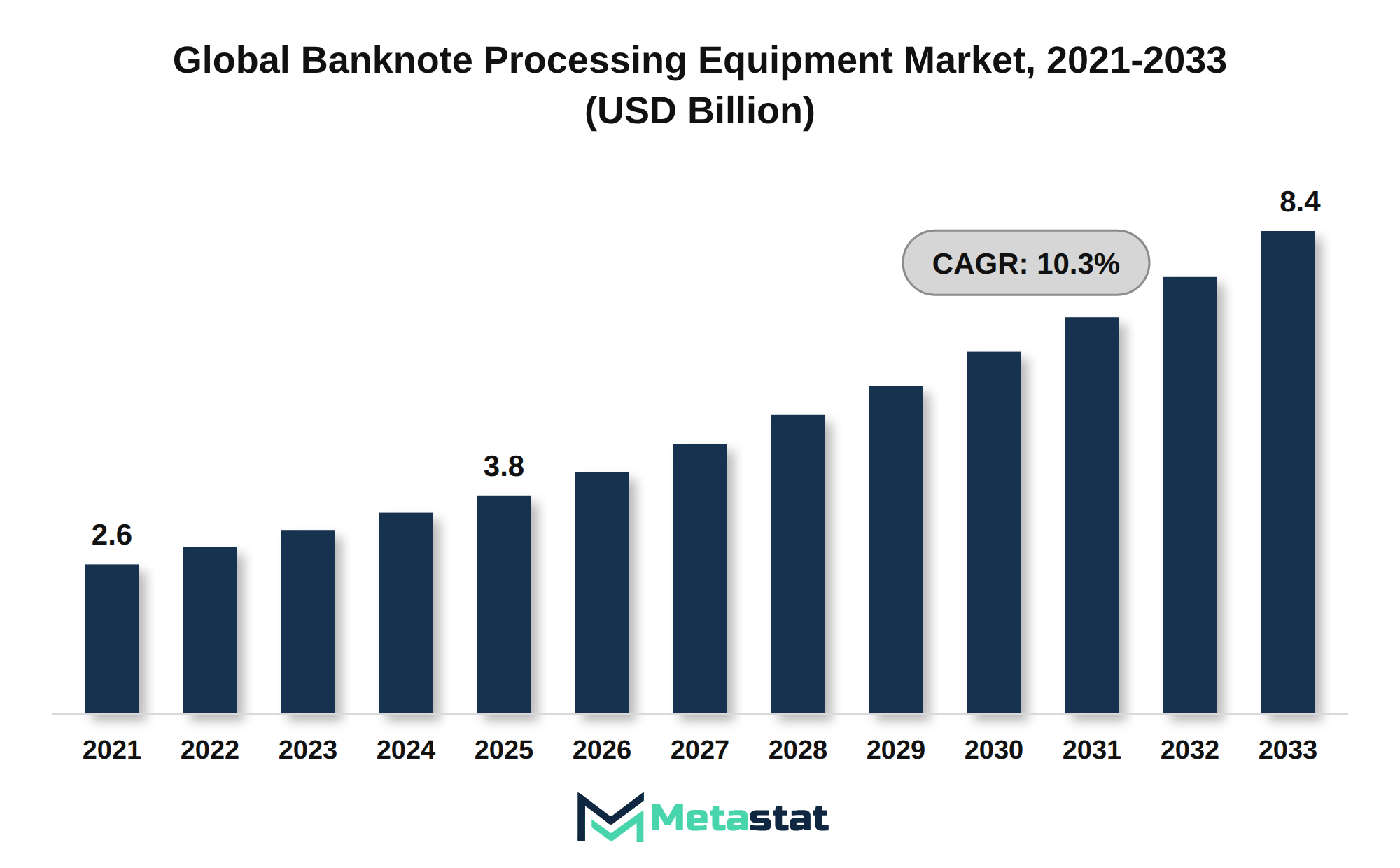
The global Banknote Processing Equipment market was valued at USD 3.8 billion in 2025 and is projected to reach USD 8.4 billion by 2033, growing at a CAGR of 10.3% over the forecast period.
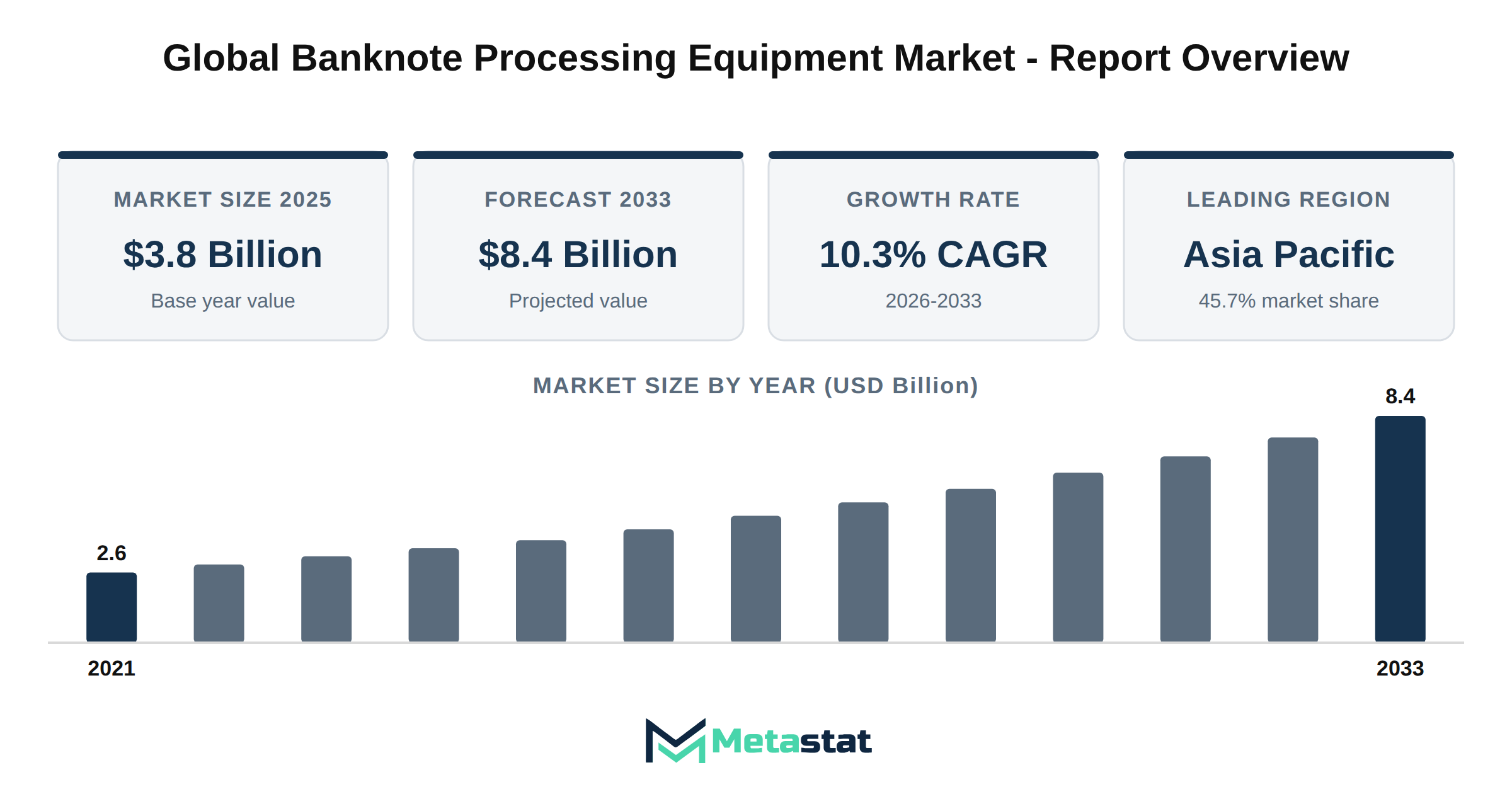
The Banknote Processing Equipment market reached a value of USD 3.8 billion in 2025, demonstrating a compound annual growth rate (CAGR) of 10.3% projected to increase the market value to USD 8.4 billion by 2033. Historical data shows a steady increase in market value, with figures of USD 2.6 billion in 2021, USD 2.9 billion in 2022, USD 3.2 billion in 2023, and USD 3.5 billion in 2024.
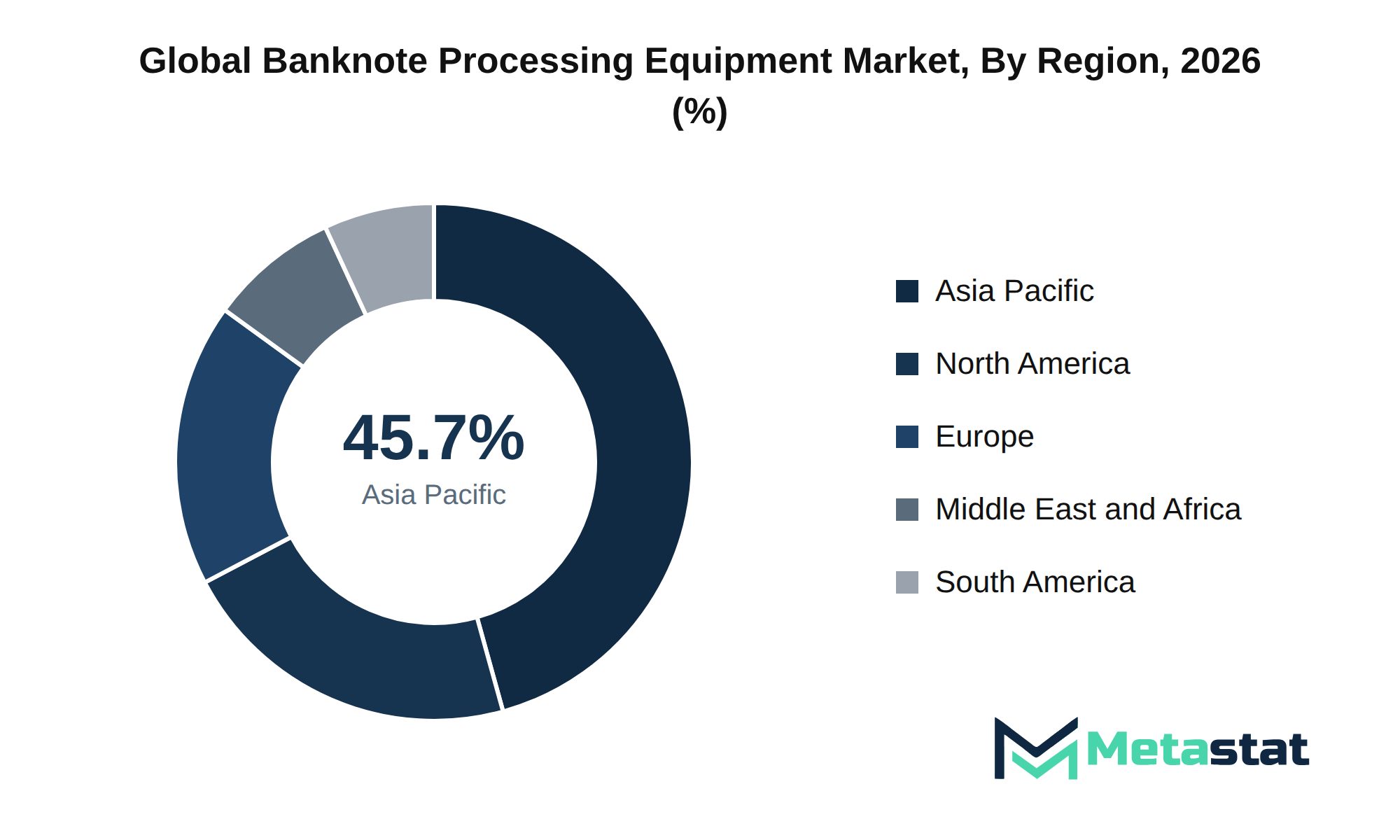
Regional analysis indicates that the Asia Pacific region commands the largest share of the market at 45.7%, followed by North America at 21.6%, Europe at 17.7%, the Middle East and Africa at 8.1%, and South America at 6.9%. North America is projected to achieve a market value of USD 1.5 billion by 2033, reflecting a CAGR of 10.3%.
In terms of equipment type, counting equipment is expected to grow from USD 1 billion in 2026 to USD 1.8 billion by 2033, while sorting equipment will increase to USD 1.5 billion by the same year, marking a CAGR of 9.5%. Cash recycling and deposit equipment will contribute significantly to overall growth.
Processing capacity segments illustrate a diverse landscape, with low-speed processing anticipated to grow from USD 0.7 billion in 2026 to USD 1.2 billion by 2033. Medium-speed processing will reach USD 2.5 billion, while high-speed and ultra-high-speed processing sectors are positioned for considerable growth.
The Banknote Processing Equipment market experiences significant growth driven by various factors, including regulatory compliance and standards. These elements create a framework that shapes operational practices and influences investment decisions across different regions. The increasing focus on compliance with international standards enhances the demand for advanced processing equipment, ensuring security and efficiency in cash handling.
Disruption in traditional banking systems and the rise of digital transactions impact the market landscape, necessitating adaptation among stakeholders. Cash-in-transit companies and financial institutions face challenges in balancing operational costs while integrating next-generation innovations into their processes. The emphasis on R&D trajectories supports the development of sophisticated technologies, including cash recycling and deposit equipment, which improve processing efficiency and reduce physical cash handling risks.
Sustainable transformation emerges because a critical theme influencing purchasing decisions within the market. Stakeholders prioritize equipment that supports decarbonization efforts and aligns with circular economy dynamics. This shift toward sustainability not only addresses environmental concerns but enhances brand reputation and customer loyalty in an increasingly eco-conscious consumer base.
The supply chain landscape for banknote processing equipment is increasingly complex, characterized by a need for efficient logistics architecture and sourcing strategies. Robust procurement practices become essential for managing costs and ensuring timely delivery of components. Strategic capital allocation and infrastructure investments form the backbone of operational efficiency, enabling market players to maintain competitiveness in a changing environment.
Macroeconomic headwinds, including inflationary pressures and currency volatility, introduce additional layers of complexity for market participants. These economic factors influence pricing strategies and overall market dynamics, requiring stakeholders to remain agile and responsive to changing conditions. Future strategic outlooks emphasize the importance of high-value recommendations that guide investment and operational decisions, ensuring sustained growth and resilience in the Banknote Processing Equipment market.
Market Dynamics
Macro-economic factors drive capital investments
Growth in the Banknote Processing Equipment market aligns with macro-economic factors, including GDP growth and increasing capital investments. A positive economic climate enhances the spending power of both public and private sectors, propelling demand for banknote processing solutions. Financial institutions and retail businesses invest in advanced equipment to streamline operations and improve efficiency in cash handling, resulting in strengthened long-term demand.
Technological integration supports this growth, facilitating the adoption of automation and digital transformation in cash management processes. Upgrading legacy systems enables faster processing and improved accuracy, addressing the evolving needs of end users. This trend encourages further investment in innovative solutions, enhancing market competitiveness and expanding the addressable base.
Cost-efficiency initiatives drive organizations to seek solutions that reduce operational overhead and enhance productivity. The focus on optimizing labor and streamlining processes leads to increased demand for sophisticated banknote processing equipment. While organizations strive to improve margins, heightened interest in equipment that supports these objectives reinforces the segment's position.
Digital transformation enhances operational efficiency
Significant advancements in digital transformation influence the Banknote Processing Equipment market, driving improvements in operational efficiency and process optimization. Increased adoption of automation technologies and artificial intelligence enhances productivity across various end-user segments, particularly in commercial banks and cash processing centers. These technologies streamline operations, reduce manual errors, and facilitate quicker transaction processing, resulting in strengthened long-term demand for advanced equipment.
The integration of software solutions and digitization of legacy systems supports organizations in upgrading their banknote processing capabilities. Modernized systems lead to improved accuracy in cash counting and verification, minimizing the risks associated with human error. This transformation builds confidence among stakeholders and promotes a shift towards more advanced equipment within the market, reinforcing the segment's position.
Investment in innovative technologies aligns with the broader trend of enhancing operational productivity and cost-efficiency initiatives. Organizations increasingly seek solutions that fulfill regulatory requirements while delivering long-term financial sustainability. Enhanced operational efficiency through digital transformation results in reduced overhead costs, enabling firms to allocate resources more effectively and respond proactively to evolving market demands, thereby increasing compliance cost for participants.
Regulatory challenges hinder market growth
Compliance hurdles related to evolving regulations present significant obstacles in the Banknote Processing Equipment market. Tightening regulatory frameworks impose additional costs on manufacturers, forcing them to adjust their processes and technologies to meet new standards. Such adjustments result in increased operational expenses and delays in product development and deployment.
Macroeconomic headwinds, including inflationary pressures, impact purchasing power and reduce investment capacity among key end users. Financial institutions and cash processing centers face rising costs, leading to cautious spending on new equipment. This environment creates a challenge for suppliers seeking to maintain growth in a saturated market.
Supply chain disruptions contribute to delays in sourcing components necessary for banknote processing. Geopolitical instability complicates logistics and procurement, impacting the efficiency of operations. Manufacturers encounter difficulties in securing reliable supply chains, which heightens production costs and extends delivery timelines.
High capital investment requirements for advanced banknote processing technology deter new entrants while restricting expansion for existing players. The need for substantial financial resources limits market participation, particularly for smaller companies. This challenge stagnates innovation and restricts the market's evolution at the pace necessary to meet increasing demand.
Technological obsolescence poses risks for equipment manufacturers. Rapid advancements in technology create pressure to continuously innovate or risk becoming outdated. Businesses not investing in the latest solutions face substitution risks from competitors offering more efficient or cost-effective alternatives.
Infrastructure gaps and connectivity deficits in certain regions hinder the adoption of banknote processing technologies. Insufficient technological infrastructure affects the deployment of new systems in various markets. Skilled labor deficiencies and talent gaps restrict the ability to implement and maintain advanced equipment effectively.
Concerns surrounding data security and privacy vulnerabilities present further challenges. End users in the Banknote Processing Equipment market require assurance that their systems are secure from threats including IP theft. Without robust security measures, trust in these systems diminishes, slowing down market adoption.
Market fragmentation and cultural barriers influence regional adoption rates. Diverse regulatory environments and varying levels of acceptance for new technologies across different regions create complexities for manufacturers. Understanding these nuances is essential for companies aiming to navigate the market effectively and capitalize on growth opportunities.
Geopolitical fragmentation creates market challenges
Geopolitical fragmentation influences the Banknote Processing Equipment market by disrupting supply chains and creating uncertainties in trade relations. Trade deficits and tariff friction contribute to increased costs for manufacturers, impacting pricing strategies and market accessibility. Such conditions lead to complexities in securing raw materials and components, often resulting in delays and higher operational costs. The interdependence of global supply chains means that instability in one region has ripple effects across others, creating an unpredictable environment for market participants.
Technological disruptions further complicate market dynamics, necessitating continuous investment in research and development. Organizations face challenges in integrating new technologies, which create interoperability issues between different systems. This complexity results in extended timelines for product development and increased compliance overhead, straining resources and budgets. Companies in the Banknote Processing Equipment market navigate these challenges carefully to avoid falling behind amid rapid technological advancements.
Pricing compression and margin pressures have intensified due to rising input cost structures and competitive market saturation. Suppliers struggle to maintain profitability while investing in innovation and meeting evolving customer demands. Workforce skill gaps and automation displacements hinder operational efficiency; organizations face difficulties in retaining talent capable of operating advanced processing equipment. These factors impose constraints on growth and profitability within the market.
Environmental lifecycle footprints and sustainability demands prompt organizations to rethink their manufacturing processes. Compliance with tightening global regulatory standards necessitates investment in cleaner technologies and practices, introducing further complexity and cost. Companies that fail to adapt to these sustainability requirements risk losing market share to those that prioritize environmentally friendly practices. Such pressures shape the strategic direction of players within the Banknote Processing Equipment market, urging them to align with global sustainability goals.
Logistics disruptions and infrastructural gaps present additional challenges. Companies encounter bottlenecks in distribution networks, making timely delivery of products difficult. Retrofitting existing facilities to accommodate advanced equipment often requires significant capital investment, which delays implementation and hinders competitive positioning. These factors contribute to an increasingly intricate operational landscape, complicating pathways to growth in the Banknote Processing Equipment market.
Emerging regional demands fuel growth
Growth within the Banknote Processing Equipment market aligns with emerging regional demands, particularly in Asia Pacific. Rapid urbanization and economic development in countries including China and India drive increased demand for advanced banknote processing solutions. Infrastructure modernization remains a key factor, with investments in cash management systems enhancing operational capacities across various sectors, including financial services and retail.
Technological disruptions significantly influence the market landscape. Next-generation innovations, including advanced counterfeit detection systems and automated cash recycling technology, create new opportunities for suppliers. Integration of these technologies allows for improved security and efficiency, attracting interest from commercial banks and financial institutions seeking to optimize their cash operations.
Sustainability imperatives play a crucial role in shaping market dynamics. Eco-friendly practices and compliance with environmental standards impact purchasing decisions, leading firms to seek equipment that aligns with green transformation goals. Organizations focusing on sustainable solutions enhance their reputation and improve their competitive position in the Banknote Processing Equipment market.
Evolving buying behaviors drive market potential. The transition towards digital procurement and commercial model adaptations allows buyers to source equipment more effectively, streamlining the selection process. Increased attention to downstream market diversification opens avenues for suppliers to cater to new customer segments, including cash-in-transit companies and retail cash operations.
Strategic consolidation within the industry creates opportunities for M&A initiatives, enhancing the competitive landscape. Collaborations between technology providers and equipment manufacturers expand market reach and product offerings. This consolidation strengthens the value chain, enabling more robust solutions to meet the diverse needs of clients across different regions.
Value-chain optimization through process automation results in operational yield maximization. Suppliers focusing on enhancing their production capabilities reduce costs and improve service delivery. This efficiency is crucial, especially for firms servicing high-volume cash environments, positioning them favorably against competitors in the Banknote Processing Equipment market.
Market Segmentation Analysis
The Global Banknote Processing Equipment market is segmented based on Equipment Type, Processing Capacity, End User, and Application.
By Equipment Type, the market is further segmented into:
- Counting Equipment
- Sorting Equipment
- Cash Recycling and Deposit Equipment
- Packaging, Strapping and Bundling Equipment
- Banknote Authentication and Validation Equipment
- Integrated Banknote Processing Systems
- Others (Vacuum Bundle Counters, Single-Note Inspection Equipment, Banknote Orientation and Facing Equipment)
Counting Equipment
Valued at USD 1 billion in 2026, the Counting Equipment segment of the Banknote Processing Equipment market is projected to reach USD 1.8 billion by 2033, reflecting a CAGR of 8.7% during the forecast period. Demand for counting equipment arises from the increasing need for accuracy and efficiency in cash handling processes across various sectors, including banks, retail, and cash processing centers. The adoption of advanced technologies, including automated counting and sorting features, enhances operational efficiency and significantly reduces manual errors.
Segment expansion drives innovations in counting equipment, influenced by rising consumer expectations for faster and more reliable transactions. Next-generation upgrades introduce features including improved counterfeit detection capabilities and integration with digital payment systems, addressing the evolving needs of end users. Increasing focus on compliance standards and regulatory requirements further drives investment in high-quality counting solutions, ensuring that financial institutions and businesses adhere to stringent cash handling guidelines.
Cost structures remain a critical factor influencing purchasing decisions, with organizations seeking equipment that balances initial investment with long-term operational savings. Pricing volatility in raw materials for manufacturing counting equipment poses challenges; however, manufacturers focus on supply chain resilience to mitigate disruptions. Strategic opportunity windows arise through partnerships and collaborations that enable firms to leverage complementary technologies and expand their market reach, thereby enhancing their competitive positioning within the Banknote Processing Equipment market.
Sorting Equipment
In the evolving market of banknote processing, demand for efficient sorting equipment advances steadily. This segment is estimated to reach USD 1.5 billion by 2033, at a CAGR of 9.5% during the forecast period. Increasing volumes of cash transactions globally drive the demand for advanced sorting solutions, particularly among banks and financial institutions aiming to streamline operations and enhance accuracy. Adoption of sophisticated sorting technologies enables organizations to optimize cash handling processes, thereby reducing operational costs and improving service delivery.
Technological maturation significantly influences this segment's growth trajectory. Enhanced sorting capabilities, including counterfeit detection and denomination sorting, align with the need for improved security and efficiency. The introduction of next-generation upgrades, including AI-driven algorithms, facilitates better sorting accuracy and speed, further attracting investments in this equipment type. Evolving regulations surrounding cash handling and processing contribute to the segment's expansion, necessitating compliance with stringent standards and encouraging innovation.
End-user dynamics indicate that commercial banks and financial institutions represent significant consumers of sorting equipment, driven by the need for efficiency and accuracy in cash management. Retail operations seeking to automate cash handling processes drive consumption shifts towards advanced sorting solutions. Consequently, manufacturers focus on enhancing product features to meet the specific demands of diverse end-users.
The Banknote Processing Equipment market reflects a strategic opportunity window for stakeholders invested in sorting equipment. Companies positioned to leverage advancements in technology, alongside addressing regulatory compliance, stand to gain substantial market share. Overall, the sorting equipment segment within the banknote processing equipment market is projected for significant growth, driven by increasing demand and ongoing technological advancements.
Cash Recycling and Deposit Equipment
Growth in the Cash Recycling and Deposit Equipment segment reflects increasing demand for efficient handling of banknotes within various financial institutions. The segment is expected to reach USD 1.6 billion by 2033, driven by the need for enhanced cash management solutions and the growing focus on operational efficiency. Adoption of advanced cash recycling systems facilitates improved cash flow management, particularly in retail and banking environments.
Technological maturation significantly shapes this segment, with next-generation upgrades contributing to enhanced functionalities, including automated cash handling, increased processing speeds, and advanced counterfeit detection capabilities. These features promote operational effectiveness across commercial banks and cash processing centers, supporting their transition to more automated solutions.
End-use dynamics illustrate a shift towards greater reliance on cash handling technologies, driven by users aiming to enhance accuracy and reduce operational costs. Regulatory compliance standards further influence the adoption of cash recycling and deposit equipment, pushing institutions to implement solutions that adhere to security and efficiency guidelines. This need for compliance, combined with the rising costs of manual cash handling, drives the market forward.
Pricing volatility associated with raw material sourcing influences the cost structures within the segment. Suppliers strive to maintain competitive pricing while navigating fluctuations in material costs. Strategic opportunity windows arise for manufacturers focusing on innovation and product evolution, ensuring that new offerings align with market needs and consumer expectations.
The market reflects a resilient supply chain. Manufacturers aim to mitigate logistics vulnerabilities. Investment in research and development continues to drive product advancements, with companies enhancing their offerings to include multifunctional capabilities and greater integration with digital systems. This focus positions the market for sustained growth and adaptation in an evolving financial landscape.
Packaging, Strapping and Bundling Equipment
Strong demand for Packaging, Strapping and Bundling Equipment stems from the increasing need for secure and efficient cash handling processes across various financial sectors. Rapid advancements in technology drive the adoption of innovative solutions, enhancing operational efficiency in cash management. Factors including growing retail operations and the rising number of cash transactions further support market expansion.
The segment is projected to grow at a CAGR of 7.8% during the forecast period. Regulatory compliance regarding cash handling and security standards fuels investments in advanced packaging solutions, ensuring businesses meet stringent requirements. Enhanced product features, including automation and advanced tracking capabilities, attract both new and existing users, thereby boosting market penetration.
While banks and financial institutions prioritize cash recycling and secure processing, demand for specialized equipment continues to rise. Increased competition among suppliers encourages ongoing product development, leading to more effective solutions tailored to specific customer needs. Investment in this segment reflects a strategic opportunity window for manufacturers, highlighting the importance of technological innovation in the Banknote Processing Equipment market.
Banknote Authentication and Validation Equipment
Growth in the market for banknote authentication and validation equipment stems from the increasing need for secure and efficient processing methods in financial institutions. Rising incidents of counterfeiting drive demand for advanced authentication technologies, with central banks and commercial entities seeking to enhance their security measures. Technological maturation in sensor and imaging technologies facilitates the development of next-generation authentication systems, offering improved accuracy and reliability, which strengthens long-term demand.
Investment in this segment aligns with broader trends toward digitization and automated cash handling processes. Financial institutions strive to reduce operational risks and enhance customer trust through rigorous authentication measures. Regulatory compliance standards require robust validation systems, expanding market adoption among banks and cash-in-transit companies, resulting in increased investment across the value chain.
Shifts in cash handling practices due to increased e-commerce activities and contactless payments influence market dynamics. While cash remains a vital payment method in many regions, evolving consumer preferences necessitate efficient authentication solutions to ensure effective transactions. Strategic opportunity windows arise from the ongoing evolution of counterfeit detection technologies, allowing firms to differentiate their offerings and capture a larger market share, reinforcing the segment's position.
Integrated Banknote Processing Systems
Growing interest in Integrated Banknote Processing Systems arises from the need for enhanced operational efficiency and accuracy in currency management. These systems streamline cash handling processes, which improves service delivery in commercial banks and cash processing centers. The integration of advanced technologies, including automation and real-time data analytics, supports the transition towards more intelligent and responsive systems that align with the dynamic demands of the Banknote Processing Equipment market.
Adoption of these systems aligns with ongoing trends in digital transformation and the increasing focus on reducing human error in cash handling. Financial institutions recognize the critical importance of maintaining security and compliance with regulations, which drives demand for integrated solutions that offer robust counterfeit detection and currency verification capabilities. Enhanced regulatory compliance standards further support the development of sophisticated systems that ensure adherence to international norms and practices.
Market players benefit from evolving customer preferences that prioritize efficiency and accuracy over traditional cash handling methods. The integration of innovative technologies positions these systems because ideal solutions for addressing the complexities of modern cash management. This adaptability to changing market conditions drives manufacturers to invest in research and development, fueling further advancements in system capabilities.
Strategic partnerships and collaborations among technology providers and financial institutions enhance the resilience of supply chains and drive the development of next-generation integrated systems. The continuous evolution of consumer expectations and regulatory frameworks creates opportunities for market participants to innovate and differentiate their offerings, ensuring a competitive edge in the Banknote Processing Equipment market.
Others (Vacuum Bundle Counters, Single-Note Inspection Equipment, Banknote Orientation and Facing Equipment)
Demand for equipment within the Banknote Processing Equipment market is influenced by the need for enhanced efficiency and accuracy in cash handling operations. The adoption of advanced technologies including vacuum bundle counters and single-note inspection equipment supports improved operational performance, minimizing human error in banknote processing. These technologies cater to various end-users, including banks and cash-in-transit companies, facilitating higher throughput and reducing processing times.
Technological maturation drives innovation in the segment, with manufacturers focusing on next-generation upgrades that enhance functionality and user experience. The evolution of these products aligns with the increasing need for secure and reliable cash management systems. Regulatory compliance standards related to counterfeiting and cash handling further increase demand for advanced inspection equipment, pushing organizations to invest in innovative solutions that ensure adherence to financial regulations.
The segment experiences significant opportunities due to shifting consumer behaviors and preferences toward faster and more accurate cash processing solutions. Businesses increasingly prioritize automation and efficiency, leading to market evolution and opening strategic opportunity windows for product development and investment. Investments in research and development ensure that manufacturers remain competitive, adapting to changing market dynamics and technological advancements.
By Processing Capacity, the market is further segmented into:
- Low-Speed
- Medium-Speed
- High-Speed
- Ultra-High-Speed / Cash-Center Grade
Low-Speed
Valued at USD 0.7 billion in 2026, the Low-Speed segment is projected to reach USD 1.2 billion by 2033, at a CAGR of 6.9% during the forecast period. Increasing demand for cost-effective banknote processing solutions drives adoption among financial institutions and cash handling organizations. The efficiency of low-speed equipment in handling smaller volumes of cash without compromising security enhances its appeal.
Technological maturation and advancements in automation enhance the performance of low-speed equipment, allowing for improved reliability and reduced operational downtime. Banks and financial institutions prioritize integration of these systems within existing infrastructure, further propelling growth. The segment benefits from ongoing investments in next-generation upgrades, including advanced counterfeit detection and enhanced user interfaces, ensuring compliance with evolving regulatory standards.
End-use dynamics indicate a shift toward increased cash handling efficiency, particularly within central banks and cash-in-transit companies. Demand for low-speed equipment aligns with the need for secure cash processing environments, where accuracy and reliability remain critical. Strategic opportunity windows emerge for manufacturers to innovate within this segment, addressing specific market requirements and enhancing overall performance.
Consumption shifts toward low-speed solutions highlight the ongoing transformation in the banknote processing landscape. With a focus on optimizing cost structures while adhering to strict compliance regulations, operators across various sectors increasingly integrate this equipment into their cash handling operations. The market for banknote processing equipment thus stands to benefit from the sustained expansion of the Low-Speed segment over the forecast period.
Medium-Speed
Growth in the Medium-Speed segment of the Banknote Processing Equipment market aligns with increasing demand for efficient cash processing solutions. The transition towards automation within financial institutions drives adoption, driven by organizations seeking to enhance operational efficiency and accuracy in cash handling. Technological advancements in processing speed lead to the evolution of equipment, resulting in enhanced functionalities and improved user experiences.
Medium-Speed segment is estimated to reach USD 2.5 billion by 2033, at a CAGR of 9.3% during the forecast period. Rising consumer expectations for quick service and security in cash transactions further increase demand. Financial institutions and cash processing centers prioritize investments in medium-speed technologies to streamline operations and respond to market pressures.
Investment in next-generation upgrades enhances the segment's appeal, enabling users to meet regulatory compliance standards while ensuring robust performance. The market exhibits resilience through effective supply chain management, addressing raw material sourcing and logistics vulnerabilities. Strategic opportunity windows arise for manufacturers focusing on innovative solutions that mitigate risks associated with technological obsolescence.
The evolution of applications within the Medium-Speed segment reflects shifts in end-user dynamics, particularly among commercial banks and cash-in-transit companies. Enhanced functionalities, including counterfeit detection and denomination sorting, capture the attention of operators seeking comprehensive processing capabilities. While the market continues to grow, stakeholders emphasize the importance of capital investment outlooks to maintain competitive advantages.
High-Speed
Significant growth in the High-Speed segment of the Banknote Processing Equipment market aligns with rising demands for faster processing capabilities in financial institutions and cash handling operations. This segment is projected to reach USD 2.9 billion by 2033, reflecting an increasing preference for high-capacity solutions that enhance operational efficiency. Enhancements in technology enable manufacturers to improve processing speeds and deliver higher accuracy in banknote handling, which is essential in dynamic environments.
The adoption of high-speed equipment arises from the necessity for quick cash processing in various applications, including commercial banks and cash-in-transit companies. Rising transaction volumes lead financial institutions to recognize the need for reliable and swift processing systems to manage cash flow effectively. Advancements in high-speed processing technology contribute to enhanced counterfeit detection and authentication capabilities, ensuring compliance with regulatory standards.
Investment in high-speed processing machinery provides a competitive edge among financial institutions, allowing for improved customer service and reduced operational costs. The focus on streamlining cash handling processes through advanced equipment drives demand for high-speed solutions within the Banknote Processing Equipment market. Continued innovation and strategic investments in high-speed equipment will shape industry dynamics.
Ultra-High-Speed / Cash-Center Grade
Demand for Ultra-High-Speed / Cash-Center Grade equipment aligns with the growing need for faster and more efficient processing solutions within financial institutions and cash handling operations. This segment is projected to grow at a CAGR of 14.2% during the forecast period. Key factors driving this expansion include technological advancements that enhance processing speeds and reliability. Increased cash transactions resulting from economic activities further fuel the demand for high-speed processing equipment.
Financial institutions and cash processing centers prioritize optimizing operations to reduce turnaround times and improve service delivery. Investments in ultra-high-speed equipment support these objectives, leading to improved efficiency and reduced operational costs. The competitive landscape influences suppliers to innovate continuously, ensuring that equipment meets evolving customer needs within the Banknote Processing Equipment market.
Technological advancements enable next-generation upgrades, enhancing features including counterfeit detection and automated sorting capabilities. These improvements significantly impact customer satisfaction and operational performance, reinforcing the segment’s growth. The increasing complexity of cash handling in diverse applications, from retail to banking, highlights the critical role of ultra-high-speed processing solutions.
Regulatory compliance regarding cash handling drives demand within the market. While standards evolve, financial institutions invest in technology that meets compliance requirements and enhances operational efficiency. The strategic opportunity for suppliers lies in offering products that provide both compliance solutions and operational enhancements, positioning them favorably within the market.
By End User, the market is further segmented into:
- Commercial Banks and Financial Institutions
- Central Banks and Currency Authorities
- Cash-in-Transit (CIT) Companies and Cash Processing Centers
- Retail and Commercial Cash Operations
- Casinos and Gaming Operators
- Currency Exchange Centers
- Government and Public-Sector Cash Operations
- Others (Vending, Transportation and Self-Service Operators)
Commercial Banks and Financial Institutions
Valued at USD 1.7 billion in 2026, the Commercial Banks and Financial Institutions segment is projected to reach USD 3.2 billion by 2033, at a CAGR of 9.1% during the forecast period. The increasing focus on digital banking and cashless transactions is driving demand for efficient cash management solutions within this segment. Technological advancements in banknote processing equipment facilitate enhanced accuracy and speed, which are crucial for commercial banks and financial institutions aiming to optimize operations. Regulatory compliance standards in various regions further increase the need for advanced equipment to ensure secure and efficient currency handling. The market for banknote processing equipment continues to expand, reflecting the essential role that these institutions play in the broader financial ecosystem.
Central Banks and Currency Authorities
In the Banknote Processing Equipment market, the Central Banks and Currency Authorities segment is estimated to reach USD 2 billion by 2033, at a CAGR of 10.3% during the forecast period. This growth results from increasing demand for advanced banknote processing solutions, driven by the necessity for improved security and efficiency in currency management. Central banks adapting to evolving economic dynamics and technological advancements find investments in modern banknote processing equipment critical for enhancing operational effectiveness.
Adoption of next-generation technologies, including counterfeit detection and advanced sorting capabilities, significantly influences this segment. These innovations facilitate accurate currency validation, contributing to the overall integrity of financial systems. Regulatory compliance standards imposed on currency management further increase the need for reliable and efficient processing solutions, with central banks aiming to enhance operational resilience and capacity.
Cost structures associated with outdated technologies pose challenges for central banks, prompting a shift toward more efficient equipment that reduces long-term operational expenses. Competitive pressures within the market drive entities to seek solutions that enhance productivity while providing substantial return on investment. The expansion of this segment reflects a strategic response to market demands and regulatory requirements, positioning it for sustained growth in the coming years.
Cash-in-Transit (CIT) Companies and Cash Processing Centers
Growing demand within Cash-in-Transit (CIT) Companies and Cash Processing Centers drives significant expansion in the Banknote Processing Equipment market. This segment is projected to reach USD 1.4 billion by 2033, reflecting a strong growth trajectory. Primary demand drivers include increasing cash handling requirements and the necessity for secure, efficient cash logistics in financial operations. Enhanced focus on regulatory compliance and the need for stringent cash management protocols stimulate investment in advanced banknote processing technologies.
Technological maturation influences product evolution, with next-generation upgrades enhancing processing speed and accuracy. Innovations in counterfeit detection and authentication technologies increase confidence in cash transactions, prompting CIT companies to adopt state-of-the-art equipment. End-use dynamics shift towards automated systems that reduce operational costs and improve performance, driving demand for high-quality processing solutions. While the market evolves, strategic opportunity windows materialize, encouraging firms to invest in modern processing systems capable of addressing the increasing complexities of cash logistics.
Retail and Commercial Cash Operations
Valued at USD 1.4 billion in 2033, the Retail and Commercial Cash Operations segment is projected to grow at a CAGR of 12.2% during the forecast period. This growth is attributed to increasing consumer spending and the expansion of retail activities, which drive demand for efficient cash handling solutions. Enhanced cash management and security concerns among retailers and commercial establishments lead to a rise in investment in banknote processing equipment. Adoption of advanced technologies, including smart cash registers and integrated banking systems, influences the evolution of products tailored to the needs of this segment.
Regulatory compliance standards shape operational practices within retail and commercial cash operations, necessitating investments in equipment that meets stringent requirements for accuracy and security. Competition among retailers and cash handling firms creates price pressures, impacting margins while simultaneously spurring innovation in banknote processing technologies. The focus on establishing resilient supply chains and optimizing cash management practices remains critical, creating an environment ripe for strategic opportunity windows.
Investment in next-gen upgrades enhances operational efficiency and strengthens market positioning. Technological maturation facilitates the integration of automation and artificial intelligence into cash processing equipment, optimizing accuracy and reducing manual intervention. End-use dynamics reflect a shift toward digital payments; however, cash remains integral in various sectors, ensuring sustained demand for banknote processing equipment in retail and commercial cash operations.
Casinos and Gaming Operators
Growing interest from Casinos and Gaming Operators contributes to advancements in banknote processing technologies. This segment benefits from an increase in cash transactions, particularly in regions with a high concentration of casinos and gaming facilities. Enhanced security features and efficient handling processes are driving the adoption of advanced processing equipment.
Investment in the latest technologies, including counterfeit detection and authentication measures, aligns with the rising need for operational efficiency and security. Casinos prioritize accurate transaction processing to maintain customer trust and regulatory compliance. Innovations in cash handling solutions streamline operations, reduce manual intervention, and enhance user experience, resulting in increased operational efficiency.
Competition within the Banknote Processing Equipment market has prompted suppliers to introduce next-generation upgrades, enhancing product capabilities. The shift towards integrated systems that facilitate cash recycling and efficient cash management systems addresses the evolving needs of gaming operators. Strategic opportunities exist for suppliers focusing on providing tailored solutions to meet the specific requirements of this sector, potentially increasing their market share.
Market dynamics are influenced by regulatory compliance standards that necessitate stringent controls over cash handling processes. Casinos and gaming operators face pressure to ensure that their cash management systems align with evolving regulatory requirements, impacting their operational strategies. This situation creates a favorable environment for suppliers offering compliant and efficient banknote processing solutions, enhancing their competitive position in the market.
Currency Exchange Centers
Currency Exchange Centers play a significant role in the Banknote Processing Equipment market, driven by increasing international travel and global trade. Rising demand for efficient and accurate currency exchange services is increasing the adoption of advanced banknote processing technologies. These centers require high-speed and reliable equipment to handle diverse currency denominations and ensure compliance with regulatory standards.
Technological maturation emphasizes the importance of next-generation upgrades, enhancing both operational efficiency and customer experience. Equipment evolution within this segment focuses on integrating features including counterfeit detection and advanced sorting capabilities. Such advancements improve service delivery and help maintain the integrity of transactions.
Consumption shifts toward digital payment solutions impact the demand for cash-based transactions, causing currency exchange centers to adapt their offerings. Regulatory compliance standards further influence operational requirements, compelling these centers to invest in advanced banknote processing solutions to meet stringent guidelines.
Cost structures within this segment reflect the necessity for maintaining high-performance equipment while navigating pricing volatility. Margin pressures arise from balancing quality service delivery with competitive pricing, forcing centers to evaluate their investment strategies carefully. Strategic opportunity windows exist for players offering innovative solutions that enhance processing capabilities while ensuring compliance and efficiency in operations.
Government and Public-Sector Cash Operations
Government and public-sector cash operations play a crucial role in the overall landscape of the Banknote Processing Equipment market. Demand for efficient cash handling systems arises from the increasing emphasis on security and accuracy in cash transactions. Regulatory compliance standards drive the need for advanced equipment that ensures proper counting and verification of banknotes. Partnerships with technology providers enhance access to innovative solutions, boosting operational efficiency and reducing the risk of counterfeit currency circulation.
Technological maturation influences the evolution of products designed for public-sector operations. Enhanced features including real-time tracking, automated reporting, and integration with existing financial systems enable smoother operations within government entities. The push towards modernization supports a shift towards high-speed and ultra-high-speed processing equipment. This shift is expected to improve transaction times while maintaining accuracy in currency handling.
Investment in next-gen upgrades forms a strategic opportunity for government and public-sector cash operations. Upgrading existing equipment aligns with the growing trend of digitization within financial systems. By adopting advanced solutions, these entities enhance service delivery, ultimately benefiting stakeholders and the public through improved efficiency and reduced operational costs.
End-use dynamics reflect a preference for products tailored to meet the unique demands of public-sector operations. The focus remains on ensuring compliance with stringent regulations while adapting to evolving cash management needs. This ongoing transformation highlights the importance of strategic investment and innovation in the Banknote Processing Equipment market.
Others (Vending, Transportation and Self-Service Operators)
Growing adoption of banknote processing technologies among vending, transportation, and self-service operators enhances operational efficiency. This segment experiences increased demand driven by the necessity for accurate cash handling and automation in cash transactions. The need for reliable equipment stems from the growing trend toward cashless solutions, compelling these operators to invest in modern processing systems to streamline their operations. Technological maturation further influences the market, with advancements in cash handling technologies meeting specific needs within vending and transportation sectors. In particular, next-gen upgrades improve transaction speeds and accuracy, addressing the evolving demands of consumers and operators alike. End-use dynamics indicate a shift towards greater automation and integration of cash processing systems within operational workflows. Regulatory compliance standards governing cash transactions prompt operators to invest in equipment that adheres to strict safety and authenticity protocols. This trend drives consumption shifts, reflecting businesses' increasing prioritization of secure and efficient cash management solutions. Strategic opportunity windows arise for suppliers within this segment through the introduction of innovative products that enhance processing capabilities. While cash transactions persist in various sectors, investment in reliable banknote processing equipment proves essential for maintaining competitiveness and operational integrity in the market.
By Application, the market is further segmented into:
- Cash Counting and Verification
- Denomination Sorting
- Fitness Sorting and Recirculation
- Counterfeit Detection and Authentication
- Cash Deposit and Recycling
- Cash Bundling, Strapping and Packaging
- Cash-Center Automation and Workflow Management
- Others (Orientation, Facing and Issue-Year Sorting)
Cash Counting and Verification
Valued at USD 1 billion in 2026, the Cash Counting and Verification segment is projected to reach USD 1.6 billion by 2033, at a CAGR of 7.6% during the forecast period. This growth results from rising demand for efficient cash management solutions across various sectors, including banking and retail. Increasing transaction volumes and the need for accuracy in cash handling drive the adoption of advanced counting and verification technologies.
Technological maturation enhances product offerings, with next-generation upgrades focusing on automation and integration capabilities. These advancements enable businesses to streamline cash handling processes, reduce errors, and improve operational efficiency. Regulatory compliance standards regarding cash handling and security fuel the necessity for reliable counting and verification equipment.
End-use dynamics significantly influence market growth. Commercial banks, financial institutions, and retail operations prioritize accurate cash counting to minimize discrepancies and enhance customer satisfaction. Investments in modern cash counting and verification solutions continue to rise, supporting overall growth within the Banknote Processing Equipment market.
Strategic opportunity windows emerge due to businesses seeking solutions that address cash handling challenges while adapting to changing consumer behaviors. Capital investment outlook remains positive, with companies recognizing the value of robust counting and verification systems in maintaining cash flow integrity and operational success.
Denomination Sorting
Growth in the Denomination Sorting segment of the Banknote Processing Equipment market reflects increased demand for efficient cash handling solutions. Precise sorting capabilities enable financial institutions to enhance operational efficiency and reduce handling costs. Regulatory standards aimed at counterfeit prevention further drive investment in advanced sorting technology, resulting in heightened demand for sophisticated equipment.
Investment in next-generation upgrades and technological maturation continues to shape the market. Innovations in sorting equipment enhance speed and accuracy, which directly support adoption among central banks and commercial financial institutions. By 2033, the Denomination Sorting segment is projected to reach USD 1.5 billion, with a CAGR of 10% during the forecast period.
Technological advancements lead to product evolution, positioning the segment for significant growth. Enhanced features, specifically in counterfeit detection and verification, align with evolving end-use dynamics. The shift towards automated cash handling solutions across various sectors drives the need for high-performance sorting equipment, reinforcing demand within the market.
Fitness Sorting and Recirculation
Growing recognition of effective cash management solutions drives demand for Fitness Sorting and Recirculation equipment within the Banknote Processing Equipment market. This segment is projected to reach USD 1.3 billion by 2033, highlighting the increasing focus on efficiency in cash handling processes. Key factors contributing to market expansion include technological advancements that enhance sorting accuracy and speed, reflecting the rising expectations of financial institutions and businesses.
The evolution of cash handling practices, coupled with heightened awareness of counterfeit detection and banknote quality, strengthens the importance of Fitness Sorting and Recirculation applications. Financial institutions and other end users increasingly adopt these solutions to ensure revenue protection and operational efficiency. Regulatory compliance standards influence purchasing decisions, driving stakeholders to invest in advanced technologies that support cash management goals.
Cost structures and pricing volatility impact segment dynamics, with manufacturers focusing on optimizing production processes to mitigate margin pressures. Strategic opportunity windows arise from ongoing technological obsolescence, prompting continuous upgrades and innovations in fitness sorting equipment. This proactive approach enhances competitive positioning within the market and supports growth.
Counterfeit Detection and Authentication
Counterfeit detection and authentication plays a critical role within the Banknote Processing Equipment market, driven by increasing instances of counterfeiting and demand for advanced security measures. Regulatory compliance standards require financial institutions to implement robust anti-counterfeiting technologies. Technological maturation enables the development of sophisticated detection systems, integrating artificial intelligence and machine learning to enhance accuracy and efficiency in identifying counterfeit currency.
Segments including cash-in-transit companies and financial institutions prioritize investment in counterfeit detection solutions to safeguard against financial losses and reputational damage. This growing focus on security creates strategic opportunities for manufacturers and suppliers within the market. The counterfeit detection and authentication segment is projected to grow at a CAGR of 11.2% during the forecast period.
Investment in next-generation upgrades enhances the effectiveness of systems while reducing operational costs over time. Evolving consumer expectations call for improved transaction security, prompting end-users to adopt advanced detection technologies. Demand for counterfeit detection and authentication solutions supports operational efficiency and contributes to overall market growth.
Cash Deposit and Recycling
Increasing emphasis on efficient cash management fuels demand for cash deposit and recycling solutions within the Banknote Processing Equipment market. Financial institutions require reliable systems that streamline cash handling processes while ensuring accuracy and security. Enhanced focus on reducing operational costs drives investment in technology that automates cash handling tasks, thereby increasing overall efficiency.
The segment experiences growth due to the rise in cash-based transactions, necessitating robust cash deposit and recycling systems. Rapid urbanization and population growth increase the need for efficient cash management in retail environments, prompting significant investments in advanced equipment. Regulatory compliance standards related to cash handling further stimulate adoption, driven by institutions prioritizing systems that align with industry regulations.
Technological advancements in cash deposit and recycling equipment support the transition towards greater automation and digitalization in cash management. Innovations in user-friendly interfaces and enhanced security features contribute to improved operational efficiency and customer satisfaction. While cash handling evolves, the segment captures opportunities for next-generation upgrades that address emerging needs and enhance overall functionality in the market.
Supply chain resilience influences the availability of components for cash deposit and recycling systems. Fluctuations in raw material sourcing and logistics vulnerabilities create challenges that impact production timelines and cost structures. Addressing these issues will be essential for maintaining competitive pricing and ensuring consistent supply to meet growing demand.
Cash Bundling, Strapping and Packaging
Increased focus on effective cash management strategies drives demand for cash bundling, strapping, and packaging solutions. Financial institutions recognize that efficient cash handling reduces operational costs and enhances overall service delivery. The segment benefits from advancements in automation technologies, which streamline processes and improve accuracy in cash handling. End users including commercial banks and cash-in-transit companies seek reliable solutions that ensure security and compliance with regulatory standards. The market experiences growth attributed to financial institutions adopting systems that enhance cash processing capabilities while meeting evolving consumer expectations.
Technological maturation in the Banknote Processing Equipment market leads to innovative product offerings, enabling next-generation upgrades in cash bundling, strapping, and packaging equipment. These advancements support the growing trend towards integrated systems that enhance the overall efficiency of cash management operations. Adoption of smart technologies allows for better tracking and management of cash flow, further enhancing operational effectiveness. Investment in these technologies reflects a commitment to maintaining competitive advantages within the financial services sector.
Cash-Center Automation and Workflow Management
Automation and workflow management within cash centers transforms operational efficiency across various financial institutions. Increased digitization and the shift towards streamlined processes drive demand for innovative solutions. Financial organizations seek systems that enhance accuracy, reduce human error, and facilitate rapid transactions. Adoption of advanced technology aids in improving cash handling efficiency, ensuring timely processing and secure transactions.
The need for real-time monitoring and reporting drives investments in automated systems. Enhanced compliance with regulatory standards further accelerates market growth, driven by organizations striving to meet evolving legal requirements. This focus on compliance encourages firms to implement solutions that offer robust reporting capabilities and audit trails. Regulatory pressures compel financial entities to adopt more sophisticated cash management systems, offering significant advantages in transparency and accountability.
Technological maturation enables the introduction of next-generation upgrades that enhance existing cash-center operations. Innovations in machine learning and artificial intelligence promise to optimize workflows and minimize operational bottlenecks. These advancements not only support greater cash processing accuracy but provide strategic opportunities for organizations to improve service delivery and cost efficiency. Investment in these technologies positions firms to better adapt to changing industry dynamics.
Competitive pressures encourage organizations within the Banknote Processing Equipment market to evolve their offerings continuously. The focus on cost structures and pricing volatility influences strategic decision-making, prompting firms to explore partnerships and collaborations that enhance resource sharing and technology transfer. Increased collaboration among players in the market promotes an ecosystem that drives innovation and enhances the overall product portfolio.
Cash-center automation and workflow management play a vital role in driving efficiency within the Banknote Processing Equipment market. The ongoing evolution of technologies and the regulatory landscape create a dynamic environment for firms seeking to optimize operations and enhance customer service delivery.
Others (Orientation, Facing and Issue-Year Sorting)
Technological advancements significantly influence the Others (Orientation, Facing and Issue-Year Sorting) segment within the Banknote Processing Equipment market. Enhanced accuracy and efficiency in banknote handling drive adoption among various end users, particularly in commercial banks and cash processing centers. Continuous improvements in automation and integration capabilities within processing systems create opportunities for this segment to expand. The increasing complexity of cash handling and management stimulates investments in sophisticated sorting technologies. Regulatory compliance regarding counterfeit detection and sorting standards necessitates upgrades and innovations, impacting product evolution. Financial institutions emphasize risk management, and the demand for reliable orientation and facing equipment strengthens. These trends highlight the shift towards advanced solutions capable of meeting stringent operational requirements, reinforcing growth within the market.
By Region
Based on geography, the Global Banknote Processing Equipment market is divided into North America, Europe, Asia-Pacific, South America, Middle East, and Africa.
North America
North America Banknote Processing Equipment Market is set to expand at a CAGR of 10.3% within the forecast period, reaching a market size (TAM) of USD 1.5 billion by the end of 2033. A robust demand for banknote processing equipment arises from commercial banks and financial institutions, which increasingly adopt advanced technologies to enhance operational efficiency and streamline cash management processes. The region, comprising the United States, Canada, and Mexico, holds a share of 21.6% in the global market in 2025.
Infrastructure modernization initiatives across North America drive demand for high-speed processing capacities and advanced sorting equipment. The region's mature market dynamics reflect established banking practices, creating a steady replacement cycle for aging equipment. Emerging trends in localized manufacturing densities and nearshoring initiatives facilitate a more resilient supply chain, enhancing the market's overall stability.
Regulatory frameworks and local compliance mandates further shape the competitive landscape within the North American market. Domestic market participants leverage their positions by investing in innovative solutions tailored to meet the unique needs of regional clients. Demand for cash-in-transit companies and cash processing centers remains strong, with an increasing emphasis on security and efficiency influencing procurement decisions.
The regional market for banknote processing equipment benefits from strategic entry barriers, attracting foreign direct investment (FDI) flows. While geographic expansion windows open, vendors seek to capitalize on growing opportunities in underpenetrated territories, driving incremental growth vectors in both commercial and public sector applications. Overall, the North American Banknote Processing Equipment market is poised for sustained growth, underpinned by a combination of technological advancements, robust demand, and an increasingly competitive landscape.
Europe
The Banknote Processing Equipment market in Europe reflects a diverse landscape, characterized by varying demand drivers and regional dynamics. Key markets include Germany, France, the UK, Italy, Spain, and Russia, each contributing to the overall market growth. Increasing focus on cash management solutions among commercial banks and financial institutions enhances demand for advanced banknote processing technologies. The region's commitment to infrastructure modernization supports the adoption of new equipment types, particularly in cash recycling and deposit functionalities.
European financial institutions prioritize high-value replacement cycles within their existing cash management systems, creating opportunities for equipment upgrades and improvements. The presence of established domestic market participants facilitates competition and drives innovation across the segment. Localized procurement dynamics influence purchasing behaviors, driven by organizations seeking suppliers that align with specific regulatory frameworks and compliance mandates prevalent in the region.
Emerging trends including supply chain regionalization and nearshoring initiatives contribute to localized manufacturing densities within Europe. These efforts enhance operational resilience and align production capacities with regional demand, further stimulating growth in the Banknote Processing Equipment market. With a market share of 17.7% by 2025, Europe stands because a significant player in the global landscape, reflecting both mature market characteristics and incremental growth vectors.
Asia-Pacific
Asia-Pacific represents a significant portion of the Banknote Processing Equipment market, accounting for 45.7% of the global market share in 2025. The region's robust economic growth, driven by increasing urbanization and a rising middle class, is increasing demand for efficient cash management solutions. Countries like China, Japan, and India lead in adopting advanced banknote processing technologies, significantly enhancing operational efficiency within commercial banks and financial institutions.
Infrastructure modernization remains a critical factor in the region, with investments aimed at upgrading cash handling systems across various sectors. The expansion of cash-in-transit companies and retail operations further stimulates market growth. Emerging markets within Southeast Asia include underpenetrated territories poised for higher adoption rates of banknote processing equipment.
Localized manufacturing densities and nearshoring initiatives enhance supply chain efficiencies, reducing lead times and costs for regional players. Domestic market participants leverage these advantages to strengthen their competitive positions within the market. The ongoing trend towards vendor consolidation highlights a shift in competitive dynamics, creating a more collaborative environment among suppliers.
Geopolitical factors and regulatory frameworks influence market dynamics, compelling manufacturers to adapt their strategies to meet local compliance mandates. Cultural nuances impact B2B buying behaviors, necessitating tailored approaches to procurement in different countries. Overall, Asia-Pacific's evolving market landscape presents ample opportunities for growth and innovation within the Banknote Processing Equipment market.
South America
The Banknote Processing Equipment market in South America faces unique dynamics influenced by various factors. Brazil and Argentina serve because key players in the region, reflecting a growing interest in modernizing cash handling systems. Investment in technological upgrades in these countries drives demand for advanced processing equipment, enhancing operational efficiency in banks and retail sectors.
Infrastructure modernization remains essential in the region, with initiatives aimed at improving local cash management capabilities. The market benefits from underpenetrated territories, presenting opportunities for growth among smaller financial institutions and retail operators. Local compliance mandates further shape the market, emphasizing the importance of adhering to regulatory standards in cash processing.
Regional competitive landscapes feature a mix of domestic and international players, with local vendors gaining traction through strategic partnerships. These partnerships promote innovation and help tailor solutions to meet specific market needs. An increasing focus on localized procurement dynamics strengthens market resilience, enabling businesses to respond effectively to local customer demands.
The banknote processing landscape in South America shows considerable potential for expansion, driven by cultural nuances and regional B2B buying behaviors. A rise in foreign direct investment (FDI) supports the development of localized manufacturing facilities, contributing to the availability of advanced banknote processing solutions. The market is anticipated to exhibit significant growth, driven by stakeholders capitalizing on these emerging trends.
Middle East and Africa
The Banknote Processing Equipment market in the Middle East and Africa shows a developing landscape characterized by various demand drivers and regional dynamics. Countries including Saudi Arabia, UAE, and South Africa exhibit increasing investment in banknote processing technologies, which supports modernization efforts across financial institutions and cash processing centers. The regional market benefits from a robust focus on enhancing cash management solutions, driven by both efficiency needs and the demand for effective counterfeit detection systems.
Infrastructure modernization is significant, with initiatives aimed at upgrading cash handling capabilities in both commercial and central banking sectors. The presence of local compliance mandates and trade policy shifts influences purchasing behavior, contributing to growth within the market. Increasing foreign direct investment (FDI) flows into localized manufacturing densities strengthen the supply chain, allowing for increased accessibility to advanced banknote processing equipment.
Competitive dynamics within the region feature domestic market participants and vendor consolidation trends, enhancing competitive positioning through strategic partnerships and collaborations. The market is anticipated to grow incrementally, with opportunities emerging from underpenetrated territories, presenting avenues for new entrants and established players alike.
Market analysis emphasizes the importance of cultural nuances in regional B2B purchasing behaviors, influencing the selection of banknote processing technologies. This dynamic environment establishes a foundation for sustained growth across the Middle East and Africa, driven by stakeholders leveraging advancements in cash processing to meet evolving market demands.
Competitive Landscape and Strategic Insights
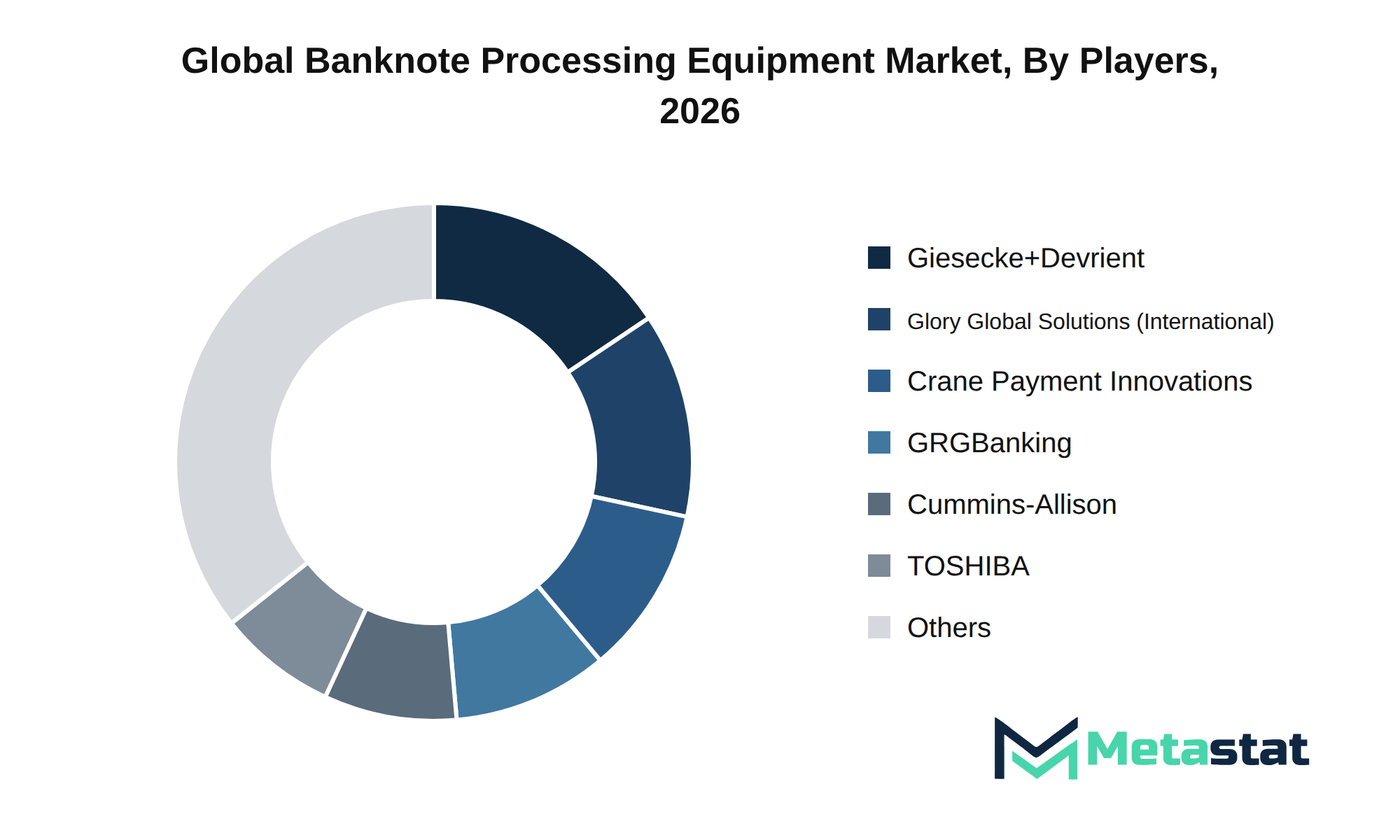
The Banknote Processing Equipment market experiences a diverse competitive landscape shaped by strategic behaviors among key players. Companies including Giesecke+Devrient GmbH, Glory Global Solutions (International) Limited, and Cummins-Allison Corp. engage in product differentiation and innovation to establish their market presence. Their focus on proprietary technologies enhances their competitive advantage, allowing them to cater to specific customer needs effectively.
Strategic alliances and joint ventures play a significant role in strengthening market positioning. For instance, collaborations between suppliers like TOSHIBA CORPORATION and various technology providers aim to enhance R&D pipelines and create integrated banknote processing solutions. The emphasis on customer retention strategies influences the market, driven by companies prioritizing brand equity dynamics to secure long-term relationships with commercial banks and financial institutions. The ongoing developments in intellectual property (IP) portfolios and patent landscapes contribute to the technological defensibility of major players, maintaining a robust competitive environment.
Forecast and Future Outlook
Market size is forecast to rise from USD 3.8 billion in 2025 to over USD 8.4 billion by 2033. This growth reflects a compound annual growth rate (CAGR) of 10.3%, driven by increasing demand for efficient banknote processing solutions across various sectors. Macroeconomic factors, including economic cycles and downstream demand changes, significantly influence market dynamics. Recovery and expansion in economies result in increased spending on banknote processing equipment, confirming the correlation between economic health and equipment demand.
Core industry maturation impacts the competitive environment, pushing existing players to innovate and enhance product offerings. Integration of next-generation technology, including advancements in automation and artificial intelligence, drives operational efficiencies and raises the standard for equipment performance. R&D commercialization timelines dictate the speed at which new innovations become available, shaping future market prospects.
Regulatory evolution remains critical, with imminent compliance milestones affecting equipment standards and operational practices. Geopolitical realignments and evolving trade corridors influence supply chain dynamics, prompting companies to adapt to new market realities. Strategic capital allocation directives focus on infrastructure commitments, with significant capital expenditure (CapEx) investments directed toward upgrading processing capabilities.
Emerging white-space opportunities indicate unmet enterprise needs, particularly in regions with growing cash economies. High-growth pockets within the market present avenues for expansion, emphasizing the necessity for companies to align with executive-level strategic imperatives. Defensibility roadmaps will prove essential for firms aiming to sustain competitive advantages during evolving market conditions in the banknote processing equipment market.
Banknote Processing Equipment Market Key Segments
By Equipment Type:
- Counting Equipment
- Sorting Equipment
- Cash Recycling and Deposit Equipment
- Packaging, Strapping and Bundling Equipment
- Banknote Authentication and Validation Equipment
- Integrated Banknote Processing Systems
- Others (Vacuum Bundle Counters, Single-Note Inspection Equipment, Banknote Orientation and Facing Equipment)
By Processing Capacity:
- Low-Speed
- Medium-Speed
- High-Speed
- Ultra-High-Speed / Cash-Center Grade
By End User:
- Commercial Banks and Financial Institutions
- Central Banks and Currency Authorities
- Cash-in-Transit (CIT) Companies and Cash Processing Centers
- Retail and Commercial Cash Operations
- Casinos and Gaming Operators
- Currency Exchange Centers
- Government and Public-Sector Cash Operations
- Others (Vending, Transportation and Self-Service Operators)
By Application:
- Cash Counting and Verification
- Denomination Sorting
- Fitness Sorting and Recirculation
- Counterfeit Detection and Authentication
- Cash Deposit and Recycling
- Cash Bundling, Strapping and Packaging
- Cash-Center Automation and Workflow Management
- Others (Orientation, Facing and Issue-Year Sorting)
By Region:
- North America
- Europe
- Asia-Pacific
- South America
- Middle East and Africa
Key Global Banknote Processing Equipment Industry Players
- Giesecke+Devrient GmbH
- Glory Global Solutions (International) Limited
- Cummins-Allison Corp.
- Crane Payment Innovations
- GRGBanking
- KISAN ELECTRONICS
- LAUREL BANK MACHINES CO., LTD.
- TOSHIBA CORPORATION
- Julong Co., Ltd.
- Suzhou Ribao Technology Co. Ltd.
- Longgang Xinda Electronics Equipment Co., Ltd.
- Innovative Technology
- Magner Corporation Europe
- Semacon Business Machines, Inc.
- SUZOHAPP
- JCM American Corporation
- Kusters Engineering India Pvt. Ltd
- TAKAMISAWA CYBERNETICS COMPANY, LTD.
- Vivex Group
- Hyundai MIB International Co., Ltd.
- LIDIX INNOVATIONS PVT. LTD.
- BellCon ApS
- Thames Business Solutions Ltd.
Report Coverage
The report strategically identifies and profiles the key market players and analyses their core competencies in each sub-segment of the Banknote Processing Equipment market.
Report Attributes | Details |
Study Period | 2021-2033 |
Base Year | 2025 |
Estimated Year | 2026 |
Forecast Period | 2026-2033 |
Historical Period | 2021-2025 |
Growth Rate | CAGR 10.3% from 2026 to 2033 |
Revenue Unit | USD billion |
Segmentation | By Equipment Type, Processing Capacity, End User, Application, and Region |
By Region | North America (By Equipment Type, Processing Capacity, End User, Application, and Country)
|
Europe (By Equipment Type, Processing Capacity, End User, Application, and Country)
| |
Asia Pacific (By Equipment Type, Processing Capacity, End User, Application, and Country)
| |
South America (By Equipment Type, Processing Capacity, End User, Application, and Country)
| |
Middle East and Africa (By Equipment Type, Processing Capacity, End User, Application, and Country)
|
What Report Provides
- Key Company Market Share, Revenue and Ranking for the Banknote Processing Equipment Market
- Key Market Leaders in the Banknote Processing Equipment Industry
- Full In-Depth Analysis of the Parent Industry
- Industry Statistics for Banknote Processing Equipment
- Important Changes in Market and Its Dynamics
- Segmentation Details of the Banknote Processing Equipment Market
- Historical, Ongoing and Projected Market Analysis
- Key Strategies of Major Players in the Market
Frequently Asked Questions
Find answers to common questions about this report
The Banknote Processing Equipment market size was valued at USD 3.8 billion in 2025.
The Banknote Processing Equipment market is projected to grow at a CAGR of 10.3% during the forecast period from 2026 to 2033.
The North America Banknote Processing Equipment market size is estimated to reach USD 1.5 billion by 2033.
The segment leading the Banknote Processing Equipment market is Commercial Banks and Financial Institutions, with a projected value of USD 3.2 billion in 2033. This segment demonstrates significant growth potential, with a compound annual growth rate of 9.1 percent.
Key drivers for the Banknote Processing Equipment market include GDP growth, increasing capital investments, and the adoption of automation technologies. Financial institutions and retail businesses seek advanced solutions to enhance operational efficiency, reduce costs, and streamline cash handling processes, creating demand for innovative banknote processing equipment.
Macroeconomic headwinds, including inflationary pressures, reduce purchasing power and investment capacity among key end users. Compliance hurdles related to evolving regulations impose additional costs on manufacturers. Supply chain disruptions and geopolitical instability complicate logistics and procurement, while high capital investment requirements deter new entrants, restricting expansion and stagnating innovation in the Banknote Processing Equipment market.
Economic growth and increased capital investments drive product adoption in the Banknote Processing Equipment market. Financial institutions and retail businesses invest in advanced equipment to enhance operational efficiency and streamline cash handling processes, leading to higher product adoption.
The Banknote Processing Equipment market is estimated to reach a valuation of USD 8.4 billion by 2033.
Key players in the Banknote Processing Equipment market include Giesecke+Devrient GmbH, Glory Global Solutions (International) Limited, Cummins-Allison Corp., Crane Payment Innovations, GRGBanking, and TOSHIBA CORPORATION.
Demand for banknote processing equipment aligns with GDP growth and increased capital investments. Financial institutions and retail businesses invest in advanced equipment to enhance cash handling efficiency.
Choose Your License
Global Banknote Processing Equipment Market
Related Reports
Explore related market intelligence reports worth reading alongside this one.