
Global Multi-Material Molded Components Market
Global Multi-Material Molded Components Market Size, Share, By Molding Process (Multi-Shot and Multi-Component Injection Molding (2K, 3K and Higher), Sequential Overmolding, Insert Molding, In-Mold Assembly, Others (Multi-Material Compression, Transfer and Hybrid Molding)), By Material Combination (Thermoplastic + Thermoplastic, Thermoplastic + TPE / TPU / TPV, Thermoplastic + Silicone / LSR, Plastic + Metal, Rubber / Elastomer + Metal, Plastic + Glass / Ceramic, Others (Composites, Magnets and Electronic Inserts)), By Component Function (Sealing, Gasketing and Fluid Management Components, Electrical, Electronic and Connector Components, Structural and Load-Bearing Components, Ergonomic, Grip and Soft-Touch Components, Vibration, Noise and Impact-Damping Components, Optical, Lighting and Display Components, Decorative, Haptic and Surface-Integrated Components, Thermal Management and Insulation Components, Others (Wear, Friction and Specialty Functional Components)), By End-Use Industry (Automotive and Transportation, Medical and Healthcare, Electrical and Electronics, Consumer Products and Appliances, Industrial Machinery and Equipment, Packaging, Building and Construction, Aerospace and Defense, Others (Sports, Personal Care and Specialty Applications)), Industry Analysis, Growth, Trends, and Forecast, 2026-2033
MSI-5009
August 20, 2026
Updated
309 Pages
Historical
Base year
Forecast
Forecast period
Report Details
Comprehensive Market Analysis And Insights
Market Overview
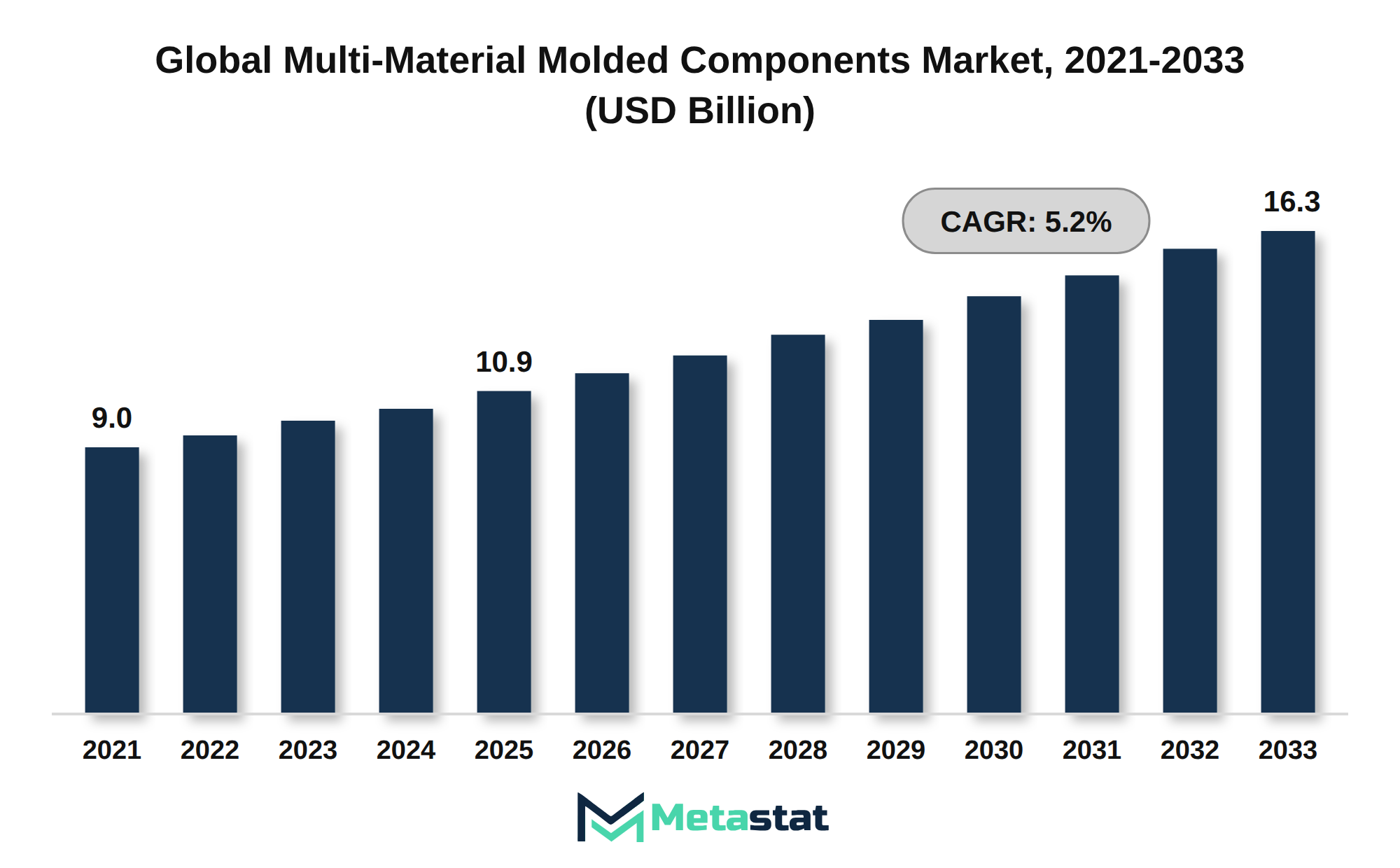
The global Multi-Material Molded Components market was valued at USD 10.9 billion in 2025 and is projected to reach USD 16.3 billion by 2033, growing at a CAGR of 5.2% over the forecast period.
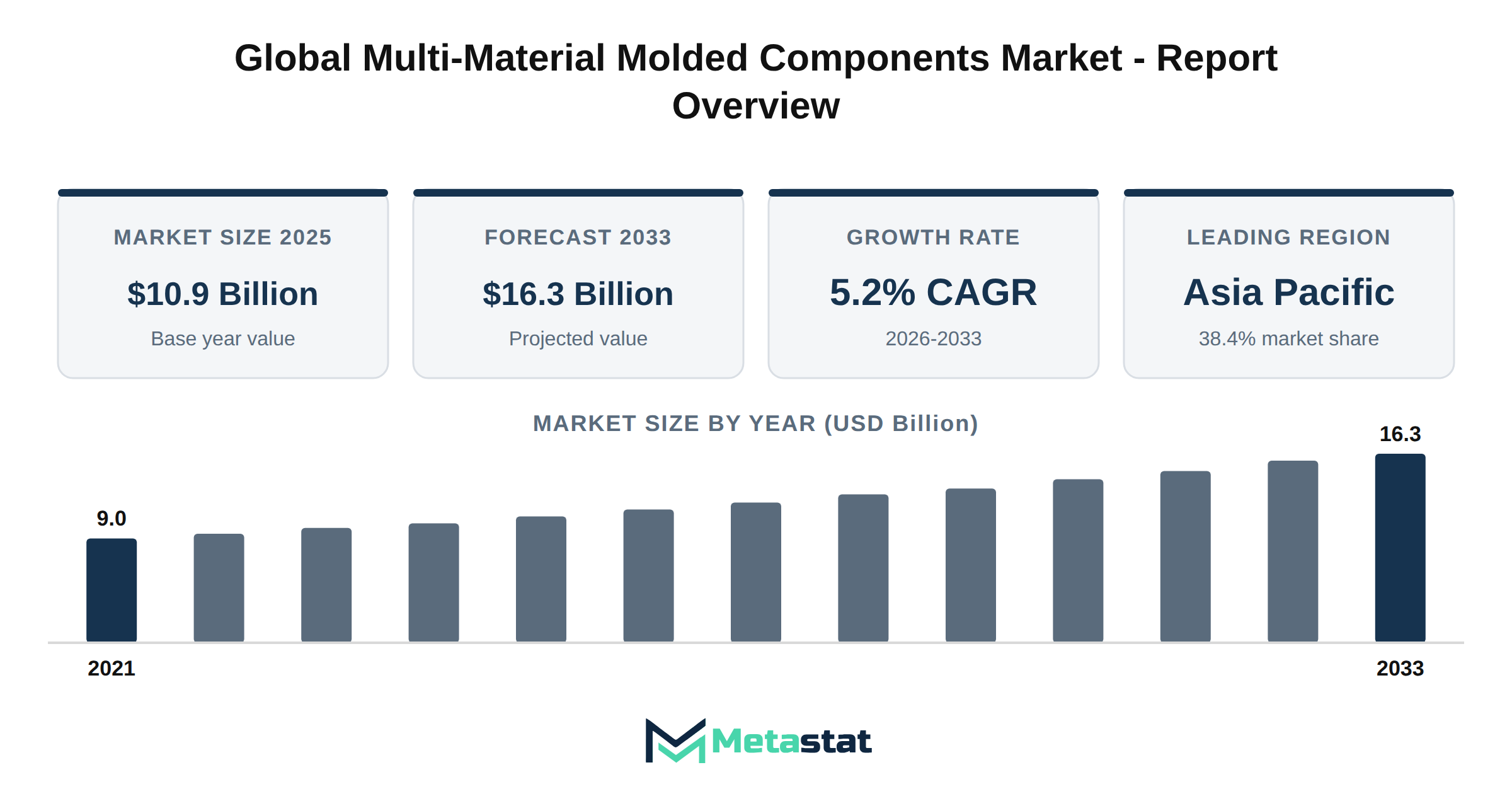
The Multi-Material Molded Components market had a base value of USD 10.9 billion in 2025, with an expected growth to USD 16.3 billion by 2033, reflecting a compound annual growth rate (CAGR) of 5.2%. Historical data shows a steady increase in market value, starting at USD 9 billion in 2021 and reaching USD 10.3 billion in 2024.
Key drivers of growth include advancements in molding processes and material combinations, which enhance product capabilities and reduce manufacturing costs. The automotive and transportation sector represents a significant segment, with a projected increase from USD 3.4 billion in 2026 to USD 4.5 billion by 2033, driven by demand for lightweight and durable components. The medical and healthcare industries contribute to market expansion, reflecting growth in the use of multi-material components for specialized applications.
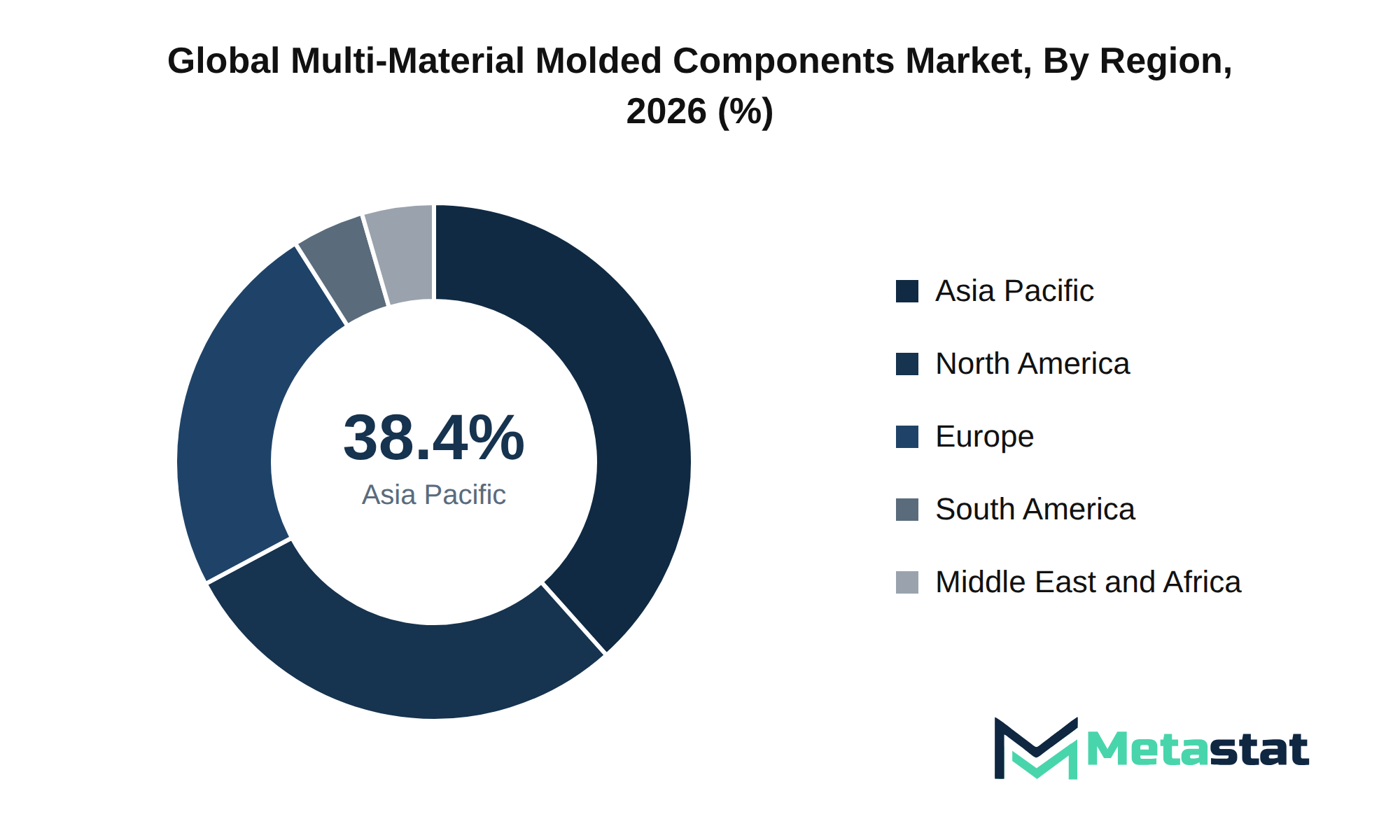
Regional dynamics indicate that the Asia Pacific region holds the largest market share at 38.4%, followed by North America at 28.8% and Europe at 23.8%. This distribution highlights varying regional demands and the presence of established manufacturers in these areas. North America is projected to achieve a market value of USD 4.4 billion by 2033, supported by continuous investments in manufacturing technology and infrastructure.
The Multi-Material Molded Components market faces challenges, including supply chain disruptions and inflationary pressures that impact material costs. Companies adapt through strategic investments in R&D to develop innovative solutions that align with sustainability goals, contributing to decarbonization efforts within the industry. Future growth is expected to depend on effective capital allocation and the ability to navigate macroeconomic headwinds that influence market dynamics.
The Multi-Material Molded Components market experiences significant influences from regulatory compliance and standards, which shape operational practices across various industries. Adherence to these regulations ensures product safety and quality, impacting procurement decisions and supply chain strategies.
Geopolitical risks create fluctuations in sourcing landscapes and logistics architecture, necessitating agile responses from companies. The market's fragmentation due to diverse regional demands and varying compliance standards complicates supplier relationships and necessitates strategic partnerships to ensure continuity and stability.
Investment in research and development trajectories drives next-generation innovations within the market. Companies prioritize sustainable transformation initiatives, focusing on decarbonization and circular economy dynamics to align with global sustainability goals. This commitment enhances brand reputation and meets rising consumer expectations for environmentally friendly products.
Macroeconomic headwinds, including inflationary pressures and currency volatility, challenge operational efficiency in the market. Inflationary pressures and currency volatility influence capital allocation, impacting both operational expenditure and capital expenditure decisions. Navigating these complexities requires strategic foresight to maintain competitiveness and profitability.
The future strategic outlook for the Multi-Material Molded Components market emphasizes the importance of high-value recommendations. Firms are encouraged to leverage insights from market dynamics to enhance customer journey experiences, optimize procurement strategies, and explore mergers and acquisitions to strengthen market positioning and achieve sustainable growth.
Market Dynamics
Investment in digital transformation initiatives
Investment in digital transformation initiatives significantly influences the Multi-Material Molded Components market. Businesses increasingly adopt automation, artificial intelligence, and software solutions to enhance efficiency and productivity. The growing demand for streamlined processes aligns with the need for modernized production methodologies, enabling companies to remain competitive in a changing environment. Organizations prioritizing these technological integrations experience reduced operational costs and improved output quality.
The push for digitizing legacy processes accelerates innovation within the market, leading to the development of advanced multi-material molded components that cater to diverse applications. Companies involved in the market capitalize on the opportunities presented by these advancements to expand their product offerings, ultimately driving revenue growth. Investment in these digital initiatives enhances supply chain resilience, allowing firms to respond effectively to market fluctuations and consumer demands.
With businesses continuing to embrace digital transformation, the Multi-Material Molded Components market is expected to experience sustained growth. The integration of new technologies creates a more agile manufacturing environment and aligns with broader trends of operational efficiency and cost-effectiveness. This focus on innovation and productivity positions organizations to thrive amid rising competition and evolving consumer preferences.
Technological integration improves operational productivity
Technological integration significantly impacts the Multi-Material Molded Components market by driving automation and enhancing productivity. Investments in automation technologies streamline production processes, reduce labor costs, and increase output efficiency. Key players adopt advanced manufacturing techniques, including AI-driven solutions and software for real-time monitoring, which lead to improved decision-making and reduced waste. Such advancements support market growth by enabling suppliers to respond swiftly to dynamic consumer demands.
The shift towards digitizing legacy processes allows manufacturers to enhance quality control and reduce time-to-market for new products. The integration of IoT devices further optimizes operational workflows by providing data analytics that support predictive maintenance and inventory management. These technological advancements play a crucial role in minimizing operational costs and establishing competitive advantages in the Multi-Material Molded Components market.
Continuous investment in research and development enables companies to innovate products and services, effectively meeting evolving customer preferences. The focus on sustainability and resource stewardship drives the adoption of technologies aimed at reducing carbon footprints, aligning with consumer expectations for eco-friendly practices. This combination of technological integration and sustainable strategies drives growth within the market.
Regulatory hurdles inhibit market growth
The Multi-Material Molded Components market faces substantial challenges due to regulatory hurdles that increase compliance costs and operational complexities. Stringent regulations surrounding environmental impacts, material safety, and product standards create barriers to market entry. Manufacturers encounter increased expenses associated with meeting these regulations, which deter investment and innovation in new product development.
Geopolitical instability contributes to uncertainty in regulatory environments, prompting companies to reassess strategies and potentially delay expansions or new projects. Supply chain disruptions, exacerbated by changing trade policies, further complicate compliance efforts. These factors collectively hinder the market's growth trajectory and impact profitability for firms operating within this sector.
The requirement for high capital investment to establish compliant manufacturing facilities poses another barrier. Startups and smaller enterprises in the Multi-Material Molded Components market often struggle to secure necessary funding, limiting their ability to compete against established players. This dynamic reduces competition and slows overall industry advancement.
Regional adoption resistors present challenges in specific markets. Cultural barriers and differing regional regulations result in inconsistent adoption rates of multi-material technologies, affecting the market's potential. The culmination of these factors creates a complex environment that constrains overall market growth and influences strategic decision-making among stakeholders.
Geopolitical tensions disrupt supply chain stability
Geopolitical fragmentation presents notable challenges for the Multi-Material Molded Components market by creating uncertainties in supply chains and increasing tariff friction among countries. Trade deficits further complicate relationships, leading to fluctuations in material availability and rising costs. These issues necessitate a reevaluation of sourcing strategies, particularly for manufacturers reliant on specific regions for critical components.
Technological disruptions introduce additional complexity by demanding integration of advanced materials and processes that require significant research and development investment. Firms face interoperability friction when adapting existing production systems to accommodate these innovations, which delay product launches and increase operational costs. The need for skilled labor to manage these technologies increases workforce skill gaps, often resulting in talent retention pressures within organizations.
Environmental considerations regarding lifecycle footprints intensify competitive pressures. Companies in the market encounter demands for sustainable practices and decarbonization mandates, forcing adjustments in manufacturing processes. This shift towards sustainability leads to increased compliance overhead and evolving legal liabilities resulting from businesses navigating the regulatory landscape.
Logistics disruptions contribute to supply chain instability, impacting delivery timelines and costs. Coupled with rising input costs and pricing compression, these challenges affect profit margins across the market. Firms address these challenges strategically to maintain their market presence and ensure growth during fluctuating economic conditions.
Emerging regional demands drive market growth
The Multi-Material Molded Components market benefits from emerging regional demands fueled by rapid industrialization and urbanization across Asia Pacific and Latin America. Increased investments in infrastructure modernization, particularly in developing countries, support the need for advanced manufacturing techniques and high-performance materials. This expansion creates a rising demand for innovative molded components tailored to diverse applications in automotive, medical, and consumer goods industries.
Technological disruptions, including advancements in multi-shot injection molding and in-mold assembly processes, enhance productivity and product quality. These innovations increase adoption of multi-material solutions, allowing manufacturers to meet specific performance requirements efficiently. The integration of these technologies into production lines leads to improved operational yields and cost efficiency, further driving growth in the market.
The ongoing digital transformation across various sectors contributes to evolving buying behaviors, prompting manufacturers to adopt digital procurement strategies. This shift enables companies to streamline their supply chains and optimize sourcing processes, enhancing flexibility and responsiveness to market changes. Consequently, suppliers in the Multi-Material Molded Components market adapt to these trends by offering customized solutions designed for rapid delivery and competitive pricing.
In addition, sustainability imperatives influence the market owing to both manufacturers and consumers increasingly prioritizing eco-friendly practices. The demand for green transformations encourages innovation in the development of recyclable materials and sustainable production methods. Companies investing in these initiatives position themselves favorably within the market, appealing to environmentally conscious consumers and meeting regulatory compliance standards. Overall, these factors create substantial opportunities for growth and diversification in the Multi-Material Molded Components market.
Market Segmentation Analysis
The Global Multi-Material Molded Components market is segmented based on Molding Process, Material Combination, Component Function, and End-Use Industry.
By Molding Process, the market is further segmented into:
- Multi-Shot / Multi-Component Injection Molding (2K, 3K and Higher)
- Sequential Overmolding
- Insert Molding
- In-Mold Assembly
- Others (Multi-Material Compression, Transfer and Hybrid Molding)
Multi-Shot / Multi-Component Injection Molding (2K, 3K and Higher)
Valued at USD 3.6 billion in 2026, the Multi-Shot / Multi-Component Injection Molding (2K, 3K and Higher) segment is projected to reach USD 5.5 billion by 2033, at a CAGR of 6.2% during the forecast period. Demand for this segment is driven by the increasing need for complex geometries and multi-functional components in various industries, particularly automotive and consumer electronics. These industries require lightweight and durable parts, leading to higher adoption rates of multi-shot molding technologies.
Technological advancements contribute to segment growth through improved molding processes, enhancing precision and reducing waste. The evolution of materials, including advanced thermoplastics and elastomers, enables the production of more sophisticated components, providing opportunities for manufacturers to innovate their offerings. The integration of automation and smart manufacturing techniques further supports efficiency in production, favoring market growth.
Regulatory compliance and standards in the automotive and medical sectors influence the demand for high-quality molded components. Stringent requirements for product reliability and safety drive manufacturers to invest in multi-component molding technologies. The ongoing trend towards sustainability prompts the exploration of bio-based and recyclable materials, impacting raw material sourcing and cost structures within the market.
End-use dynamics reflect shifting consumption patterns, with increasing emphasis on customization and lightweight designs. Ultimately, these factors position the Multi-Material Molded Components market for substantial growth, driven by manufacturers adapting to evolving market demands and technological capabilities.
Sequential Overmolding
Sequential Overmolding plays a significant role in the Multi-Material Molded Components market, driven by its capability to enhance the functionality of molded parts through layered material integration. This process enables manufacturers to create complex geometries and multi-functional components, fulfilling increasing demands from various end-use industries, including automotive, healthcare, and electronics. The segment is projected to reach USD 4.6 billion by 2033, at a CAGR of 5.6% during the forecast period.
Technological advancements in overmolding processes contribute to improved production efficiency and reduced cycle times, facilitating broader adoption across sectors. The integration of innovative materials, including advanced thermoplastics and elastomers, supports the development of components with enhanced performance characteristics, including flexibility, durability, and resistance to environmental factors. This evolution aligns with market trends prioritizing lightweight and high-performance materials, particularly in the automotive and electronics sectors, where weight reduction and performance optimization are critical.
Regulatory compliance and certification requirements drive the demand for sequential overmolding, especially in the medical and healthcare industries, where component reliability and safety are essential. Adherence to these standards increases supplier confidence, encouraging capital investments in advanced manufacturing technologies, which subsequently drive growth in the segment. With a focus on sustainability, manufacturers are increasingly exploring eco-friendly materials and processes, further shaping the segment's trajectory within the market.
Supply chain resilience remains vital, particularly regarding raw material sourcing and logistics vulnerabilities. Fluctuations in material availability or pricing influence production costs and timelines, emphasizing the need for strategic partnerships and diversified sourcing strategies. While the market evolves, stakeholders will focus on identifying strategic opportunity windows to leverage advancements in sequential overmolding, enhancing competitive positioning and overall market share.
Insert Molding
Strong growth in the Insert Molding sub-segment of the Multi-Material Molded Components market derives from increasing demand for complex, high-quality components across various industries. This demand aligns with advancements in manufacturing technologies, enhancing production capabilities and enabling the integration of multiple materials in a single process. Industries including automotive, medical, and electronics increasingly adopt insert molding for its efficiency in producing intricate designs that meet strict performance standards.
The Insert Molding segment is projected to reach USD 3.3 billion by 2033. The segment's expansion aligns with the broader trends of customization and lightweighting, which drive the need for innovative solutions. Technological maturation in molding processes supports this trend, allowing manufacturers to deliver precise and reliable components while minimizing waste and reducing production costs.
Regulatory compliance is essential, with manufacturers focusing on certifications that ensure product quality and safety. While industries evolve, downstream application dynamics shift towards integrated solutions that leverage the capabilities of insert molding. This transformation creates a competitive landscape where companies prioritize investment in next-generation upgrades to sustain market growth. Overall, the Insert Molding segment stands poised for significant advancement, driven by market trends and technological progress.
In-Mold Assembly
Growth in the In-Mold Assembly segment stems from its efficiency and ability to produce complex parts in a single manufacturing step. This process reduces labor costs and material waste, appealing to manufacturers focused on streamlining production. Industries including automotive, consumer products, and electronics drive demand for this method owing to the increasing need for high-quality, integrated components that enhance product performance. Regulatory compliance regarding product durability and safety further encourages adoption of advanced molding technologies, positioning this segment favorably within the Multi-Material Molded Components market.
Investment in research and development advances technological maturation in In-Mold Assembly, leading to next-generation upgrades and improved product offerings. This segment is projected to grow at a CAGR of 4% during the forecast period, reflecting its increasing relevance in a competitive landscape. The evolving preferences of consumers towards multifunctional products necessitate innovative solutions, driving manufacturers to explore In-Mold Assembly because a viable option to meet market demands. Competitive pressures compel manufacturers to enhance their capabilities, ensuring that investments in this segment yield substantial returns.
Others (Multi-Material Compression, Transfer and Hybrid Molding)
By Material Combination, the market is further segmented into:
- Thermoplastic + Thermoplastic
- Thermoplastic + TPE / TPU / TPV
- Thermoplastic + Silicone / LSR
- Plastic + Metal
- Rubber / Elastomer + Metal
- Plastic + Glass / Ceramic
- Others (Composites, Magnets and Electronic Inserts)
Thermoplastic + Thermoplastic
Valued at USD 2.7 billion in 2026, the Thermoplastic + Thermoplastic segment is projected to reach USD 3.7 billion by 2033, at a CAGR of 4.5% during the forecast period. Increased adoption of thermoplastic materials in diverse applications drives demand within this segment. Industries including automotive and consumer products leverage these materials for their lightweight, durable, and versatile properties. These characteristics align with the ongoing pursuit of efficiency and cost-effectiveness in manufacturing processes.
The evolution of production techniques, including advanced injection molding methods, enhances the capability to create complex geometries and incorporate multiple functionalities into single components. This development is particularly relevant in sectors prioritizing innovation and product differentiation. Regulatory standards focusing on sustainability influence material selection, propelling the use of thermoplastics due to their recyclability and reduced environmental impact.
Cost structures related to raw materials and production processes exhibit volatility, impacting price stability within the segment. Strategic sourcing of materials and technological advancements in manufacturing processes mitigate these pressures. Increased competition among suppliers drives innovation and leads to improved offerings in thermoplastic solutions, benefiting the overall market.
Investment in research and development initiatives supports the introduction of next-generation thermoplastic materials that offer enhanced performance characteristics. Continuous improvements in processing technologies contribute to greater efficiency and reduced waste in production. This dynamic environment positions the Thermoplastic + Thermoplastic segment favorably within the Multi-Material Molded Components market, aligning with emerging consumer preferences and industry trends.
Thermoplastic + TPE / TPU / TPV
Growth in the Thermoplastic + TPE / TPU / TPV sub-segment aligns with increasing demand for flexible and durable materials in various applications. This segment is projected to reach USD 4.1 billion by 2033, at a CAGR of 6.2% during the forecast period. Enhanced properties of thermoplastic elastomers, including improved elasticity and resistance to environmental factors, drive adoption across industries. The automotive and medical sectors particularly benefit from advancements in material formulations that improve performance and reduce costs.
Consumer preferences for sustainable and high-performance products fuel the expansion of this segment. Technological maturation leads to the development of new blends and composites, enhancing product offerings. Regulatory compliance surrounding safety and environmental impact influences manufacturers to innovate in the material combinations. Increased investment in research and development facilitates the introduction of next-gen upgrades, ensuring competitiveness in the market.
Strategic opportunity windows arise from shifts in consumption patterns favoring lightweight and multifunctional components. Companies in the Multi-Material Molded Components market respond by optimizing supply chain resilience and raw material sourcing strategies. These factors contribute to the long-term growth trajectory of the Thermoplastic + TPE / TPU / TPV segment within the broader market.
Thermoplastic + Silicone / LSR
Growing interest in the Thermoplastic + Silicone / LSR sub-segment stems from its diverse applications across various industries, including automotive, medical, and consumer products. This segment benefits from the unique properties of silicone, including flexibility, durability, and resistance to extreme temperatures, which enhance product performance and lifespan. Manufacturers prioritize lightweight and high-performance materials, leading to significant expansion in the adoption of thermoplastic and silicone combinations.
Technological advancements drive innovation in processing techniques, enabling more efficient production methods. This evolution supports the development of complex geometries and multi-functional parts, which are increasingly demanded in a competitive market. The integration of sustainable practices and regulatory compliance further influences growth, driven by industries seeking materials that meet stringent environmental standards while delivering superior performance.
In 2033, this segment is expected to reach USD 2.3 billion, reflecting a strong market trajectory. End-users continue to prioritize high-quality components, and the demand for Thermoplastic + Silicone / LSR solutions remains robust. The market for Multi-Material Molded Components is positioned to expand significantly because these dynamics unfold.
Plastic + Metal
Growth in the Plastic + Metal segment of the Multi-Material Molded Components market stems from several factors, including demand for lightweight materials in manufacturing and the need for enhanced durability in products. This segment is projected to grow at a CAGR of 4.5% during the forecast period. Industries including automotive, aerospace, and consumer electronics increasingly adopt plastic and metal combinations due to superior mechanical properties and cost-effectiveness. The ability to achieve complex geometries with multi-material designs enables manufacturers to innovate product offerings, aligning with consumer preferences for functionality and aesthetics.
Technological advancements in molding processes enhance production efficiencies, directly impacting cost structures and pricing strategies. Manufacturers invest in next-generation upgrades to their equipment, ensuring compliance with evolving regulatory standards and addressing market shifts towards sustainable practices. Strategic opportunities arise from increasing integration of smart technologies into products, resulting in higher demand for components that incorporate both plastic and metal materials. Development of this sub-segment aligns with market trends towards performance-driven solutions, positioning it favorably in the competitive environment of multi-material components.
Rubber / Elastomer + Metal
Growing industrial applications drive demand for rubber and elastomer combined with metal in the Multi-Material Molded Components market. This combination enhances performance, durability, and flexibility across various sectors, including automotive and aerospace. Achieving lightweight components while maintaining strength aligns with trends toward sustainability and efficiency.
Adoption of this material combination benefits from advancements in manufacturing technologies, leading to improved integration and precision in production. Increasing regulatory requirements for safety and environmental standards drive investments in innovative solutions, reinforcing the importance of rubber/elastomer and metal composites in addressing these challenges.
Strategic opportunity windows exist for manufacturers seeking to differentiate their products through unique material properties. Enhanced product performance through targeted development increases competition, positioning this sub-segment favorably within the broader context of the market. Investment in research and development remains crucial for firms aiming to capitalize on evolving customer preferences and regulatory landscapes.
Plastic + Glass / Ceramic
Integration of plastic with glass and ceramic materials presents unique advantages in the Multi-Material Molded Components market. This integration enhances product performance through improved durability, aesthetic appeal, and lightweight properties, which are crucial for applications in industries including automotive, healthcare, and consumer electronics. Increased demand for high-quality, innovative products drives adoption of the plastic plus glass and ceramic combination.
Technological advancements facilitate the evolution of manufacturing processes, enabling more precise and efficient production methods. This evolution supports the development of next-generation products that meet stringent quality and performance standards. Increased adoption of these advanced manufacturing techniques enhances supply chain resilience, allowing manufacturers to respond effectively to market fluctuations and customer requirements.
End-use dynamics influence the demand for plastic combined with glass and ceramic materials. Industries focusing on aesthetic design and functionality observe a shift towards these composites, which provide enhanced performance attributes. Regulatory compliance and certification standards validate the suitability of these materials for various applications, promoting wider acceptance across industries.
Fluctuations in raw material costs affect pricing strategies in this segment, leading to margin pressures for producers. Awareness of substitution risks and the potential impact of disruptive alternatives prompts companies to invest in innovation and product development. Strategic opportunity windows arise from trends emphasizing sustainability and lightweight designs, positioning the plastic plus glass and ceramic combination because a preferred choice for future applications.
Others (Composites, Magnets and Electronic Inserts)
Technological advancements significantly influence the Others (Composites, Magnets and Electronic Inserts) segment within the Multi-Material Molded Components market. Innovations in materials and processes drive demand across diverse industries, including electronics, automotive, and healthcare. Enhanced functionality and performance characteristics of composites and electronic inserts cater to the evolving needs of manufacturers seeking lightweight, durable, and efficient solutions. This segment thrives on the integration of next-generation upgrades that facilitate improved product designs and downstream applications.
Increased focus on sustainability and environmental compliance shapes consumption patterns. Manufacturers prioritize materials that offer reduced environmental impact while maintaining performance standards. Regulatory frameworks around material sourcing and waste management necessitate compliance, pushing companies to seek advanced composites that align with these standards. Supply chain resilience becomes crucial, emphasizing the need for reliable sourcing of raw materials and components to mitigate disruptions.
Market dynamics reflect significant opportunities for strategic investments, particularly in research and development initiatives. Companies that innovate effectively within this segment gain competitive advantages. The ongoing evolution of consumer preferences towards smart and integrated solutions further drives market growth, highlighting the importance of adaptability in production processes. This segment is expected to expand, fueled by the demand for multifunctional components that enhance product value across various applications.
By Component Function, the market is further segmented into:
- Sealing, Gasketing & Fluid Management Components
- Electrical, Electronic & Connector Components
- Structural & Load-Bearing Components
- Ergonomic, Grip & Soft-Touch Components
- Vibration, Noise & Impact-Damping Components
- Optical, Lighting & Display Components
- Decorative, Haptic & Surface-Integrated Components
- Thermal Management & Insulation Components
- Others (Wear, Friction and Specialty Functional Components)
Sealing, Gasketing & Fluid Management Components
Demand for Sealing, Gasketing & Fluid Management Components reflects significant growth, driven by advancements in material technology and increasing applications across various industries. Valued at USD 2 billion in 2026, this segment is projected to reach USD 2.7 billion by 2033, at a CAGR of 4.2% during the forecast period. The growing emphasis on reliability and performance in applications contributes to this trend.
Healthcare and automotive sectors stand because primary consumers of these components, where regulatory compliance and performance standards significantly influence purchasing decisions. While industries evolve, the demand for components that provide effective sealing and fluid management solutions continues to rise, shaping the market dynamics.
Technological maturation enhances the functionality of sealing and gasketing solutions, leading to increased adoption of innovative materials and designs. Continuous product evolution ensures that manufacturers remain competitive, meeting the diverse needs of end users while addressing challenges related to raw material sourcing and substitution risks.
Strategic opportunities exist within the Multi-Material Molded Components market, particularly for firms investing in next-generation upgrades and solutions. The focus on sustainability and efficiency within manufacturing processes positions the segment well for future growth, driven by increasing consumer demands for reliable, high-performance products.
Electrical, Electronic & Connector Components
Demand for Electrical, Electronic & Connector Components within the Multi-Material Molded Components market is projected to reach USD 3.3 billion by 2033, achieving a CAGR of 7.1% during the forecast period. This growth results from increasing adoption of advanced components in various sectors, particularly in consumer electronics and automotive applications. The evolution of technology leads to the development of more intricate electrical connections, necessitating the integration of multi-material solutions that enhance performance and reliability.
Regulatory compliance standards and certifications drive demand for high-quality molded components that meet specific safety and performance requirements. The need for improved functionality influences continuous innovation in the design and manufacturing processes of these components. Manufacturers focus on creating more efficient production techniques, resulting in an upward trajectory in investment and technological maturation for the segment.
End-use dynamics play a crucial role in shaping the market. Industries including automotive and medical devices exhibit a growing reliance on advanced electrical components that require precise integration of multiple materials. This trend towards customization and enhanced performance capabilities illustrates the segment's potential for expansion within the broader Multi-Material Molded Components market.
Structural & Load-Bearing Components
Growth in Structural & Load-Bearing Components results from increasing demand across various industries, including automotive and construction. The expansion of these sectors drives a need for components that provide strength and durability, attributed to their critical functions in load-bearing applications. The focus on lightweight materials enhances performance while reducing energy consumption in end products, further influencing adoption within the Multi-Material Molded Components market.
Technological maturation influences this segment, with advancements in molding techniques improving precision and efficiency. Innovations in materials and manufacturing processes enhance the performance profiles of structural components, enabling their use in more demanding applications. This evolution presents strategic opportunities for manufacturers to expand their product offerings and capture new market segments.
Regulatory compliance standards drive the need for components that meet safety and durability requirements. Certifications that ensure quality and reliability of materials build confidence among end-users, thus propelling growth in the market. Cost structures associated with production processes influence pricing strategies, compelling manufacturers to optimize operations while maintaining quality, thereby affecting margins.
Structural & Load-Bearing Components segment is expected to reach USD 2.3 billion by 2033. This forecast reflects anticipated increases in industrial and consumer applications, reinforcing the segment's relevance in the evolving landscape of multi-material solutions.
Ergonomic, Grip & Soft-Touch Components
Demand for Ergonomic, Grip & Soft-Touch Components arises from the increasing focus on user comfort and the growing trend toward customization in products. This segment is projected to grow at a CAGR of 4.1% during the forecast period. Businesses in the automotive, medical, and consumer product industries prioritize these components, recognizing their impact on user experience and product appeal. Enhanced designs that incorporate soft-touch materials improve grip and usability, thus driving adoption across various applications.
Technological maturation enables manufacturers to develop innovative solutions that meet consumer preferences. Advanced molding techniques facilitate the creation of intricate designs and textures, enhancing the functionality of products. Regulatory compliance and certifications regarding material safety and performance influence market dynamics, ensuring that products meet industry standards and consumer expectations.
Price volatility in raw materials, particularly in the thermoplastic and elastomer sectors, introduces cost pressures on manufacturers. Effective supply chain management and strategic sourcing of materials mitigate these challenges, allowing companies to maintain competitive pricing. The market for Multi-Material Molded Components evolves, driven by shifts in consumer behavior and the demand for high-quality, ergonomic solutions.
Vibration, Noise & Impact-Damping Components
Strong demand for Vibration, Noise & Impact-Damping Components arises from various industries, including automotive, aerospace, and consumer electronics. These components play a critical role in enhancing user experience by minimizing noise and vibrations while ensuring structural integrity. Key factors driving adoption include increasing consumer expectations for quieter environments and improved comfort in vehicles and electronic devices.
Technological advancements fuel segment expansion, with manufacturers focusing on innovative materials and designs that optimize performance. The market experiences a shift towards lightweight and durable materials, enabling the production of components that meet stringent industry standards. Regulatory compliance related to noise and vibration control standards further increases the demand for these components.
Strategic investments in research and development drive product evolution, resulting in next-generation solutions tailored to specific applications. Opportunities exist for manufacturers to explore new markets, capitalize on emerging trends, and address unique consumer needs. The Multi-Material Molded Components market stands to benefit from these dynamics, indicating a promising outlook for the segment.
Pricing volatility and cost structure challenges impact profitability within this segment. Manufacturers face pressures to balance quality and cost while sourcing raw materials effectively. Supply chain resilience remains a focus area driven by companies navigating disruptions and seeking to maintain efficient operations. Overall, the market presents opportunities driven by ongoing innovation and evolving consumer demands.
Optical, Lighting & Display Components
Technological advancements drive demand for Optical, Lighting & Display Components within the Multi-Material Molded Components market. The rise of energy-efficient lighting solutions and advanced display technologies necessitates the integration of multi-material approaches, enhancing product performance and aesthetics. Several industries, including consumer electronics and automotive, increasingly adopt these components to improve energy consumption and design flexibility, strengthening long-term demand.
Product evolution, characterized by the integration of smart technologies and improved functionalities, influences the segment's growth trajectory. Enhanced features including light weight, durability, and superior optical properties cater to the requirements of modern applications. Regulatory compliance standards regarding energy efficiency and material safety impact the design and manufacturing processes, ensuring that products meet consumer expectations and environmental regulations, which reinforces market adoption.
End-use dynamics reflect a shift towards more sophisticated lighting and display solutions. The automotive sector incorporates advanced lighting systems, while consumer electronics emphasize high-definition displays. This trend stimulates innovation within the market, prompting manufacturers to invest in next-gen upgrades that align with evolving consumer preferences and industry standards, resulting in increased investment across the value chain.
Supply chain resilience plays a critical role in sustaining production capabilities, especially in light of global material sourcing challenges. Sourcing raw materials from diverse suppliers mitigates risks associated with supply disruptions. With growing competition, manufacturers seek strategic opportunities to differentiate their offerings, leveraging advanced technologies and unique material combinations, which enhances their competitive position.
Decorative, Haptic & Surface-Integrated Components
Consumer preferences increasingly emphasize aesthetics and tactile experiences, driving demand for Decorative, Haptic & Surface-Integrated Components. This segment enhances product appeal in various industries, particularly in consumer products and electronics, where visual and tactile interactions significantly influence purchasing decisions. Technological maturation leads to advanced manufacturing processes that integrate these components seamlessly into consumer goods, enhancing functionality while maintaining design integrity.
Integration of sensory elements in products improves user experience and satisfaction, prompting manufacturers to invest in innovation. Regulatory compliance standards focusing on safety and environmental considerations shape material choices, pushing producers to adopt sustainable practices. This segment benefits from capital investment in research and development to create new designs and functionalities that align with consumer trends.
While brands increasingly focus on differentiation in competitive markets, the need for innovative surface-integrated solutions becomes evident. The Multi-Material Molded Components market experiences growth driven by evolving design requirements and the pursuit of novel applications across various sectors. This evolution creates opportunities for companies to explore unique combinations of materials that enhance performance and engage consumers.
Thermal Management & Insulation Components
Increasing focus on energy efficiency and sustainability drives demand for Thermal Management & Insulation Components within the Multi-Material Molded Components market. Industries including automotive and electronics prioritize effective thermal management solutions to enhance performance and reliability. The integration of advanced materials and innovative design enhances heat dissipation and insulation capabilities, which contributes to product evolution within this segment.
Technological maturation influences the development of next-generation thermal management solutions. Manufacturers continually invest in research and development to improve material properties, enabling better thermal performance. Regulatory compliance standards influence the segment, reflecting pressure on industries to meet stricter energy efficiency regulations.
Adoption of thermal management solutions aligns with shifting consumption patterns toward environmentally friendly products. Consumer preferences increasingly favor components that offer durability and sustainability, prompting manufacturers to enhance their offerings. Strategic opportunities in emerging markets support the segment's expansion, where demand for energy-efficient products continues to grow.
Supply chain resilience becomes critical owing to raw material sourcing and logistics vulnerabilities impacting the availability and pricing of key components. Manufacturers assess substitution risks and consider disruptive alternatives to ensure consistent supply. Overall, the Thermal Management & Insulation Components segment demonstrates significant potential for growth within the Multi-Material Molded Components market, driven by technological advancements and evolving end-use dynamics.
Others (Wear, Friction and Specialty Functional Components)
By End-Use Industry, the market is further segmented into:
- Automotive & Transportation
- Medical & Healthcare
- Electrical & Electronics
- Consumer Products & Appliances
- Industrial Machinery & Equipment
- Packaging
- Building & Construction
- Aerospace & Defense
- Others (Sports, Personal Care and Specialty Applications)
Automotive & Transportation
Growth in the automotive and transportation sector drives demand for multi-material molded components due to the continuous push for lightweight materials that enhance fuel efficiency and reduce emissions. The integration of advanced materials in vehicle manufacturing reflects a shift towards improved performance and sustainability. Investments in electric vehicles and autonomous driving technology create new requirements for components that support complex systems and functionality, directly influencing the multi-material molded components market.
The Automotive & Transportation segment is valued at USD 3.4 billion in 2026 and is projected to reach USD 4.5 billion by 2033, at a CAGR of 4.1% during the forecast period. Regulatory compliance standards and consumer expectations for safety and reliability shape the direction of product development. Manufacturers prioritize the innovation of components that meet these standards while optimizing costs and maintaining quality.
Technological maturation in multi-material processing techniques promotes the adoption of new combinations of materials, including thermoplastics and elastomers, enhancing the functional properties of components. These advancements support the production of parts that meet stringent performance criteria in various applications within the automotive industry. Demand for products that ensure durability and functionality in harsh environments continues to influence market dynamics.
Strategic opportunity windows arise from manufacturers exploring collaborations and partnerships to enhance supply chain resilience and mitigate risks associated with raw material sourcing and logistics vulnerabilities. The multi-material molded components market benefits from increased capital investment aimed at developing next-generation products that address emerging trends in automotive design and functionality.
Medical & Healthcare
Strong growth in the Medical & Healthcare segment stems from rising demand for specialized medical devices and equipment. Innovations in material science enhance the capabilities of multi-material molded components, creating opportunities for manufacturers to deliver advanced solutions that satisfy regulatory compliance and improve patient outcomes. Investments in healthcare infrastructure and the increasing prevalence of chronic diseases promote heightened procurement of medical devices, which rely on multi-material designs for functionality and safety.
The Medical & Healthcare segment is projected to reach USD 2.8 billion by 2033, at a CAGR of 6.6% during the forecast period. The focus on durability, precision, and customization in medical applications drives manufacturers to adopt advanced molding techniques, including sequential overmolding and insert molding. These techniques enable the production of complex geometries and multi-functional components that cater to the specific needs of healthcare providers.
Consumer preferences shift towards personalized and high-performance medical solutions. Multi-material molded components enhance device functionality and user experience. Regulatory standards increasingly emphasize the need for quality and safety, reinforcing demand for advanced molded components in the medical sector. The market for multi-material molded components experiences consistent growth, supported by ongoing technological advancements and an expanding range of applications in the healthcare industry.
Electrical & Electronics
Increasing reliance on advanced electronics fuels growth in the Electrical & Electronics segment of the Multi-Material Molded Components market. This segment is projected to reach USD 2.6 billion by 2033, driven by the rapid evolution of consumer electronics and automotive technologies that require lightweight and durable components. The ongoing shift towards miniaturization and efficiency in electronic devices accelerates demand for multi-material solutions that provide enhanced performance and functionality.
Technological advancements play a significant role in this segment's expansion, with innovations in molding processes and material combinations enabling the development of complex geometries and integrated functionalities. Manufacturers benefit from this trend by meeting the diverse needs of end users across various applications, including telecommunications, computing, and automotive sectors.
Investment in research and development enhances product offerings, focusing on next-generation upgrades that align with regulatory compliance and sustainability standards. Environmental concerns gain prominence, prompting electronic manufacturers to seek materials that meet performance standards and contribute to reducing carbon footprints.
Strong competition and pricing volatility within the market contribute to margin pressures, prompting companies to adopt strategic initiatives. These strategies include optimizing supply chain resilience and sourcing raw materials efficiently to mitigate risks associated with fluctuating costs. Manufacturers that leverage advanced technologies and maintain an agile operational framework position themselves favorably in a dynamic market.
Consumer Products & Appliances
Shifts in consumer preferences towards innovative and functional products drive growth in the Consumer Products & Appliances segment of the Multi-Material Molded Components market. The segment is projected to grow at a CAGR of 4.1% during the forecast period. Increasing demand for lightweight, durable, and aesthetically pleasing products contributes significantly to this trend. Manufacturers focus on developing multi-material solutions that enhance product functionality while meeting consumer expectations for sustainability and environmental responsibility.
Technological advancements in molding techniques enable the production of complex designs with improved performance characteristics, further stimulating market growth. The integration of various materials, including thermoplastics with elastomers, facilitates the creation of products that are visually appealing and meet specific functional requirements. This evolution in product design attracts consumer interest and differentiates offerings in a competitive market.
While the market continues to evolve, companies focus on strategic investment in R&D to drive innovation and adapt to changing consumer dynamics. Collaboration between suppliers, manufacturers, and designers enhances the development of next-generation products that align with market demands. This collaborative approach ensures resilience in the supply chain and secures a competitive edge for participants operating within the Multi-Material Molded Components market.
Industrial Machinery & Equipment
Growing demand for industrial machinery and equipment supports the Multi-Material Molded Components market through enhanced production processes and the need for durable, high-performance components. The emphasis on automation and efficiency in manufacturing has accelerated the adoption of advanced component technologies, driving innovation and product evolution in this segment. Manufacturers increasingly seek solutions that optimize machinery performance, contributing to the continuous development of multi-material molded solutions.
Technological advancements in molding processes, including multi-shot and sequential overmolding, enhance the ability to produce complex geometries and achieve superior performance characteristics. These improvements facilitate the integration of various materials, allowing for innovative combinations that deliver functional and structural benefits to machinery components. While manufacturers pursue next-generation upgrades, the demand for versatile and adaptable components grows, reinforcing the market's expansion.
Industrial machinery faces increasing pressure to comply with regulatory standards regarding safety and environmental impact. Compliance with these standards drives the demand for high-quality, reliable components that contribute to the operational integrity of machinery. Regulatory compliance influences purchasing decisions, resulting in a preference for multi-material solutions that deliver improved performance while meeting stringent guidelines.
Shifts in consumption patterns reflect a growing focus on sustainability and resource efficiency within the industrial sector. Manufacturers prioritize sourcing materials with reduced environmental impact, affecting raw material procurement strategies and component design. The trend toward sustainable practices encourages innovation in the Multi-Material Molded Components market, creating opportunities for firms that position themselves because leaders in eco-friendly solutions.
The landscape of industrial machinery is evolving, with increasing investments in smart technologies and automation reshaping the component requirements. The integration of smart functionalities into machinery necessitates components that support advanced features including connectivity and data analysis. This transformation presents strategic opportunities for manufacturers who develop next-generation molded components tailored to the evolving needs of the industrial sector.
Packaging
Demand for packaging materials within the Multi-Material Molded Components market experiences growth driven by increased consumer expectations for product safety and convenience. E-commerce expansion significantly influences this trend, driving the need for innovative packaging solutions that enhance product protection and visual appeal.
Technological advancements in material science facilitate the development of lightweight, sustainable, and cost-effective packaging options. The adoption of biodegradable and recyclable materials aligns with rising environmental consciousness among consumers, prompting manufacturers to seek eco-friendly alternatives.
Regulatory compliance standards surrounding packaging waste management and sustainability have intensified. Companies increasingly prioritize certifications that demonstrate commitment to environmental responsibility, influencing purchasing decisions across multiple industries.
Cost structures within the packaging segment face pressures from fluctuating raw material prices and supply chain vulnerabilities. Manufacturers strategically invest in supply chain resilience to mitigate these challenges, ensuring product availability and quality during periods of market volatility.
Downstream application dynamics emphasize versatility in packaging solutions, accommodating a diverse range of products across sectors including food and beverage, healthcare, and consumer goods. This versatility enhances market opportunities, driving innovation and product evolution within the Multi-Material Molded Components market.
Building & Construction
Growing urbanization and infrastructure development significantly influence the demand for Multi-Material Molded Components within the building and construction sector. Increasing investments in residential and commercial projects stimulate the use of advanced materials that enhance durability, functionality, and aesthetic appeal. Companies within this segment prioritize innovative solutions to meet stringent construction standards and performance specifications.
Technological advancements in manufacturing processes facilitate the integration of multi-material components, resulting in improved efficiency and reduced waste. The market experiences growth driven by builders and contractors seeking materials that provide both cost-effectiveness and enhanced functionality in construction applications. Adoption of sustainable practices drives suppliers to offer eco-friendly materials that align with evolving regulatory standards and consumer preferences.
Shifts in construction methodologies, including modular construction and prefabrication, create opportunities for Multi-Material Molded Components, enabling quicker assembly times and reduced labor costs. Market participants focus on developing solutions that cater to specific application requirements, enhancing the overall value proposition for clients across various construction projects.
Aerospace & Defense
Growing investment in the Aerospace & Defense sector drives demand for advanced components that enhance system performance and reliability. Manufacturers prioritize lightweight and durable materials in applications including aircraft and defense systems, where performance and safety standards are critical. Innovations in multi-material technologies facilitate the creation of components that meet these stringent requirements, promoting the adoption of multi-material molded components.
The ongoing need for next-generation upgrades fuels advancements in product design and functionality. Aerospace and defense contractors continuously seek to enhance the capabilities of their products, leading to increased integration of multi-material molded components. This evolution aligns with industry trends toward automation and digitalization, which further enhance operational efficiency and performance metrics.
Regulatory compliance remains a driving factor within the sector. Aerospace and defense manufacturers face rigorous standards for safety and reliability, necessitating components that withstand extreme operating conditions. Companies in the Multi-Material Molded Components market focus on certifications that ensure products meet these industry-specific regulations, supporting confidence among end-users.
Supply chain resilience and raw material sourcing remain essential in this segment. Strategic partnerships with suppliers help mitigate disruptions and ensure consistent delivery of high-quality materials necessary for production. Companies actively evaluate their sourcing strategies to balance cost structures with the need for reliable and innovative materials that fulfill the demands of aerospace and defense applications.
Others (Sports, Personal Care and Specialty Applications)
Interest in the Others (Sports, Personal Care and Specialty Applications) segment is driven by evolving consumer trends and an increasing emphasis on customization. Consumers increasingly seek products that align with personal aesthetics and functionality, creating demand for unique, high-quality components. This segment benefits from innovations in design and material technology, enabling manufacturers to produce tailored solutions that meet diverse end-user needs.
The market experiences significant expansion due to the integration of advanced materials and manufacturing techniques, which enhance product performance in various applications. Increasing participation in recreational activities contributes to the growth of sports-related products. The personal care sector benefits from rising disposable incomes and health awareness. These factors stimulate investment in R&D, leading to enhanced product offerings in the Multi-Material Molded Components market.
Regulatory compliance and certifications emerge because critical factors shaping product development and market entry strategies. Manufacturers prioritize adherence to safety and environmental standards, ensuring that products are sustainable and safe for consumer use. This focus on compliance enhances market competitiveness and builds consumer trust, positioning players favorably within the market.
Strategic opportunity windows arise from shifts in consumer priorities and technological advancements. Companies engaging in innovation and sustainable practices gain a competitive edge, tapping into niche markets and securing customer loyalty. Long-term growth in this segment is anticipated due to continuous product evolution and the ongoing transformation of consumer expectations within the Multi-Material Molded Components market.
By Region
Based on geography, the Global Multi-Material Molded Components market is divided into North America, Europe, Asia-Pacific, South America, Middle East, and Africa.
North America
The North America Multi-Material Molded Components market is set to expand at a CAGR of 5.2% within the forecast period, reaching a market size (TAM) of USD 4.4 billion by the end of 2033. This growth stems from strong demand across various end-use industries, particularly in the automotive and healthcare sectors. Investment in infrastructure modernization and technological advancement supports the adoption of innovative multi-material solutions.
Regional characteristics, including localized manufacturing densities and supply chain regionalization, enhance market dynamics. The market benefits from the presence of well-established domestic players, which strengthens competitive positioning and encourages vendor consolidation trends. Compliance with geographic regulatory frameworks and local mandates presents challenges, yet manufacturers adapt to meet these requirements effectively.
North America represents a substantial portion of the global Multi-Material Molded Components market. The emphasis on high-value replacement cycles and incremental growth vectors further enhances market potential. Increased cross-border trade corridors facilitate access to new opportunities, while geopolitical factors shape regional strategies for growth.
Europe
In Europe, the Multi-Material Molded Components market benefits from a diverse industrial landscape, characterized by a strong manufacturing base and advanced technology adoption. Countries including Germany, France, the UK, Italy, and Spain contribute significantly to the market, reflecting the region’s commitment to innovation and quality in component design.
The presence of established automotive and electronics sectors stimulates demand for multi-material solutions, particularly in high-precision applications. Rising environmental regulations and a growing emphasis on sustainability further drive the adoption of multi-material technologies, enabling manufacturers to create efficient and eco-friendly products.
Investment in infrastructure modernization expands the market, with significant projects underway to enhance manufacturing capabilities. The region's competitive landscape features several domestic companies, focused on maintaining technological advancements and consolidating their positions through strategic partnerships.
Localized procurement dynamics shape purchasing behaviors, where businesses prioritize suppliers within the region to ensure compliance with local regulations. This trend reflects cultural nuances that influence decision-making processes in B2B transactions, highlighting the importance of regional market insights.
Overall, Europe's Multi-Material Molded Components market demonstrates robust potential, driven by sector-specific demand and a commitment to innovation. The combination of mature market dynamics and emerging growth opportunities suggests a favorable outlook for the forecast period.
Asia-Pacific
Asia-Pacific represents a significant share of the Multi-Material Molded Components market, accounting for 38.4% of the global market in 2025. This region's growth is driven by a strong demand for advanced manufacturing techniques and materials, particularly in countries like China, Japan, and India. The automotive and electronics industries remain major contributors, with robust investments in infrastructure modernization further stimulating market expansion.
Localized manufacturing densities are rising in Asia-Pacific, enhancing supply chain efficiency and reducing dependency on global supply networks. Countries like South Korea and Australia are observing increased foreign direct investment flows, which contribute to technological advancements and capacity enhancement in multi-material molded components production. Emerging market front-runners adopt innovative manufacturing technologies, promoting the growth of the market.
Incremental growth vectors, including high-value replacement cycles, enhance demand for multi-material molded components. The diverse end-use industries in the region favor tailored solutions, creating opportunities for suppliers to meet specific requirements. Cultural nuances influence B2B buying behaviors, leading to distinct procurement strategies across countries, including India and Southeast Asia.
Geopolitical fragmentation affects the region, driven by companies adapting to the evolving regulatory frameworks and compliance mandates. Domestic market leaders establish competitive advantages through vendor consolidation trends and strategic partnerships, further strengthening their position in the market.
South America
Market dynamics in South America for Multi-Material Molded Components reflect a growing interest in localized manufacturing and supply chain regionalization. Brazil and Argentina emerge because key players within the region, contributing significantly to the market's performance. The share of South America in the global market in 2025 stands at 4.5%, highlighting the potential for growth in this territory.
Growing demand for innovative products, particularly in the automotive and healthcare sectors, supports the expansion of the market. Manufacturers are investing in technologies that enhance the performance and efficiency of multi-material components, ensuring they meet the evolving needs of local consumers.
Infrastructure modernization initiatives across South America facilitate improved access to production facilities, further driving market growth. The strategic focus on enhancing local compliance and regulatory frameworks aids both domestic and foreign investments, creating a more competitive environment.
Cultural nuances and regional B2B buying behaviors impact procurement strategies, leading to tailored approaches in the market. This adaptability among suppliers and manufacturers strengthens their position in an increasingly competitive environment.
Middle East and Africa
The Multi-Material Molded Components market in the Middle East and Africa faces unique dynamics influenced by regional demand drivers. This market benefits from a growing automotive sector in countries including Saudi Arabia and the UAE, where manufacturers seek advanced components to enhance vehicle performance and functionality. In South Africa, the rising focus on local manufacturing capabilities supports the adoption of multi-material molded solutions, aimed at improving production efficiency and product quality.
Investment in infrastructure modernization emerges because a critical factor driving market expansion. Initiatives to upgrade transportation, healthcare, and electronics sectors within this region facilitate the integration of multi-material components, addressing both functional and aesthetic requirements. The strong potential for localized manufacturing encourages global players to establish production facilities, enhancing supply chain resilience and reducing import dependencies.
Competitive dynamics in the region show a growing presence of local vendors alongside established global manufacturers. This landscape creates an environment for strategic partnerships and collaborations. Domestic players leverage cultural nuances and regional B2B buying behaviors, leading to tailored offerings that meet specific market needs. With an increasing number of projects focused on sustainability, the shift towards eco-friendly materials further influences purchasing decisions in the Multi-Material Molded Components market.
Emerging market front-runners continue to shape the competitive landscape, with a notable emphasis on high-value replacement cycles. Sectors including medical devices and consumer products exhibit significant growth trajectories, reflecting the evolving demands of end-users. Enhanced supply chain regionalization initiatives and localized procurement strategies support the development of this market, fueling incremental growth vectors across various applications.
Competitive Landscape and Strategic Insights
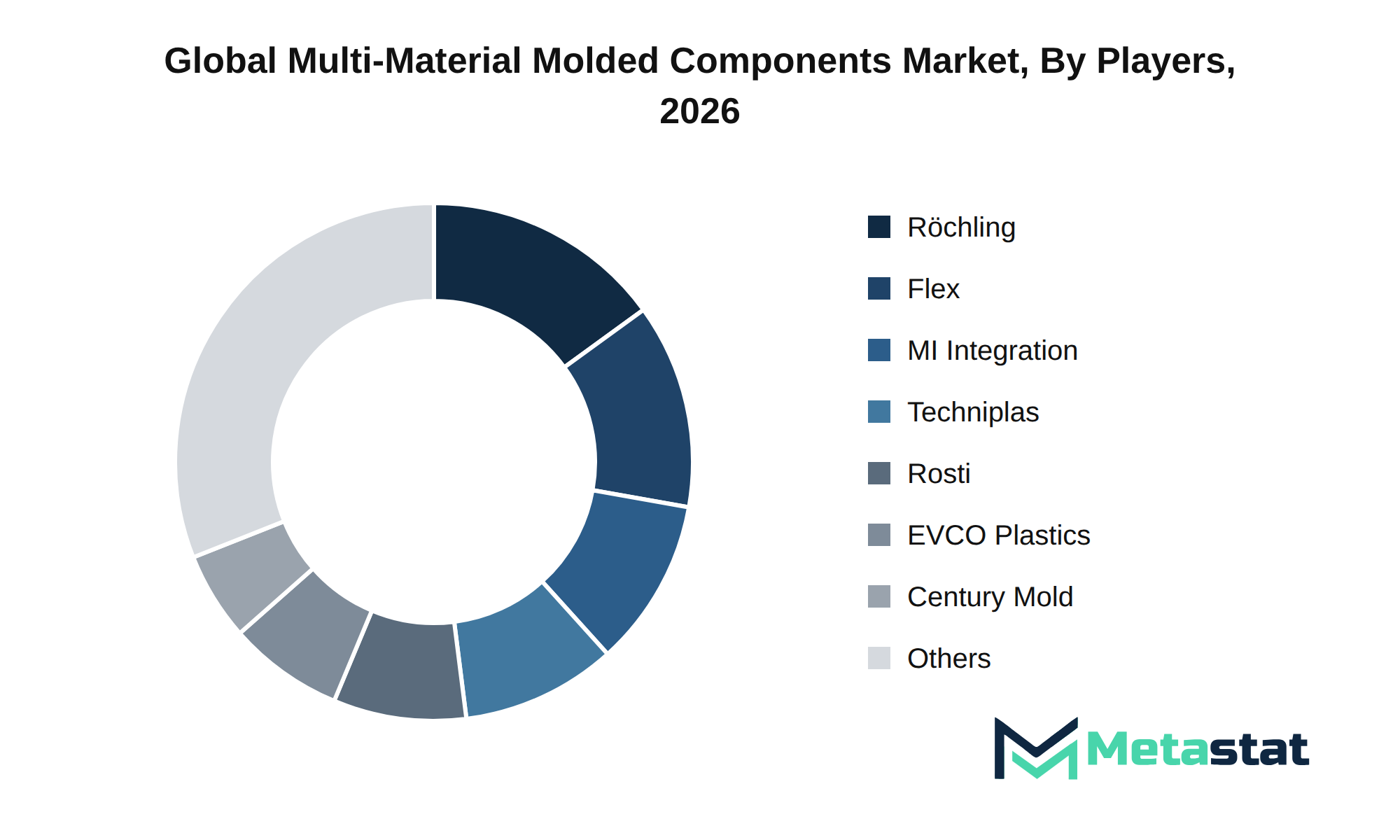
The Multi-Material Molded Components market features a diverse group of companies engaging in strategic consolidation and partnerships to enhance their market positioning and capabilities. Companies including MI Integration, Techniplas, and Röchling Group actively pursue mergers and acquisitions to expand their product offerings and geographical reach. This strategic behavior enables firms to leverage synergies and consolidate their market presence, thereby increasing competitiveness.
In terms of go-to-market strategies, Flex Ltd. and Rosti Group emphasize product differentiation through innovation and proprietary technology. These companies invest significantly in research and development to establish technological moats that protect their market positions. Strategic alliances and joint ventures are common in the market, allowing players to pool resources and enhance their value propositions.
Competitive dynamics include substantial barriers to entry, which create challenges for new entrants. Established companies like EVCO Plastics and Kaysun Corporation hold significant intellectual property portfolios, further strengthening their competitive standing. Customer retention strategies and brand equity play crucial roles, with firms focusing on building strong relationships with clients to mitigate switching costs and maintain market share.
Future outlooks for the Multi-Material Molded Components market suggest continued growth driven by innovation and strategic positioning. Companies including Injectoplast Pvt. Ltd. and Gemini Group explore new growth vectors through technological advancements and market expansion efforts. This landscape reflects an evolving market, where competitive strategies remain critical for sustaining long-term success.
Market size is forecast to rise from USD 10.9 billion in 2025 to over USD 16.3 billion by 2033. The base case indicates growth at a 5.2% CAGR throughout this period. The bullish scenario anticipates accelerated adoption of next-generation technologies, driving substantial demand across sectors including automotive and healthcare, while the bearish outlook considers economic downturns and supply chain disruptions that could hinder market expansion.
Macroeconomic factors, including regulatory changes and geopolitical shifts, will shape the Multi-Material Molded Components market landscape. Companies adapt to evolving compliance milestones and invest strategically in infrastructure to remain competitive. Rising needs for innovative product solutions create high-growth pockets that present opportunities for new entrants and established players.
Investment in research and development will influence timelines for commercialization and product life cycles, affecting market dynamics. While industries mature, demand for multi-material solutions continues to evolve, aligning with structural consumption shifts in various applications. The market's trajectory relies on executive-level strategies that prioritize defensibility and long-term growth.
Multi-Material Molded Components Market Key Segments
By Molding Process:
- Multi-Shot / Multi-Component Injection Molding (2K, 3K and Higher)
- Sequential Overmolding
- Insert Molding
- In-Mold Assembly
- Others (Multi-Material Compression, Transfer and Hybrid Molding)
By Material Combination:
- Thermoplastic + Thermoplastic
- Thermoplastic + TPE / TPU / TPV
- Thermoplastic + Silicone / LSR
- Plastic + Metal
- Rubber / Elastomer + Metal
- Plastic + Glass / Ceramic
- Others (Composites, Magnets and Electronic Inserts)
By Component Function:
- Sealing, Gasketing & Fluid Management Components
- Electrical, Electronic & Connector Components
- Structural & Load-Bearing Components
- Ergonomic, Grip & Soft-Touch Components
- Vibration, Noise & Impact-Damping Components
- Optical, Lighting & Display Components
- Decorative, Haptic & Surface-Integrated Components
- Thermal Management & Insulation Components
- Others (Wear, Friction and Specialty Functional Components)
By End-Use Industry:
- Automotive & Transportation
- Medical & Healthcare
- Electrical & Electronics
- Consumer Products & Appliances
- Industrial Machinery & Equipment
- Packaging
- Building & Construction
- Aerospace & Defense
- Others (Sports, Personal Care and Specialty Applications)
By Region:
- North America
- Europe
- Asia-Pacific
- South America
- Middle East and Africa
Key Global Multi-Material Molded Components Industry Players
- MI Integration
- Techniplas
- Röchling Group
- Flex Ltd.
- Rosti Group
- Century Mold Co., Inc.
- SEKISUI DLJM Molding Pvt. Ltd.
- EVCO Plastics
- Kaysun Corporation
- Injectoplast Pvt. Ltd.
- Gemini Group
- Wilko Plastics Inc.
- PAPP Plastics
- Layana Company
- Makuta, Inc.
- Triangle Rubber & Plastics, Inc.
- Pexco
- AQ Group AB
- Tessy Plastics
- Beyonics
Report Coverage
The report strategically identifies and profiles the key market players and analyses their core competencies in each sub-segment of the Multi-Material Molded Components market.
Report Attributes | Details |
Study Period | 2021-2033 |
Base Year | 2025 |
Estimated Year | 2026 |
Forecast Period | 2026-2033 |
Historical Period | 2021-2025 |
Growth Rate | CAGR 5.2% from 2026 to 2033 |
Revenue Unit | USD billion |
Segmentation | By Molding Process, Material Combination, Component Function, End-Use Industry, and Region |
By Region | North America (By Molding Process, Material Combination, Component Function, End-Use Industry, and Country)
|
Europe (By Molding Process, Material Combination, Component Function, End-Use Industry, and Country)
| |
Asia Pacific (By Molding Process, Material Combination, Component Function, End-Use Industry, and Country)
| |
South America (By Molding Process, Material Combination, Component Function, End-Use Industry, and Country)
| |
Middle East and Africa (By Molding Process, Material Combination, Component Function, End-Use Industry, and Country)
|
What Report Provides
- Key Company Market Share, Revenue and Ranking for Multi-Material Molded Components
- Key Market Leaders in Multi-Material Molded Components Industry
- Full In-Depth Analysis of the Parent Industry Dynamics
- Industry Statistics and Important Changes in Market Trends
- Segmentation Details of the Multi-Material Molded Components Market
- Historical, Ongoing, and Projected Market Analysis
- Assessment of Niche Industry Developments and Opportunities
- Key Strategies of Major Players in Multi-Material Molded Components
Frequently Asked Questions
Find answers to common questions about this report
The Multi-Material Molded Components market size was valued at USD 10.9 billion in 2025, according to the Metastat Insights study.
The Multi-Material Molded Components market is projected to grow at a CAGR of 5.2% during the forecast period from 2026 to 2033.
The North America Multi-Material Molded Components market size is estimated to reach USD 4.4 billion by 2033.
The segment leading the Multi-Material Molded Components market is "Multi-Shot / Multi-Component Injection Molding (2K, 3K and Higher)," with a projected value of USD 5.5 billion by 2033. This segment demonstrates the highest growth potential within the market.
Key drivers for the Multi-Material Molded Components market include the investment in digital transformation initiatives, which enhances efficiency and productivity through automation and advanced manufacturing techniques. the focus on sustainability and the need for compliance with evolving regulations further stimulate growth in this sector.
The Multi-Material Molded Components market faces challenges from regulatory hurdles that increase compliance costs and operational complexities. Stringent regulations regarding environmental impacts and material safety create barriers to entry, deterring investment and innovation. geopolitical instability and supply chain disruptions further complicate compliance efforts, hindering overall market growth.
Investment in digital transformation initiatives significantly favors product adoption in the Multi-Material Molded Components market. The integration of automation and advanced technologies enhances efficiency, reduces operational costs, and improves output quality, enabling companies to meet evolving consumer demands and remain competitive in a rapidly changing environment.
The Multi-Material Molded Components market is estimated to reach a valuation of USD 16.3 billion by 2033.
Key players in the Multi-Material Molded Components market include MI Integration, Techniplas, Röchling Group, Flex Ltd., Rosti Group, and Century Mold Co., Inc.
The Multi-Material Molded Components market is projected to grow at a CAGR of 5.2% from 2026 to 2033.
Choose Your License
Global Multi-Material Molded Components Market
Related Reports
Explore related market intelligence reports worth reading alongside this one.