
LEAD ANALYST
Utkarsh Khirodkar is a Lead Market Research Analyst at MetaStat Insight, specializing in market intelligence, technology sector assessments, and competitive strategy.

Global Laminated Glass Market Size, Share, By Interlayer Type (Polyvinyl Butyral (PVB), Ionoplast, Ethylene Vinyl Acetate (EVA) and Others (Thermoplastic Polyurethane and Cast-in-Place Resin)), By Type (Clear Glass, Tinted or Colored Glass, Reflective Glass and Others (Fire-Resistant Laminated Glass and Low-E Laminated Glass)), By Application (Façades & Curtain Walls, Windows & Doors, Balustrades & Railings, Roofs, Skylights & Canopies, Interior Partitions & Space Dividers, Floors, Stairs & Walkways, Storefronts & Display Glazing and Others (Elevator Enclosures and Furniture)), By End-User Industry (Building and Construction, Automotive, Electronics and Others (Security and Defense)), Industry Analysis, Growth, Trends, and Forecast, 2026-2033
Report ID
MSI-5213
Published
September, 2026
Pages
297 Pages
Format
Historical
Base year
Forecast
Forecast period
Report Details
Choose Your License
Global Laminated Glass Market
The global Laminated Glass market was valued at USD 26.6 billion in 2025 and is projected to reach USD 40.5 billion by 2033, growing at a CAGR of 5.4% over the forecast period.
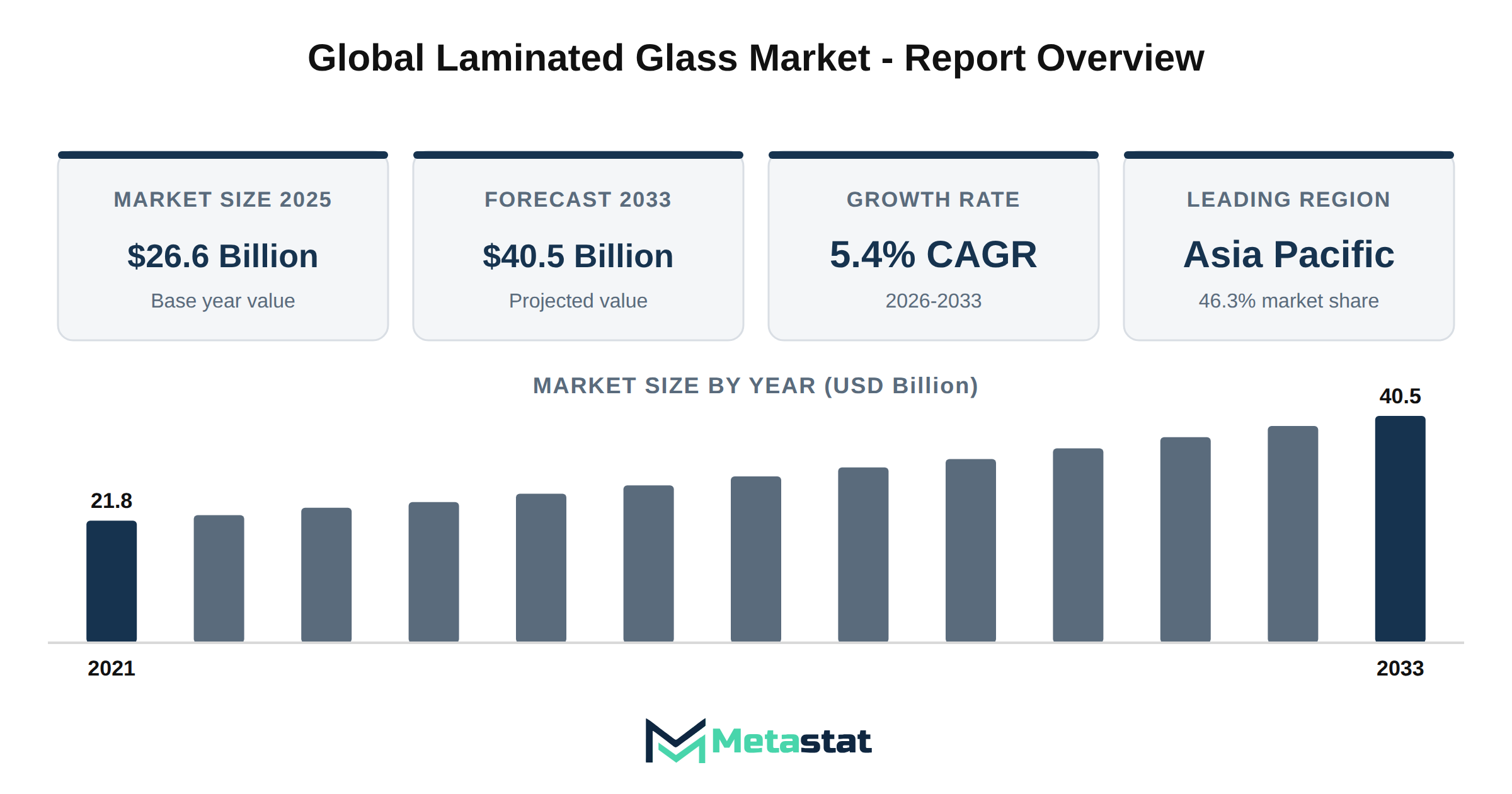
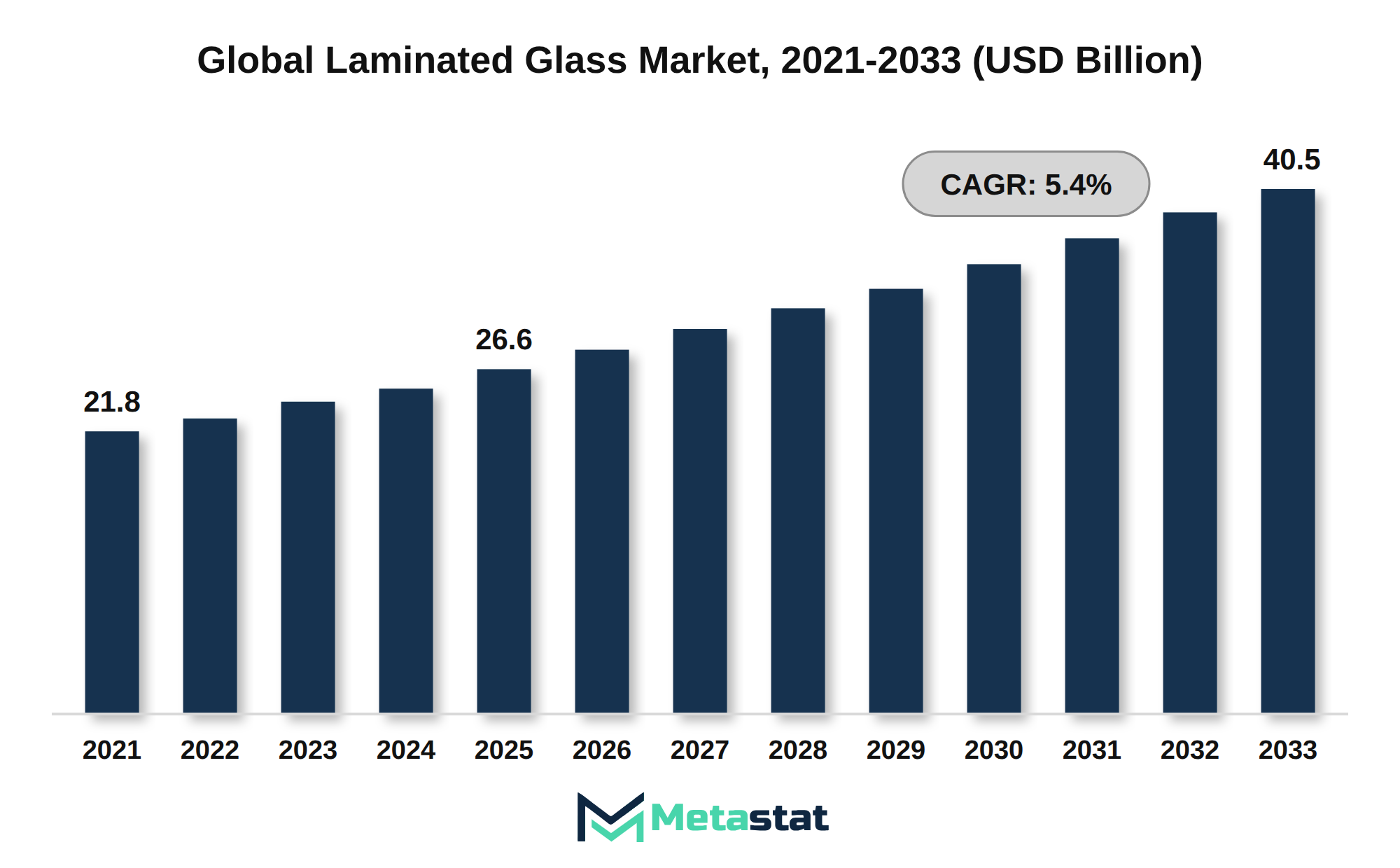
The global Laminated Glass market was valued at USD 26.6 billion in 2025 and is projected to reach USD 40.5 billion by 2033, reflecting a compound annual growth rate (CAGR) of 5.4%. The market has experienced steady growth from USD 21.8 billion in 2021, increasing to USD 22.8 billion in 2022 and USD 24.1 billion in 2023, with an estimate of USD 25.1 billion in 2024. This upward trajectory highlights the rising demand across various applications, particularly in construction and automotive sectors.
Demand for laminated glass across construction and automotive applications drives significant market expansion. The construction industry increasingly emphasizes safety and energy efficiency, propelling the adoption of laminated glass in façades, windows, and doors. The automotive sector recognizes the advantages of laminated glass for safety features, enhancing consumer protection and vehicle aesthetics. This convergence of demand across sectors contributes to growth in the laminated glass market.
Technological advancements in interlayer materials, including Polyvinyl Butyral (PVB), Ionoplast, and Ethylene Vinyl Acetate (EVA), shape the future of laminated glass products. These innovations provide enhanced safety, durability, and performance characteristics, catering to the evolving needs of various end-user industries. The integration of advanced interlayer technologies not only improves product functionality but opens new avenues for market growth.
Architectural applications of laminated glass, particularly in façades, railings, and skylights, experience increasing adoption. This trend aligns with the growing focus on modern architecture that prioritizes aesthetics, safety, and energy efficiency. Laminated glass serves because a critical component in enhancing the visual appeal of buildings while ensuring structural integrity and occupant safety.
Innovation in laminated glass products includes low-emissivity (Low-E), acoustic, and fire-resistant variants, meeting specific performance requirements in diverse applications. These innovations support the demand for products that comply with stringent building codes and safety regulations, enhancing consumer confidence in laminated glass solutions. The dynamic nature of product development in the market drives ongoing investment and interest from manufacturers.
The demand for laminated glass is increasing within the construction and automotive sectors. This trend is driven by the growing emphasis on safety, security, and energy efficiency. Laminated glass offers significant advantages, including enhanced structural integrity and sound insulation, appealing to architects and builders focused on modern design and functionality.
Technological advancements in interlayer materials, particularly PVB, Ionoplast, and EVA, enhance the performance of laminated glass. Ongoing research into these materials results in improved durability, optical clarity, and resistance to environmental factors, ensuring better product offerings for consumers and industries alike.
Architectural applications for laminated glass are expanding, particularly in façades, railings, and skylights. This shift is attributed to the desire for aesthetically pleasing yet functional designs that meet safety standards while contributing to energy efficiency in buildings. Growth in these applications reflects a broader trend toward integrating innovative materials in construction practices.
Innovation in laminated glass includes developments in Low-E, acoustic, and fire-resistant technologies. These advancements cater to diverse market needs, promoting energy savings, sound reduction, and enhanced safety in buildings and vehicles. Manufacturers focusing on these innovations position themselves competitively by addressing critical consumer demands.
Pricing dynamics in the laminated glass market reflect fluctuations in raw material and interlayer costs. Supply chain developments influence these pricing trends, affecting manufacturers' margins and ultimately impacting market pricing strategies. Understanding these dynamics is crucial for stakeholders aiming to navigate the competitive environment successfully.
Building codes and safety regulations significantly influence laminated glass adoption across various regions. Compliance with these regulations ensures that products meet necessary safety standards, driving demand among builders and developers. This regulatory framework shapes product development and market entry strategies for manufacturers.
Competitive positioning within the global laminated glass sector involves strategic maneuvers among manufacturers. Companies leverage technological advancements, product diversification, and robust distribution channels to enhance their market presence. This competitive environment encourages innovation and pushes companies to refine their offerings continually.
Future growth opportunities in the market include the development of smart, structural, and high-performance laminated glass solutions. These innovations align with emerging trends in sustainability, regulatory compliance, and decarbonization efforts. Stakeholders focusing on these areas are likely to benefit from increased market demand and expanded customer bases.
The Laminated Glass market experiences growth driven by significant investments in infrastructure development. Urbanization and increasing population densities lead to a surge in demand for new buildings, transportation networks, and public facilities. Such projects prioritize the use of laminated glass due to its superior safety features, aesthetic appeal, and energy efficiency. Construction companies and developers leverage laminated glass to meet both functional and regulatory requirements.
Government initiatives designed to enhance public-private partnerships facilitate funding for major infrastructure projects, creating a favorable capital investment environment. This environment encourages construction firms to integrate innovative materials, like laminated glass, into their designs. Enhanced strength and durability of laminated glass contribute to long-term cost savings for developers through reduced maintenance and insurance premiums.
The rising focus on sustainable building practices further influences the laminated glass market. This trend aligns with global efforts toward carbon footprint reduction and resource stewardship. By adopting laminated glass, builders comply with evolving safety standards while using materials that support energy efficiency in commercial and residential applications. Capital infusion into infrastructure projects significantly stimulates demand for laminated glass, positioning the market for growth.
The Laminated Glass market benefits from advancements in technological integration, impacting production processes and product offerings significantly. Automation, artificial intelligence, and software adoption streamline operations, resulting in reduced production costs and improved quality control. This transformation supports manufacturers in delivering high-quality laminated glass products while optimizing labor and resources.
While the market embraces digital transformation, companies increasingly invest in digitizing legacy processes to enhance productivity. These innovations enable real-time monitoring and management of production lines, leading to more efficient operations. Enhanced operational efficiency reduces overhead costs, translating to competitive pricing in the Laminated Glass market and attracting diverse customer segments.
Technological advancements shape new product development, enabling the introduction of innovative features and improvements in laminated glass applications. While the market evolves, the integration of new technologies promotes a culture of continuous improvement, ensuring that manufacturers remain responsive to changing consumer preferences and industry demands. This proactive stance positions the market for sustained growth throughout the forecast period.
The Laminated Glass market faces significant constraints due to increasing regulatory hurdles that impact industry operations. Compliance requirements related to safety and environmental standards create challenges for manufacturers and suppliers. These regulations demand adherence to specific material properties and production processes, often resulting in additional costs and complexities throughout the supply chain.
Macroeconomic factors contribute further to the market's restraint. Inflationary pressures increase costs for raw materials and labor, impacting profitability and investment decisions. High capital investment requirements deter potential entrants and limit expansion opportunities for existing players. Geopolitical instability introduces uncertainties that disrupt supply chains, forcing companies to adapt quickly to changing market dynamics.
Technological obsolescence poses another challenge, driven by rapid advancements in materials and processes that necessitate continual investments in research and development. Companies that fail to keep pace with innovations risk falling behind competitors who capitalize on new technologies. The Laminated Glass market encounters substitution risks, where alternative products emerge, potentially reducing market share.
The industry faces workforce challenges, with skilled labor deficiencies impacting production capabilities. Limited talent availability hinders operational efficiency, affecting the market's ability to meet growing demand. Market fragmentation complicates competitive dynamics, resulting from numerous small players emerging alongside established firms, making it difficult to achieve economies of scale.
Overall, these factors collectively create an environment where the growth potential of the Laminated Glass market is constrained, necessitating strategic navigation by industry participants to mitigate these risks and capitalize on emerging opportunities.
The Laminated Glass market encounters challenges stemming from geopolitical fragmentation, which disrupts trade flows and heightens tariff friction. Countries imposing tariffs on imported materials create trade deficits that impact costs and availability. These conditions compel manufacturers to seek alternative suppliers, often leading to increased operational complexity and variability in pricing structures.
Technological disruptions pose additional challenges, particularly in research and development integrations. The rapid pace of innovation requires companies to invest heavily in new technologies while managing interoperability friction among diverse systems. This complexity delays product development timelines and reduces market responsiveness.
Logistical disruptions significantly affect the market, with ongoing supply chain instability exacerbating feedstock and component volatility. Such instability introduces unpredictability in sourcing essential materials, resulting in fluctuating production costs and margin pressures. Rising input costs further strain profitability, compelling firms to reassess pricing strategies.
Workforce skill gaps create barriers to effective implementation of advanced technologies, with talent retention pressures complicating hiring efforts. The need for skilled labor remains critical, driven by automation displacements that shift job requirements within the industry. Environmental lifecycle footprints and sustainability demands add complexity, pushing companies to adapt to stricter decarbonization mandates.
Infrastructure gaps in emerging markets hinder the adoption of laminated glass solutions, creating retrofitting barriers for existing buildings. Market saturation and substitution pressures from alternative materials impede growth potential, making it essential for players to innovate continuously within the Laminated Glass market to maintain competitive advantage.
The Laminated Glass market experiences significant opportunities driven by emerging regional demands, particularly in Asia Pacific and North America. The growing urbanization in these regions fuels the need for modern construction solutions, leading to increased consumption of laminated glass products. Infrastructure modernization initiatives aimed at enhancing urban resilience and sustainability contribute to the rising demand for advanced glazing solutions, which include residential, commercial, and industrial applications.
Technological disruptions within the market create pathways for product innovation, including the integration of digital tools and automation in manufacturing processes. These innovations enhance production efficiency and quality, appealing to a broader customer base. The ongoing shift towards sustainability imperatives encourages the adoption of eco-friendly materials, positioning laminated glass because an attractive option for builders and architects aiming to meet environmental standards.
The market benefits from downstream diversification strategies, where players explore niche applications and product integrations across various industries. This strategic consolidation allows companies to tap into new revenue streams while enhancing the value proposition of their offerings. Enhanced buying behaviors and digital procurement trends further shape the landscape, enabling buyers to access a wider range of products and suppliers efficiently.
Value-chain optimization through process automation and operational yield maximization creates significant advantages for manufacturers. These strategies contribute to reduced costs and improved profit margins, reinforcing competitive positions within the market. The Laminated Glass market is poised for growth because stakeholders align operations with evolving market demands and sustainability goals.
The Global Laminated Glass market is segmented based on Interlayer Type, Type, Application, and End-User Industry.
Valued at USD 18.3 billion in 2026, the Polyvinyl Butyral (PVB) segment is projected to reach USD 24.7 billion by 2033, with a CAGR of 4.4% during the forecast period. Demand for PVB in the laminated glass market is driven by superior adhesive properties that enhance safety and structural integrity in various applications. The building and construction sector emphasizes the use of PVB laminate in façades, windows, and doors due to impact resistance and sound insulation capabilities.
Adoption of PVB interlayers is supported by regulatory compliance standards prioritizing safety and performance in construction materials. Innovations in PVB formulations and processing techniques contribute to improved performance characteristics, further enhancing appeal. The segment's expansion is driven by increasing demand from the automotive industry, where PVB is critical for windshields and other safety glass applications.
Consumption shifts towards lightweight and energy-efficient materials enhance the appeal of PVB laminates, allowing for reduced energy costs and improved environmental performance. While competition from alternative interlayer materials exists, PVB maintains a strong position due to a proven track record and extensive certifications. Strategic investment in PVB research and development presents opportunities for market players to introduce next-generation upgrades that cater to evolving consumer preferences.
Overall, the PVB segment is essential in the laminated glass market, driven by unique properties and applications across multiple industries, reinforcing market presence through continuous innovation and adherence to regulatory standards.
Growing interest in high-performance materials significantly influences the Ionoplast segment within the Laminated Glass market. This interlayer type offers enhanced durability and safety features, appealing to various applications in the building and construction industry. These characteristics lead to increased adoption in façades, windows, and automotive sectors, further driving market demand.
Ionoplast's estimated value reaches USD 7.7 billion by 2033, at a CAGR of 8.2% during the forecast period. Continuous advancements in material science and production techniques enhance the performance attributes of Ionoplast, making it a preferred choice for many manufacturers. The segment's expansion is driven by the growing focus on energy efficiency and safety standards, which align with regulatory compliance requirements across regions.
Shifts in consumer preferences towards sustainable and resilient building solutions influence the development of this segment. The integration of Ionoplast into architectural designs promotes aesthetic flexibility while maintaining structural integrity. Such trends motivate manufacturers to invest in next-gen upgrades, ensuring competitive positioning and technological maturation within the Laminated Glass market.
Cost structures associated with Ionoplast production remain effective due to streamlined processes and strategic raw material sourcing. Stable pricing contributes to maintaining margins, allowing producers to invest in innovative applications and enhance product offerings. These dynamics create strategic opportunities, supporting the overall growth trajectory of the Ionoplast segment, driven by its adaptability to evolving market demands.
Rising demand for Ethylene Vinyl Acetate (EVA) within the Laminated Glass market stems from its advantageous properties including excellent adhesion, flexibility, and durability. These features enable EVA to perform effectively in various applications, particularly in the building and construction sector, which increasingly prioritizes safety and energy efficiency. The segment is expected to reach USD 5.9 billion by 2033, indicating a strong upward trajectory driven by ongoing technological advancements and product evolution. Enhanced production techniques continue to improve EVA's performance characteristics, ensuring its suitability for diverse end-user requirements.
Market dynamics indicate a shift towards environmentally friendly materials, positioning EVA because a competitive choice attributed to its recyclable nature. Regulatory compliance standards increasingly favor sustainable practices, further encouraging adoption within the Laminated Glass market. Alongside these drivers, cost structures and pricing volatility impact manufacturers. Strategic investments in research and development facilitate innovation and product upgrades, enhancing market positioning. Suppliers focusing on raw material sourcing maintain supply chain resilience, mitigating risks associated with potential disruptions. Overall, the growth prospects for the EVA segment align with broader market trends favoring advanced, sustainable glass solutions.
Segment growth is driven by increasing applications of laminated glass in diverse industries, particularly in construction and automotive sectors. Adoption of innovative materials, including thermoplastic polyurethane and cast-in-place resin, enhances the performance characteristics of laminated glass, making it suitable for demanding environments. Growing awareness of safety and security requirements influences demand in the building and construction industry, resulting from these materials providing improved impact resistance and acoustic properties.
Technological maturation allows for the development of superior interlayer products that meet evolving consumer standards. Enhanced product evolution contributes to the sustained interest in these materials, with manufacturers focusing on next-generation upgrades to optimize performance and reduce environmental impact. Significant capital investments in production capabilities further support expansion in the segment, facilitating a broader acceptance of laminated glass products.
Others (Thermoplastic Polyurethane and Cast-in-Place Resin) segment is projected to grow at a CAGR of 6.5% during the forecast period. Cost structures play a crucial role in shaping competitive dynamics, influencing pricing strategies that affect market penetration. Regulatory compliance standards and certifications drive manufacturers to innovate, ensuring that products meet stringent quality benchmarks.
Shifts in consumption patterns reflect increased demand for energy-efficient and sustainable building solutions, facilitating the growth of the laminated glass market. Supply chain resilience becomes increasingly vital. Raw material sourcing strategies are adapted to mitigate risks associated with price volatility. Overall, the segment's performance aligns with broader trends in construction and automotive markets, supporting sustained growth and enhanced market positioning.
In 2026, the Clear Glass segment is valued at USD 14.4 billion and is projected to reach USD 19.4 billion by 2033, at a CAGR of 4.4% during the forecast period. Demand for clear glass arises from its widespread use in various applications, particularly in the construction industry for windows, facades, and interior partitions. Architectural trends favoring transparency and natural light drive consumption. Technological advancements in manufacturing processes enhance product quality and performance, leading to increased adoption.
Segment expansion is supported by developments in energy-efficient building designs, where clear laminated glass contributes to thermal insulation and sound reduction. Regulatory frameworks promoting sustainable construction practices create favorable conditions for growth in the market. Evolving preferences of end-users towards aesthetically appealing and functional glass solutions further enhance demand.
Pricing stability remains crucial, given fluctuations in raw material costs. Suppliers focus on maintaining competitive pricing while ensuring product quality, which directly impacts profit margins. Strategic opportunities for suppliers lie in innovating next-generation products with enhanced durability and energy efficiency, aligning with broader trends in the building and construction sector.
Clear Glass faces competition from alternative materials including polycarbonate and acrylic, which offer different pricing and performance characteristics. Strategic partnerships among manufacturers, architects, and construction firms enhance market resilience against disruptive alternatives. Overall, the Clear Glass segment's potential for growth aligns with the upward trajectory of the Laminated Glass market, driven by evolving consumer preferences and regulatory compliance standards.
Tinted or Colored Glass shows strong market potential within the Laminated Glass market, estimated to reach USD 9.7 billion by 2033, at a CAGR of 6.4% during the forecast period. This segment benefits from increasing consumer preference for aesthetic enhancements in architectural designs and automotive applications. Growing focus on energy efficiency and UV protection significantly drives demand for tinted glass in building facades and windows.
Technological advancements in manufacturing processes enable the production of high-quality tinted glass, enhancing durability and performance. Sustainability priorities prompt manufacturers to innovate by incorporating eco-friendly materials and production methods. This evolution in product offerings aligns with regulatory compliance standards aimed at reducing environmental impacts.
Rising urbanization and infrastructure development across various regions fuel the consumption of tinted glass, particularly in emerging economies. The automotive sector represents a significant end-user for this sub-segment, applying tinted glass in vehicle windows for both aesthetics and functionality. Increasing investments in construction and automotive industries position the market for significant growth, driven by the expanding applications of tinted or colored glass.
Significant growth in the Reflective Glass segment aligns with increasing urbanization and the architectural trend towards aesthetic and functional glass applications. Demand stems from the construction of energy-efficient buildings that require materials capable of reflecting solar radiation, thus enhancing indoor comfort and reducing energy costs. This shift towards sustainable construction practices drives investments in reflective glass technologies, improving insulation properties while maintaining visual appeal.
Reflective glass applications extend beyond traditional building facades, finding usage in automotive and electronics sectors, which strengthens its market presence. The segment is expected to reach USD 6.9 billion by 2033, indicating strong adoption rates driven by regulatory standards promoting energy efficiency in buildings and vehicles. Increased consumer awareness regarding energy savings further influences this trend, encouraging the adoption of reflective solutions across various end-user industries.
Pricing dynamics play a crucial role in segment performance. Fluctuations in raw material costs, driven by global supply chain factors, impact margins for manufacturers. Companies engage in innovation to enhance product performance while managing production costs, creating a competitive landscape within the market. The continuous evolution of reflective glass technologies, including advancements in coating processes, supports ongoing growth through enhanced functionalities and application versatility.
Growth within the Others (Fire-Resistant Laminated Glass, Low-E Laminated Glass) segment is projected to occur at a CAGR of 6.6% during the forecast period. Increasing applications in various end-user industries drive demand for specialized laminated glass products that enhance safety and energy efficiency. Fire-resistant laminated glass provides critical safety features in building and construction, addressing regulatory compliance standards that require enhanced protective measures. Low-E laminated glass offers energy-saving benefits in commercial and residential buildings, contributing to lower operational costs and promoting sustainability efforts. The focus on improving building performance and occupant safety significantly influences consumption patterns within the laminated glass market. Ongoing technological advancements enable manufacturers to develop innovative products that meet changing consumer preferences and industry standards.
Valued at USD 7.9 billion in 2026, the Façades & Curtain Walls segment is projected to reach USD 11.6 billion by 2033, at a CAGR of 5.6% during the forecast period. Demand for laminated glass within this segment is fueled by the increasing emphasis on energy efficiency and aesthetic appeal in modern architecture. Developers and architects prioritize materials that enhance building performance while providing innovative design possibilities.
Technological advancements in laminated glass production have led to enhanced durability and performance, making these products favorable for use in façades and curtain walls. The integration of advanced interlayer materials improves sound insulation and impact resistance, factors that appeal to end-users in the building and construction industry. Consequently, the market experiences a shift towards using high-performance laminated glass solutions.
Regulatory compliance standards related to energy efficiency and safety drive further adoption of laminated glass in façades and curtain walls. Governments and regulatory bodies promote the use of materials that meet stringent building codes, which supports market growth by necessitating the incorporation of laminated glass in new builds and renovations. These dynamics reinforce the segment's expansion, responding to evolving consumer preferences and regulatory landscapes.
Investment in sustainable building practices contributes to the anticipated growth in this segment, with an increasing number of projects focusing on eco-friendly materials. The trend towards green building certifications motivates developers to select laminated glass due to its favorable environmental profile and performance characteristics. This alignment with sustainability goals enhances the market's attractiveness to a broader range of stakeholders.
The Façades & Curtain Walls segment of the laminated glass market benefits from a confluence of technological advancements, regulatory pressures, and evolving consumer preferences. These factors collectively position the segment for significant growth over the forecast period, indicating a strong future for laminated glass in architectural applications.
Growth in the Windows & Doors segment aligns with increasing construction activities and renovation projects, driving demand for durable and high-performance materials. The segment is estimated to reach USD 9.3 billion by 2033, at a CAGR of 4.9% during the forecast period. Enhanced consumer awareness of energy efficiency and safety drives the adoption of laminated glass products in residential and commercial properties.
Technological advancements play a critical role in the evolution of laminated glass products tailored for windows and doors. Innovations in interlayer technologies improve performance characteristics, including impact resistance and sound insulation, which meet stringent building regulations and consumer expectations. Rising energy costs prompt builders and homeowners to prioritize energy-efficient solutions.
Regulatory compliance standards increasingly mandate the use of laminated glass in various applications, particularly in areas prone to severe weather or high safety risks. Stringent building codes and safety regulations push manufacturers to enhance product offerings, ensuring compliance with market requirements. The focus on sustainable building practices leads to greater investment in laminated glass technologies, further reinforcing its position within the market.
Supply chain resilience and raw material sourcing strategies have become essential for maintaining competitive pricing amid fluctuating raw material costs. Manufacturers explore alternative materials and innovative production methods to mitigate risks associated with price volatility and supply chain disruptions. This proactive approach supports long-term growth in the Windows & Doors segment of the Laminated Glass market.
Increasing demand for safety and aesthetic appeal in architectural applications drives the Balustrades & Railings segment within the Laminated Glass market. This segment is expected to reach USD 5.3 billion by 2033, reflecting a growing preference for enhanced design elements in residential and commercial buildings. The regulatory framework surrounding construction safety standards significantly influences adoption rates, with stringent guidelines promoting the use of laminated glass in high-risk areas including balconies and staircases.
Technological advancements in production processes contribute to the segment's growth. Innovations in glass laminating techniques improve durability and thermal performance, enhancing product appeal. The trend towards energy-efficient solutions further supports demand, driven by laminated glass products that provide better insulation properties, leading to reduced energy costs for building owners.
Market expansion in the Balustrades & Railings segment experiences a positive trajectory due to the rising construction activities in emerging economies. Increased urbanization and infrastructure development create substantial opportunities for laminated glass applications. The growing interest in modern architecture, characterized by open spaces and glass facades, further drives demand within this segment.
Growth within the Roofs, Skylights & Canopies segment is projected to grow at a CAGR of 5.9% during the forecast period. Increasing construction activities and architectural advancements drive the demand for laminated glass in this application. Enhanced performance features, including energy efficiency and safety, make laminated glass a preferred choice for roofing and canopies. The growing emphasis on sustainable building practices further supports the adoption of innovative glazing solutions, leading to a rise in market penetration.
Architectural trends favor open and light-filled spaces, thereby increasing the demand for large glass surfaces in roofs and skylights. These design preferences highlight the aesthetic value of laminated glass, positioning it because an integral component in modern architecture. Compliance with stringent building codes and regulations regarding safety and energy standards reinforces the relevance of laminated glass in this segment.
Market shifts reflect heightened awareness of the benefits provided by laminated glass, including UV protection and sound insulation. These attributes influence consumer preferences, encouraging architects and builders to select laminated glass products for new constructions and renovations. The expansion of the real estate sector in emerging economies enhances market potential, facilitating the introduction of innovative glazing technologies.
Increasing interest in modular and flexible spaces drives demand for laminated glass in interior partitions and space dividers. This trend aligns with modern architectural designs that prioritize open-concept layouts while allowing for privacy and sound insulation. The market sees significant adoption across various sectors, including commercial offices, educational institutions, and healthcare facilities, where adaptable environments enhance functionality.
Technological advancements in laminated glass production contribute to improved aesthetics and performance. Enhanced acoustic properties and safety features support the use of laminated glass in areas requiring noise reduction and impact resistance. Regulatory compliance with building codes encourages the integration of this material, ensuring safety and sustainability standards are met.
Shifts in consumer preferences towards eco-friendly materials influence market dynamics. Sustainable and energy-efficient solutions align with the growing emphasis on green building practices. Cost structures in laminated glass production evolve, with investments in innovative manufacturing processes and raw material sourcing contributing to a resilient supply chain.
Strategic opportunities exist for manufacturers to explore unique applications in the interior space. The laminated glass market presents avenues for product evolution, particularly in custom designs that cater to specific client needs. Continuous investments in research and development enhance the competitive landscape, enabling next-generation upgrades and increasing market penetration.
Increasing adoption of laminated glass in architectural designs drives demand for the Floors, Stairs & Walkways application. This shift aligns with consumer preferences for enhanced safety, durability, and aesthetic appeal in construction projects. Builders and architects prioritize materials that combine functionality with visual appeal, contributing to heightened interest in laminated glass solutions. The market benefits from technological advancements, leading to improved product offerings that cater to various design requirements and performance standards.
Developments in the regulatory landscape further boost the appeal of laminated glass in construction. Compliance with safety standards and energy efficiency regulations increases greater acceptance of laminated glass in various applications. This trend is expected to support long-term growth for the market, positioning laminated glass because a viable choice for modern construction projects.
Investment in innovative designs and production techniques enhances the competitive landscape for laminated glass. Emerging technologies improve the performance characteristics of laminated glass, enabling it to withstand environmental challenges while offering aesthetic benefits. The market's evolution continues to attract investment, ensuring that laminated glass remains a preferred choice in flooring, stair, and walkway applications.
In the competitive landscape of storefronts and display glazing, the Laminated Glass market experiences substantial growth driven by increasing retail activities and the necessity for enhanced security features. Retailers invest in high-quality glazing solutions to attract customers through appealing displays and protect their merchandise from theft or vandalism. Technological advancements in laminated glass enhance its performance, improving durability and safety, which leads to adoption by various sectors including retail and commercial enterprises.
Consumer preferences shift toward visually appealing environments, prompting businesses to adopt laminated glass in storefronts. This material provides a combination of aesthetic appeal and functional benefits, including sound insulation and UV protection. The rising emphasis on eco-friendly building materials fuels demand for laminated glass, aligning with sustainability trends within the market. Regulatory compliance regarding energy efficiency and safety standards drives the adoption of laminated glass solutions.
Investment in innovative manufacturing processes enhances the quality and variety of laminated glass products available on the market. Manufacturers focus on developing next-generation glazing solutions that integrate smart technologies, including self-tinting and energy-efficient coatings. The demand for high-performance glass solutions expands, and businesses recognize the strategic opportunity for growth and differentiation within the retail space.
Supply chain resilience becomes critical in supporting the timely delivery of laminated glass products. Collaborations among manufacturers, suppliers, and logistics providers ensure a steady flow of raw materials and finished products, minimizing disruptions. The market faces challenges related to raw material sourcing and pricing volatility, which have implications for production costs. Strategic partnerships and investment in local production facilities mitigate these risks, allowing businesses to capitalize on the growing demand for laminated glass in storefronts and display applications.
Increasing interest in innovative designs drives demand within the Others (Elevator Enclosures, Furniture and Aquariums) segment of the Laminated Glass market. Key factors include the rising emphasis on safety and aesthetics in both residential and commercial applications. The segment benefits from advancements in manufacturing techniques that enhance the durability and visual appeal of products. Regulatory compliance standards for safety and environmental impact further increase adoption in these applications. Investment in capital and technology to improve laminated glass features aligns with evolving consumer and designer expectations. This dynamic environment creates strategic opportunities for manufacturers seeking to expand their portfolios within this niche segment.
Valued at USD 17 billion in 2026, the Building and Construction segment is projected to reach USD 23.9 billion by 2033, at a CAGR of 5% during the forecast period. This growth aligns with increasing investments in infrastructure development and renovation projects across various regions. The demand for laminated glass in this segment is driven by its superior safety, durability, and aesthetic appeal, making it a preferred choice for modern architectural designs.
Technological advancements in glass manufacturing processes continue to enhance product performance, which further stimulates adoption in the sector. Regulatory compliance with safety and energy efficiency standards supports the integration of laminated glass in building codes, driving its use in residential and commercial applications. The market benefits from a wide range of applications, including façades, curtain walls, and interior partitions, which highlights its versatility and relevance in contemporary construction.
Competition among manufacturers intensifies, encouraging innovative product offerings and pricing strategies. The ongoing trend toward sustainable construction practices increases the demand for eco-friendly materials, positioning laminated glass because a viable option for environmentally conscious projects. Overall, the Building and Construction segment within the Laminated Glass market demonstrates robust potential for growth and expansion in the coming years.
Growth in the Automotive segment aligns with rising consumer demand for safety, fuel efficiency, and aesthetic appeal in vehicles. The integration of laminated glass enhances vehicle safety by providing improved strength and impact resistance, making vehicles more secure for occupants. The trend towards electric and hybrid vehicles has heightened the focus on lightweight materials, where laminated glass contributes to reducing overall vehicle weight while maintaining structural integrity.
The automotive segment is estimated to reach USD 12.6 billion by 2033, at a CAGR of 5.8% during the forecast period. This growth results from increased regulations emphasizing passenger safety and environmental sustainability, prompting automotive manufacturers to adopt advanced glass technologies. Innovations in glass manufacturing, including the development of lighter and more energy-efficient laminated glass solutions, support this trend, making vehicles not only safer but more energy-efficient.
In the competitive landscape of the Laminated Glass market, key players invest in research and development to introduce next-generation products that meet evolving regulatory standards and consumer preferences. The presence of multiple suppliers ensures a robust supply chain, enhancing the availability of laminated glass solutions across the automotive sector.
Increased usage of laminated glass in electronic devices significantly influences the demand within the Electronics segment. The rise of consumer electronics, including smartphones, laptops, and televisions, drives a need for high-quality, durable, and aesthetically pleasing glass solutions. Technological maturation in screen technology necessitates enhancements in glass performance, further boosting demand in the market.
Continuous advancements in glass processing techniques allow manufacturers to produce thinner, lighter, and more resilient laminated glass products. This evolution in product offerings aligns with the industry's focus on improving device performance and user experience. The Electronics segment is projected to reach USD 2.2 billion by 2033, reflecting strong growth driven by these factors.
Regulatory compliance around safety and durability standards pushes manufacturers to adopt laminated glass solutions, which enhance the longevity and performance of electronic devices. Pricing volatility and cost structures present challenges; however, the overall outlook for the segment remains positive, fueled by growing investment in innovation and product development. Strategic opportunities exist in addressing emerging applications and consumer preferences, ensuring the sector adapts to shifting market dynamics.
Growing emphasis on security and protection drives demand within the Others (Security and Defense) segment of the Laminated Glass market. This segment encompasses applications including ballistic-resistant glass and blast-resistant glazing, which are crucial in safeguarding sensitive environments including military installations, embassies, and high-security facilities. Investment in defense infrastructure and rising concerns over security threats contribute significantly to market expansion.
The Others (Security and Defense) segment is projected to grow at a CAGR of 6.8% during the forecast period. Innovations in interlayer materials and advancements in manufacturing technologies enhance the performance and reliability of laminated glass used in security applications. Regulatory standards related to safety and security influence the adoption of high-performance laminated glass products in defense-related installations.
Demand shifts reflect a growing preference for versatile solutions that offer both security and aesthetic value. Increased awareness of the benefits of laminated glass in threat mitigation reinforces the segment's position within the broader Laminated Glass market. The forecasted growth trajectory highlights the segment's potential to capture greater market share and drive revenue growth.
Based on geography, the Global Laminated Glass market is divided into North America, Europe, Asia-Pacific, South America, Middle East, and Africa.
North America represents a significant segment of the Laminated Glass market, contributing a notable portion of the global share in 2025. The market is set to expand at a CAGR of 5.4% within the forecast period, reaching a market size (TAM) of USD 8.8 billion by the end of 2033. Key demand drivers in this region include increasing safety regulations and a growing preference for architectural aesthetics. The modernization of infrastructure and the adoption of innovative building materials further support growth in the market.
The United States, Canada, and Mexico form the primary countries in this market, each exhibiting unique demand characteristics. The building and construction sector serves because a major influence, with rising investments in residential and commercial properties. Increased interest in energy-efficient and environmentally friendly materials enhances the adoption of laminated glass in various applications, particularly in façades and curtain walls.
Emerging market front-runners within North America include innovative manufacturers who prioritize sustainability and performance. The ongoing trend toward localized manufacturing and supply chain regionalization enhances operational efficiency and responsiveness to consumer demands. This trend aligns with geopolitical factors that encourage domestic production and reduce reliance on imports.
Competitive dynamics in the Laminated Glass market within North America feature prominent domestic players focusing on technological advancements and product differentiation. Regional compliance mandates and trade policy shifts shape the operational landscape, influencing procurement behaviors and driving competitive advantages. Ongoing foreign direct investment (FDI) flows into the region create opportunities for further market expansion.
Europe holds a substantial share of the Laminated Glass market. Countries including Germany, France, the UK, Italy, Spain, and Russia contribute prominently to this market. The increasing focus on energy efficiency and safety within the building and construction sector fuels demand for laminated glass products across these nations.
The expansion of infrastructure modernization initiatives across Europe supports the adoption of laminated glass. Urban renewal projects and the construction of new commercial spaces contribute to heightened demand. Regulatory frameworks promoting energy-efficient solutions drive manufacturers to innovate safer and more aesthetically pleasing laminated glass options.
In the automotive sector, the push for lightweight materials enhances the appeal of laminated glass due to its safety features and weight advantages. The growing electric vehicle market across Europe increases the demand for advanced glazing solutions, including laminated glass, which improves vehicle efficiency and safety.
Several domestic market participants, including Saint-Gobain Glass and AGC Glass Europe, influence competitive dynamics in the region. Their focus on localized manufacturing and supply chain regionalization strengthens their market positions while meeting specific customer needs. The consolidation of vendors within Europe accelerates innovation and improves product offerings across the Laminated Glass market.
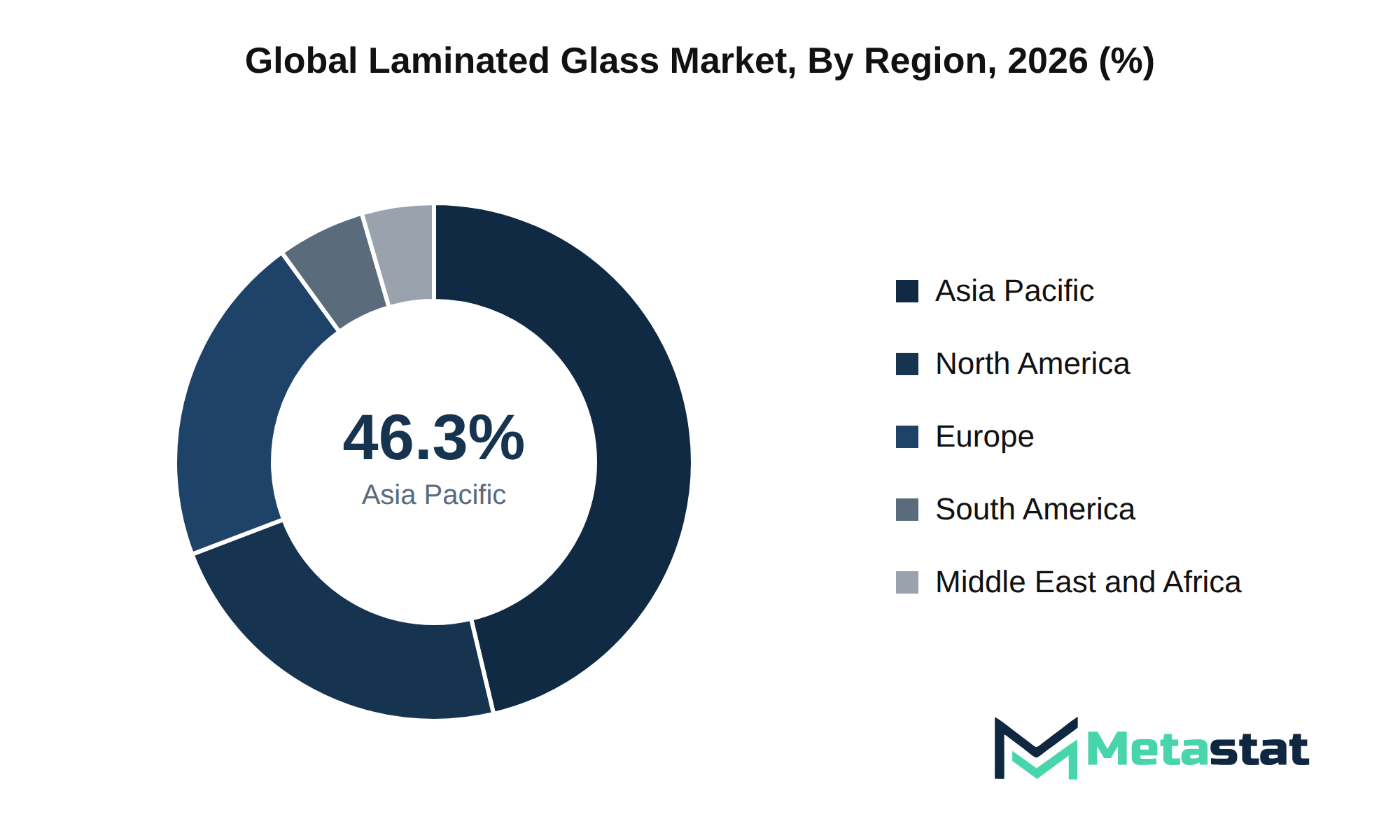
The Asia Pacific region, representing 46.3% of the global Laminated Glass market in 2025, acts because a dynamic hub for growth driven by urbanization and increasing construction activities. Countries including China, India, and Japan lead this trend, where rising infrastructure investments fuel demand for laminated glass in modern buildings and residential projects.
Growing safety regulations and a heightened focus on energy efficiency enhance the adoption of laminated glass within the region. Innovative architectural designs, particularly in urban centers, contribute to increased demand across multiple applications, including façades, windows, and doors. The market experiences accelerated growth due to the shift towards sustainable and durable materials.
The presence of domestic manufacturers, coupled with localized procurement dynamics, strengthens competition in the Asia Pacific Laminated Glass market. Industry players are responding to consumer preferences for enhanced aesthetics and functionality, driving segment expansion. Strategic investments in research and development demonstrate a commitment to meet evolving market demands.
Emerging market front-runners benefit from government initiatives aimed at infrastructure modernization, creating a conducive environment for market development. Countries like South Korea and Australia experience a rise in high-value replacement cycles, which further stimulates the market. Cross-border trade corridors facilitate regional supply chain efficiencies that support localized manufacturing densities.
South America presents unique dynamics within the Laminated Glass market, driven by the growing construction sector and evolving architectural trends. Brazil and Argentina emerge because key players, with substantial investments directed toward infrastructure modernization and urban development initiatives. The demand for laminated glass in façade applications sees significant growth, resulting from the need for enhanced safety and energy efficiency in buildings.
In this region, the market's trajectory aligns with increasing urbanization rates and a rising population, stimulating demand for residential and commercial properties. Local manufacturers gain a competitive edge by focusing on sustainable practices and leveraging regional resources, which supports the market's growth. The segment expansion is further supported by heightened awareness of the advantages of laminated glass in improving structural integrity and aesthetic appeal, particularly in high-value replacement cycles.
Cross-border trade corridors facilitate access to advanced technologies and materials, enhancing local production capabilities. Domestic market leaders recognize the potential growth and actively engage in partnerships and collaborations to strengthen their position and optimize supply chains. The regional competitive landscape features a blend of established players and emerging companies, each striving to capture a larger market share.
While the Laminated Glass market evolves, localized procurement dynamics and cultural nuances influence regional B2B buying behaviors. With a projected share of 5.5% of the global market in 2025, South America is poised for incremental growth, capitalizing on its unique opportunities while navigating the challenges inherent in a developing market.
The Laminated Glass market in the Middle East and Africa presents unique dynamics driven by infrastructure modernization and increasing construction activities. Countries including Saudi Arabia and the UAE experience substantial investments in urban development projects, fueling demand for high-performance building materials. South Africa's growing emphasis on energy-efficient and sustainable construction further supports the adoption of laminated glass solutions.
Emerging market front-runners in this region demonstrate an inclination towards high-value replacement cycles and enhanced safety features in building applications. Local procurement dynamics reflect preferences for durable and aesthetically appealing glass types, impacting segment expansion and overall market growth. The region's fragmented geopolitical landscape influences cross-border trade, prompting suppliers to establish localized manufacturing densities that cater to specific market requirements.
With a share of 4.5% of the global market in 2025, growth in this region is anticipated to continue, driven by foreign direct investment flows and strategic entry barriers. The competitive landscape highlights domestic market participants focusing on innovation and sustainability, which align with regional compliance mandates and cultural nuances in procurement behaviors. These factors contribute to a Laminated Glass market that addresses both local and international demands.
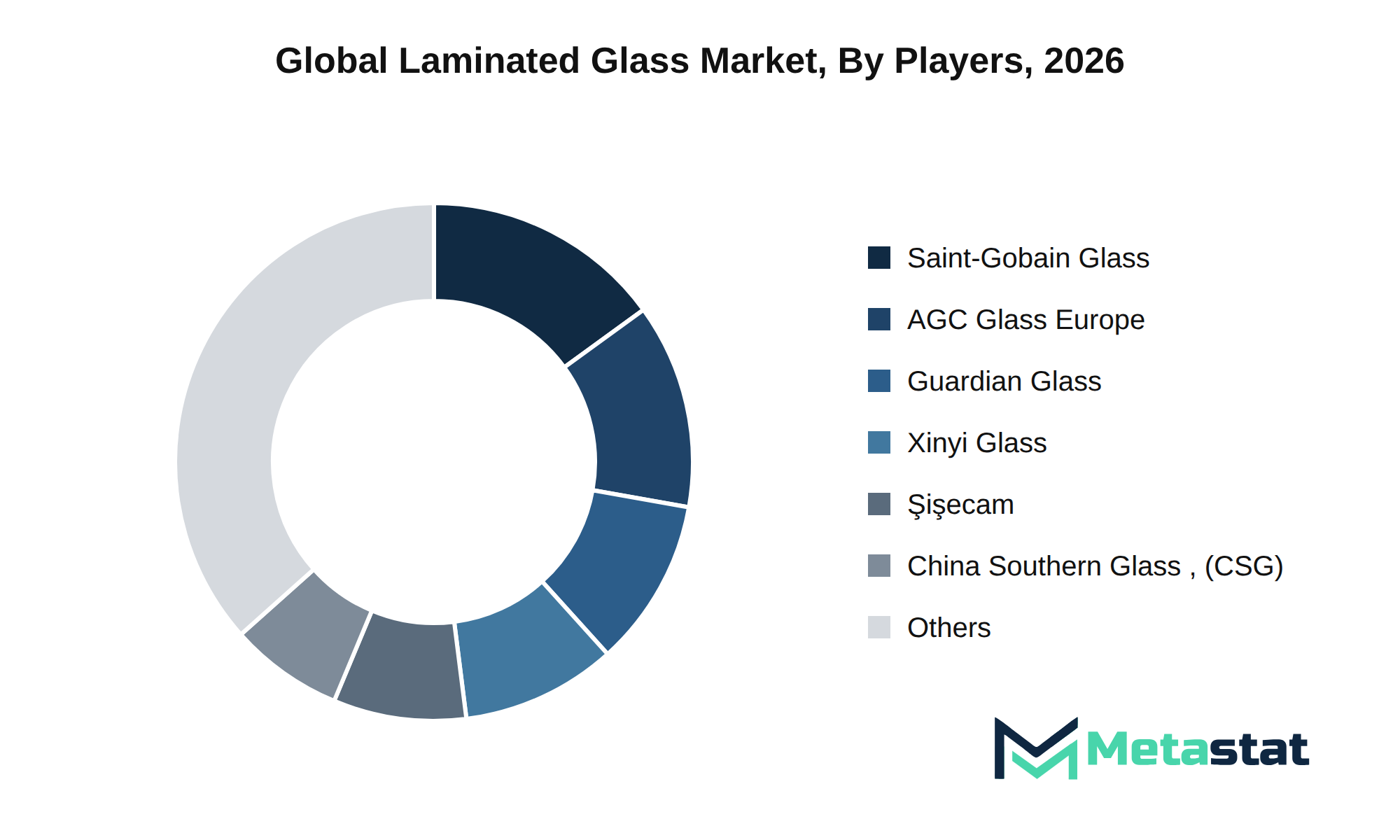
The Laminated Glass market features several key players strategically positioned to enhance their market presence. Companies including Saint-Gobain Glass, AGC Glass Europe, and Guardian Glass leverage extensive research and development capabilities to introduce innovative products. These firms focus on enhancing product differentiation through proprietary technologies, allowing them to capture various end-user segments, including building and construction and automotive.
Strategic alliances and joint ventures, including those formed by Xinyi Glass Holdings Limited and China Southern Glass Holding Co., Ltd. (CSG), strengthen competitive edge by expanding operational capacities and market access. This collaboration enables companies to overcome barriers to entry and enhance supply chain dominance. Partnerships with regional manufacturers, like Jinjing (Group) Co., Ltd. and Asahi India Glass Limited (AIS), create opportunities for localized production and distribution, further enhancing market presence.
Intellectual property portfolios play a significant role in maintaining competitive advantage within the market. Firms including Nippon Sheet Glass Co., Ltd. (Pilkington) and Viracon, Inc. focus on developing robust patent landscapes to protect innovations. The emphasis on technological defensibility contributes to long-term growth by ensuring customer retention and brand equity dynamics, ultimately driving market evolution.
Future competitive outlooks highlight a shift towards sustainable practices, with companies like PRESS GLASS Holding SA and Tecnoglass Inc. investing in environmentally friendly production processes. This focus aligns with global trends, positioning these players favorably in response to increasing consumer demand for sustainable solutions. The Laminated Glass market demonstrates a dynamic relationship of strategic consolidation and innovation, shaping its trajectory in the coming years.
Market size is forecast to rise from USD 26.6 billion in 2025 to over USD 40.5 billion by 2033. The base case reflects growth at a 5.4% CAGR, driven by multiple factors affecting the Laminated Glass market.
Macroeconomic conditions, including shifts in GDP and employment rates, influence downstream demand across various sectors, particularly construction and automotive, which are significant consumers of laminated glass products. Economic cycles lead to fluctuations in demand, causing periods of rapid growth and contraction that impact supply chain dynamics.
Technological advancements, alongside regulatory evolution, shape product life cycles and commercialization timelines for next-generation laminated glass applications. Investment in research and development remains crucial for integrating innovative technologies that enhance product performance and meet evolving compliance milestones.
Geopolitical realignments and changes in trade corridors affect the sourcing and distribution of raw materials, leading to supply chain shifts that impact pricing and availability within the market. Strategic capital allocation directives and infrastructure commitments from government and private sectors contribute to market expansion, particularly in emerging regions.
Identifying unmet enterprise needs and high-growth pockets within the Laminated Glass market presents opportunities for new entrants and established firms alike. Market players devise defensibility roadmaps while focusing on addressing regulatory demands and evolving consumer preferences to secure future growth. Investment in innovative solutions aligns with executive-level strategic imperatives that emphasize sustainability and resilience in production practices.
The report strategically identifies and profiles the key market players and analyses their core competencies in each sub-segment of the Laminated Glass market.
Report Attributes | Details |
Study Period | 2021-2033 |
Base Year | 2025 |
Estimated Year | 2026 |
Forecast Period | 2026-2033 |
Historical Period | 2021-2025 |
Growth Rate | CAGR 5.4% from 2026 to 2033 |
Revenue Unit | USD billion |
Segmentation | By Interlayer Type, Type, Application, End-User Industry, and Region |
By Region | North America (By Interlayer Type, Type, Application, End-User Industry, and Country)
|
Europe (By Interlayer Type, Type, Application, End-User Industry, and Country)
| |
Asia Pacific (By Interlayer Type, Type, Application, End-User Industry, and Country)
| |
South America (By Interlayer Type, Type, Application, End-User Industry, and Country)
| |
Middle East and Africa (By Interlayer Type, Type, Application, End-User Industry, and Country)
|
Find answers to common questions about this report
The Laminated Glass market size was valued at USD 26.6 billion in 2025.
The Laminated Glass market is projected to grow at a CAGR of 5.4% during the forecast period from 2026 to 2033.
The North America Laminated Glass market size is estimated to reach USD 8.8 billion by 2033.
The Clear Glass segment leads the Laminated Glass market with a projected value of USD 19.4 billion by 2033, based on its growth from USD 14.4 billion in 2026.
Significant investments in infrastructure development drive the Laminated Glass market. Urbanization and increasing population densities create demand for new buildings and facilities, while government initiatives enhance funding for such projects. The rising focus on sustainable building practices further supports market growth, aligning with efforts to reduce carbon footprints and improve energy efficiency.
The Laminated Glass market faces significant constraints due to increasing regulatory hurdles that raise compliance costs and complexities. Macroeconomic factors like inflation increase raw material and labor costs, while geopolitical instability disrupts supply chains, creating uncertainties that hinder growth potential. Workforce challenges and technological obsolescence further complicate operational efficiency and market responsiveness.
Significant investments in infrastructure development and rising urbanization drive the adoption of laminated glass. Its superior safety features, aesthetic appeal, and energy efficiency make it a preferred choice for construction companies and developers aiming to meet functional and regulatory requirements while supporting sustainable building practices.
The Laminated Glass market is estimated to reach a valuation of USD 40.5 billion by 2033.
Key players in the Laminated Glass market include Saint-Gobain Glass, AGC Glass Europe, Guardian Glass, Şişecam, Xinyi Glass Holdings Limited, China Southern Glass Holding Co., Ltd. (CSG), and Jinjing (Group) Co., Ltd.
The Laminated Glass market is projected to grow at a compound annual growth rate (CAGR) of 5.4% from 2026 to 2033.
The analysts below cover Chemicals and Materials research at Metastat Insights.
LEAD ANALYST
Utkarsh Khirodkar is a Lead Market Research Analyst at MetaStat Insight, specializing in market intelligence, technology sector assessments, and competitive strategy.

INDUSTRY CONSULTANT - CHEMICALS & ADVANCED MATERIALS
Chemicals and Materials · Machinery & Equipment · Packaging
Amit Gadhekar Consultant for Chemicals and Materials at MetaStat Insight, directing sector-specific intelligence, research, and strategic consulting across global chemical and processing markets.
Enterprise zero-trust network rollouts are often slowed down by multi-cloud transit latency and proprietary hardware retirement schedules. This study provided realistic total cost of ownership models comparing cloud-delivered security edge solutions against traditional hardware refreshes. The analysis of contract renewal lengths and software maintenance fees gave us clear visibility into enterprise replacement cycles over the next three to five years.
Scaling antibody-drug conjugate manufacturing hinges on contract manufacturing availability for high-potency active ingredients. The MetaStat Insight analysis looked closely at global cleanroom slot constraints, bioconjugation batch failure rates, and supply chain redundancies between the US, Europe, and India. The supplier capability matrix proved genuinely useful for our team when mapping secondary source options across our clinical pipeline.
Floating offshore wind feasibility relies heavily on specialized installation vessel availability and port crane limits, which most broad renewable energy forecasts ignore. The report delivered a thorough analysis of dry dock capacity, mooring chain supply constraints, and raw material pricing trends for deepwater anchor installations. It served as a solid independent sanity check for our offshore project capital expenditure assumptions.
Explore related market intelligence reports worth reading alongside this one.