
LEAD ANALYST
Utkarsh Khirodkar is a Lead Market Research Analyst at MetaStat Insight, specializing in market intelligence, technology sector assessments, and competitive strategy.

Robot Joint Actuator Modules Market By Type (Integrated Smart Servo Modules, Planetary Gear Joint Actuator Modules, Harmonic Drive Joint Actuator Modules, Direct-Drive Torque Joint Modules, and Others), By Application (Micro Humanoid Robots, Quadruped, Hexapod, and Legged Robots, Desktop and Micro Collaborative Robots, Service, Social, and Companion Robots, Educational and Research Robotics Platforms, Wearable and Exoskeleton Systems, Others (Medical, and Surgical Microrobotics, etc.), By End User (Industrial Robot and Cobot OEMs, Service and Social Robot OEMs, Humanoid and Legged Robotics Startups, Educational, Research, and University Labs, Medical Robotics and Rehabilitation Device Companies, Defense, Security, and Inspection Robotics Providers, Others (System Integrators, Custom Machine Builders, etc.), By Industry Analysis, Size, Share, Growth, Trends, and Forecasts 2025-2032
Report ID
MSI-4501
Published
November, 2025
Pages
256 Pages
Format
Report Details
Choose Your License
Robot Joint Actuator Modules Market
The global robot joint actuator modules market is a sector that will continue to attract interest as industry players move toward a concept of machines that can work with much better precision, balance, and autonomy. While present discussions often emphasize the technical upgrade, the underlying story will go far beyond that of mere mechanical strength. The market will dictate how the future factory, hospital, logistics hub, and research environment function-not just in terms of movement but also in redefining the way humans and machines share space. The shift will not be about constructing faster or more powerful robots; it will pave the way for a change in working patterns, decision-making frameworks, and expectations from the automated system.
As advanced modules become more adaptable, the industry will go on to explore new possibilities in areas where tasks require subtle motion, quick adjustment, and reliable consistency. This progress will invite companies to rethink the design of whole processes; because the efficiency of these modules will encourage a move from rigid layouts to flexible systems that will adjust to changing production needs. In areas like healthcare and public services, this transformation will open pathways for gentle, safe, interactive robotic assistance and will build trust in areas where robots once felt out of place.
The global robot joint actuator modules market is mainly classified based on Type, Application, End User.
The global robot joint actuator modules market will see integrated smart servo modules gain wider adoption as future robotic designs shift toward compact motion systems. Growing interest in connected automation will mean these modules will support smoother control, faster response, and simplified installation that will help manufacturers build agile robots for a variety of tasks without adding unnecessary weight or complexity.
The global robot joint actuator modules market will continue to be shaped by planetary gear joint actuator modules that support sturdy torque output and stable motion. These modules will, in turn, attract demand for robots expected to operate within tight industrial spaces where strong load handling and long-term durability matter. Their structured layout will help robotic systems achieve reliable movement without regular adjustments.
The Harmonic Drive Joint Actuator Modules will have an impact on the global robot joint actuator modules market, which provides precise control and smooth rotation, ideal for advanced robotic limbs. In the future, this mechanism will enable robots to execute careful and delicate motions. Its compact structure makes it useful for lightweight robots that need high precision without losing energy efficiency or compromising on space.
The global robot joint actuator modules market is set to be driven by increasing demand for silent, vibration-free performance through Direct-Drive Torque Joint Modules. These will also support robots designed to operate in medical, research, and human-facing environments where accuracy and quiet operation matter. Their frictionless design will help motion systems get cleaner, more responsive, and easier to maintain over longer periods.
Other types of actuators will also continue to add diversity to the global robot joint actuator modules market by offering special features to projects that require non-standard motion elements. In this way, future robotics innovators will have the opportunity to build machines suited to niche industrial tasks, compact research devices, and sensitive environments that would require customizable motion and flexible engineering possibilities.
The Micro Humanoid Robots will extend the prospects of the global robot joint actuator modules market as compact robots find their place in healthcare, education, and service. Advanced actuators will be required at their miniature joints to create expressiveness in their controlled movements, thus allowing small-scale robotic figures to perform helpful tasks in tight indoor spaces consistently and with smooth coordination.
Quadruped, Hexapod, and other legged robots will drive the global robot joint actuator modules market toward stronger, lightweight modules that can support climbing, running, and navigation on uneven terrain. Such robots would require durable actuators to maintain balance and coordination for performing rescue operations, inspection tasks, outdoor research, and autonomous field activities.
Growth in the global robot joint actuator modules market will be strengthened by desktop and micro collaborative robots as smaller work cells become common across labs and offices. These will rely on compact joint modules with safe interaction, steady rotation, and precise load handling to help them perform repetitive tasks without causing strain, noise, or workflow interruptions.
Service, social, and companion robots will drive future demand in the global robot joint actuator modules market by necessitating fluid motion for communication, assistance, and daily interaction. Actuator modules will be used to enable natural gestures and smooth limb behaviour of these robots operating in homes, public places, and hospitality environments where comfort and trust shape usage.
Educational and Research Robotics Platforms will add to the demand in the global robot joint actuator modules market due to students and researchers experimenting with new robotic movement methods. Joint modules will be instrumental in the creation of flexible prototypes testing motion accuracy, load capacity, and control strategies; hence, supporting long-term innovation and encouraging hands-on exploration at schools, institutes, and technical training centers.
Wearable and exoskeleton systems are going to drive the development in the global robot joint actuator modules market by stipulating the requirement for strong yet lightweight modules to support human mobility. These actuators will help future assistive devices provide steady lifting, controlled movement, and safe operation. Their smooth performance will aid recovery programs, workplace support suits, and mobility enhancement tools.
Other applications will continue to shape the global robot joint actuator modules market in ways such as driving demand for ultra-small, precise actuator modules. Medical and surgical microrobotics will require controlled, reliable movement for delicate actions. Such solutions will create avenues for miniature tools used in diagnosis, internal navigation, and precision treatment that support improvements in accuracy and patient safety.
Industrial Robot and Cobot OEMs will remain central in the global robot joint actuator modules market as factories shift to smarter automation. The nature of actuator modules will grant support for stable, repetitive, and coordinated movement along production lines so machines can handle assembly, packaging, and material transfer with improved speed, reduced downtime, and steady performance in the long run.
Service and social robot OEMs will drive trends in the global robot joint actuator modules market with a requirement for joints that provide natural motion emulation to interact with the public. Such actuators will facilitate smooth motion in future robots guiding customers, providing visitor assistance, or offering company in homes. It will support precision in motion for better engagement and user comfort.
Humanoid and Legged Robotics startups will create an influx in the global robot joint actuator modules market, powered by fresh designs that rely on compact, flexible actuators. Such modules will make possible life-like walking, lifting, and bending; enabling the creation of advanced robotic bodies by these startups, their progress supporting future innovations in entertainment, research, service automation, and high-mobility robotic assistance.
Academic, research, and university labs will spur the interest of the global robot joint actuator modules market by pushing experimentation with new motion systems. Actuators can help prototype building to let learning and scientists test ideas in robotics. This environment supports invention, helping future engineers to comprehend how motion behaves when they practically explore and work through structured projects.
The companies involved in medical robotics and rehabilitation devices will drive the global robot joint actuator modules market to demand smooth, precise, and safe motion components. The actuators will be used to build assistance devices, surgery-supporting tools, and rehabilitation systems that are able to move carefully around patients. Stable performance will be key in ensuring gentle handling for improved outcomes and comfort during treatment.
The Defense, Security, and Inspection Robotics Providers will facilitate new requirements in the global robot joint actuator modules market by relying on actuators capable of sustaining outdoor conditions during demanding missions. Future robots will need dependably reliable motion to navigate over difficult terrain, handle hazardous materials, and perform surveillance-type duties, supporting safety and enhanced operational awareness in restricted environments.
Other users will bring diversity to the global robot joint actuator modules market by customizing the joint modules for special machines. System integrators and custom builders will adapt actuator designs to suit unique industrial needs, thereby helping companies develop tools that perform uncommon movements or support non-standard workflows with consistent accuracy and dependable structure.
|
Forecast Period |
2025-2032 |
|
Market Size in 2025 |
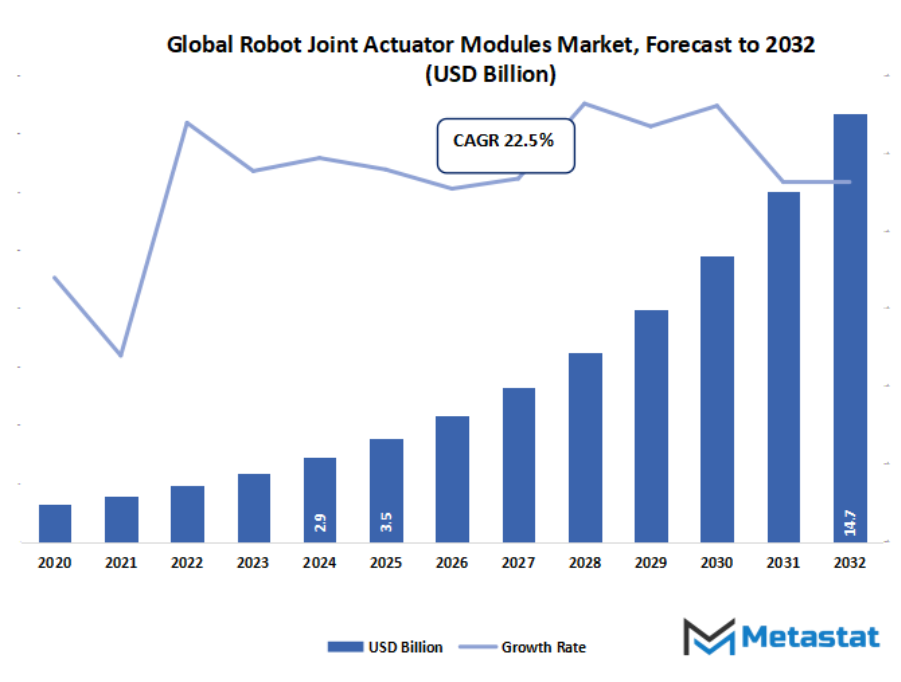
$3.5 Billion |
|
Market Size by 2032 |
$14.7 Billion |
|
Growth Rate from 2025 to 2032 |
22.5% |
|
Base Year |
2024 |
|
Regions Covered |
North America, Europe, Asia-Pacific, South America, Middle East & Africa |
Growing interest in having safer and smarter factory floors will drive industries toward the deployment of robots that can work smoothly alongside human workers. New systems will rely on more precise and efficient motion units, pushing steady interest toward advanced joint actuator designs. This would support future production setups in several industrial zones.
Fast-moving robotic structures will increasingly need smaller and stronger motion units that allow for quick assembly and flexible upgrades. There will be further demand from industries for solutions that reduce machine weight without sacrificing accuracy of movement. This, in turn, is likely to support new strides in automation, leaving room for creative engineering methods over the next few years.
Building future motion units will need strong engineering efforts, raising design and testing expenses. Older factory systems may not easily align with new components, thus adjustments might be time-consuming. These are the barriers that will hold back large-scale adoptions and force companies to balance their budgets while upgrading the automation setup.
Established motion systems will still prevail in many industries as companies remain skeptical toward adopting modern units. Due to limited standardization across actuator technologies, compatibility will be hard to attain. This shall lead to being late in the general shift toward advanced modules and longer evaluation periods.
Robots used for delivery, cleaning, inspection, and warehouse operations will require motion units fitting smaller frames while delivering strong force and real-time digital control. These needs will drive fresh interest in new designs that support faster response, lower energy use, and easier monitoring. This trend shall shape the future directions of the global robot joint actuator modules market.
The global robot joint actuator modules market will be in the limelight as automation gets integrated into production, logistics, healthcare, and other service-based activities. These industries will push the market into growth as compact systems that can deliver accuracy, stable performance, and smooth motion control are sought after. Companies from various sectors will build machinery using these modules to support repetitive tasks, reduce human effort, and enhance output. This will create steady interest in advanced actuator technologies, pushing the drive for better efficiency and longer operating life within manufacturers.
The global robot joint actuator modules market will also develop through consistent innovation, whereby companies keep exploring ways to speed up motion response and reduce weight while improving durability. A strong focus on research will guide the next stage of progress, enabling the industries to use robotic systems in new environments needing careful control and dependable performance. This growth will not only influence factories but will gradually reach small businesses, training systems, and household applications where compact robotic units are needed.
Major companies and newly emerging regional manufacturers, which have been steadily expanding their presence, are expected to continue shaping the global robot joint actuator modules market. Some of the key names, consisting of Arcsecond Robo, Avatar Robot, CubeMars, Damiao/Precision Motion Solutions, Faradyi Motor, Hangzhou RoboCT Technology Development Co., Ltd, JKONGMOTOR, Maxon Group, Realman Intelligent Technology, ROBOTIS Co., Ltd, SGMADA, SteadyWin Motor, Suzhou Honpine Precision Industry Co., Ltd, Synapticon GmbH, Techsoft Robots, and Zhengzhou Defy Mechanical & Electrical, will stay energetic in enhancing their imparting portfolios. The presence of those gamers will foster an excessive degree of competition, riding non-stop improvement in layout, cloth selection, and usual overall performance. New entrants from numerous areas will upload to the dynamism of the marketplace by means of supplying pretty cheaper solutions that appeal to low-finances customers.
In the case of the global robot joint actuator modules market, it will progress gradually toward a phase when the users are going to need flexible solutions that can work in various types of robotic setups. Growing requirements for collaborative robots, lightweight automation equipment, and programmable robotic modules will facilitate this course. The industries are further aiming for increased safety, decreased downtime, and reliable automation; based on which, the demand for improved joint actuator modules is increasing. This trend will enable the market to move ahead at a steady rate, whereby each manufacturer will try to be outstanding on the basis of smooth motion, energy efficiency, and systems that will endure for extended hours of operations without frequent repairs.
Market size is forecast to rise from USD 3.5 Billion in 2025 to over USD 14.7 Billion by 2032. Robot Joint Actuator Modules will maintain dominance but face growing competition from emerging formats.
Beyond manufacturing floors, the impact of this market will shift toward industries that earlier solely depended on human judgment. As those modules decrease and get more intelligent, they will match into light-weight service robots, inspection gear, and mobile platforms in an effort to reach difficult-to-reach or unsafe regions with ease. It may also shift expectations for renovation and product lifecycles, forcing companies to design smarter tracking tools and extra sustainable fabric choices.
This research report categorizes the Robot Joint Actuator Modules market based on various segments and regions, forecasts revenue growth, and analyzes trends in each submarket. The report analyses the key growth drivers, opportunities, and challenges influencing the Robot Joint Actuator Modules market. Recent market developments and competitive strategies such as expansion, type launch, development, partnership, merger, and acquisition have been included to draw the competitive landscape in the market. The report strategically identifies and profiles the key market players and analyses their core competencies in each sub-segment of the Robot Joint Actuator Modules market.
Find answers to common questions about this report
Global Robot Joint Actuator Modules market is valued at $3.5 Billion in 2025.
Global Robot Joint Actuator Modules market is estimated to grow with a CAGR of 22.5% from 2025 to 2032.
Global Robot Joint Actuator Modules market is estimated to reach $14.7 Billion by 2032.
Top players operating in the Robot Joint Actuator Modules industry includes Arcsecond Robo, Avatar Robot, CubeMars, Damiao/Precision Motion Solutions,
The analysts below cover Information & Technology research at Metastat Insights.
LEAD ANALYST
Utkarsh Khirodkar is a Lead Market Research Analyst at MetaStat Insight, specializing in market intelligence, technology sector assessments, and competitive strategy.

PRINCIPAL CONSULTANT - ENTERPRISE AI & EMERGING TECHNOLOGIES
Banking & Finance · Electronics and Semiconductor · Energy and Power · Healthcare IT · Information & Technology · Professional Services
Vijay Gunti is a Principal Consultant at MetaStat Insight, bringing over two decades of experience across enterprise digital transformation, technology strategy, and intelligent systems.

LEAD CONSULTANT - COMMUNICATION, TELECOM, AND IT
Electronics and Semiconductor · Information & Technology · Machinery & Equipment · Professional Services
Ravindra Sathe Consultants for Communication, Telecom, and IT at MetaStat Insight. He leads the firm's industry research initiatives across telecommunications infrastructure, digital connectivity, enterprise networking, and emerging information technology domains.
Decarbonizing industrial thermal processes hinges on refrigerant regulations and compressor efficiency limits. Metastat Insights delivered a thorough market analysis that evaluated natural refrigerants like CO2 and hydrocarbons against synthetic low-GWP alternatives. The breakdown of utility incentives and grid capacity constraints across key European manufacturing hubs offered valuable perspective. The follow-up conversation with their sector analysts addressed our specific questions on mechanical vapor recompression systems efficiently.
Assessing 200mm wafer transition schedules and substrate supply bottlenecks requires precise technical intelligence. MetaStat Insight supplied an actionable breakdown comparing planar and trench MOSFET architectures across automotive and industrial drive markets. The regional capacity estimates for Asia-Pacific foundries helped clarify lead-time uncertainties during our strategic planning session. When we needed additional clarification on high-purity raw material sourcing, their analyst team responded with helpful context within twenty-four hours.
Tracking maintenance cycle demand for secondary flight display units and terrain collision avoidance systems across regional jet fleets involves complex aftermarket dynamics. MetaStat Insight provided practical analysis separating airline retrofit programs from OEM forward-fit production schedules in North America and Southeast Asia. The supplier matrix highlighted component obsolescence timelines without resorting to vague generalizations. The dataset served as a dependable reference during our annual program review meetings.
Explore related market intelligence reports worth reading alongside this one.