
LEAD ANALYST
Utkarsh Khirodkar is a Lead Market Research Analyst at MetaStat Insight, specializing in market intelligence, technology sector assessments, and competitive strategy.

Stage Hoist Market Size, Share, By Product Type (Electric Stage Hoists, Manual Stage Hoists, Pneumatic Stage Hoists, and Hydraulic Stage Hoists), By Load Capacity (Up to 1 Ton, 1-5 Tons, and Above 5 Tons), By Application (Theaters, Concerts, Arenas, Studios, and Others), By Customer Type (Theatre Venues, Performing Arts Venues, Concert Companies, Live Event Production Companies, Broadcast Studios, Film Studios, Rental Service Providers, Staging Service Providers, Convention Organizers, Exhibition Organizers, and Others), Industry Analysis, Growth, Trends, and Forecast, 2026-2033
Report ID
MSI-4804
Published
June, 2026
Pages
312 Pages
Format
Report Details
Choose Your License
Stage Hoist Market
Global Stage Hoist market size is valued at USD 236.3 million in 2025 and projected to grow at a CAGR of 6.3% during the forecast period, reaching USD 395.3 million by 2033.
North America holds 34.0% in 2025 with US leading the market share in 2025.
Key trends driving growth: Expansion of live events, touring productions, and multipurpose venue infrastructure, along with increased focus on safe overhead rigging, precise motion control, and faster setup efficiency in entertainment environments.
Opportunities include rising adoption of intelligent hoists with load monitoring, encoder feedback, SIL-based motion control, and integrated automation for complex stage environments
Key insight: Expansion of live entertainment infrastructure accelerating demand for technologically advanced stage hoist systems.
The Global Stage Hoist Market forms part of the entertainment rigging and live production equipment industry, supporting safe and controlled vertical lifting across concerts, theaters, broadcast studios, arenas, touring productions, and temporary event venues. Stage hoists are shifting from basic lifting equipment to integrated motion-control systems used within digital show control environments. Production teams are adopting hoist systems that connect with lighting consoles, motion software, automated rigging platforms, and stage automation systems to synchronize vertical movement with visual effects, sound cues, scenic transitions, and performance choreography.
Stage lifting equipment will increasingly move toward intelligent control architectures supported by sensors, load-tracking software, encoder feedback, and automated safety verification. These systems will support scenery movement, lighting structure positioning, LED wall suspension, stage platform movement, and coordinated motion sequences planned during production design. Engineers and show designers will treat stage hoists as programmable infrastructure that supports dynamic storytelling across arenas, theaters, concert venues, and broadcast studios.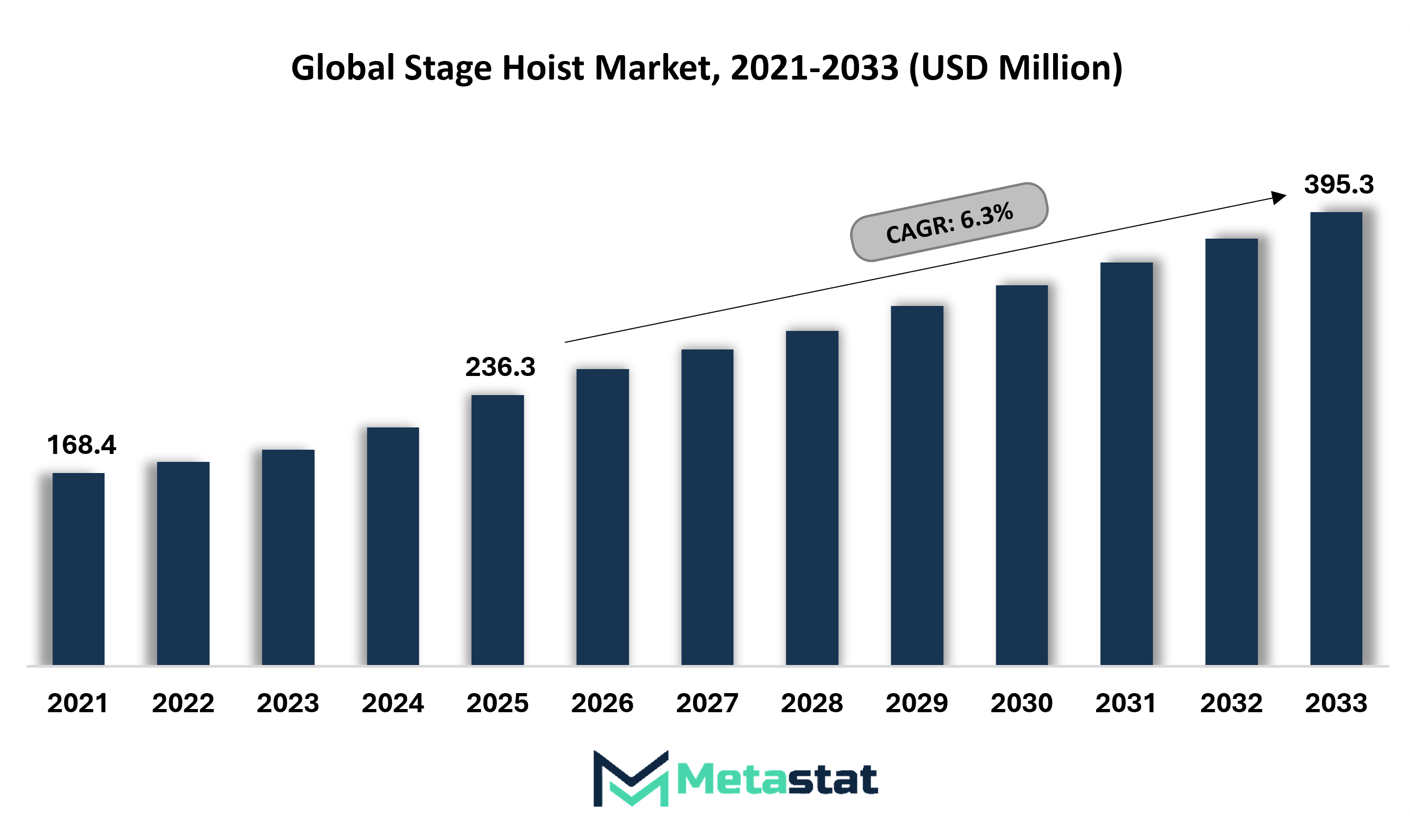
Expansion of live events, touring productions, and multipurpose venue infrastructure.
Rapid expansion of live shows, theatrical productions, corporate showcases, cultural events, sports ceremonies, and large public gatherings continues to drive adoption in the Global Stage Hoist Market. Construction of multipurpose arenas, convention centers, performing arts halls, and event venues is encouraging the use of advanced stage lifting systems. Infrastructure investment across entertainment venues is supporting equipment modernization, improved load-handling capability, enhanced operational reliability, and structured rigging architecture suitable for large-scale productions.
Increased focus on safe overhead rigging, precise motion control, and faster setup efficiency in entertainment environments
Operational safety requirements across entertainment venues strongly influence equipment selection in the Global Stage Hoist Market. Production managers prioritize accurate motion positioning, stable load lifting, controlled descent, braking performance, and synchronized movement for lighting grids, stage props, LED structures, and scenic installations. Adoption is increasing for systems that deliver consistent performance, simplified setup, minimal downtime, and efficient production turnaround during high-frequency event schedules.
High compliance burden linked to safety certification, inspection, and operator training requirements
Regulatory oversight linked to lifting equipment places pressure on stakeholders operating in the Global Stage Hoist Market. Certification processes, mandatory inspection cycles, documented safety audits, and professional operator training programs increase operational complexity. Compliance management requires structured technical knowledge, administrative resources, and financial commitment. Small production companies face challenges in maintaining required certification standards, inspection records, and continuous safety documentation.
Elevated upfront cost for certified hoists, controllers, load monitoring, and integrated automation systems
Procurement of professional stage lifting solutions requires significant capital investment in the Global Stage Hoist Market. Certified hoists, intelligent controllers, load monitoring devices, automation software, communication modules, and integrated safety systems require substantial budget allocation. Budget constraints across independent theaters, touring groups, community venues, and small production houses slow adoption. Long procurement cycles, funding assessments, and financial approval stages also influence purchasing decisions for advanced rigging technology.
Rising adoption of intelligent hoists with load monitoring, encoder feedback, SIL-based motion control, and integrated automation for complex stage environments
Technological progress is creating strong opportunities across the Global Stage Hoist Market. Intelligent lifting equipment equipped with load monitoring sensors, encoder feedback systems, SIL-rated motion controllers, and automated positioning software supports complex stage choreography. Production designers gain improved control over synchronized movement of lighting arrays, scenery components, video walls, and stage platforms, enabling visually advanced performance environments across global entertainment infrastructure.
The Global Stage Hoist Market is classified based on Product Type, Load Capacity, Application, Customer Type, and Region.
Electric Stage Hoists segment is valued at USD 181.3 million in 2026 and is projected to reach USD 298.3 million by 2033, at a CAGR of 7.4% during the forecast period.
Electric Stage Hoists will gain momentum in the Global Stage Hoist Market, supported by precision lifting, controlled motion, and reliable automation. Advanced motors, remote-control panels, variable speed control, and programmable lifting systems will support complex stage designs. Large productions will prefer electric lifting solutions for safety, accurate load handling, synchronized movement, and efficient stage transformation during live performances.
Manual Stage Hoists segment is valued at USD 52.1 million in 2026 and is projected to reach USD 66.9 million by 2033, at a CAGR of 3.6% during the forecast period.
Manual Stage Hoists will maintain steady adoption owing to affordability, operational simplicity, and low maintenance requirements. Small venues, rehearsal halls, community theaters, and educational institutions will rely on manual lifting equipment where budget constraints influence procurement decisions. Mechanical reliability, minimal power dependency, and easy maintenance will preserve relevance across multiple performance environments.
Pneumatic and Hydraulic Stage Hoists will attract attention owing to robust lifting capability and smooth vertical motion. Heavy stage props, dynamic set structures, and technical installations will require controlled power output. Hydraulic pressure systems and pneumatic mechanisms will support demanding lifting operations across large-scale entertainment infrastructure and professional stage production facilities.
Up to 1 Ton segment is projected to reach USD 191.4 million by 2033, at a CAGR of 5.4% during the forecast period.
Up To 1 Ton load capacity hoists will serve lightweight stage systems, lighting rigs, curtains, decorative elements, and small scenic installations. Compact theaters, rehearsal venues, and studio production environments will depend on these lifting solutions for flexibility and ease of use. Lightweight handling systems will support quick adjustments during rehearsals, stage setup, and smaller performance productions.
1–5 Tons load capacity equipment will dominate mid-scale stage installations involving complex lighting arrays, suspended audio systems, modular set structures, and LED display systems. Production teams managing touring shows, regional concerts, and multipurpose venues will adopt medium-capacity lifting equipment for reliability, operational safety, and flexibility across varied stage configurations and venue layouts.
Above 5 Tons lifting capacity will address large structural stage components, heavy set installations, suspended production equipment, and advanced performance engineering requirements. Stadium concerts, arena productions, and international touring shows will require powerful hoisting systems capable of handling heavy loads while maintaining operational stability and safety standards during demanding performance schedules.
Theaters segment is projected to reach USD 76.8 million by 2033.
Theater environments will require stage hoisting solutions supporting scenery movement, curtain lifting, lighting adjustment, backdrop positioning, and mechanical stage transformation. Historic playhouses, modern drama venues, and performing arts centers will integrate lifting systems into technical stage infrastructure to enhance production efficiency, visual storytelling, and backstage coordination.
Concert productions will depend heavily on advanced hoisting technology supporting large lighting grids, digital display systems, sound equipment suspension, truss movement, and stage design elements. Touring concerts and music festivals will require lifting systems capable of fast setup, efficient dismantling, and dependable load control under tight performance schedules.
Arena productions will involve expansive stage engineering with large lighting trusses, suspended displays, aerial effects, and complex stage structures. Arena infrastructure will require powerful hoisting systems enabling vertical movement of large technical installations. High-capacity lifting equipment will enhance spectacle design across sports entertainment events, large concerts, and global performance tours.
Studio production environments will integrate stage hoists supporting camera rigs, lighting assemblies, sound panels, backdrop systems, and production sets. Film production facilities, television studios, and digital content production hubs will adopt lifting equipment that enables controlled adjustments during filming sessions while maintaining production efficiency and equipment safety.
Other applications will include exhibition halls, cultural facilities, educational auditoriums, convention venues, and themed entertainment facilities. Stage lifting systems across these venues will support installation of temporary sets, lighting frameworks, projection equipment, and visual systems used for events, exhibitions, presentations, and public performances.
Based on geography, the Global Stage Hoist market is divided into North America, Europe, Asia-Pacific, South America, Middle East, and Africa.
North America leads the Stage Hoist Market, supported by rising investments in large-scale concerts, live productions, touring events, and advanced stage infrastructure across entertainment venues.
North America strengthens the Stage Hoist Market through the strong presence of event production companies, theater operators, rental service providers, and staging companies adopting automated lifting systems for efficient stage control.
Europe represents a significant market for stage hoists, supported by strong investments in theaters, opera houses, concert venues, cultural centers, broadcast studios, and touring event infrastructure.
Countries such as Germany, France, the UK, Italy, and Spain continue to adopt advanced stage lifting systems for live performances, entertainment productions, exhibitions, and multipurpose venues.
Asia Pacific presents strong growth opportunities in the Stage Hoist Market, supported by rapid expansion of music festivals, cultural events, entertainment venues, and performance infrastructure across emerging economies.
Asia Pacific creates opportunities through expansion of modern auditoriums, conference facilities, multipurpose halls, and performance spaces requiring advanced stage lifting systems.
Middle East, Africa, and South America contribute to the Stage Hoist Market through rising entertainment infrastructure development, growing investments in event venues, and increasing interest in international concerts and live productions.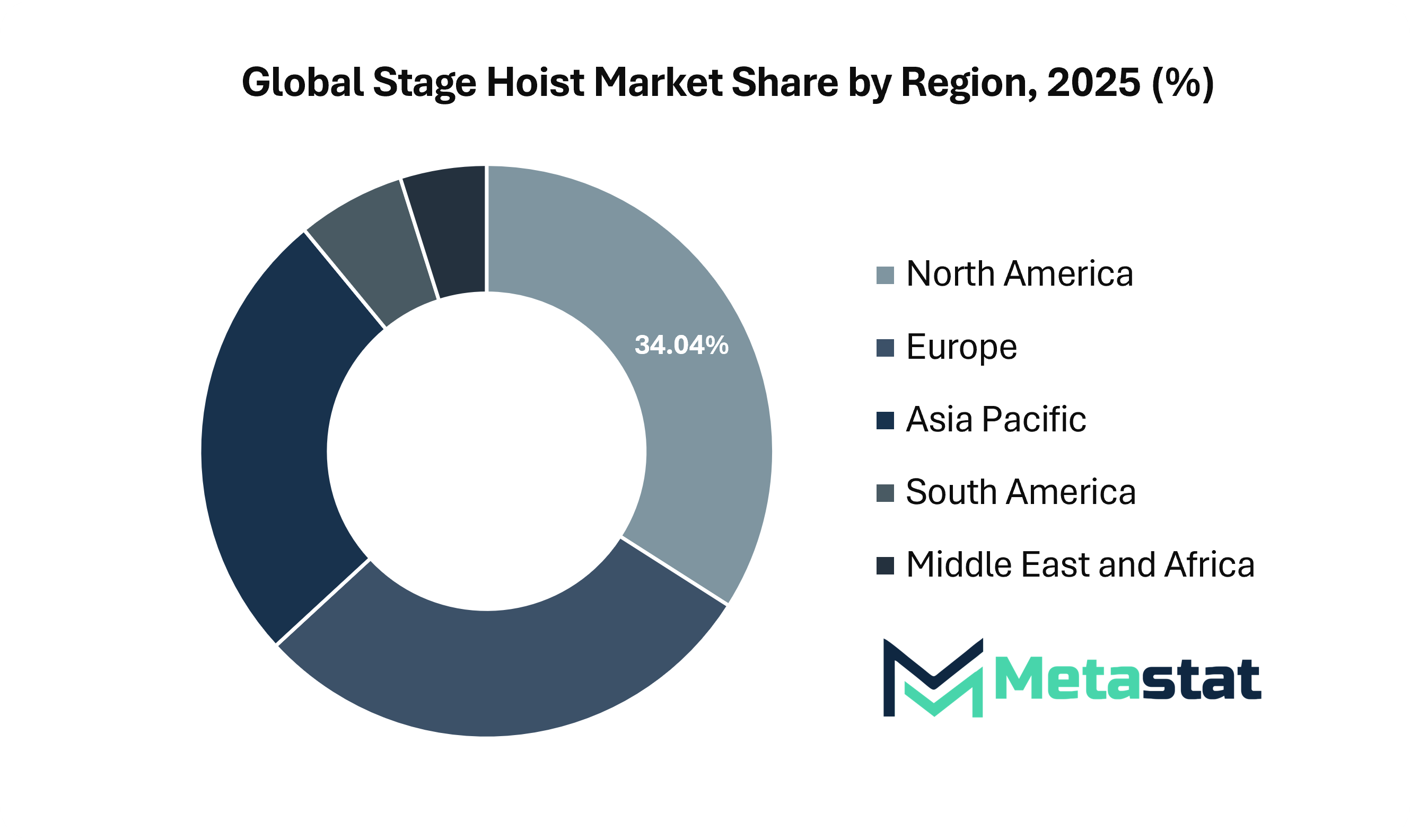
The global stage hoist market is gaining steady traction as live events, theaters, television production, concert halls, and large venues continue expanding their technical capabilities. Stage hoists are mechanical or motorized lifting systems used to raise and lower lighting, scenery, video screens, trusses, curtains, and other stage equipment safely and efficiently. Performances are becoming visually complex, encouraging production teams to rely on reliable hoisting systems that move heavy equipment quickly and with precise control. Adoption will increase across modern theaters, concert halls, theme parks, broadcast studios, and touring productions where equipment handling must remain efficient without disrupting performances.
Technology improvements are shaping the design and use of stage hoists. Manufacturers are introducing automated control systems, quieter motors, stronger lifting mechanisms, and load monitoring features that support higher loads while maintaining safety. Digital control interfaces allow technicians to program movements in advance, reducing manual work and lowering the risk of operational errors. Safety features such as overload protection, braking systems, limit switches, and monitoring sensors will remain critical since stage equipment often operates above performers and technical personnel. These upgrades are encouraging venues to replace older lifting systems with modern solutions that meet current safety and performance standards.
Growth in entertainment venues, corporate events, and broadcast productions is also supporting market expansion. Large productions now require advanced stage layouts, moving scenery, flexible lighting rigs, suspended screens, and modular production equipment. Touring shows rely on hoists that are durable, portable, and easy to install across different venues. Event organizers are investing in equipment that shortens setup time while maintaining reliability during performances. Stage hoist manufacturers are focusing on systems that combine strength, portability, safety, and simplified control.
Looking ahead, the stage hoist market will continue to grow as entertainment production becomes increasingly advanced and visually ambitious. Venues will invest in dependable lifting systems that support innovative stage designs without compromising safety. Manufacturers will place greater focus on automation, compact designs, intelligent controls, and systems that integrate with digital stage control platforms. With ongoing investment in performance spaces and event infrastructure across many regions, stage hoists will remain a critical part of modern stage engineering and technical production.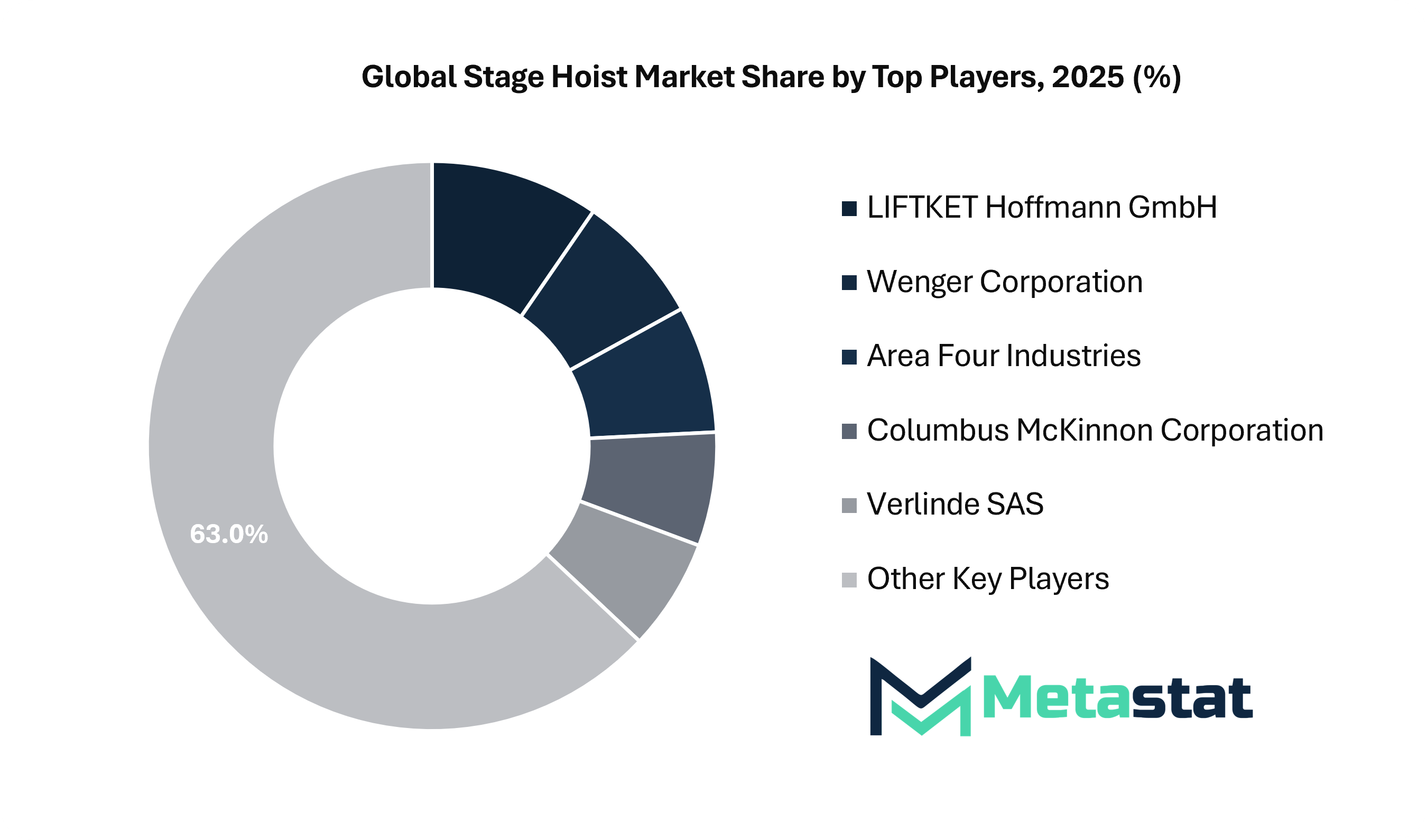
Market size is forecast to rise from USD 236.3 million in 2025 to over USD 395.3 million by 2033.
The Global Stage Hoist Market will increasingly intersect with broader entertainment technology systems that support immersive live experiences. Production environments will continue adopting automation, while motion engineering will integrate with virtual stage design, interactive displays, LED walls, digital show control, and remote programming systems. Such convergence will position stage lifting technology not only as backstage hardware but also as an active component of modern live production, venue automation, and creative stage architecture.
This research report categorizes the Stage Hoist market based on key segments and regions, forecasts revenue growth, and analyses trends in each submarket. The report analyses the key growth drivers, opportunities, and challenges influencing the Stage Hoist market. Recent market developments and competitive strategies such as expansion, product launch, partnership, merger, and acquisition have been included to draw the competitive landscape in the market.
The report strategically identifies and profiles the key market players and analyses their core competencies in each sub-segment of the Stage Hoist market.
|
Report Attributes |
Details |
|
Study Period |
2021-2033 |
|
Base Year |
2025 |
|
Estimated Year |
2026 |
|
Forecast Period |
2026-2033 |
|
Historical Period |
2021-2025 |
|
Growth Rate |
CAGR 6.3% from 2026 to 2033 |
|
Revenue Unit |
USD million |
|
Sales Volume Unit |
Units |
|
Segmentation |
By Product Type, Load Capacity, Application, Customer Type, and Region |
|
By Region |
North America (By Product Type, Load Capacity, Application, Customer Type, and Country)
|
|
Europe (By Product Type, Load Capacity, Application, Customer Type, and Country)
|
|
|
Asia Pacific (By Product Type, Load Capacity, Application, Customer Type, and Country)
|
|
|
South America (By Product Type, Load Capacity, Application, Customer Type, and Country)
|
|
|
Middle East and Africa (By Product Type, Load Capacity, Application, Customer Type, and Country)
|
Find answers to common questions about this report
Top players operating in the Stage Hoist industry includes Columbus McKinnon Corporation, LIFTKET Hoffmann GmbH, GIS AG, Verlinde SAS, Area Four Industries, TAIT LLC (Kinesys), Wenger Corporation, Nantong Allman Industry Co.,Ltd, Doughty Engineering Ltd, Steeldeck Hall Stage Ltd, SBS Bühnentechnik GmbH, Wuhan Rayvanbo Import & Export Trade Co., Ltd., EST Stage Technology, a.s., De Sisti Engineering S.r.l., and Cosmolight S.r.l.
Global Stage Hoist market is estimated to reach USD 395.3 million by 2033.
High compliance burden linked to safety certification, inspection, and operator training requirements will hamper the market growth within the forecast period.
Expansion of live events, touring productions, and multipurpose venue infrastructure and increased focus on safe overhead rigging, precise motion control, and faster setup efficiency in entertainment environments are key driving factors, boosting the market.
Asia Pacific region dominates the market.
Expansion of live events, touring productions, and multipurpose venue infrastructure and Increased focus on safe overhead rigging, precise motion control, and faster setup efficiency in entertainment environments are key driving factors, boosting the market.
The Metastat Insights analysis shows that the North America Stage Hoist market size is estimated to be USD 125.7 million by 2033.
The Metastat Insights study shows that the Global Stage Hoist market size was USD 236.3 million in 2025.
The Global Stage Hoist market is expected to grow at a CAGR of 6.3% over the forecast period (2026-2033).
The Electric Stage Hoists is the leading type of segment in the Global market.
The analysts below cover Machinery & Equipment research at Metastat Insights.
LEAD ANALYST
Utkarsh Khirodkar is a Lead Market Research Analyst at MetaStat Insight, specializing in market intelligence, technology sector assessments, and competitive strategy.

INDUSTRY CONSULTANT - CHEMICALS & ADVANCED MATERIALS
Chemicals and Materials · Machinery & Equipment · Packaging
Amit Gadhekar Consultant for Chemicals and Materials at MetaStat Insight, directing sector-specific intelligence, research, and strategic consulting across global chemical and processing markets.

PRINCIPAL CONSULTANT - QUALITY SYSTEMS & COMPLIANCE
Electronics and Semiconductor · Machinery & Equipment · Professional Services
Omkar Phadtare is an Industry Consultant at MetaStat Insight, specializing in quality systems, regulatory compliance, and standards benchmarking to drive data-driven market intelligence and strategic industry research.

ENERGY & INFRASTRUCTURE INDUSTRY CONSULTANT
Automotive and Transportation · Electronics and Semiconductor · Energy and Power · Machinery & Equipment
Saurabh Vasant Ganvir consults for Energy & Infrastructure Industry at MetaStat Insight, specializing in renewable energy, solar EPC, and electric vehicle (EV) infrastructure markets.

LEAD CONSULTANT - COMMUNICATION, TELECOM, AND IT
Electronics and Semiconductor · Information & Technology · Machinery & Equipment · Professional Services
Ravindra Sathe Consultants for Communication, Telecom, and IT at MetaStat Insight. He leads the firm's industry research initiatives across telecommunications infrastructure, digital connectivity, enterprise networking, and emerging information technology domains.
Evaluating calorific value requirements and air permit compliance across municipal waste facilities requires localized data. Metastat Insight structured their analysis around operational throughput capacity and feedstock composition variations in Latin America and Eastern Europe. Their competitive mapping of sorting equipment vendors helped clarify technology differences between optical separators and heavy media systems. The study provided an objective baseline during our capital expenditure reviews.
Decarbonizing industrial thermal processes hinges on refrigerant regulations and compressor efficiency limits. Metastat Insights delivered a thorough market analysis that evaluated natural refrigerants like CO2 and hydrocarbons against synthetic low-GWP alternatives. The breakdown of utility incentives and grid capacity constraints across key European manufacturing hubs offered valuable perspective. The follow-up conversation with their sector analysts addressed our specific questions on mechanical vapor recompression systems efficiently.
Assessing 200mm wafer transition schedules and substrate supply bottlenecks requires precise technical intelligence. MetaStat Insight supplied an actionable breakdown comparing planar and trench MOSFET architectures across automotive and industrial drive markets. The regional capacity estimates for Asia-Pacific foundries helped clarify lead-time uncertainties during our strategic planning session. When we needed additional clarification on high-purity raw material sourcing, their analyst team responded with helpful context within twenty-four hours.
Explore related market intelligence reports worth reading alongside this one.