
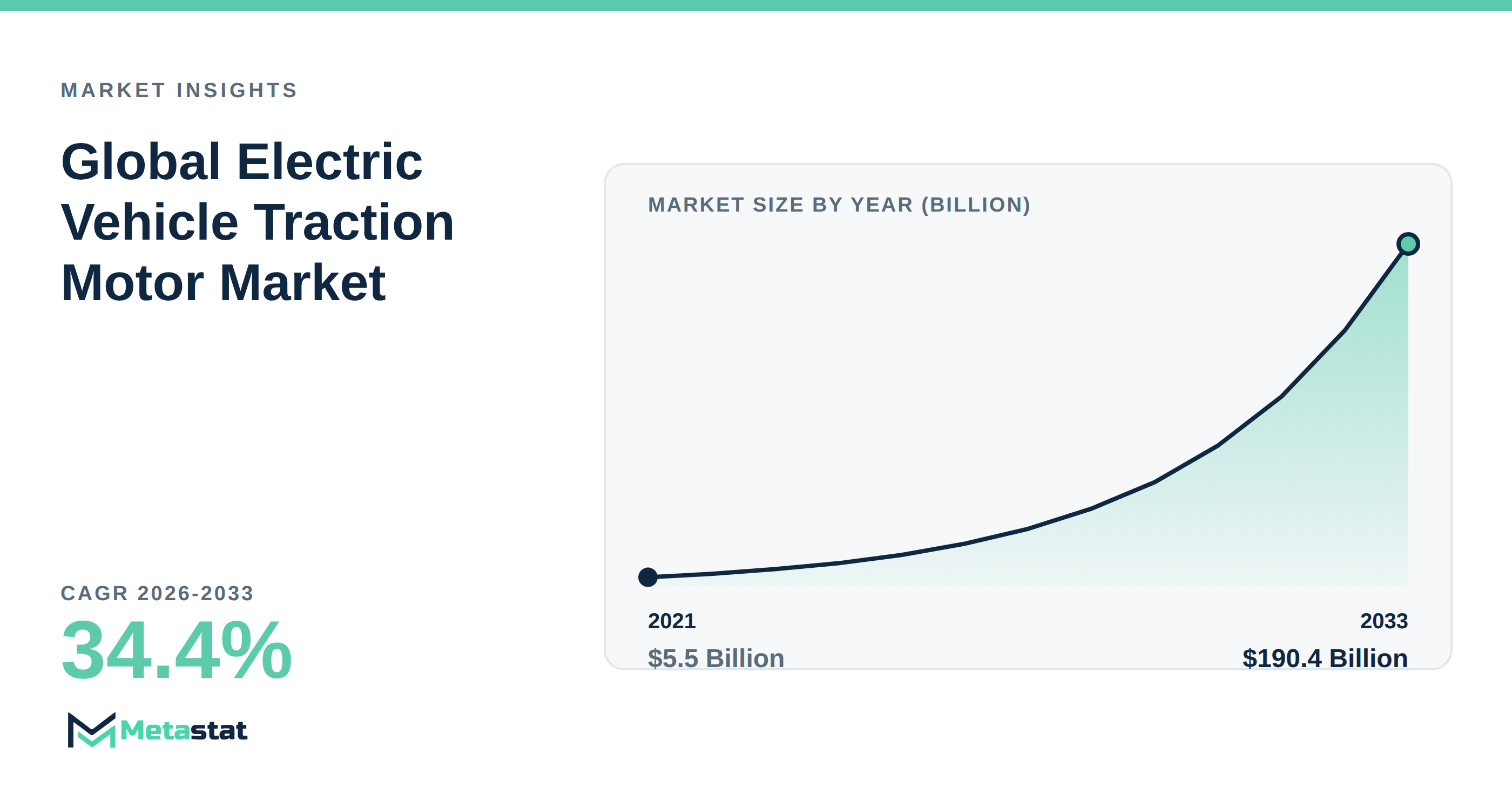
Explore the competitive landscape of the Electric Vehicle Traction Motor market, highlighting key players and their strategic innovations as the market grows towards USD 190.4 billion by 2033.
The Electric Vehicle Traction Motor market is set for remarkable expansion, with forecasts indicating an increase from USD 17.9 billion in 2025 to USD 190.4 billion by 2033. Companies operating within this sector face a complex environment shaped by technological advancements and evolving consumer preferences. Below are critical competitive positions that outline the dynamics of this growing market.
1. Leading Innovations in Permanent Magnet Synchronous Motors
Permanent magnet synchronous motors (PMSM) dominate the Electric Vehicle Traction Motor market due to their efficiency and performance capabilities. This segment is projected to surge from USD 12.6 billion in 2026 to USD 105.9 billion by 2033. Driven by advances in technology, manufacturers increasingly focus on PMSM technologies to fulfill rising consumer demand. Companies are investing extensively in research and development to refine motor designs and materials, thereby enhancing operational efficiency. This commitment to innovation allows manufacturers to establish a competitive advantage, particularly in regions with high electric vehicle adoption rates.
2. The Versatility of Brushless DC Motors
Brushless DC Motors (BLDC) have gained ground in the Electric Vehicle Traction Motor market, fueled by their energy efficiency and reduced maintenance needs. Expected to reach USD 32 billion by 2033, this segment benefits from the trend towards sustainability. Manufacturers are continuously refining BLDC technology, exploiting advancements in design and control systems to enhance vehicle performance. While the market transitions to electrification, BLDC motors present a versatile solution for various electric vehicle applications, boosting their competitive standing within the motor technology landscape.
3. Induction Motors Strengthening Commercial Applications
Induction Motors play a pivotal role in the Electric Vehicle Traction Motor market, with projections indicating a value of USD 21.9 billion by 2033. Their robust adaptability across different vehicle types makes them particularly appealing in commercial applications. While manufacturers adapt to tightening regulatory compliance standards, the emphasis on efficient technologies favors the continued relevance of induction motors in the expanding electric mobility sector.
4. High-Efficiency Wound-Rotor Motors Taking Center Stage
The Wound-Rotor / Separately Excited Synchronous Motors segment is on track for impressive growth, projected to experience a CAGR of 36.2%. This increase reflects rising demand for high-efficiency solutions, driven by the shift toward sustainable energy and stringent performance metrics outlined by regulatory frameworks. Manufacturers are investing significantly in R&D to meet these demands, thus enabling the development of more energy-efficient systems. This proactive approach positions companies advantageously due to the expanding requirement for electric vehicles.
5. Strategic Growth in Plug-in Hybrid Electric Vehicles
Projected to achieve USD 24.2 billion by 2033, the Plug-in Hybrid Electric Vehicles segment is benefitting from consumer preferences for versatile transportation options that blend electric and traditional technologies. Advances in battery efficiency and reductions in production costs enhance market accessibility. Manufacturers actively leverage government incentives promoting hybrid technologies, positioning themselves strategically within this rapidly growing segment.
6. Addressing Supply Chain Challenges with Localization
While the Electric Vehicle Traction Motor market expands, tackling supply chain challenges remains paramount. Geopolitical fragmentation and escalating raw material costs necessitate that manufacturers reassess their sourcing strategies, emphasizing localized production to mitigate dependencies. Companies focusing on strengthening supply chain resilience ensures stable production flows, maintaining competitiveness in a shifting market. This strategy positions firms favorably amid economic fluctuations and regulatory pressures.
The insights provided illustrate the dynamic nature of the Electric Vehicle Traction Motor market because industry players adapt to technological advancements and consumer trends. Understanding these competitive positions is crucial for stakeholders aiming to leverage significant growth opportunities in the years ahead. For more detailed insights, readers access the Global Electric Vehicle Traction Motor Market.
Tags
About the Authors

LEAD ANALYST
Utkarsh Khirodkar is a Lead Market Research Analyst at MetaStat Insight, specializing in market intelligence, technology sector assessments, and competitive strategy.

ENERGY & INFRASTRUCTURE INDUSTRY CONSULTANT
Automotive and Transportation · Electronics and Semiconductor · Energy and Power · Machinery & Equipment
Saurabh Vasant Ganvir consults for Energy & Infrastructure Industry at MetaStat Insight, specializing in renewable energy, solar EPC, and electric vehicle (EV) infrastructure markets.