
Explore key competitive positions in the Mobile Biometrics market, including regional dynamics, technology advancements, and strategic partnerships shaping the industry.
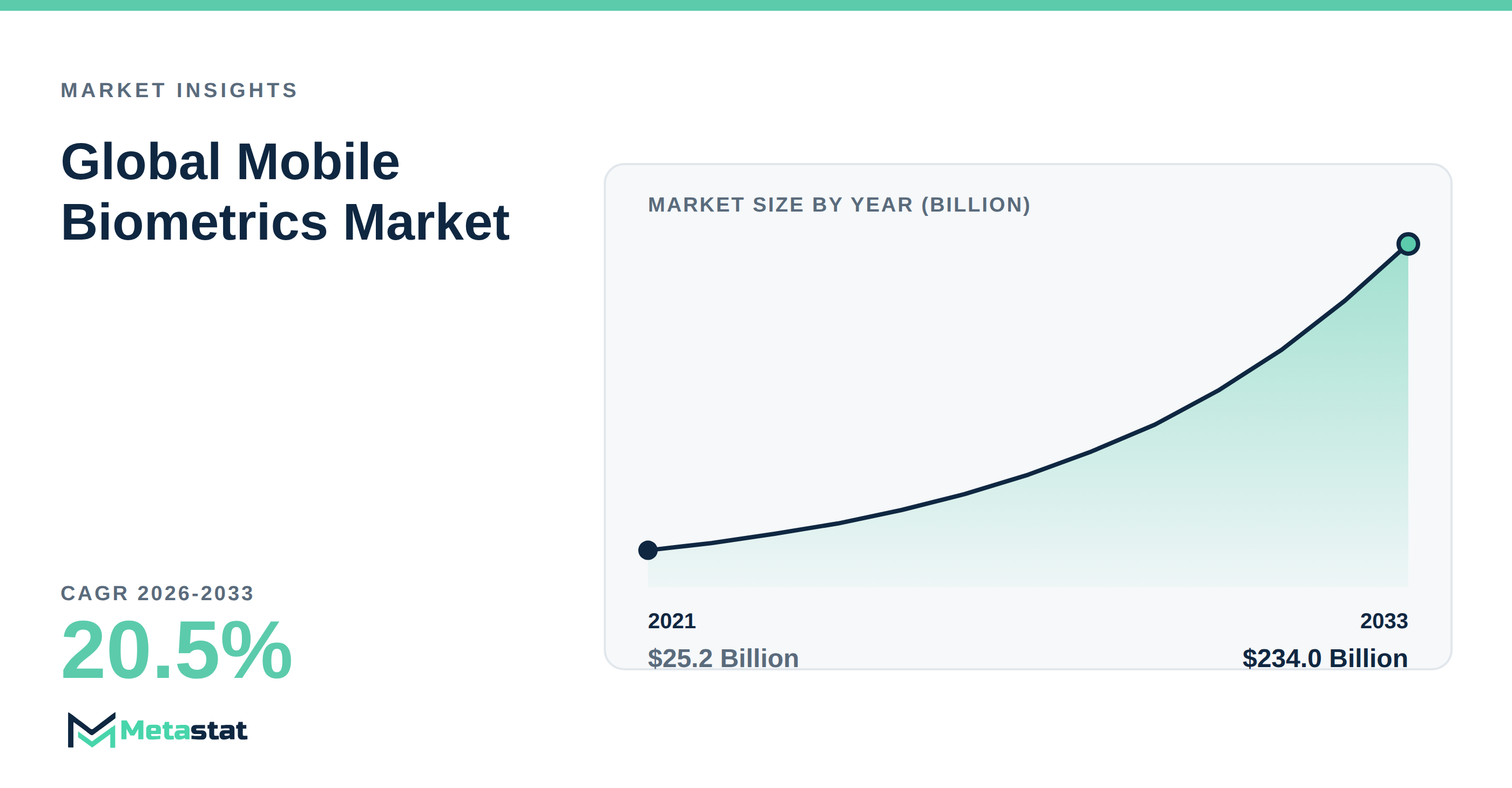
The Mobile Biometrics market is on a rapid growth trajectory, projected to expand from USD 52.6 billion in 2025 to USD 234 billion by 2033, at a CAGR of 20.5%. Understanding the competitive positioning of key players in this market is crucial for stakeholders. The following highlights key competitive positions within the Mobile Biometrics market.
1. North America leads with technological adoption
North America commands a prominent share of the Mobile Biometrics market, holding 38.1%. This leadership stems from a combination of high technological adoption rates, significant investments in security infrastructure, and a strong focus on regulatory adherence. Companies including Safran SA and NEC Corporation are thriving in this landscape, continuously investing in innovative solutions that cater to the sophisticated security demands of this region. Their dedication to enhancing user experience alongside regulatory compliance strengthens their competitive position.
2. Europe prioritizes regulatory compliance
Europe represents a substantial segment of the Mobile Biometrics market, capturing 24.9% of the share. The region's heightened focus on compliance with regulations like the General Data Protection Regulation encourages the adoption of Mobile Biometrics solutions. Companies including Aware, Inc. and Thales Group are strategically aligning their offerings to meet stringent regulatory standards, enhancing consumer trust and minimizing legal risks. Their emphasis on compliance positions them advantageously within the evolving regulatory environment.
3. Asia Pacific's growth driven by innovative investments
The Asia Pacific region, which comprises 25.4% of the Mobile Biometrics market, is experiencing significant growth fueled by increasing investments in technology innovation and modernization efforts. Major players including Aratek and M2SYS Technology are capitalizing on this trend by advancing their biometric solutions. While businesses prioritize robust authentication methods, these firms establish themselves because leaders by expanding product offerings and venturing into emerging markets.
4. Diverse technology offerings enhance competitive dynamics
Intense competition within the Mobile Biometrics market is attributed to companies diversifying their technology offerings. Technologies including fingerprint recognition, facial recognition, and voice recognition are key areas attracting substantial investment. Firms like IDEMIA and Qualcomm Technologies Inc. emphasize research and development to improve biometric accuracy, speed, and security, appealing to a wider customer base spanning various sectors including banking, healthcare, and government. This diversity of technology supports competitive differentiation.
5. Strategic partnerships facilitate market expansion
Strategic partnerships provide a critical pathway for companies seeking to broaden their market influence. Collaborations among key players, including HID Global Corporation and Applied Recognition, foster access to new technologies and market segments. These alliances enhance the capabilities of biometric solutions, enabling firms to leverage each other's strengths, thereby improving competitiveness and deepening market penetration.
6. Sustainable practices create a competitive advantage
Companies in the Mobile Biometrics market increasingly adopt sustainable practices to align with consumer preferences for environmentally responsible solutions. This transition not only meets regulatory standards but bolsters brand reputation. Organizations like Veridium and Integrated Biometrics are integrating sustainable technologies into their operations, crafting a competitive edge in a market that equally values corporate responsibility and innovation.
Overall, the competitive landscape of the Mobile Biometrics market is shaped by regional strengths, compliance demands, diverse technology offerings, collaborative strategies, and commitments to sustainability. Companies that effectively navigate these dynamics position themselves for success in this rapidly expanding market. For more detailed insights, refer to the Global Mobile Biometrics Market report.
Tags
About the Authors

LEAD ANALYST
Utkarsh Khirodkar is a Lead Market Research Analyst at MetaStat Insight, specializing in market intelligence, technology sector assessments, and competitive strategy.

PRINCIPAL CONSULTANT - ENTERPRISE AI & EMERGING TECHNOLOGIES
Banking & Finance · Electronics and Semiconductor · Energy and Power · Healthcare IT · Information & Technology · Professional Services
Vijay Gunti is a Principal Consultant at MetaStat Insight, bringing over two decades of experience across enterprise digital transformation, technology strategy, and intelligent systems.

PRINCIPAL CONSULTANT - QUALITY SYSTEMS & COMPLIANCE
Electronics and Semiconductor · Machinery & Equipment · Professional Services
Omkar Phadtare is an Industry Consultant at MetaStat Insight, specializing in quality systems, regulatory compliance, and standards benchmarking to drive data-driven market intelligence and strategic industry research.

ENERGY & INFRASTRUCTURE INDUSTRY CONSULTANT
Automotive and Transportation · Electronics and Semiconductor · Energy and Power · Machinery & Equipment
Saurabh Vasant Ganvir consults for Energy & Infrastructure Industry at MetaStat Insight, specializing in renewable energy, solar EPC, and electric vehicle (EV) infrastructure markets.

LEAD CONSULTANT - COMMUNICATION, TELECOM, AND IT
Electronics and Semiconductor · Information & Technology · Machinery & Equipment · Professional Services
Ravindra Sathe Consultants for Communication, Telecom, and IT at MetaStat Insight. He leads the firm's industry research initiatives across telecommunications infrastructure, digital connectivity, enterprise networking, and emerging information technology domains.