
The Europe Marketing Analytics market is projected to grow significantly, driven by digital transformation and cloud technology adoption. This article explores key growth factors and market dynamics.
The Europe Marketing Analytics market is experiencing significant growth, with forecasts indicating an expansion from USD 1,936.2 million in 2025 to USD 7,181.7 million by 2033. This increase reflects a compound annual growth rate (CAGR) of 17.8%, highlighting the importance of understanding the factors contributing to this upward trend. Insight into these drivers will help businesses adapt and thrive in this evolving environment.
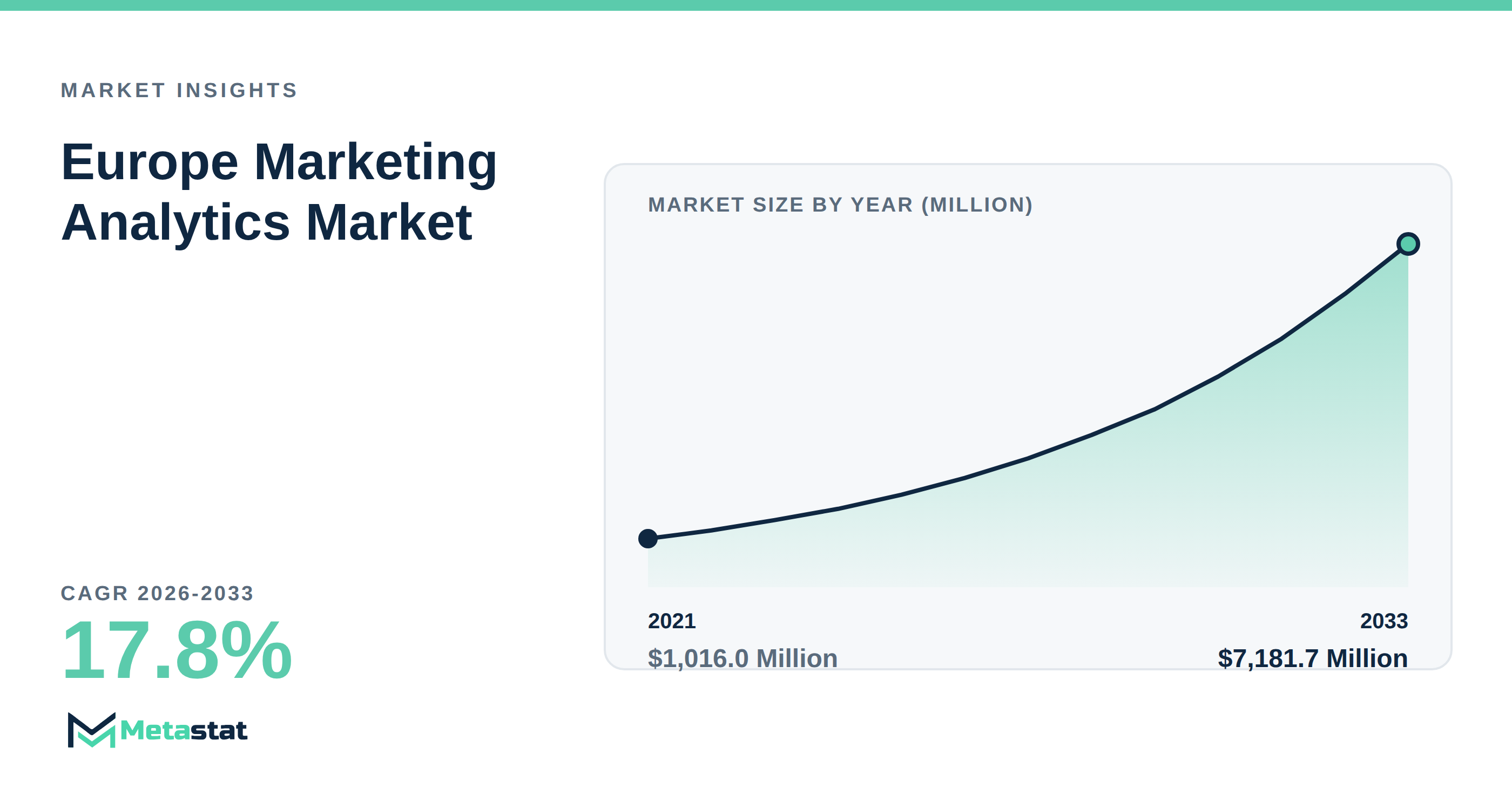
What key factors are driving demand in the Europe Marketing Analytics market?
Digital transformation is a primary catalyst for growth in the Europe Marketing Analytics market. Organizations across various sectors recognize the invest in advanced analytics technologies that enhance their data capabilities. This trend is particularly prominent in industries including retail, banking, and healthcare, where leveraging data-driven insights significantly improve customer engagement and overall operational efficiency. Companies increasingly rely on sophisticated analytics tools to refine marketing strategies and optimize their return on investment.
How does cloud technology influence market growth?
The transition towards cloud-based marketing analytics solutions significantly impacts the expansion of the market. The cloud segment is set to grow substantially, with projections estimating it will hit USD 5,668.5 million by 2033, achieving a CAGR of 19.9%. The increasing preference for flexible and scalable analytics solutions allows organizations to adapt quickly to changing needs and market conditions. Cloud technologies facilitate real-time data processing and informed decision-making, enhancing customer engagement. Integrating artificial intelligence and machine learning within cloud solutions further optimizes operational efficiencies across various sectors.
What regulatory challenges does the market encounter?
While growth in the Europe Marketing Analytics market is robust, regulatory compliance poses significant challenges. Numerous industries, including financial services and healthcare, must navigate intricate regulatory frameworks, necessitating substantial resources for compliance. These challenges not only increase operational costs but hinder investments in advanced analytics solutions. Macroeconomic factors, including inflation and currency volatility, further complicate the market landscape, pushing companies to refine their resource allocation strategies. Balancing adherence to regulations while maintaining innovative marketing efforts increasingly tests the capabilities of market players.
Which industries are championing marketing analytics adoption?
Retail and e-commerce lead the way in adopting marketing analytics, driven by fierce competition within the sector. Organizations in these industries utilize analytics tools to gain deeper insights into consumer behavior and refine their marketing strategies accordingly. The emphasis on enhanced personalization through advanced analytics tools substantially boosts customer engagement, showcasing the sector's reliance on data-driven insights. The healthcare sector is showing growing interest in marketing analytics to improve patient outreach and service delivery, portraying a clear commitment to leveraging analytics for better customer experiences.
What strategic approaches should businesses adopt for success?
To capitalize on the opportunities presented by the Europe Marketing Analytics market, businesses should focus on integrating advanced analytics capabilities that involve artificial intelligence and machine learning. These technologies enhance predictive analytics, automate marketing processes, and improve overall effectiveness. Companies should prioritize investments in cloud-based solutions that offer scalability and flexibility to adapt their marketing strategies effectively. While consumer behaviors evolve, incorporating sustainability goals into marketing initiatives aligns with rising ESG-driven consumer preferences, further solidifying market positioning.
By strategically aligning investments with innovative analytics tools, organizations will enhance their competitive edge while navigating market challenges. Firms that commit to leveraging data-driven insights and adapt to ongoing digital transformation trends will thrive in this dynamic environment.
For a deeper understanding of the factors influencing the Europe Marketing Analytics market, refer to the Europe Marketing Analytics Market report.
Tags
About the Authors

LEAD ANALYST
Utkarsh Khirodkar is a Lead Market Research Analyst at MetaStat Insight, specializing in market intelligence, technology sector assessments, and competitive strategy.

PRINCIPAL CONSULTANT - ENTERPRISE AI & EMERGING TECHNOLOGIES
Banking & Finance · Electronics and Semiconductor · Energy and Power · Healthcare IT · Information & Technology · Professional Services
Vijay Gunti is a Principal Consultant at MetaStat Insight, bringing over two decades of experience across enterprise digital transformation, technology strategy, and intelligent systems.

LEAD CONSULTANT - COMMUNICATION, TELECOM, AND IT
Electronics and Semiconductor · Information & Technology · Machinery & Equipment · Professional Services
Ravindra Sathe Consultants for Communication, Telecom, and IT at MetaStat Insight. He leads the firm's industry research initiatives across telecommunications infrastructure, digital connectivity, enterprise networking, and emerging information technology domains.